When the Assyrian king, Sennacherib, boasted of the destruction he had wrought upon Babylon in 689 BC, he likened his army to a raging flood that swept the city into the sea and carried its debris “as far as Dilmun.” Accordingly Dilmun should, be located somewhere in the Persian Gulf. This admittedly is a broad target but a good place to begin our search. Another text from the same period describes the location of Dilmun as lying “30 double-hours away in the midst of the sea of the rising sun.”1This text comes from the annals of Sargon II. The relevant portion reads “Uperi, king of Dilmun, whose abode is situated, like a fish, 30 double-hours away in the midst of the seas of the rising sun… sent his gifts (Bibby 1984, 60).” Although the exact distance represented by “30 double-hours” is uncertain, the approximate distance matches the location of Bahrain, which is a two-day’s sail from the head of the Persian Gulf.2Bibby 1984, 62
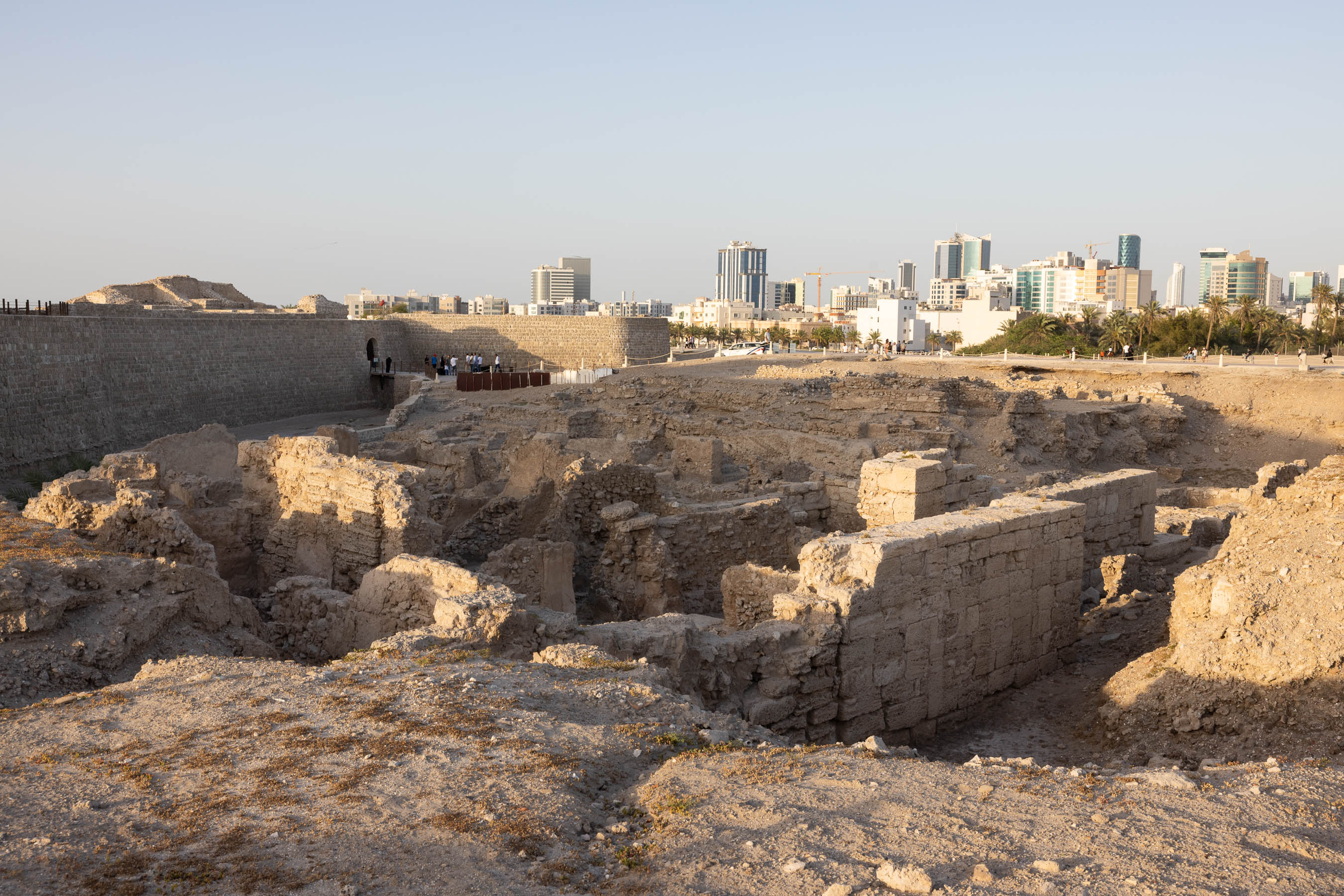
Exposed parts of the ancient city on Dilmun. The earliest levels of the city probably date to the first half of the 3rd millennium BC.
The island of Bahrain was undoubtedly considered to be “Dilmun” in texts of the Assyrian period, such as those cited above. However, Daniel Potts, an archaeologist with extensive experience excavating sites in Iran and Arabia, argues that the center of early Dilmunite civilization should be sought on the island of Tarout, approximately 60 miles northwest of Bahrain, where archaeologists found Intercultural Style chlorite vessels. Curiously, none of these vessels, which date to the Early Dynastic II-III and which were so broadly distributed during the Early Dynastic period, were found on Bahrain. Potts therefore suggests that Dilmunite culture on Bahrain is relatively late. He dates the founding of Qala’at al-Bahrain to the Ur III period, which is quite a bit later than the dates assigned by Bibby and Glob.3Potts 1983, 19
The eminent Sumeriologist, S. N. Kramer, took a third position, arguing that the civilization of Dilmun should not be sought on Tarout or Bahrain. Although his arguments have not received widespread acceptance, they are nevertheless instructive. Firstly, like Potts he argues that the material culture of Bahrain is not early enough to be the Dilmun mentioned in Sumerian texts. Secondly, he points out that the land of Dilmun is described in Sumerian texts as a garden paradise. Great cedar forests were said to grow on Dilmun, an island which is described as being located far to the east, where the sun rises. When Gilgamesh sought Utnapishtim in Dilmun, he had to cross many seas and mountain ranges to get there. And if Bahrain is described as a rich and fertile land, where grain was harvested, it is now a desert! It is as though there are two Dilmun’s: a “primordial” Sumerian Dilmun, and a “historical” Assyrian one. The two are apparently irreconcilable. Kramer acknowledged that the matter was not settled and that Bahrain may be correct, but he preferred to identify Dilmun with the Indus Valley Civilization.4Kramer 1963, 280-283
Despite Kramer’s compelling arguments, it seems to me that Bahrain remains the best candidate for Dilmun. At least it clearly was regarded as such in later periods. And though the Early Dynastic is poorly represented on Bahrain, it seems to me that Bibby was correct in arguing that the earliest stratum of Qala’at al-Bahrain goes back to at least the latter half of the Early Dynastic period.
The Stratification of Qala’at al-Bahrain
Bibby and Glob found five distinct strata or “cities” at Qal’at al-Bahrain. The earliest was designated City I. Bibby tentatively assigned the period 3000—2300 BC to this first city, which would make it contemporary with the Jemdet Nasr and Early Dynastic periods in Mesopotamia. He assigned the period 2300—1750 BC to City II. These are very long spans of years which Bibby assigns to the first two strata of the city. As noted above, Potts argued that they should be lowered by nearly a millennium. I’ve opted for a middle position.
| Stratum | Potts (1983) | Bibby (1984) | Ancient List | Description |
|---|---|---|---|---|
| City I | Akkadian—Ur III (2254-2025 BC) | Jemdet-Nasr—Early Dynastic (3000-2300 BC) | Early Dynastic (2650-2150 BC) |
|
| City II | Isin-Larsa (c. 1900-1700BC) | Akkadian—Isin-Larsa (2300-1700 BC) | Akkadian—Isin-Larsa (2150-1600 BC) |
|
| City III | Kassite (1600-1155 BC) | Kassite (1500-1155 BC) |
|
One way to gauge the long reach of Dilmun’s trade emporium comes from a unique type of stamp seal found on Bahrain, and further afield, at Ischali in the Diyala Valley, and Lothal on the coast of India. Naturally, a considerable number of these seals were also found at Ur. The first of peculiar stamp seals discovered at Qala’at al-Bahrain, recounts Bibby, was found on the level of a street in City II, and thus at a considerable depth in the mound. While clearing debris from the street, one the workmen plucked a Dilmun stamp seal from the sand.
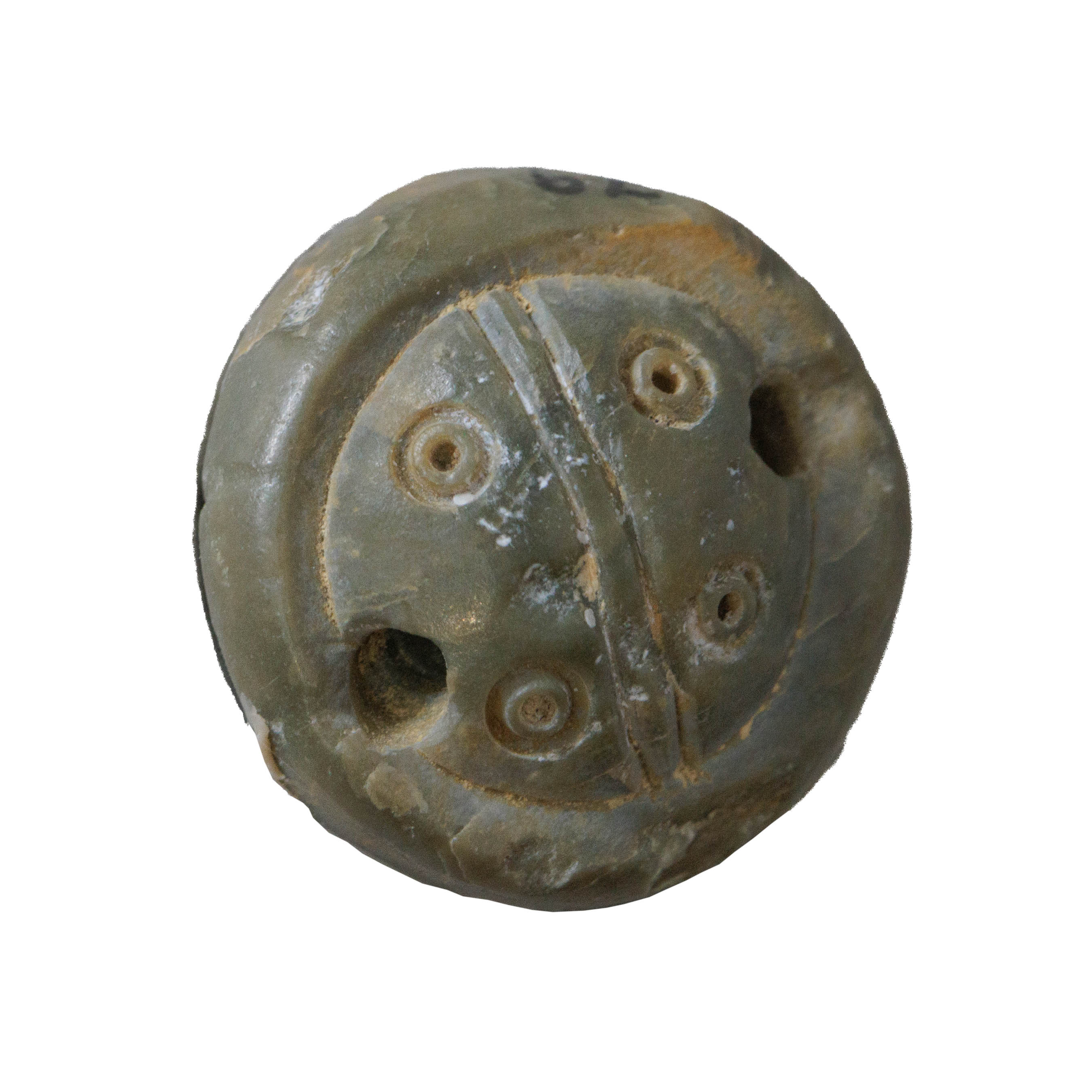
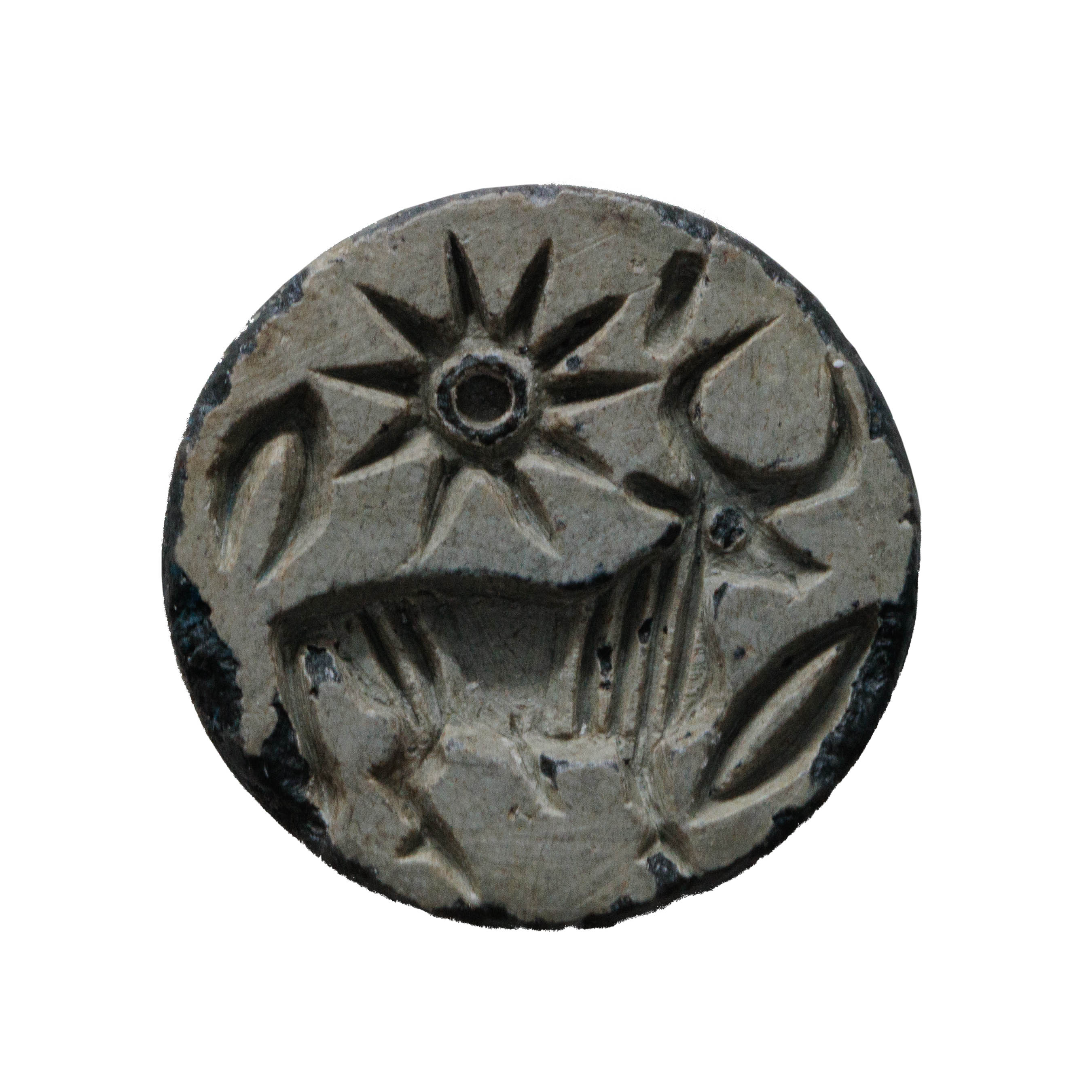
A typical steatite stamp seal found on Bahrain.
They would find many more seals of this type at Qal’at al-Bahrain. Particular to Dilmun-type seals are sea monsters and animal heads arranged like the spokes of a wheel. The seals are carved from soft steatite which was subsequently fired, hardening the stone and giving its surface a glassy finish. Their domed back was often divided with one, two, or three incised lines, and drilled with a “circle-dot” in each quarter.

Seals often show animal heads radiating around a central hub.


These scenes feature a “hatched box” which likely represents an altar. One of the seals shows an animal bound and placed on one of these podiums.
ARC/Bahrain National Museum


These scenes show a man holding an object which appears to be a shield. He is always accompanied by a gazelle.
ARC/Bahrain National Museum


These seals depict monstrous or wild animals with gaping jaws.
ARC/Bahrain National Museum

The boat has a center mast for a sail and a distinctive beaked prow and stern. The center mast of one is surmounted by a crescent disc (recall this feature was also displayed on boats depicted on the Gebel el-Arak knife).
ARC/Bahrain National Museum


A man and a woman drink beer through straws with a star in the sky above them. The closest analogues to these seals comes from Sumerian cylinder seals produced during the Early Dynastic III.1Collon 1987, 27
ARC/Bahrain National Museum

The temple depicted on the first seal appears to be of a type which was excavated at Barbar (next entry). The square podium inside the enclosure is probably an altar. The two bull’s heads are reminiscent of a bull’s head found in the Barbar temple (next entry).
ARC/Bahrain National Museum

Seals were also carved from conch shells, the spiral of the shell and the surrounding dots produce a unique seal impression.
ARC/Bahrain National MuseumMerchants of Dilmun
The name “Dilmun” already begins to appear in texts of the Uruk and Jemdet-Nasr periods. The the earliest literary reference to Dilmun is found on the Perforated Relief of Ur-Nanshe discovered at Lagash (ED III). The relevant portion reads:
The ships of Dilmun brought him wood as a tribute from foreign lands.5Kramer 1963, 308

The text on the relief is the first to make reference to Dilmun. As you may recall, Ur-Nanshe was a king of Lagash during the Early Dynastic III period.
It is curious that the earliest recorded cargo carried by a ship of Dilmun was wood. There are no supplies of wood anywhere in the Persian Gulf today. The entire region on both sides of the gulf is quite barren, broken only by the occasional oasis and seasonal wadi. Conversely, there were vast forests in the mountains north and east of Mesopotamia where wood was readily chopped and floated downriver. Why would a boat with a very limited cargo capacity be loaded with wood? Presumably the Dilmun ships carried rare and expensive species, such as ebony and boxwood, the latter being useful for making musical instruments, chariots, furniture, etcetera. Ur-Nammu doesn’t tell us specifically where the wood was imported from, just that it came from “foreign lands.” The wood might have come from Meluhha (probably the Indus Valley) since texts of the Ur III period frequently list wood among the products imported from there.
We also cannot exclude the possibility that there were once forests growing in areas of the Persian Gulf where none grow today. The Roman historian, Arrian (early 2nd century AD), in his history of Alexander the Great’s campaigns, makes an offhanded reference to an island in the mouth of the Euphrates which “was dense with all kinds of trees.”6Arrian 7.20.3 from J. Romm and P. Mensch 2010, 304 Arrian says that Alexander named the island Ikaros. Fittingly, a Greek temple to Artemis, goddess of the woodland, was constructed there. Known today as Failaka, the island belongs to the emirate of Kuwait. Although no forests grow on the island, presumably conditions on the island were different during the Hellenistic period—a period which we have argued elsewhere was likely wetter than today. Conditions in the Gulf would have been even wetter during the first half of the Early Bronze period.
Bibby, Geoffrey.
Looking for Dilmun.
Great Britain: Penguin, 1984.
Potts, D. T.. “Review of Reflections on the History and Archaeology of Bahrain by Serge Cleuziou, Pierre Lombard, Jean-Francois Salles, Monik Kervran, Arlette Negre, Michelle Pirazzoli t’Sertsevens, Moawiyah Ibrahim, et all.” Journal of the American Oriental Society 105, no. 4 (1985): 675–710.
Potts, Daniel T. “Northeastern Arabia: From the Seleucids to the Earliest Caliphs.” Expedition 26, no. 3 (1984): 21-30. Link
Potts, Daniel.Dilmun II (1983): 15-19.
Arrian of Nicomedia.
The Landmark Arrian: The Campaigns of Alexander, edited by James Romm, translated by Pamela Mensch.
United Kingdom: Anchor Books, 2012.