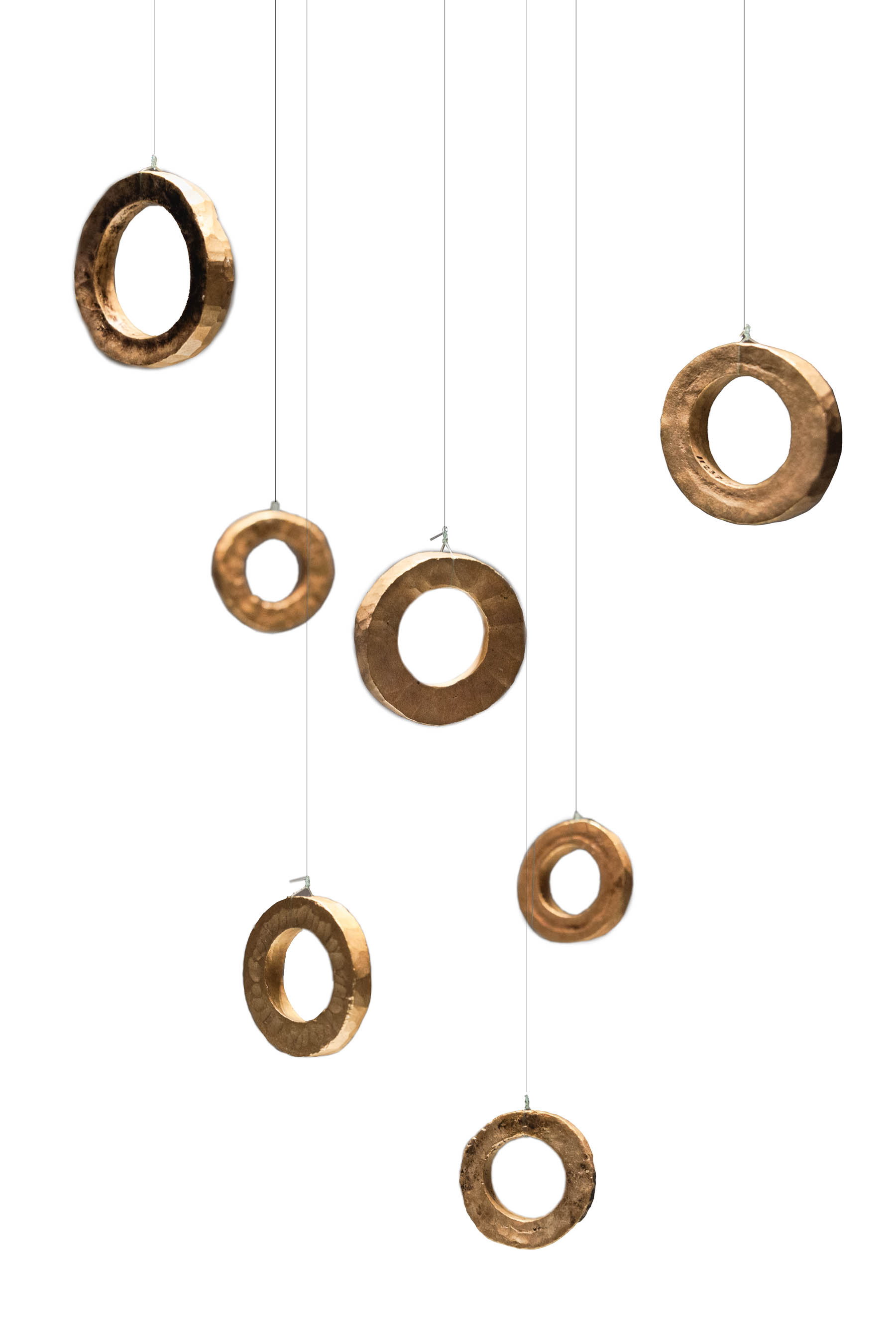
These gold and electrum circlets are the earliest known examples of gold “bullion.”
In 1980, members of the Israel Cave Research Center visited the village of Kfar Lakhif seeking information about caves in the area. They were directed to a cave in the nearby Wadi Qanah, in western Samaria. Its entrance was large enough to walk through but quickly narrowed to a passage with just enough space to wriggle through. The narrow passage continued for approximately 25 feet. Just when it seemed as though the passage dead-ended, it rose steeply before opening onto a giant cavern. The explorer brave enough to follow the passage to its end was rewarded with a spectacular display of glistening stalactites that hung like massive suspended pillars from the roof of a vast cavern known as the “Main Hall.” Aside from the spectacular geology of the cave, the spelunkers noticed large amounts of pottery littering its floor. The cave clearly warranted further investigation, but the difficulties associated with excavating underground meant that nothing was done for another four years. The difficult task of excavating the cave was finally undertaken in 1987 by Tsvika Tsuk and Avi Gopher, under the auspices of the Israeli Antiquities Authority. What began as an investigation of the “Main Hall” turned into a much more difficult affair when the archaeologists discovered “the Passage” in the deepest region of the cave. This passage led to another series of galleries which penetrated deep underground. Copper objects were found in the smallest of these galleries, named the “Copper Room,” located immediately adjacent to the Passage. Another gallery with squared walls was named the “Rectangular Room,” while a third was named the “Neolithic Room” after the pottery discovered there. The deepest part of the cave, located some three hundred feet from the entrance and approximately eighty-two feet underground, showed signs of terracing, and was therefore named the “Hall of Terraces.” Pottery from the Neolithic and Chalcolithic periods was discovered throughout the cave.


This crossection of the cave is simplified in order to show the various rooms.
The Rings of Gold
“The Passage” and adjacent “Copper Room” produced the greatest number of objects, including a copper standard, piriform maceheads, and a copper adze. The style of the metal objects leaves no doubt that they belong to the same general period as the hoard of objects discovered at Nahal Mishmar, and belong therefore to the Ghassulian culture. However, the most important discovery awaited the final day of excavations in the cave when diggers uncovered a ring-like object embedded in the muddy floor of “the Passage.” Here is how Tsuka and Gopher describe the discovery:
“After briefly rubbing it we could see that it was yellow in colour. The ring was crude but its colour was quite unlike the green oxidized copper items which we had found before. All that sprang to mind was that this was that noble metal, unaffected by its surroundings—gold—as indeed it turned out to be.”1Tsuka and Gopher 1996, 5
Eight rings were found altogether, two of which may properly be termed gold (one ring is 98% pure gold, the other is 89% gold and 10% silver). The other six are electrum, which by definition is comprised of approximately 70% gold and 30% silver.2Tsuka and Gopher 1996, 165 Each ring measures approximately 2 inches in diameter and weighs on average around 4.3 ounces. The gold and electrum probably came from Nubia (modern day Sudan and Ethiopia), this being the primary source of gold imported into the Levant. Surprisingly, for all of their skill at working gold, the Egyptians were never able to separate silver from gold. Thus many of their articles of “gold” are actually electrum.3Redford 2001 “Technology”
The discovery of gold and electrum in the Nahal Qanah Cave came as a complete surprise to the excavators since no other gold objects are known from Chalcolithic / EB I contexts in the southern Levant despite many decades of excavating. And only very small objects of gold have been found in Mesopotamia and Egypt from the same period. Moreover, significant amounts of gold are not found anywhere in the Ancient Near East until the latter half of the Early Bronze period (EB III).4The gold treasures found at Varna in Bulgaria are generally thought to date to the middle of the 4th millennium BC but these dates are probably much too early.

These were found in “The Passage” of the Nahal Qanah cave.

This tomb relief was discovered in the tomb of an Egyptian official. It dates to c. 1353-1327 BC. Among the gifts presented by the Nubians are ring-shaped gold ingots shaped like the ones found in Nahal Qanah.
Mining for Gold
The sum total of all the gold discovered in the Nahal Qanah cave adds up to almost one kilogram or 35 ounces, which is a substantial amount of gold considering the amount of energy required to mine it. Gold is only found in two places: alluvial deposits (laid down by water) and veins of rock. The easiest gold to mine comes from alluvial deposits since water has already done the hard work of extracting the gold from the rock and depositing it in the form of nuggets and flakes on the river bed. In contrast, gold embedded in veins of rock must be laboriously extracted by hammering, crushing, and grinding. The Nahal Qanah gold seems to be of the latter type since it lacks the trace elements which alluvial gold typically possesses.5Gopher and Tsuk 1996, Chapter 7; See also their conclusion on pg 229
The Greek historian, Diodorus of Sicily, writing in the 1st century BC, describes the working conditions of the gold mines located in Nubia and Arabia. Diodorus writes,
At the extremity of Egypt and in the contiguous territory of both Arabia and Ethiopia there lies a region which contains many large gold mines, where the gold is secured in great quantities with much suffering and at great expense. For the earth is naturally black and contains seams and veins of a marble* which is unusually white and in brilliancy surpasses everything else which shines brightly by its nature, and here the overseers of the labour in the mines recover the gold with the aid of a multitude of workers.6Diodorus Siculus, Historical Library, 3.12 *Diodorus was mistaken in referring to the white rock as ‘marble’. It was actually quartz.

The veins of gold are visible in the white quartz (from Canada). The gold ore on the right comes from California.
Diodorus provides a vivid account of how slaves toiled in dark shafts deep underground without light except for a candle attached to their foreheads. They used fire to heat the hard quartz and water to quench it, causing the quartz to fracture. Men armed with iron picks extracted the fractured ore from the mountainside while boys used iron pestles to break the rock into smaller pieces. Finally, the ore was placed beneath a heavy millstone and crushed into fine powder. Diodorus describes the sad plight of the slaves who toiled at the millstones.
And since no opportunity is afforded any of them to care for his body and they have no garment to cover their shame, no man can look upon the unfortunate wretches without feeling pity for them because of the exceeding hardships they suffer. For no leniency or respite of any kind is given to any man who is sick, or maimed, or aged, or in the case of a woman for her weakness, but all without exception are compelled by blows to persevere in their labours, until through ill-treatment they die in the midst of their tortures. Consequently the poor unfortunates believe, because their punishment is so excessively severe, that the future will always be more terrible than the present and therefore look forward to death as more to be desired than life.7Diodorus Siculus, Historical Library, 3.13
One final step was required to extract the gold from the quartz dust; the dust was sprinkled onto an inclined board and washed. The water carried away the lighter particles of stone and earth, leaving behind the gold powder which became trapped in the porous wood grain. The work was performed by criminals and enemy captives as well as by unfortunate wretches impressed into slavery for no reason at all. In later periods, Christians were also assigned to work in the mines.

A church in Wadi Feinan located next to a giant smelting site where the copper ore mined from the nearby hills was processed into metal ingots.
Such is the account provided by Diodorus. It illustrates just how rare gold is and how difficult it is to extract. Large stores of energy are needed to find the gold, extract it, and smelt it. Therein lies its value as a medium of exchange. But for as long as humans have been using money, there has always been a temptation to “cheat” by diluting the gold, reducing its energy content. Indeed, the debasement of gold may already be observed in the Nahal Qanah gold circlets. As noted previously, six out of the eight circlets are electrum. These electrum circlets should be a noticeably lighter color compared to the two gold ones but they do not look appreciably different.
It appears as though the surface of the electrum circlets was heat treated in order to give it a deeper yellow, more golden color, making them difficult to distinguish from the pure gold ones. We don’t know whether this was actually an attempt at counterfeiting but it does appear as though the gold smelters tried to disguise the high silver content of the bullion. The invention of coinage in the 6th century BC was supposed to solve the problem of debasement by producing coins with a standard weight and purity. Unfortunately, the guardians of the coinage, whose visages were stamped on their coins, often succeeded only in monopolizing their debasement.
Diodorus of Sicily, C. H. Oldfather.
Bib. hist..
Cambridge, Mass: Harvard University Press, 1935.
Gopher, A, T. Tsuk.
The Nahal Qanah Cave : Earliest Gold in the Southern Levant.
Tel Aviv: Institute of Archaeology of Tel Aviv University Publications Section, 1996.
Redford, D.B.
The Oxford Encyclopedia of Ancient Egypt.
Oxford, New York: Oxford University Press, 2001. Link