
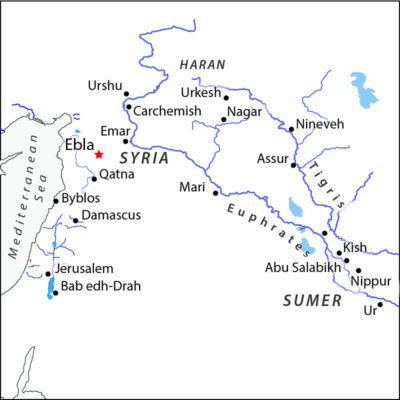
The importance of Ebla is evident by the size of the mound which rises above the Syrian plain.
When an Italian expedition from the University of Rome began excavating Tell Mardikh in Syria in 1964, they did not know its ancient name. It wasn’t until 1968 that a statue was discovered identifying the city with Ebla.
Ibbit-Lim… the king of the Eblaite League.1Matthiae 1981, 59
A city by that name was also known from the royal inscriptions of Sargon of Akkad and Naram-Sin. Both were kings of Akkad who claimed to have conquered Ebla in the late 3rd millennium BC. The Italian expedition therefore hoped to find a large Early Bronze city at the site and a destruction level which could be attributed to the Akkadians, but after five years of digging, they still had not found evidence of an Early Bronze occupation.
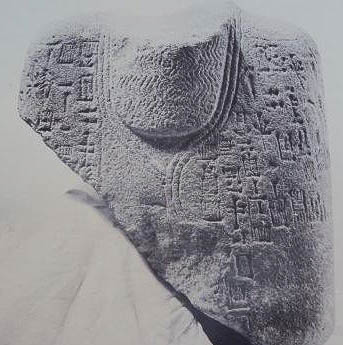

The statue recovered from Tell Mardikh records the name of the city “Ebla.”
The Discovery of Early Bronze Ebla
Disappointed by their inability to find the Early Bronze levels of the city, Paolo Matthiae, the director of the dig at Tell Mardikh, decided to focus on locating these strata. Even so, it took another five years of digging before the Italian expedition finally exposed the mudbrick walls of what turned out to be an Early Bronze palace, which they dubbed “Palace G.”

The walls of ‘Palace G’ from the Early Bronze period. Note the location of the ‘Great Archive’.
The palace was made from mudbrick and probably roofed with thatch. Everything else was made from wood, including the fir paneling, cedar roof beams, and olive, cherry and ash furnishings.2Caracuta and Fiorentino 2013 Thus most of the rough mudbrick we see today, including the interior of the staircase leading to the upstairs apartments, was all covered in wood. Although only fragments of furniture were recovered from the palace, the great variety of species used in its construction points to the importance of timber to the economy of Ebla. This is proven also by an inscriptions belonging to Gudea (c. 2050 BC) who claims to have floated great rafts of cedar and boxwood from Ebla to his capital at Lagash. The length of the cedar logs is given at 60 cubits, which is approximately 100 feet (1 cubit = 20″), and the boxwood at 25 cubits. The latter species is known for its dense, fine grain which makes it an excellent choice for producing musical instruments and measuring tools (rulers have traditionally been made from boxwood). Gudea also mentions pine, fir, and plane trees which he brought from “the city of Ursu in the mountain of Ebla.” Ursu was located approximately 100 miles north of Ebla, in the foothills of the Amanus Mountains, probably on the site occupied today by Gaziantepe in Turkey. The fact that a site so far distant from Ebla should still have been referred to as the “mountain of Ebla” shows how great an area Ebla controlled at one time.3Astour 2002, 81-82

Probably the most unique object discovered by the Italian expedition in the palace was a crouching bull-man carved from steatite (“soap-stone”) and covered with gold leaf. According to one interpretation, these bull-men were guardians of the gates of the horizon through which the sun was supposed to pass each morning.
The Silver Standard
Cuneiform tablets discovered at Ebla provide some insight into the vast amounts of land cultivated by the Eblaites. The following tablet, for example, lists the name of the village and the amount of land cultivated:
3 thousand iku
(1 iku is equal to approximately .8 acres)5Benati 2020, pg 42, note 9
of the village Sagu;
3 thousand iku
of the village Dagu;
a thousand iku
of the village A’ada.
and Gidu
7 thousand iku
of the village Guwalu.4Pettinato 1981, 160
It may be inferred from tablets such as this one that hundreds of square miles of land were put into production. Cereal crops such as wheat and barley were staples; grapes and olives were also cultivated. Considerable forested areas probably still existed around the city.6Caracuta and Fiorentino 2013, 100 The Eblaites also maintained a vast number of sheep, goats, and cattle. The king alone is said to have possessed 80,000 sheep kept for their wool.
The primary means of exchange was gold and silver valued at a ratio of 5 shekels of silver to 1 shekel of gold.7Pettinato 1981, 168; See also 195 ff. This was the same gold / silver ratio maintained in Egypt during the Old Kingdom period. Although the Eblaites probably did not mine silver directly, they traded for it and exacted it as tribute, so that enough silver was in circulation to make it a viable means of exchange. After studying the archives discovered at Ebla, Pettinato concluded,
All goods are put in relationship to the principal good which is silver; this means that they already had an idea of abstract value which entails the formulation of very exact prices.8Pettinato 1981, 195;
The usage of silver as money in Sumer may be traced back to the Jemdet Nasr period. Thus it may be said that for as long as records of account have been maintained, silver was used as money.
Astour, Michael C.
“A Reconstruction of the History of Ebla (Part 2),” in Eblaitica : Essays on the Ebla Archives and Eblaite Language, Volume 4, edited by C. H Gordon, Gary Rendsburg.
Winona Lake, Indiana: Eisenbrauns, 2002.
Benati, Giacomo , Marco Bonechi.
“The Fiscal Capacity of the Ebla State in the Early Bronze Age: Taxation and Political Structure,” in Economic Complexity in the Ancient Near East, edited by Jana Mynářová , Sergio Alivernini .
Prague: Charles University, 2020. Link
Caracuta, Valentina, Girolamo Fiorentino.
“Use of Wood and Environment in Bronze Age Ebla: Results of the Anthracological Analyses,” in Proceedings of the Fourth International Meeting of Anthracology, edited by Freddy Damblon. BAR International Series 2486 vols.
Oxford, UK: Archaeopress, 2013. Link
Matthiae, Paolo.
, edited by Mattia Bilardello, Anita Weston, translated by Richard Bates.
London and New York: Routledge, 2021.
Matthiae, P.
Ebla : An Empire Rediscovered.
Garden City, N.Y: Doubleday, 1981. Link
Pettinato, G.
The Archives of Ebla : An Empire Inscribed in Clay.
Garden City, N.Y.: Doubleday, 1981. Link