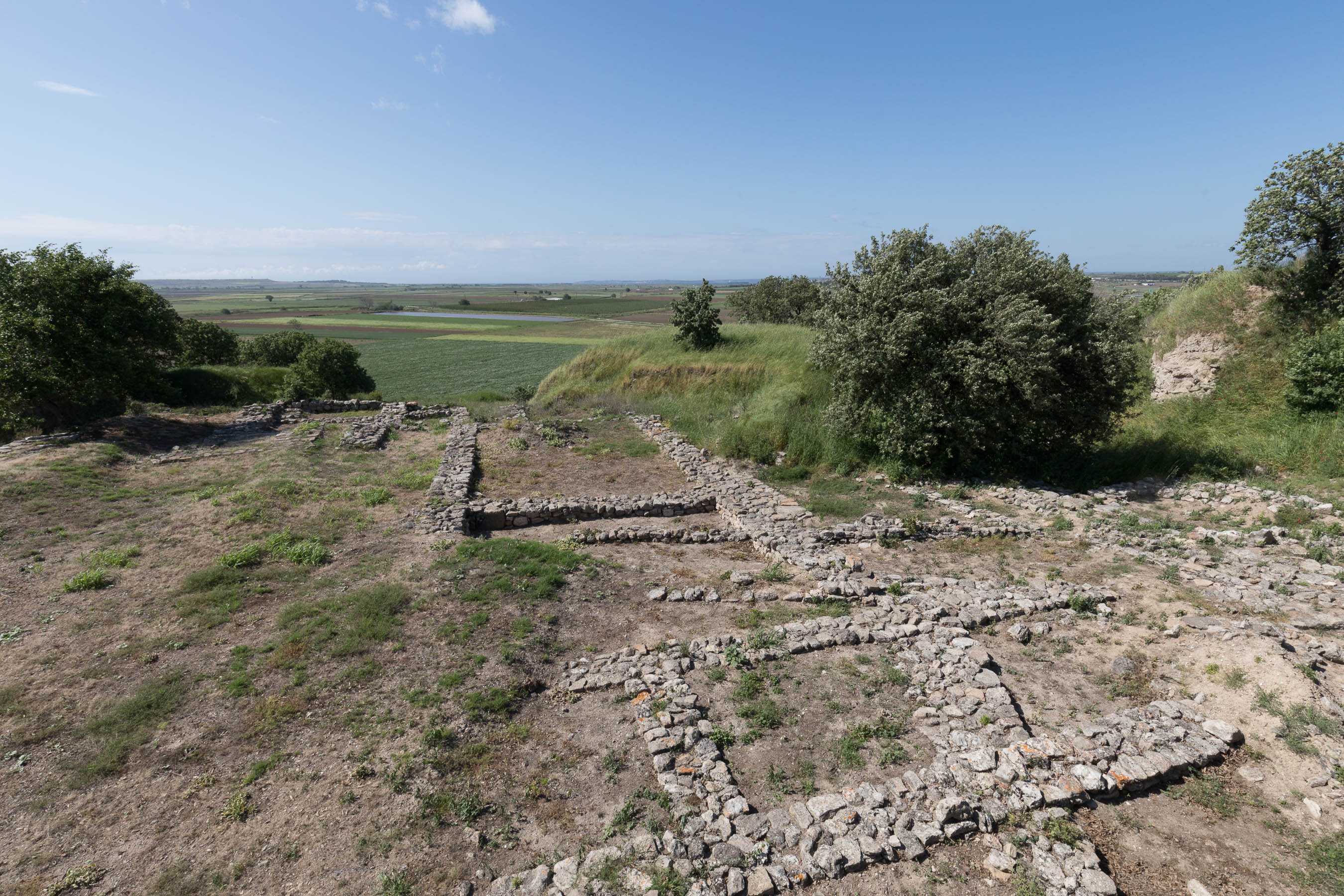
The stone foundations of one of the “megara” on the citadel. The coastal plain is visible in the distance, and beyond that the Dardanelles.
Excavations on the highest part of Hisarlik revealed long, narrow structures which archaeologists refer to as megara (sing. “megaron”) after the Greek term “palace.” The entrance was on the short wall, through an attached porch, often flanked by columns. Megara are typically stand-alone structures that do not share a wall. Subsequent excavations at other sites indicate that was a style of architecture widespread in Greece and western Anatolia for the whole of the Bronze Age.
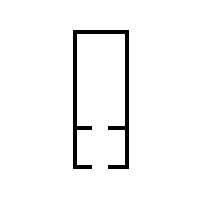
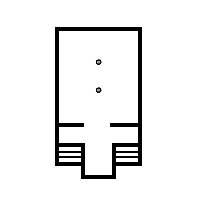
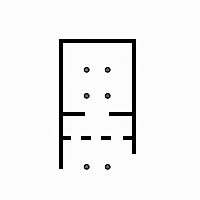
This type of structure was found across the Aegean world during the Bronze Age.
Müller, “Development of the ‘Megaron’ in Prehistoric Greece,” Fig. 1. LinkTowards the very end of his time excavating at Troy, Schliemann found some particularly fine megaron-type structures. These belonged to the stratum which named “Troy II.” Prior to this discovery, the only structures exposed on the citadel were small and poorly constructed houses which Schliemann assigned to Troy III. They looked like they belonged to a small village perched atop the mound and were, therefore, a disappointment to Schliemann, who was looking for the “well towered” and “spacious” city described by Homer. It was not until the final years of Schliemann’s excavations at Troy that he uncovered the impressive megara structures on the citadel of Troy II.

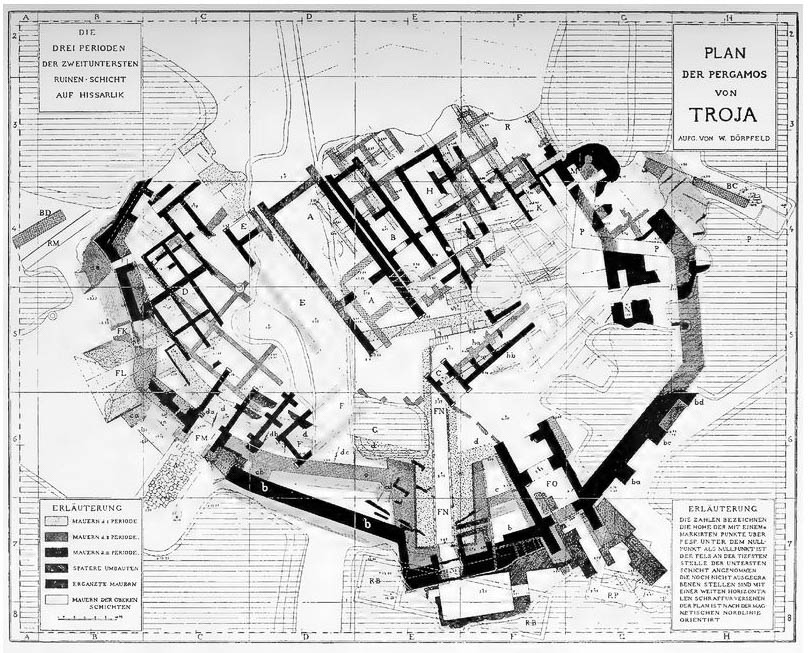
Left: The plan of Troy drawn in 1879. Note the houses with flimsy walls, somewhat reminiscent of Kastri. Right: The plan drawn by Dorpfeld (1902) showing Troy II and the large megara structures on the citadel.
Left: Dörpfeld, Troja und Ilion I, Fig. 4. Link , Right: Dorpfeld, Troy and Ilium: Results of the Excavations in the Prehistoric and Historic Layers of Ilium, 1870-1894 . LinkThe largest megaron (Megaron IIA) measures approximately 34 feet wide by 65 feet long.1The length is more difficult to determine since the entire back of the megaron is missing. Although almost completely destroyed in the fire which ended Troy II, enough remained to reconstruct how it might have looked. Its 4 1/2 foot thick mudbrick walls were set on a solid stone foundation and plastered. A round hearth in the middle of a long hall kept the building warm during the cold winter months. Dorpfeld thought the structure probably had a thatched roof supported by large beams capable of spanning the full width of the structure. There is no evidence of supports. An opening in the thatched would have allowed the smoke to escape. Whether the walls had windows or not is impossible determine but if the buildings depicted on a Minoan frescos of a later period are any indication, then the megara of Troy probably did also.
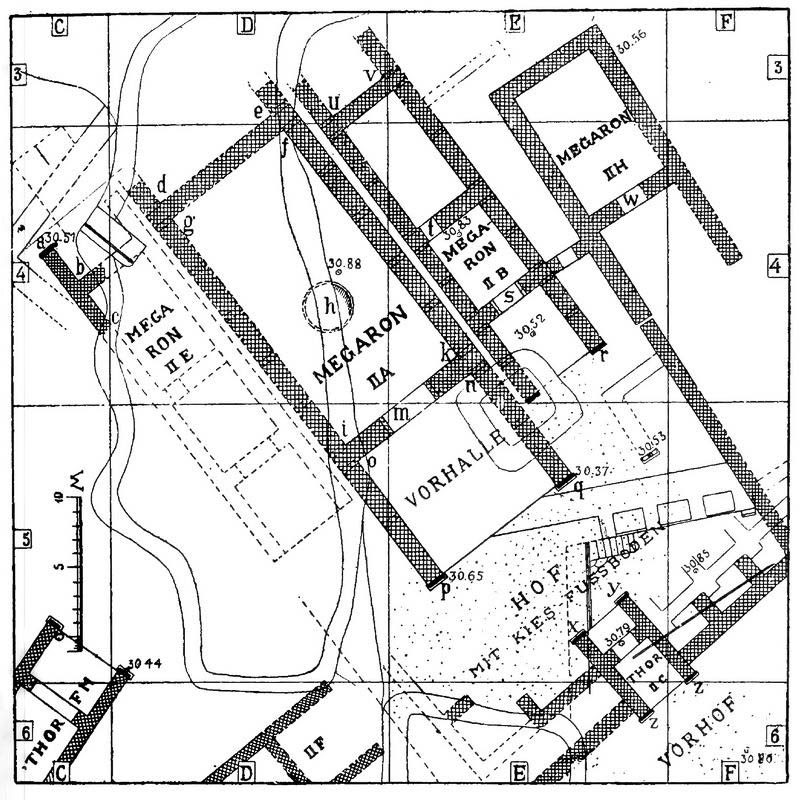
Note how each structure has its own wall rather than sharing a wall.


The fresco shows a Minoan city (Akrotiri) of the Late Bronze situated on one of the islands of the Cyclades (Thera). Based on the quality of masonry of Troy II, we should expect that the megara structures where not dark, smoke-filled halls, but airy, well-lit structures.
The bricks used to construct the megaron where of a standardized size. Their length to width ratio being such that three bricks laid side by side were equal to two bricks laid end for end. The walls were reinforced with embedded wooden beams laid horizontally, every third course. The ends of the walls were finished with a wooden “pilaster” (a half column attached to the wall). The entire structure was supported by a heavy and solidly built stone foundation.
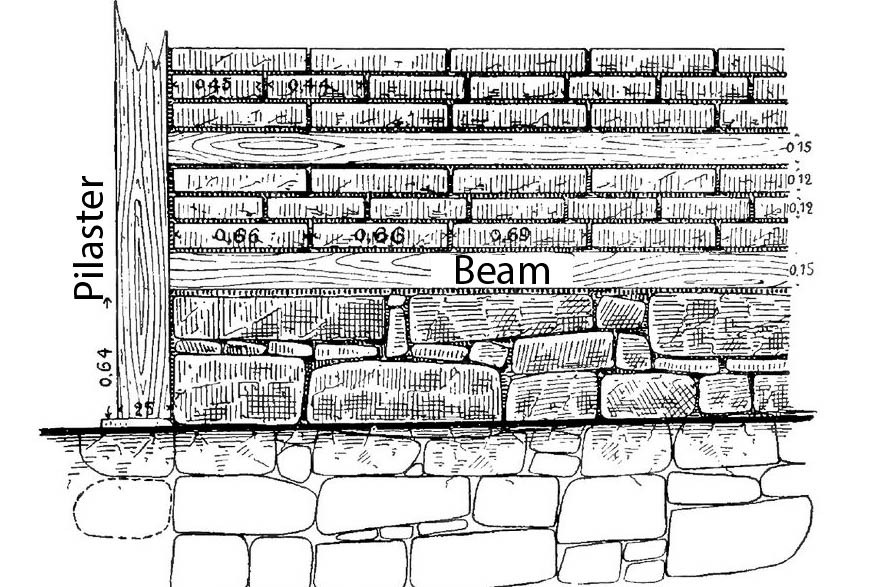
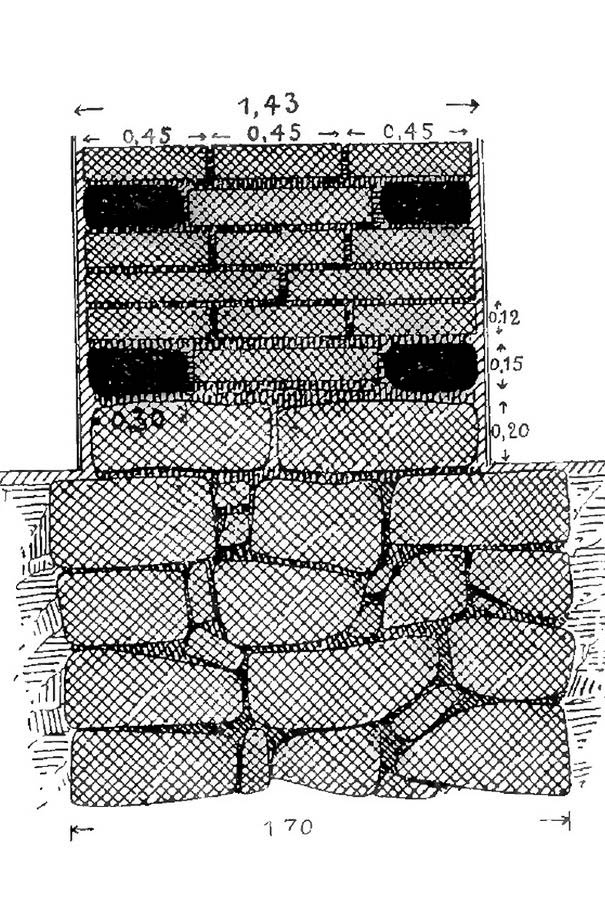
A section of the wall of a megara showing its well constructed stone foundations and mudbrick walls reinforced with wooden beams.
What was the purpose for these buildings? Dorpfeld noted that there were too many megaron-type structures on the citadel for them to have all been temples and there was nothing found in them to suggest that they were used as such. He concluded that the megara were the “dwellings of the lord of the castle, his relatives and perhaps his entourage.”2Dorpfeld 1901, Link
Lower City
The buildings of Troy II are impressive. One can see how Schliemann might have concluded that this was the city of Homeric fame, especially since he was unaware of the larger city of Troy VI. However, Schliemann was also forced to admit that Troy II was really more of a citadel than a city. Although he and his successors thought there must have been a lower city, their limited probing on the plateau south of the citadel did not provide any conclusive evidence of such. The small size of the citadel has been the primary argument against identifying Hisarlik with the Troy of Homeric fame, or a reason to deny that such a city ever existed in the first place.
Excavations outside of the citadel did not begin in earnest until Manfred Korfmann, of the University of Tubingen, initiated excavations on the southern plateau in 19883Easton et al. 2002, 87 Korfmann had sufficient financial backing from the German state and industry to work for eleven seasons in the lower city where he employed geomagnetic surveys and drill coring to explore the area. Easton summarizes Korfmann’s discoveries as follows:
The single most important outcome of Korfrnann’s work is the discovery that, throughout the Bronze Age, Troy consisted not just of the small citadel excavated by his predecessors, but included also a substantial lower town spread around it on the plateau to the south and east. This lower town seems to have grown as the citadel grew, so that by the time of Troy VI it extended fully along the plateau to the south.4Donald Easton from the Introduction; Blegen 2005, xxii
Korfmann’s discoveries in the lower city generated considerable controversy, which we will look at in more detail in our discussion of Troy VI. For now, it is worth noting that oftentimes all that is found of a city is its citadel. Although there may have been a lower city, it is either neglected by archaeologists who would rather focus on the acropolis, or because it has all but disappeared, having alternatively been deeply buried under sediment or eroded away. Archaeology can only grapple with what has survived, which in many cases, is not very much at all.
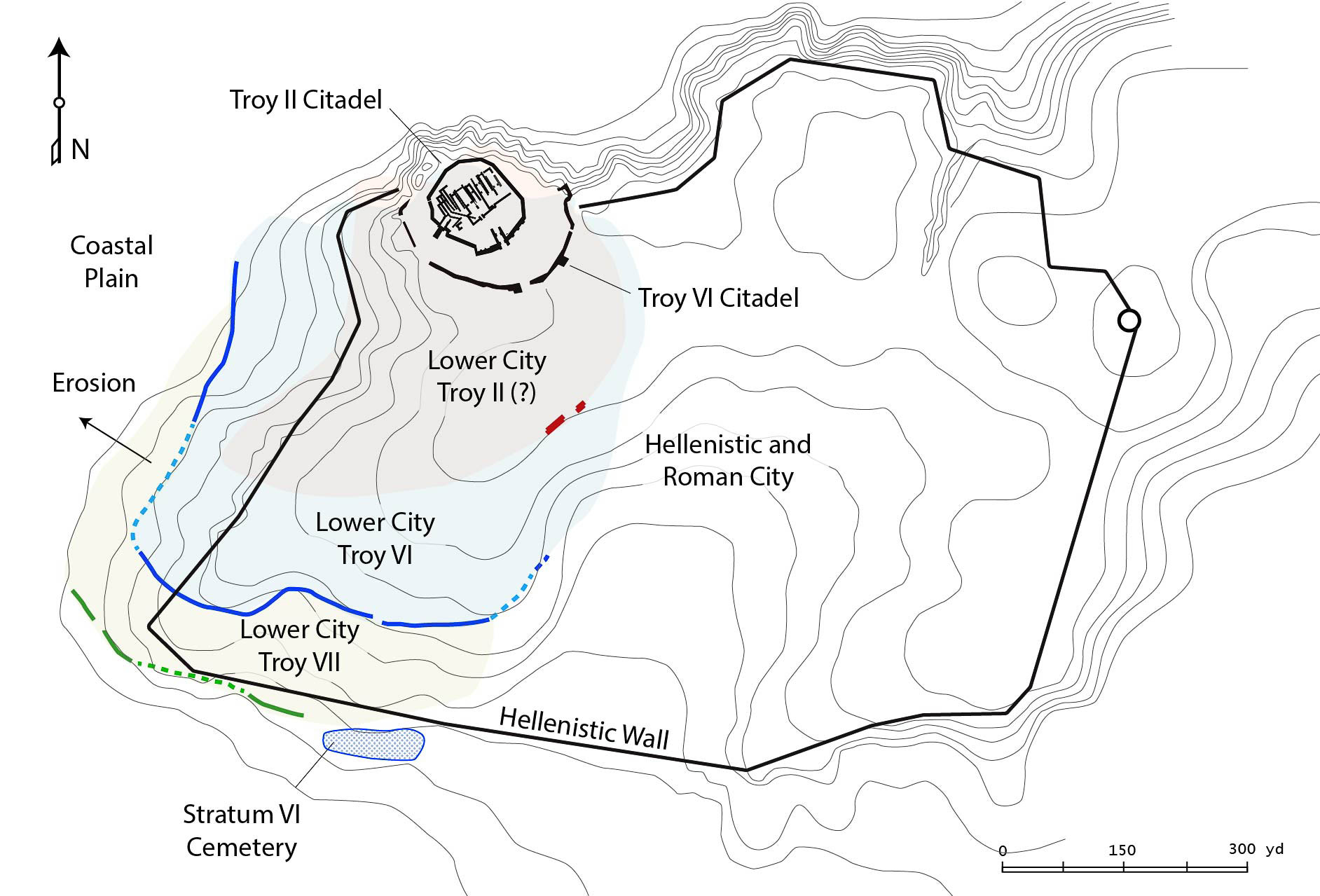
The citadel of Troy in relation its lower city and the walls of the city constructed there during the Hellenistic period. Note how erosion has destroyed the northern fortification walls of the citadel and forced the city to creep eastwards over the millennia.
Schaeffer, C. F. A.
+++ Schaeffer, C. F. A – Xe et XIe Campagnes de Fouilles a` Ras Shamra-Ugarit (Automne et Hiver 1938-1939) : Rapport Sommaire.
Paris: P. Geuthner, 1941.
Blegen, Carl.
Troy and the Trojans.
London: The Folio Society, 205.
Dörpfeld, Wilhelm.
Troja und Ilion I.
Athen: Beck & Barth, 1902. Link
Easton, D. F., J. D. Hawkins, A. G. Sherratt, E. S. Sherratt. “Troy in Recent Perspective.” Anatolian Studies 52 (2002): 75-109. Link
Smithsonian Magazine. Beck & Barth. October 15, 2024. Link
Kayan, İlhan.
“Geoarchaeological research at Troia and its Environs,” in Studia Troica Monograph 5, edited by Ernst Pernicka, Charles Brian Rose, Peter Jablonka.
Bonn, Germany: Dr. Rudolph Habelt GMBH, 2014. Link
Korfmann, M.
“Troy: Topography and Navigation,” in Troy and the Trojan War: A Symposium Held at Bryn Mawr College, October 1984, edited by J. L Angel, M. J. Mellink.
Bryn Mawr, Pa: Bryn Mawr College, 1986. Link
Müller, Valentin. “Development of the ‘Megaron’ in Prehistoric Greece.” American Journal of Archaeology 48, no. 4 (1944): 342–48. Link
Schliemann, H.
Troy and its Remains; A Narrative of Researches and Discoveries Made on the Site of Ilium, and in the Trojan Plain.
London: J. Murray, 1875. Link
Dorpfeld, Wilhelm.
Troy and Ilium: Results of the Excavations in the Prehistoric and Historic Layers of Ilium, 1870-1894 .
Athens: Beck & Barth, 1902. Link