According to a tradition preserved in the Epic of Gilgamesh, the foundations of Uruk were laid by Seven Sages who are supposed to have appeared from the sea and taught mankind the arts of civilization. They are curiously depicted in Mesopotamian artwork as hybrid creatures, half fish and half man, known from later Babylonian texts as the apkallu, the Babylonian term for “wise men.”


Left: Half fish and half man, the apkallu or “wise men” are credited with building Uruk. Right: The figure of a king (“ensi”) of Uruk.
An important text, known as the Sumerian King List (SKL), of which we will have more to say later, also links the early history of Uruk with the sea. In this case, it is Meskiagesher, the first king of Uruk, who is said to have disappeared into the sea.
Mesh-ki-ang-gasher entered the sea and disappeared.
This is the only known literary reference to Meskiagesher. The same cannot be said for his successor, Enmerkar, who is credited with introducing brick construction, writing and agriculture.
Enmerkar and (his) wife Enmerkar-zi,
who know (how to build) towns (made) brick and brick pavements.
When the yearly flood reached its proper level,
(they made) irrigation canals and all kinds of irrigation ditches.1Source
Enmerkar was succeeded by Lugalbanda, Dumuzi, and Gilgamesh. Their reigns belong to a heroic age, when Uruk would grow to become the largest and most powerful city on earth. The fame of Gilgmesh, in particular, was memorialized in the first great literary epic. Its opening lines sing the praises of Uruk’s greatest king and extol the beauty of the city’s architecture.
The hidden he saw, laid bare the undisclosed.
He brought report of before the Flood,
Achieved a long journey, weary and worn.
All his toil he engraved on a stone stela.
Of ramparted Uruk, the wall he built,
Of hallowed Eanna, the pure sanctuary.
Behold its out wall, whose cornice is like copper,
Peer at the inner wall, which none can equal!
seize upon the threshold, which is from of old!
Draw near to Eanna, the dwelling of Ishtar,
Which no future king, no man, can equal.
Go up and walk on the walls of Uruk,
Inspect the base terrace, examine the brickwork:
Is not its brickwork of burnt brick?
Did not the Seven [Sages] lay its foundations?2Pritchard 1958, 40
Excavations at Uruk have uncovered the remnants of a massive defensive wall, reinforced with an estimated nine hundred semicircular towers.3The walls and towers were built with distinctive “plano-convex” bricks which did not enter into use until the Early Dynastic period. (Nissen 1984, 92-93) The wall measures six miles in circumference and encompasses an estimated 1350 acres (5.5 square kilometers) of land. The population of Uruk may have grown to as many as fifty thousand people during this period.

The two main regions of Uruk are marked “Eanna” and “Kulaba.”
Very little of the lower part of the city has been excavated. However, studies conducted in the 1990’s using new technologies, such as ground penetrating radar and drill cores, have revealed a network of canals that crisscrossed the city.4Bruckner 2019 These canals were probably fed by a branch of the Euphrates which, it has been theorized, ran through the center of the city, dividing the Kulaba and Eanna districts.
Eanna
Excavations at Uruk have been conducted intermittently by the German Oriental Society since the first expedition was organized in 1912-1913. A major focus of these excavations was the Eanna district, where a series of impressively large, monumental buildings were discovered. Unfortunately, it appears as though the contents of the buildings were removed in ancient times before the buildings were intentionally razed to the ground so that new ones could be erected in their place. Oftentimes only the first course of bricks remain. This type of controlled demolition does not help the archaeologist who benefits most when a building is destroyed catastrophically, sealing valuable objects in the layers beneath. The dearth of artifacts has made it difficult to establish a chronological sequence for the site. A probe conducted in the Eanna revealed 18 levels of occupation which extend back to the Ubaid period.
| Strata | Period |
|---|---|
| XVIII-XVI | Ubaid |
| XV-X | Early Uruk |
| IX-VII | Middle Uruk |
| VI-IV | Late Uruk |
| III | Jemdet Nasr |
| I-II | Early Dynastic |
Remnants of buildings have only been found in the upper strata (VI-I).
Although remnants of earlier structures belonging to the Ubaid period were discovered in the probe mentioned above, the most significant building levels belong to the Late Uruk period (late 4th or early 3rd millennium BC).


The earliest structures on the Eanna (VI-V) are also the most impressive. They were constructed on limestone foundations, a material rarely used in southern Mesopotamia since the nearest source of stone was 40 miles distant from Uruk, and not of very good quality.5Nissen 1990, 96-97 More remarkable still were the techniques employed in the construction of the Stone Cone Building (VI-V). It receives its name from the multi-colored stone cones which were impressed into the outer surface of its walls, forming a mosaic. The creation of so many stone cones must have been labour intensive indeed! The same technique was used to decorate other building on the Eanna which were built after the Stone Cone Building, but they used clay cones instead of stone. Another remarkable feature of the Stone Cone Building is the use of slabs of terracotta clay embedded in cement mortar for the construction of its walls, a method that anticipated Roman brick construction by several millennia.


The use of clay cone mosaics is an important marker of the Uruk culture which flourished at the beginning of the Early Bronze period (EB I).

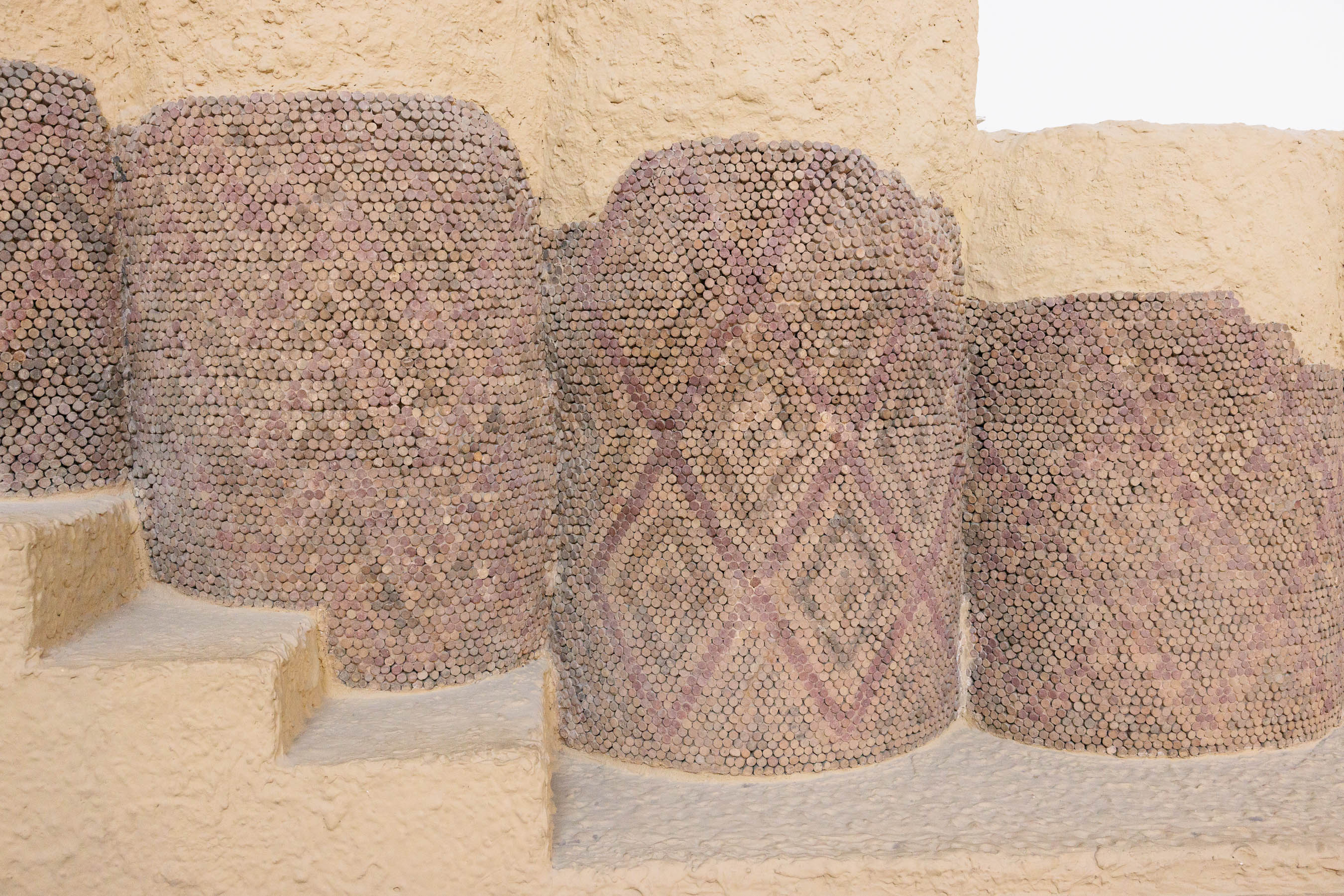


Portions of walls decorated with clay cone mosaics found on the Eanna have been preserved in the Pergamon Museum in Berlin.
An and Inanna
The name Eanna probably means “House of Heaven” (e– “house”, anna “of heaven”). According to one Sumerian text, known as Ninmešarra, the original temple on the Eanna was dedicated to An and then stolen by Inanna.
You [Inanna] have indeed stolen the Eanna temple from An, you have not feared An the king.6Ninmešarra 86–87, cited in Krul 2018, 11
Another text tells how Inanna eventually rose to occupy the place which formerly belonged to An.
Great An feared your [Innana’s] precinct and was frightened of your dwelling-place. He let you take a seat in the dwelling-place of great An and then feared you no more, saying: “I will hand over to you the august royal rites and the great divine rites.”7Innin Shagurra 106-108, cited in Krul 2018, 11
One final source describes how Inanna recruited her brother Utu, the sun god, and Adagbir, the divine fisherman, to help her capture the “House of Heaven” from An. Here is how J. Krul summarizes what happened next.
They succeed in pulling the temple down from sky. It tumbles into the reed beds below. An is greatly upset, since establishing such a heavenly abode on earth has made Inanna greater than himself, but eventually he accepts what has happened and ordains a glorious destiny for the Eanna.8Krul 2018, 11
These texts seem to suggest that the cult of An was at some point supplanted by that of Inanna at Uruk. The god of heaven, An, was not only the highest deity in the Sumerian pantheon, but also the most distant and detached. An rarely appears in Sumerian mythology. Inanna, on the other hand, is the subject of more Sumerian myth than any other god or goddess in the Sumerian pantheon. Her cult seems to have been the primary one at Uruk until the the Seleucid period (late 4th century BC) when her place, curiously, was “retaken” by An.9Krul 2018
Black, J. A.
The literature of ancient Sumer.
Oxford, New York: Oxford University Press, 2004.
Bruckner, Helmut.
“The Geoarchaeology of Uruk,” in Excavating Uruk: First City of the Ancient World, edited by Nicola Crusemann, Margarete Van Ess, Markus Hilgert, Beate Slaje.
Los Angeles: J. Paul Getty Museum, 2019.
Eichmann, Ricardo.
Uruk Architektur I, Von den Anfangen bis zur fruhdynastischen Zeit, edited by Rainer Michael Boehmer. Band 14 vols.
Rahden: Deutsches Archaeologisches Institut Orient-Abteilung, 2007.
Frankfort, H.
The Birth of Civilization in the Near East.
New York: Doubleday Anchor Books, 1956.
Kramer, S. N.
The Sumerians: Their History, Culture, and Character.
Chicago: University of Chicago Press, 1963. Link
Krul, J..
The Revival of the Anu Cult and the Nocturnal Fire Ceremony at Late Babylonian Uruk.
Leiden, Boston: Brill, 2018. Link
Nissen, H. J. R.
The Early History of the Ancient Near East, 9000-2000 B.C..
Chicago: University of Chicago Press, 1988. Link
Strommenger, Eva. “The Chronological Division of the Archaic Levels of Uruk-Eanna VI to III/II: Past and Present.” American Journal of Archaeology 84, no. 4 (1980): 479–87. Link
van Ess, Margarete.
“The Clay Cone Mosaic Technique,” in Uruk, First City of the Ancient World, edited by Nicola Crüsemann, Margarete van Ess, Markus Hilgert, Beate Salje.
: Getty Publications, 2009.