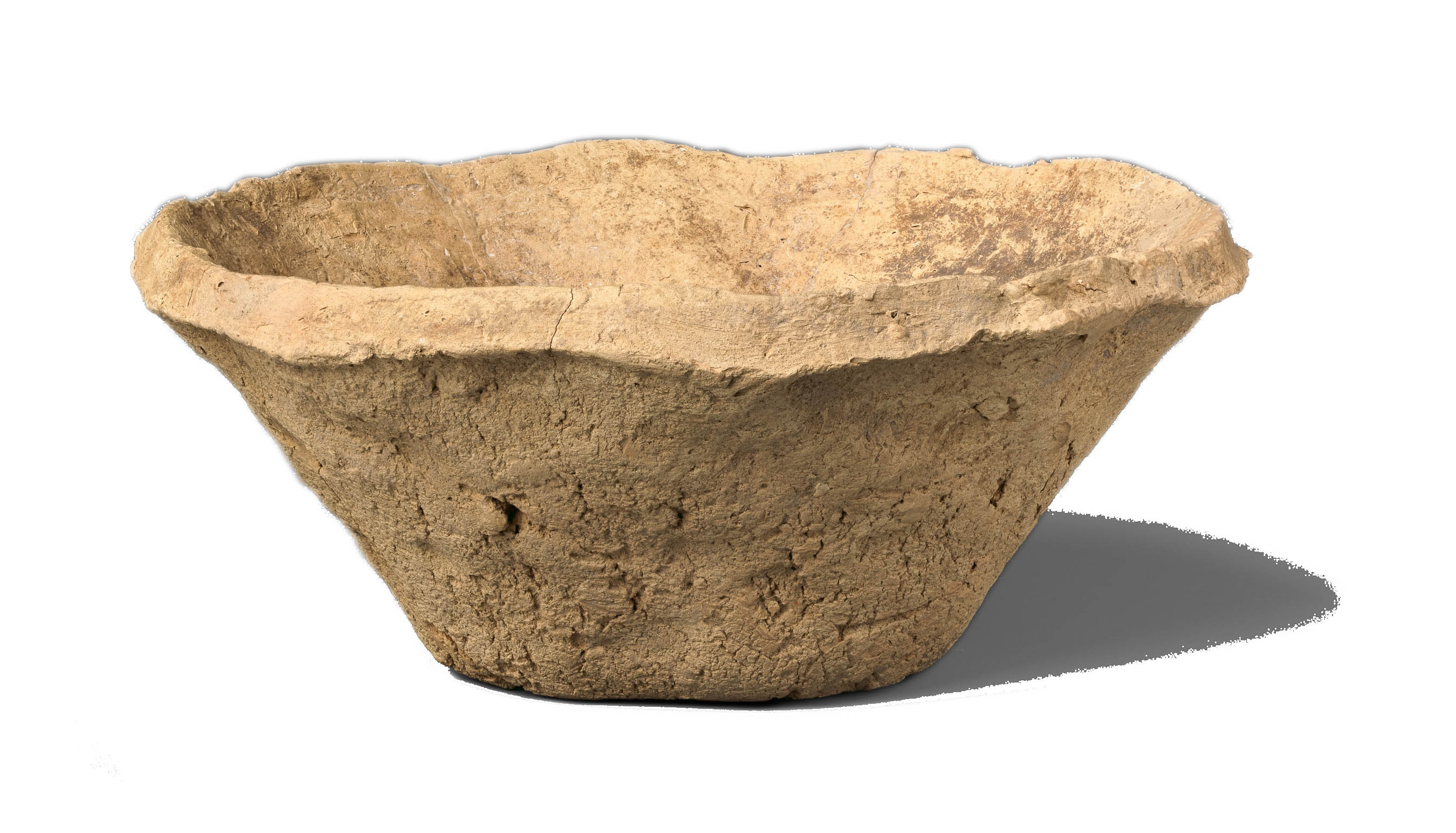
These ubiquitous clay bowls were made of sun dried clay hastily thrown over a mold.
Probably no object from Uruk has received more scholarly attention than the humble Beveled-Rim Bowl (BRB). Made by roughly forming clay over a mold, these bowls may be considered the first mass-produced consumer product. Hundreds of thousands of them have been found at Uruk period settlements. It is not unusual for BRB’s to comprise three-quarters of all the pottery recovered from a site.

BRB’s found at Tello (ancient Girsu) in southern Mesopotamia.
Rations
But what was their purpose? Nissen suggested that the bowls could have been used to measure a day’s rations.1Nissen 1988, 83 Supporting evidence for this theory comes from the Sumerian cuneiform sign “to eat” which combines the symbol of a head with what appears to be a Beveled-Rim Bowl held to the mouth.

The symbol combines a head with a bowl shaped like a BRB.
The BRB’s might be compared to the cheap terracotta bowls used to serve cooked meat in Egyptian restaurants until today. They are produced cheaply enough that they may be discarded after a single use.
The Uruk Expansion
Beveled-Rim Bowls have been found at sites as far afield as southcentral Anatolia and southwestern Iran. Along with cylinder seals and accounting tablets, they are a key marker of the phenomenon, known as the “Uruk Expansion,” during which Urukian merchants developed an extensive trading network that stretched across a vast swath of the Ancient Near East. Several sites, such as Habuba Kabira on the upper Euphrates and Susa in the Iranian lowlands ,seem to have functioned as colonies whereas others, such as Godin Tepe in the Iranian highlands and Arslantepe in southcentral Anatolia, probably served trading posts.2Algaze 2005 The trade network likely arose due to the formation of a new class of artisans in Uruk who required an ever increasing quantity of natural resources to feed their workshops. The demand for finished goods was likely fueled by the increased productivity of Sumerian farmers who adopted new irrigation methods and more advanced tools, such as the copper axe and the ox-driven plough.

This map shows the distribution of cylinder seals and bevel-rimmed bowls in the Ancient Near East.
Algaze, Guillermo.
The Uruk World System: The Dynamics of Expansion of Early Mesopotamian Civilization (2nd Edition).
Chicago, IL: The University of Chicago Press, 2005.
Kramer, S. N.
The Sumerians: Their History, Culture, and Character.
Chicago: University of Chicago Press, 1963. Link
Nissen, H. J. R.
The Early History of the Ancient Near East, 9000-2000 B.C..
Chicago: University of Chicago Press, 1988. Link