Two major types of axes have been found at sites in the Caucasus: the flat axe and the shaft-hole axe. Each type has its stone counterpart. In many places, the stone version was used well into the Early Bronze Age or even later. The city of Troy (Hissarlik), for instance, was an early center of metalworking yet Schliemann counted 500 stone axes recovered from the bronze age levels of that city.1Sugaya 2012
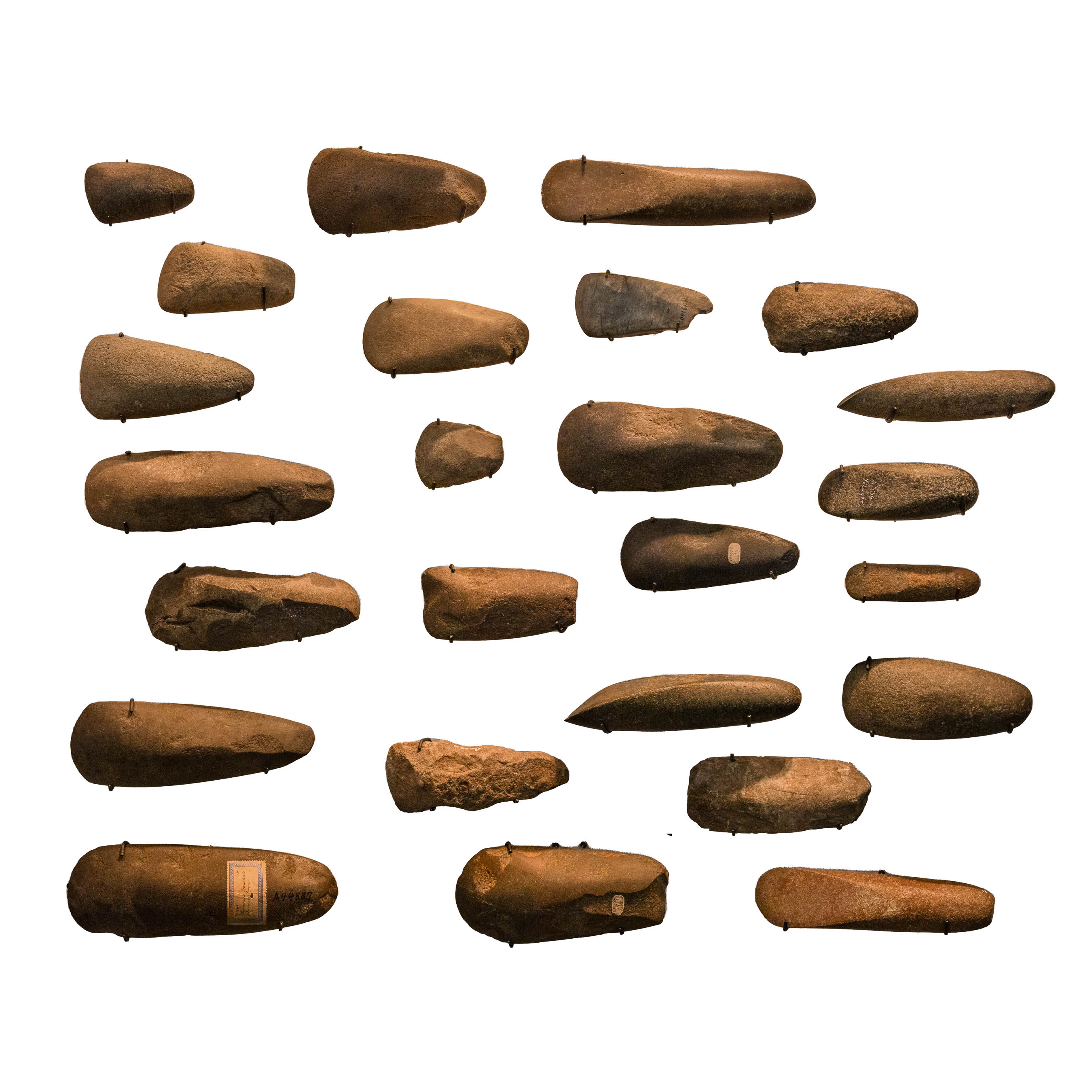

Flat axes were easily cast in open molds and beaten into shape. They never fully replace stone axes until bronze began to replace copper towards the end of the Early Bronze period.


Another style of axe utilized a hole through the center. This was was the go-to tool for the early bronze farmer; many of this type of axe have been found in the Caucasus and Eastern Europe.
Battle Axe
A mold for casting a battle axe was found at Shengavit. Often depicted on Sumerian artwork of the period, these axes were recovered from the Royal Cemetery of Ur. They are often shown being carried by Sumerian rulers. Thus they seems to have served a ceremonial as well as a practical function. These axes probably date to the middle of the third millennium BC.


One half of a two-piece (bivalve) mold found at Shengavit. The mold utilized an insert for making the shaft hole.
Simonyan, Hakob, Mitchell S Rothman.
Shengavit: A Kura-Araxes Center in Armenia.
Costa Mesa, California: Mazda Publishers, 2023.
Stöllner, Thomas, Irina Gambashidze, Ihab Al-Oumaoui, Tobias Baldus.
Between Valleys and Mountains: The Dzedzvebi Plateau as an Intermediate Settlement Site of Late Chalcolithic and Early Bronze Age Communities in the Lesser Caucasus. Archaeologia Austriaca, Band 107 vols.
Wien: Österreichische Akademie der Wissenschaften, 2023. Link
“The Stone Axes of Troy.” Aegeus Society. Österreichische Akademie der Wissenschaften. March 12, 2025. Link
Tamazashvili, Ketevan.
“The Prehistoric Mining Implements from Georgia,” in On Salt, Copper and Gold, edited by Catherine Marro, Thomas Stöllner.
Lyon: : MOM Éditions, 2021. Link
Vajk, Szeverényi.
“The Earliest Copper Shaft-Hole Axes in the Carpathian Basin: Interaction, Chronology and Transformations of Meaning ,” in Moments in Time: Papers Presented to Pál Raczky on His 60th Birthday , edited by Alexandra Anders, Gabriella Kulcsár.
Budapest: Eötvös Loránd University , 2013.