
This lengthy tablet, which dates to the Old Babylonian period, vividly recounts the invasion of Sumer by Gutians, Amorites, and Elamites.
When Amar-Sin succeeded his father, Shulgi, to the throne of Ur, he opted to take a more diplomatic approach towards the Hurrians. Thus he arranged for a Sumerian princess to marry a son of Pusham, king of Simmanum. (This city should not be confused with Simurrum, another Hurrian city which we discussed in a previous entry.) The Sumerian princess was not actually a daughter of Amar-Sin, who was an older man when he became king, but a daughter of Shu-Sin, the son of Amarsin. The king of Ur was acting in accordance with custom by arranging for a dynastic marriage with Simmanum—another was arranged between Ur and Mari—but this does not mean that such marriages did not often end badly.
In this case, Pusham was overthrown in a palace coupe. By this time Shu-Sin had arisen to the throne of Ur and was therefore forced to respond to the threat posed to his daughter and the removal of an ally from the throne of Simmanum. It seems that Shu-Sin was able to successfully reinstall Pusham as king for he continued westwards from there, across the Euphrates into Syria, and then south towards Jebel Bishri.1Hamblin 2006, 115 Ur could now boast of an empire which encompassed many important northern cities in Mesopotamia, with governors installed on the thrones of such important cities as Assur, Babylon, Eshnunna and Simurrum. Ur also controlled Susa while many more distant cities sent tribute. Even Ebla would send 500 bows and quivers as tribute to Ur.2Hamblin 2006, 114
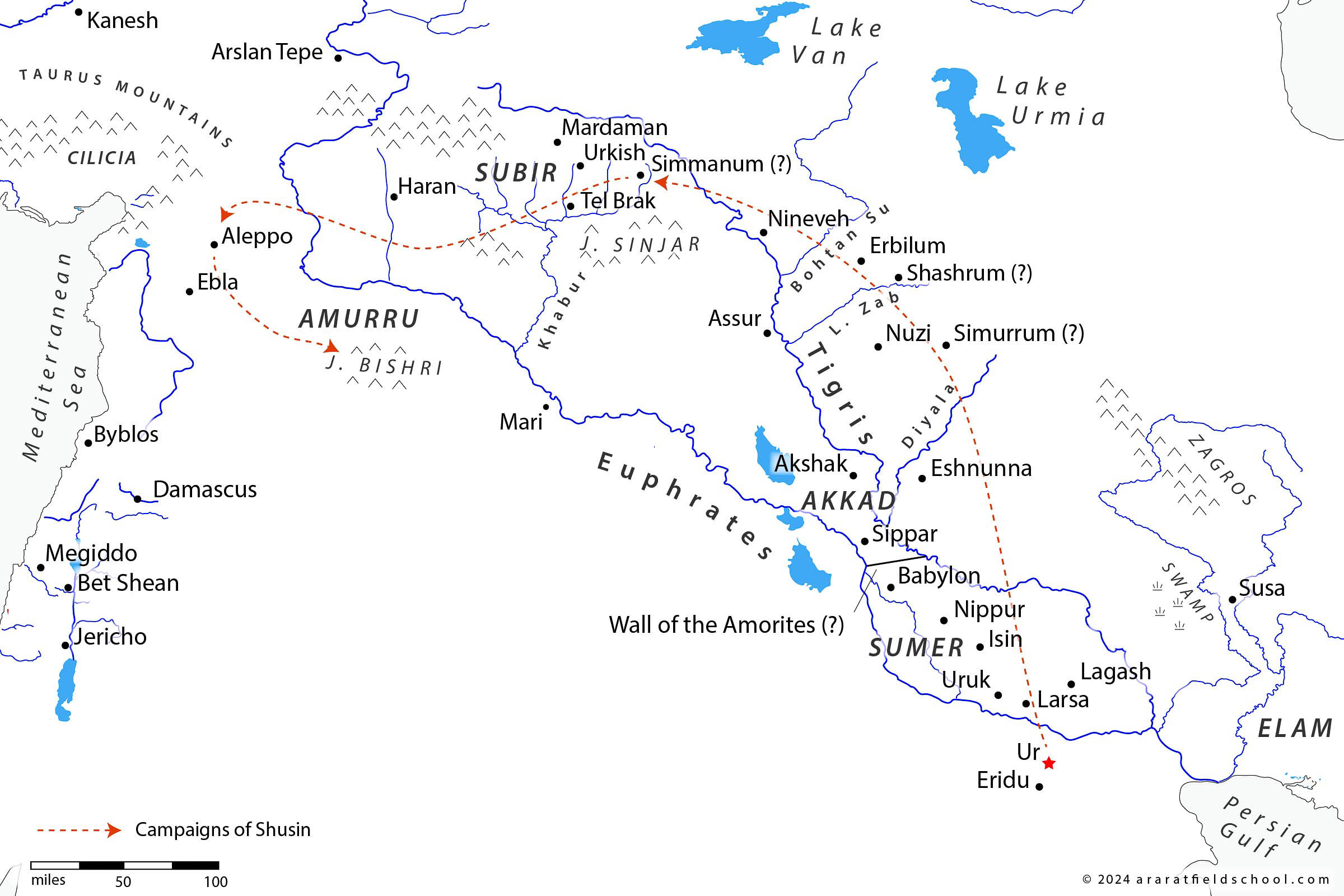
Shusin claims to have campaigned as far as Aleppo and to have subdued “the big mountain where the Amorites live,” a reference no doubt to Jebel Bishri.
In terms of boundary lines on a map, the Sumerians were the dominant power in the region but there were signs of growing pressure. In the final years of his reign, Shu-Sin rebuilt the “wall of the territories” constructed by his grandfather, Shulgi, but renamed it “the wall of the Amorites for keeping Tidnum at bay.” These Amorites came from Jebel Bishri in southern Syria, known also as “Mountain of the Amorites” or “Tidnum.”
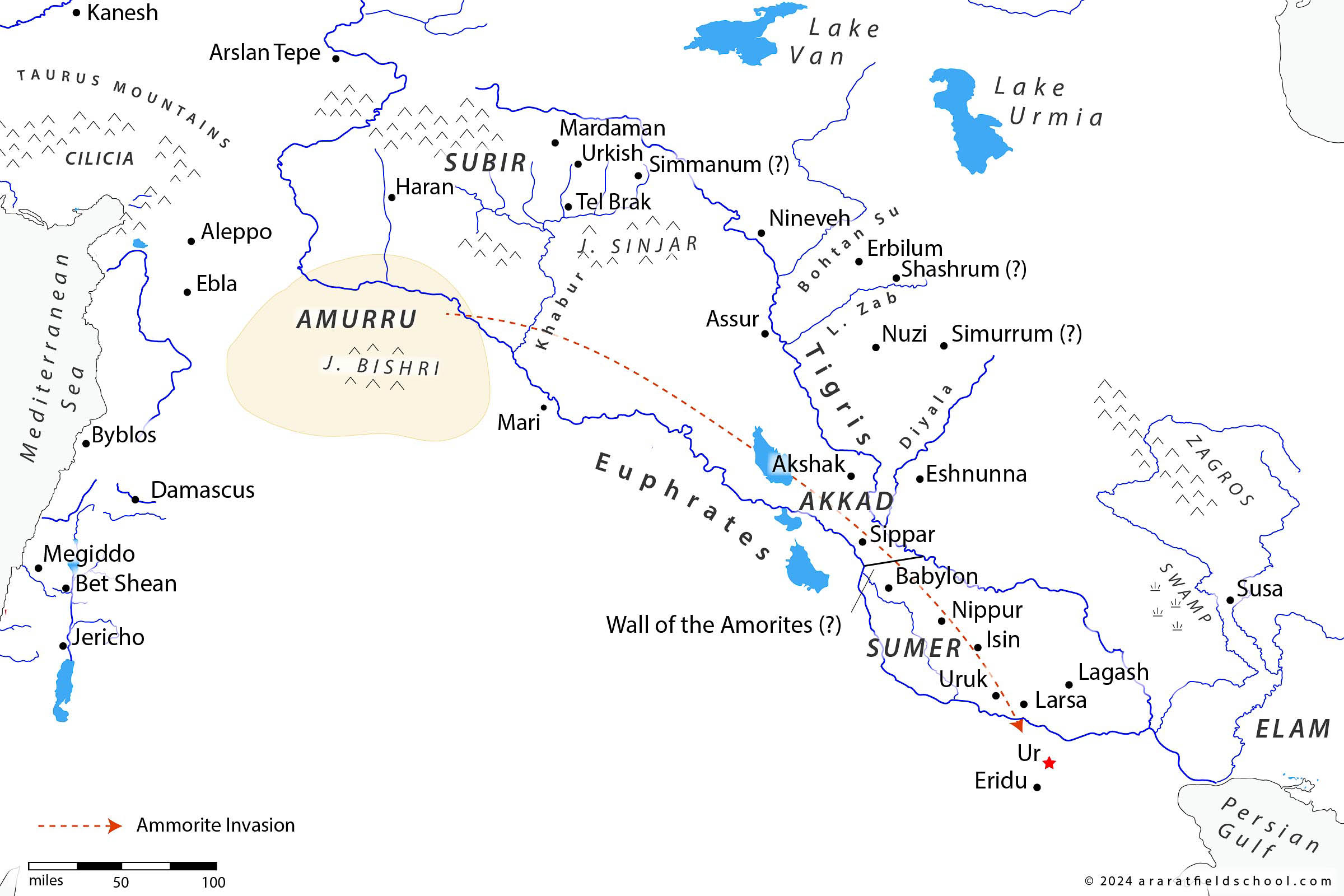
The Amurru homeland was Jebel Bishri in southern Syria, directly west of Mari.
The Amorites
Mar-tu in Sumerian and Amurru in Akkadian, both terms have the same basic meaning of “westerner.” The Amorites are listed among the nations which rebelled against Naram-Sin. They appear again in the royal inscriptions of Shar-Kalli-Shari, the last ruler of a unified Akkadian empire; he led a campaign against the amurru in Mount Bashar (that is Jebel Bishri).3Hamblin 2006, 158 The Amorites must have grown in strength and numbers in the years following the disintegration of the Akkadian empire for when they appear again in texts of the Ur III period, they are threatening Sumer itself. The defensive walls constructed by Shulgi, and reinforced by his grandson, Shu-Sin, seems to have been partially effective at keeping the Amorites at bay, but the country was completely overrun during the reign of Shu-Sin’s son, Ibbi-Sin.
The year names of Ibbi-Sin tell the story.
… the year when a flood decreed by the gods had blurred the boundaries of heaven and earth, caused Ur to weather out the storm.
… the year when the heavy ape (from) the mountain struck Ibbi-sin, the King of Ur.4The word “struck” can also be translated “brought to.” Thus some scholars prefer to translate the year name as, “the year a heavy ape was brought to Ibbi-sin…” (Hallo 2010, 457).
Hallo notes that the scribes who resided in Ur during its final years appear unwilling to admit that anything was wrong. They continue to record the installations of priests and priestesses, the construction of new buildings, and the receipt of tribute, while the world around them was crumbling. Unable to harvest fields or thresh grain, Ibbi-Sin resorted to purchasing grain at what were, apparently, inflated prices.51 shekel for 1 gur seems to have been the going rate during the Ur III period but Ibbi-Sin clearly considers this to have been an exorbitant price (Cripps 2017, 3). Thus Ishbi-Erra, the governor of Isin, informed Ibbi-Sin that he had managed to secure 72,000 gur of barley for 20 talents or 72,000 shekels. This is the equivalent of purchasing approximately 130,000 oil drums (42 gallons each) worth of barley with six and one half tons of silver.61 gur is equal to approximately 80 US gallons. Ibbi-Sin did not greet the news with rejoicing but accused his governor of purchasing twice as much grain as he let on and withholding half of it.
Thus says your king Ibbi-sin: … You received twenty talents of silver to buy grain and you proceed to buy two gur of grain for reach shekel, but to me you send one gur for each shekel…7Hamblin 119
Ibbi-Sin also accused Ishbi-Erra of failing to attack the Amorites with the weapons he provided. Ishbi-Erra emerges from this correspondence looking like a villain but reading between the lines, it appears as though Ibbi-Sin thought he could bribe and cajole his way out of trouble using his enormous treasury and armory, without having to fight.
Threatened from without, it was internal division which finally brought Sumer to its knees. Having perhaps seen the writing on the wall, Ishbi-Erra declared independence from Ur. Whether he was the conniving traitor Ibbi-Sin said he was, or simply acted in the best interests of his city, the response of Ibbi-Sin to the actions of his rebellious governor proved to be disastrous. Ibbi-Sin hired Amorite mercenaries to attack Ishbi-Erra, thereby effectively opening the gates of Sumer to the Amorites.8Hamblin writes, “Thus, as has happened on occasion in history, when two rivals are locked in a civil war for the control of an empire, one may turn to outside barbarians for assistance, buying short-term victory at the cost of long-term security.” Hamblin 2006, 119 The famous Sumerian text The Lament for Sumer and Ur describes the dissension that racked the crumbling empire during its final days.
Enlil afflicted the city with an evil famine. He afflicted the city with that which destroys cities, that which destroys houses. He afflicted the city with that which cannot be withstood with weapons. He afflicted the city with dissatisfaction and treachery.9“The Lament for Sumer and Urim” (Lines 296-300) in Black 2006, 135
Ur was destroyed in the end, not by the Amorites, but by its most ancient foe, the Elamites. Its downfall would be remembered by future generations of Mesopotamians with the same feelings of awe and horror with which we recall the sacking and burning of Rome. Here is how The Lament describes Ur’s final moments:
Its king sat immobilized in the palace, all alone. Ibbi-Suen was sitting in anguish in the palace, all alone. In E-namtila, his place of delight, he wept bitterly. The devastating flood was levelling everything. Like a great storm it roared over the earth-who could escape it?-to destroy the city, to destroy the house, so that traitors would lie on top of loyal men and the blood of traitors flow upon loyal men.10“The Lament for Sumer and Urim“ (Lines 104-111) in Black 2006, 131
Why did Ur fall? The Lament refers to factions and traitors inside the city but ultimately the poet concludes that the city fell because that was the fate decreed by the gods. Even Nanna, the patron god of Ur, was unable to turn back the tide.
There is lamentation in the haunted city, reeds of mourning grow there. In its midst the people pass their days in sighing. Oh Nanna, the noble son…, why do you concern yourself with crying? The judgment uttered by the assembly cannot be reversed. The word of An and Enlil known no overturning. Urim was indeed given kingship but it was not given an eternal reign. From time immemorial, since the Land was founded, until people multiplied, who has ever seen a reign of kingship that would take precedence for ever? The reign of its kingship had been long indeed but had to exhaust itself. O my Nanna, do not exert yourself in vain, abandon your city.11“The Lament for Sumer and Urim” (Lines 360-370) in Black 2006, 137
The Lament for Sumer and Ur does not accuse the inhabitants of Ur with murder, adultery, and falsehood; nor does it censure the king or his stewards for greed, drunkenness, or the miscarriage of justice. It does not even make reference to a failure to maintain proper ritual. Ur’s downfall was fated to happen. Ur’s time had come! This is in striking contrast to the laments recorded in the Bible, which accuse the kings, priests, and people of Israel of all of these things, and worse. If we were to translate this distinction into modern times, it would be the difference between a historian who views the decline of the West in terms of cycles of empire versus a historian who attributes its decline to the venality of its leadership and the degeneracy of its people. Neither view is mutually exclusive, but the moral perspective shines forth particularly clearly in the prophetic books of the Bible and is completely absent from The Lament for Sumer and Ur.
The Lamentation
There are six laments concerning the fall of Ur, two of which date to the reign of Ishme-Dagan, a king of Isin whose ascension occurred no more than fifty years after the fall of Ur.12Hallo 2010, 300 Thus while the lament genre cannot properly be classified as history, some of the laments may have been written by eyewitnesses to the events they describe and thus preserve a more or less accurate description of the city’s downfall. The laments might be likened to Shakespeare’s history plays, which recount real events but in a dramatic fashion. Thus the final moments of Ur are described in terms of the gods fleeing the city in distress crying “alas the destroyed city, my destroyed house!” while the king, who is accustomed to eating the sumptuous food of the palace, grabs for rations along with everyone else. In the end, we find him sitting alone in his beautiful palace weeping while the walls of his besieged city are “covered with barbed arrows like a raining cloud.” The purpose of the lament is not to tell us what happened, although it does do that, but to make us weep with the people of Ur for a beautiful city that was lost.
Many of the laments were written in emesal (Sumerian. “thin” or “weak”), a dialect employed by Sumerian scribes for the speech of a woman or goddess. Although emesal uses the same grammatical rules as the standard dialect of Sumerian, it has different pronunciations.13Hallo 2010, 301 It seems likely therefore that the lamentations were sung by women to the accompaniment of the harp, reed pipe, or tambourine. In later periods we encounter specific types of laments known as “harp songs” and “tambourine laments.”14Hallo 2010, 301
Lamenting what was, these texts reveal how the Sumerians defined civilization.
- The canal runs with brackish water that cannot support carp.
- The quays are silted up.
- The roads are no longer passable.
- Butter and cheese are no longer made in the cattle-pen.
- Wine and syrup cease to flow.
- The sheep do not multiply in their folds.
- The smell of roasting meat is gone.
- Weeds grow in the fertile fields.
- The melody of the cowherd’s song does not resound in the open country.
- Mothers do not look after their children.
- A young wife does not take joy in her husband’s embrace.
- The wet nurse does not sing lullabies.
It is important to note that The Lament for Sumer and Ur does not end with the city’s destruction but with its restoration, initiated by none other than Ishbi-Erra, the rebellious governor of Isin. The same governor would thrust the Elamites out of Ur in his 26th year. With the ascension of his son, Shu-Ilishu, the kings of Isin laid claim once again to that ancient title “king of Sumer and Akkad.” Shu-Ilishu also restored the cult image of Nanna to Ur that had been captured by the Elamites. It was probably during his reign that The Lament for Sumer and Ur was composed.
That the orchards should bear syrup and grapes, that the high plain should bear the mashgurum tree, that there should be long life in the palace.15“The Lament for Sumer and Urim” (Lines 505-507) in Black 2004, 141
Black, J. A.
The literature of ancient Sumer.
Oxford, New York: Oxford University Press, 2004.
Cripps, Eric L. “The Structure of Prices in the Neo-Sumerian Economy (I): Barley : Silver Price Ratios.” Cuneiform Digital Library Journal , no. 2 (2017). Link
Hallo, W.
The World’s Oldest Literature : Studies in Sumerian Belles-lettres. .
Leiden, Boston: Brill, 2010.
Hamblin, W. J.
Warfare in the Ancient Near East to 1600 BC: Holy Warriors at the Dawn of History.
London ; New York: Routledge, 2006. Link