As noted previously, the most important discovery on the mound at Hierakonpolis was the Main Deposit, discovered by Green and Quibbel beneath the floor of the main temple at the site, dedicated the falcon god, Horus.
The objects found in the Main Deposit must have belonged to an earlier temple on the mound. Although nothing remains of it, it has been suggested that it was a shrine named per-wer. References to this shrine are found in Egypt’s earliest literature—the Pyramid Texts. Depictions of this shrine are also found on predynastic labels and seals where it appears to have been a wooden structure with a cylindrical roof. Oddly enough, the building was shaped like an elephant. It was replicated in stone during the Old Kingdom period, although by then its connection with the elephant was almost completely lost.

This image comes from a clay sealing discovered at Saqqara. It shows the basic elements of the Egyptian shrine known as per-wer.
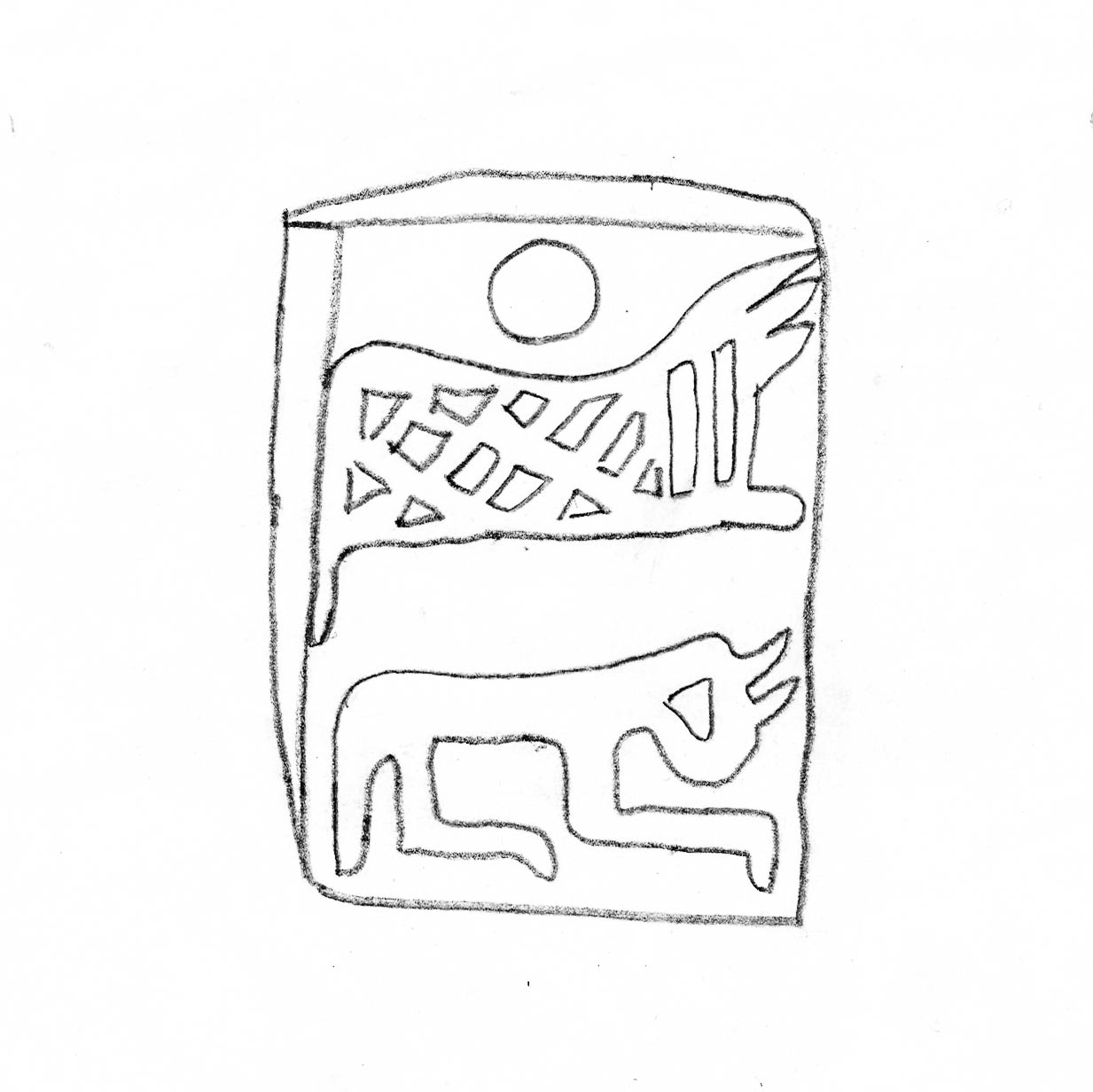


(a-b) Bone tags from Tomb U-j at Abydos
(c) Seal impression from Saqqara
(d) The hieroglyph for “shrine” with the elephant connection still visible.
As noted previously, the per-wer may have once stood on the mound of Hierkaonpolis where the Main Deposit was discovered and where a succession of important temples can be traced back to the Early Dynastic period. Unsurprisingly, given its wooden construction, nothing of the original per-wer shrine was discovered there.
It is also possible that the per-wer was located in the elite cemetery HK6 discussed previously. As you may recall, the remnants of a number of ancient wooden structures were found in the cemetery, most notably Structure 7 which seems to have functioned as a mortuary temple. An elephant burial was discovered next to this structure, leading Baruch Brandl to suggest that this may have functioned as a per-wer shrine. In defense of this position, Brandl points to the per-wer shrines depicted on bone tags found at Abydos. A second elephant is depicted on these tags which Brandl suggest was as an elephant burial.1Brandl 2011, 216 ff. It is an interesting solution to a puzzle which has long baffled researchers.


Elephant(?) Amulet
The importance of the elephant in Upper Egypt during the Predynastic period may prove to be the key to unlocking the meaning of an amulet found in Upper Egypt. Petrie found considerable numbers of these in predynastic tombs, which he interpreted as the head of a bull or a ram, although neither of these suggestions are very compelling. It has also been suggested that the head on the amulet belongs to an elephant and that what are usually interpreted as horns are really tusks. The problem with this interpretation is that the “tusks” are not really shaped like tusks at all.


The amulet may represent a facing elephant.
Of course, we are looking at an abstraction of an animal, and thus no anatomical detail can be taken too seriously. However, Brandl makes another proposal worth considering; the amulet represents the forepart of two elephants shown in profile.2Brandl 2016 What was interpreted as the central “snout” of the elephant is actually its front leg, while the “tusks” are really the trunks of two elephants in profile.


The amulet may represent the forequarters of two juxtaposed elephants shown in profile.
The practice of juxtaposing two heads opposite each other is not unusual for this period.3ie. Egyptian stone palettes and Ghassulian copper standards Most notably, several ivory amulets were found in the lowest levels of the Sin Temple at Khafajah that display the same basic arrangement.


These pendants came from the earliest levels of the Sin Temple at Khafajah, in northern Mesopotamia. On the analogy of the Egyptian amulets, they may also be abstract representations of elephants.
Brandl sees the disappearance of elephant amulets from Egypt during the Early Dynastic period as evidence for the killing and expulsion of elephants from the cultivated lands of Egypt during that period.4Brandl 2016, 222-223 However, in light of the evidence for a more arid climate during the latter half of the Early Bronze period (See: Harrat Kaybar) it is more likely, in my opinion, that the African savannah retreated southwards, and the animals of the savannah with it, including the elephant, giraffe, hartebeest and baboon. Thus they vanished also from the iconography of ancient Egypt.
Brandl, B.
“The Sealing and the pr-wr Labels from Tomb U-J at Umm el-Qa’ab, Abydos Reconsidered,” in Egypt at its origins 4 : proceedings of the fourth International conference “Origin of the State: predynastic and early dynastic Egypt”, edited by M. D. Adams.
Leuven – Paris – Bristol, CT: Peeters, 2016. Link
Delougaz, Pinhas , Seton Lloyd, Henri Frankfort, Thorkild Jacobsen.
Pre-Sargonid Temples of the Diyala Region. OIP 58 vols.
Chicago: The University of Chicago Press, 1942. Link
“Who Let the Elephants In?.” Hierakonpolis Online. February 14, 2024. Link