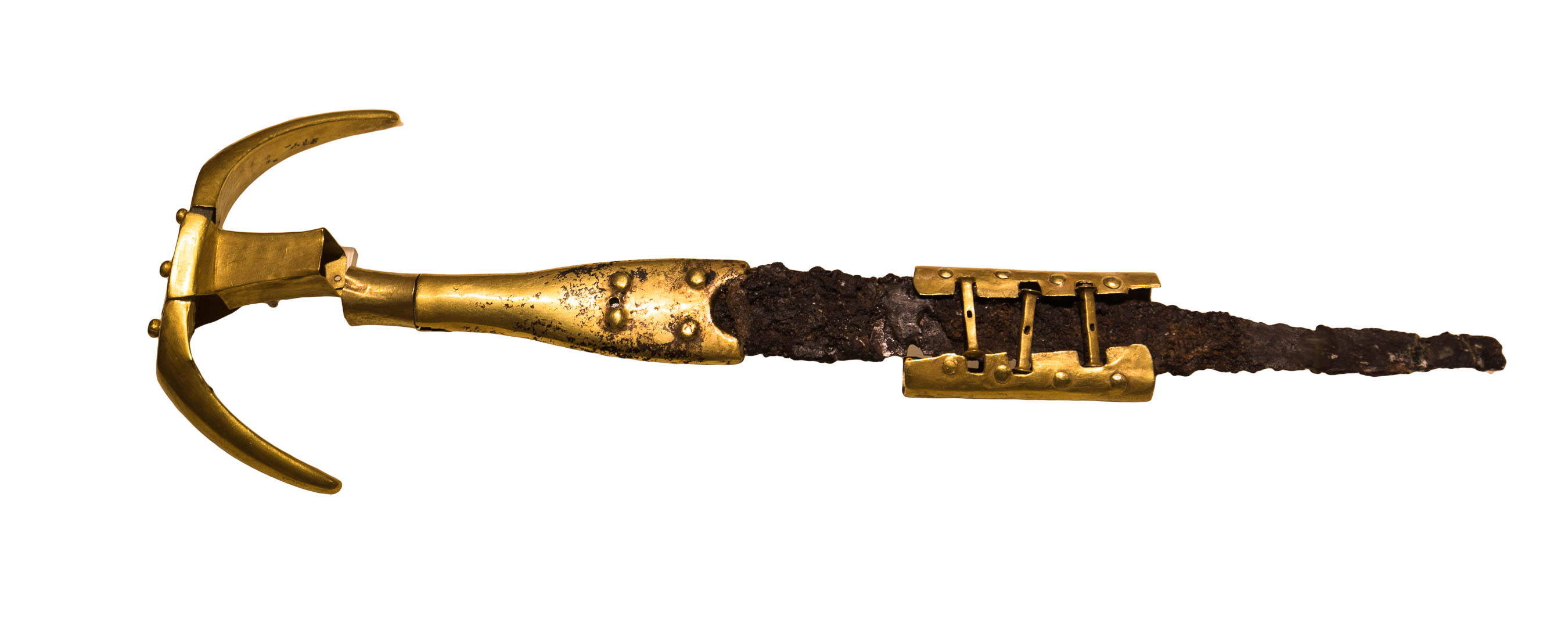
The dagger was found in Tomb K at Alacahoyuk.
A remarkable dagger made from iron was recovered from Tomb K, one of the earliest and richest tombs discovered at Alacahoyuk. Six other iron objects were found in the tombs although, unlike the dagger, they are small and poorly preserved. The discovery of iron in these tombs raises some interesting questions. If iron was not in widespread use until the Iron Age (beginning c.1200 BC), and these tombs date to the mid to late 3rd millennium BC, then where did the iron come from to make the dagger?
An iron dagger found by Woolley in one of the tombs at Ur (PG580) raises the same questions. Here is how Woolley explained it:
Here too was a very remarkable object, a tool with flat blade and tang made of iron; it was too badly decayed for its type to be determined, but that it was a hammered blade was clear; on analysis the metal proved to be meteoric, so the tool or weapon must be regarded as a ‘freak’ not at all legitimately anticipating the regular working of iron.1The knife was found in PG580. See Woolley 1959, 49; see also pg 293
No knowledge of iron smelting was necessary to produce iron objects from meteorites since these are mostly pure iron. If the iron used to make the dagger found at Alacahoyuk was derived from meteorites, then it would explains why later Hittite texts refer to iron as “sky metal.” Meteoric iron may easily be identified by its high nickel content (6-20%). Initially, an analysis of the iron objects from Alacahoyuk suggested that they contain less than 3% nickel which is much too low to have been derived from a meteor.2Yalcin writes, “Only some of the Anatolian iron finds have been analyzed. These samples usually have less than 3% nickel, showing that the iron is not meteoric in origin.Yalçın 1999, 184 Of course, these results are contingent on having a good sample for analysis which cannot be assumed since ancient iron is invariably found in a badly decayed state.3Yalçın writes, “Of these objects, the gold-handled dagger (find number A1.K.14) is the best-known. It was found in Grave K with three bronze solar discs. The end part is made of iron and severely corroded, and the analyses conducted on this section showed low values for nickel. There therefore seems to be no possibility that this dagger is made of meteoric iron. But if the analysis was conducted on the corroded area the results should be viewed with caution. a further investigation for traces of nickel in this object should be conducted.” (See Yalçın 1999, 180-181)<br><br> See also pg 184 where Yalçın further discusses Anatolian iron, “Only some of the Anatolian iron finds have been analyzed. These samples usually have less than 3% nickel, showing that the iron is not meteoric in origin. In spite of this, early iron finds in Egypt and Mesopotamia contain high values of nickel. One of the nine beads from El Gerzeh dated to c. 3500 BC contains 7.5% nickel, which suggests that it is made of meteoric iron. (pg. 184) These conclusions have been contradicted by a more recent analysis published in 2012 which points to a meteoric origin for the iron.4Nakai 2012


Left: A crossection of a meteor which shows almost pure iron mixed with olivine.
Right: The Willamette Meteor, weighing in at ~ 15 tons, is the largest and North America and the sixth largest in the world. It was found in Oregon.
Iron in the Bronze Age?
The textual evidence from Kultepe in central Anatolia suggests that iron was already known and used in the Middle Bronze Age. But It was a scarce material more prestigious even than gold. In an Old Hittite inscription (15th century BC), the Hittite king, Anitta, boasts of having received objects made of iron as tribute.
When I [ ] went into battle, the Man of Purushanda brought gifts to me. He brought to me a throne of iron and a sceptre of iron as a gift. (Anitta Inscription: 73-79)5Bryce 1998, 41
The Bible also makes a passing reference to a king of Bashan named Og, roughly contemporary with Anitta, who had a giant bed made from iron (Deut. 3:11). Commentators have explained this “iron bed” as a basalt sarcophagus—the black basalt having the appearance of iron—since iron was not thought to have been utilized during this period. However, wherever the Hebrew word eresh appears in the Bible, it is translated “bed” or “couch,” and barzel is the Hebrew word for “iron.” In any case, there is nothing anachronistic about Og’s iron bed.
The Kultepe tablets of the Middle Bronze Age measure iron in shekels, a unit of measure used for gold and silver. However, by the 14th century BC, iron is measured in minas, a much larger unit of measure, typically used for copper. The literary evidence therefore suggests that iron became increasingly common over the course of the Middle and Late bronze periods.6Yalçın 1999, 183
Akurgal, Ekrem.
The Art of the Hittites.
New York: H.N. Abrams, 1962.
Nakai, Izumi , Yoshinari Abe, Kriengkamol Tantrakarn, Sachihiro Omura. “Preliminary Report on the Analysis of an Early Bronze Age Iron Dagger Excavated from Alacahoyuk.” Anatolian Archaeological Studies. 17 (2012): 321-323. Link
Woolley, Leonard.
Ur Excavations: The Royal Cemetery (Plates).
Oxford: The University Press, 1934. Link
Yalçın, Ünsa. “Early Iron Metallurgy in Anatolia.” Anatolian Studies 49 (1999 ): 177–87. Link