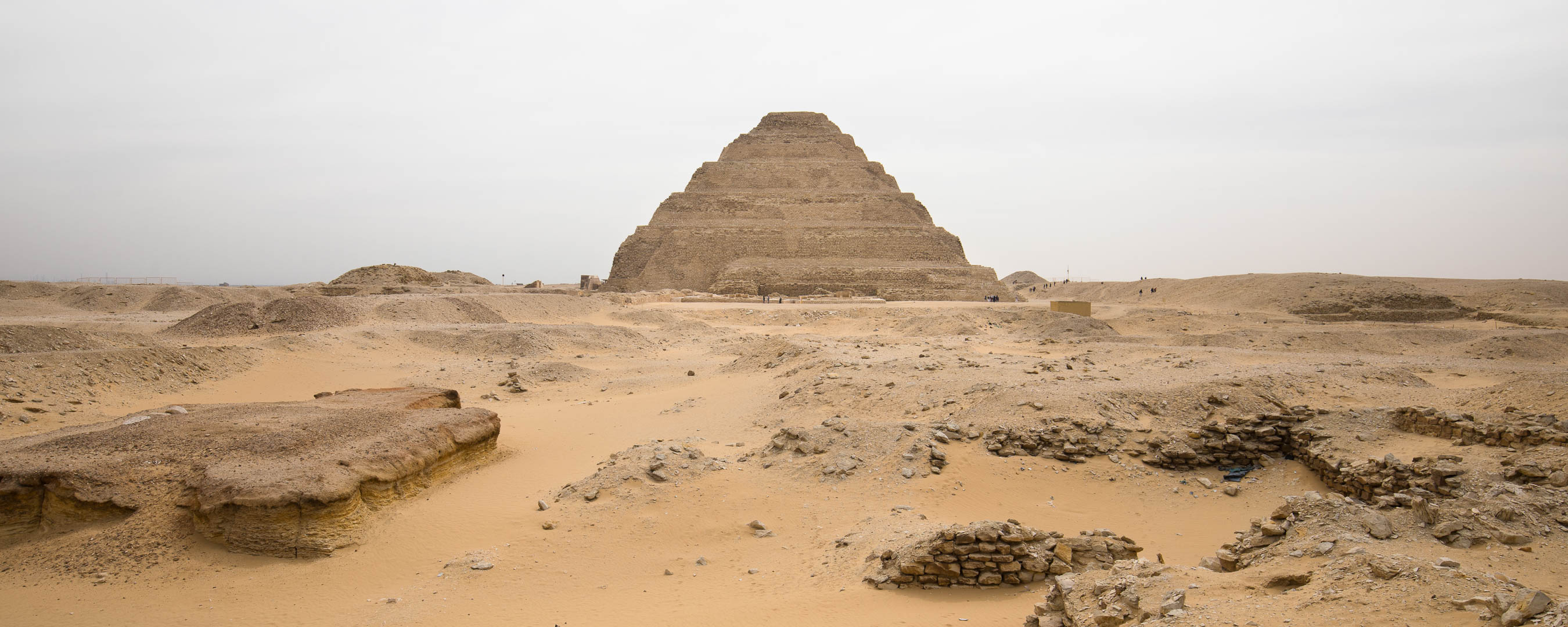
This picture was taken from the northern necropolis looking south. The pyramid of Djoser began as a “mastaba,” the outline of which is still visible in the lower right corner of the pyramid (see section drawing below). Remnants of tombs belonging to the First and Second Dynasties are visible in the foreground.
As noted previously, the great city of Memphis has all but sunk beneath the Nile mud. In order to grasp the size and importance of Memphis, one need only travel into the desert above or below the city and see the immense tombs of unparalleled splendor constructed there. The greatest and most impressive are, of course, the pyramids of Giza. But the first was Djoser’s pyramid constructed at Saqqara. He began by constructing a low, rectangular “mastaba” (Arabic “bench”) which was subsequently enlarged and built upon until it attained the form we see today of a six-stage pyramid that rises approximately 200 feet high. Over the course of the next millennium, Djoser’s pyramid would be joined by 100 more, forming a 100 mile long chain of pyramids along the west bank of the Nile that stretches from Meidum to Giza.
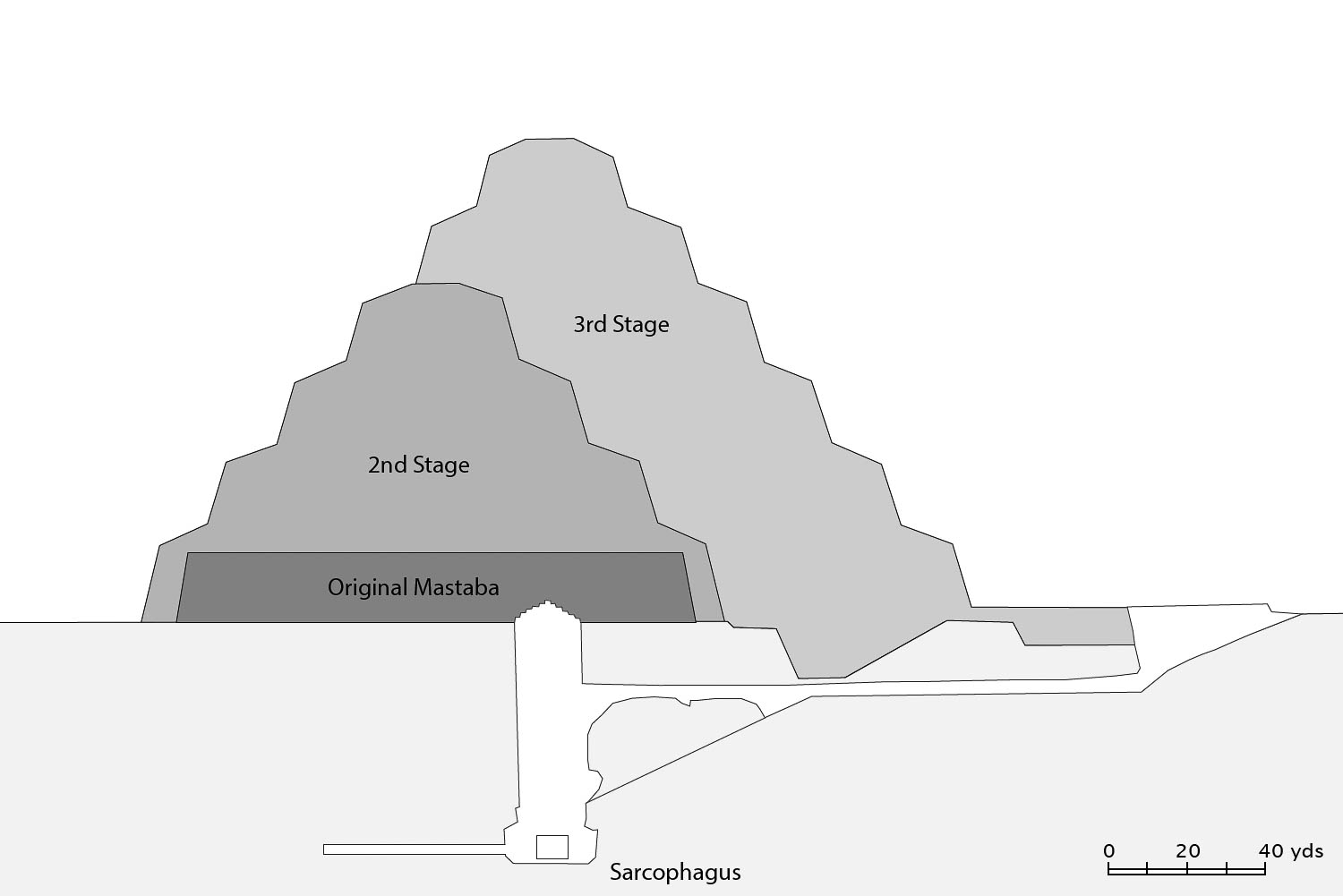
The pyramid began as a mastaba to which stages were subsequently added. A sloping ramp was constructed below grade to move the heavy granite sarcophagus of Djoser into place.
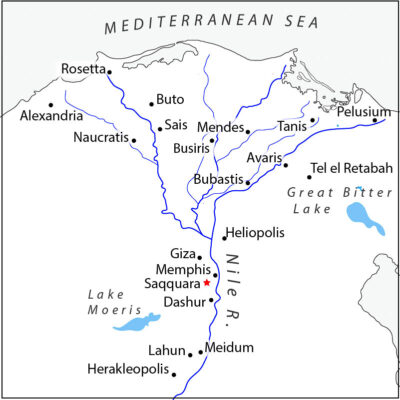

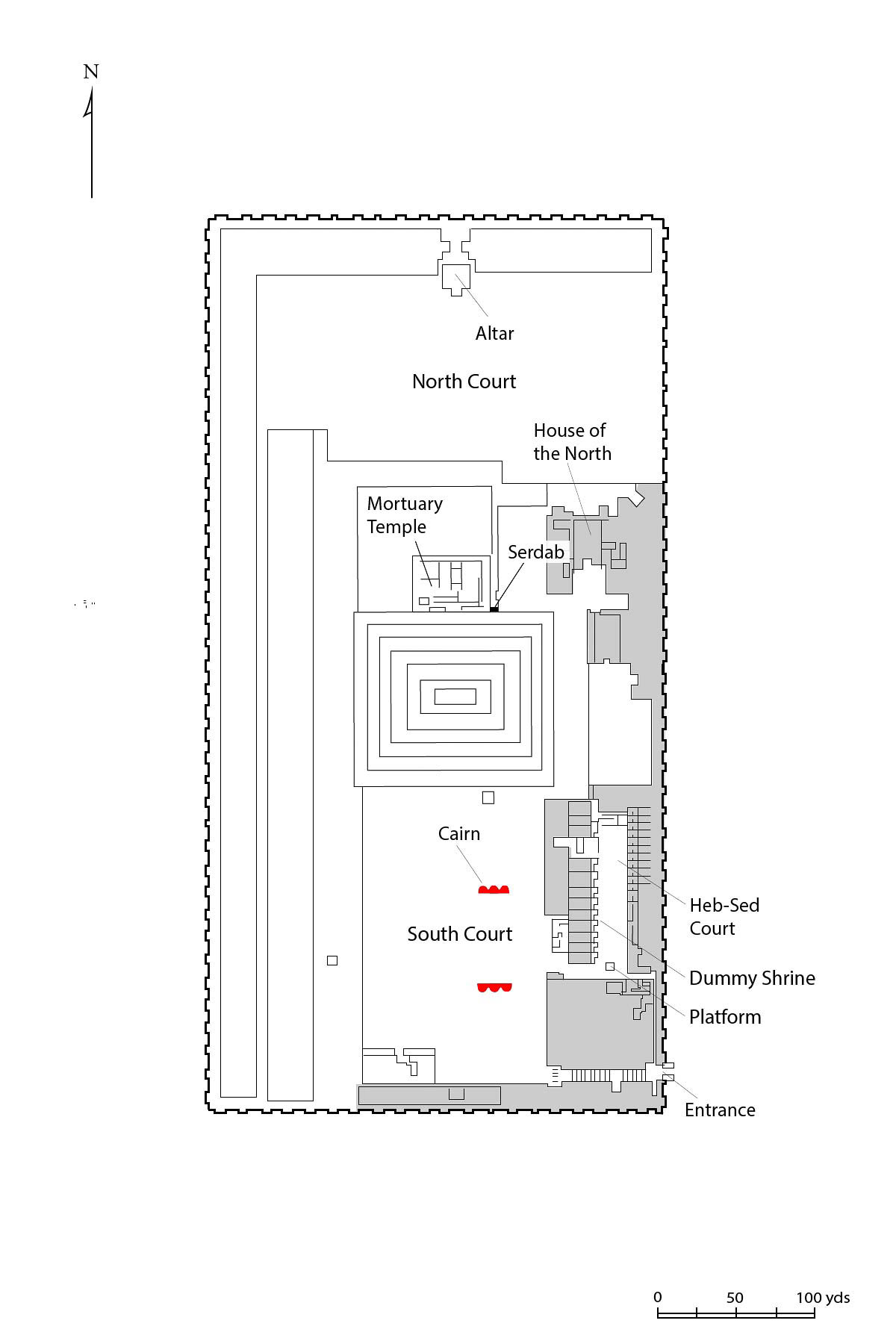
Left: A plan of the site of Saqqara showing the location of the Step Pyramid in relation to the other pyramids and cemeteries in the area. Right: A plan of the Step Pyramid enclosure. Note the location of the “cairns” in the courtyard (in red).
For all the work that went into constructing Djoser’s pyramid, perhaps just as much energy went into digging a series of galleries beneath it. These served as storerooms and accommodations for the deceased pharaoh and his court. The pyramid builders also constructed a tomb chamber approximately 90 feet underground, made with giant blocks of granite. Djoser’s pyramid would be the first to make structural use of granite, which was transported to Saqqara on barges from Aswan, more than 500 miles upstream.


Left: The tomb chamber was connected to a vast series of underground galleries. Right: The heavy granite sarcophagus was discovered at the bottom of a deep shaft approximately 90 feet beneath the pyramid.
C14 and the Age of the Pyramid
Thirteen additional tomb shafts and galleries were created for family members and court officials. The skeleton of a young woman was found by archaeologists in one of these galleries. A bone sample from the skeleton submitted for radiocarbon analysis returned dates ranging from 3532 BC to 2878 BC. Even the lowest date in this range is several hundred years too early judging by the standard chronology for the Third Dynasty (2700‒2600 BC).1Strouhal, E., et al. 1994, 239 There are three ways to resolve this discrepancy: 1) either the Step Pyramid should be dated earlier to match the radiocarbon dates, 2) the young woman was buried in the cemetery before the Step Pyramid was constructed and her bones were subsequently relocated to one of the galleries of Djoser’s pyramid, 3) the C14 dates are simply too early. The last option is probably the correct one since, as we will see, C14 dating tends to return dates that are too high for the Early Bronze period.
Enclosure Wall
The builders of Djoser’s pyramid used small, roughly-hewn blocks of limestone for the pyramid itself. In contrast, the perimeter wall and gateway were made with finely cut Turah limestone fitted together with unrivaled skill. Measuring 300 yards wide and 600 yards long, the wall encompassed a considerable area. All of it suggests that Egyptian masons had a long tradition of sculpting and building with stone to draw from but Manetho says Djoser was the first to build with stone. Archaeology supports this assertion; there is very little evidence for stone masonry in Egypt before Djoser.2Stone masonry was used in the construction of several First and Second Dynasty tombs at Abydos but these are hardly worth mentioning compared to the scale and quality of the masonry on display in Djoser’s pyramid complex.


Djoser’s pyramid complex was built from fine white Tura limestone. The columns pictured above are the earliest known instance of fluted columns.


There was one entrance to the pyramid enclosure on the south east corner. Note the niched facade of the gate.
Imhotep
Manetho credits Djoser’s famous architect, Imhotep, with mastering the art of building with stone. He is also supposed to have achieved marvelous advances in medicine, and many wise sayings are credited to him. In later periods Imhotep would become the patron god of scribes. Every major museum seems to possess a bronze statuette or two of this famous man. The Greeks identified him with their Asclepios, the god of healing, and erected a temple to him near the Serapeum at Saqqara. (We will have more to say about the Serapeum in a later entry.)

A statue of Imhotep wearing the skull cap of Ptah from Memphis. The statue dates to 634-30 BC.
A Palace for the Dead
Djoser’s pyramid complex essentially functioned in death as his earthly palace did in life, but with a catch; nothing in his ghostly palace actually works. The doors are not real doors that open and close, but dummy doors. Likewise, the shrines and temples are not functional, but solid blocks of masonry. It is a curious fact that the palace where Djoser spent most of his earthly existence was made of humble mud brick, of which nothing remains, whereas his tomb was made of stone.

The main courtyard (118 x 204 yards) of the tomb complex was the site of important ceremonies. The cobras were incorporated into the wall of the Southern Palace, another dummy building.
The Sed Festival
The Sed Festival was traditionally celebrated in the courtyard of the palace during the king’s 30th year of reign. It was intended to showcase the health and vitality of the king, and the power he wielded over Upper and Lower Egypt. This was achieved by having the pharaoh ran around an oval racetrack carrying the insignia of his royal power: a flail and cylinder. The flail was used for threshing grain and thus may have symbolized the king’s ability to provide food for his people. The meaning of the cylindrical object is unknown.
The racetrack was created with six half-moon “cairns,” three on each side, which functioned like barrels in a barrel racing competition. Several of the cairns are still visible today today in the main courtyard of Djoser’s pyramid complex (marked “territorial marker” on photo above). Their importance may be gauged by the frequency with which they appear on artifacts from the first three dynasties of Egypt. For example, a bone tag belonging to Narmer shows prisoners being paraded between six cairns (colored red) in a courtyard. In other depictions, the king is shown running around the cairns during the Heb Sed festival.

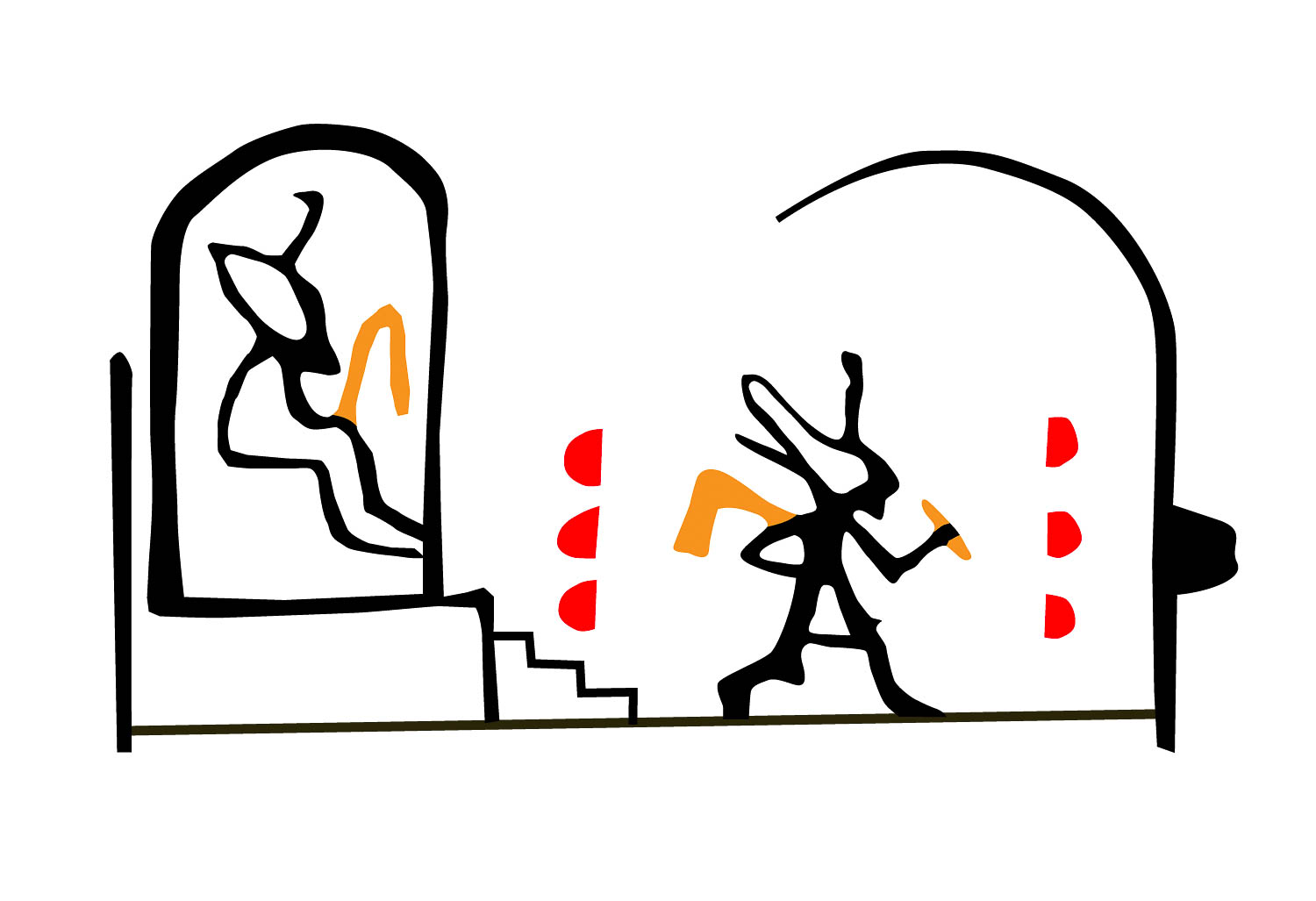
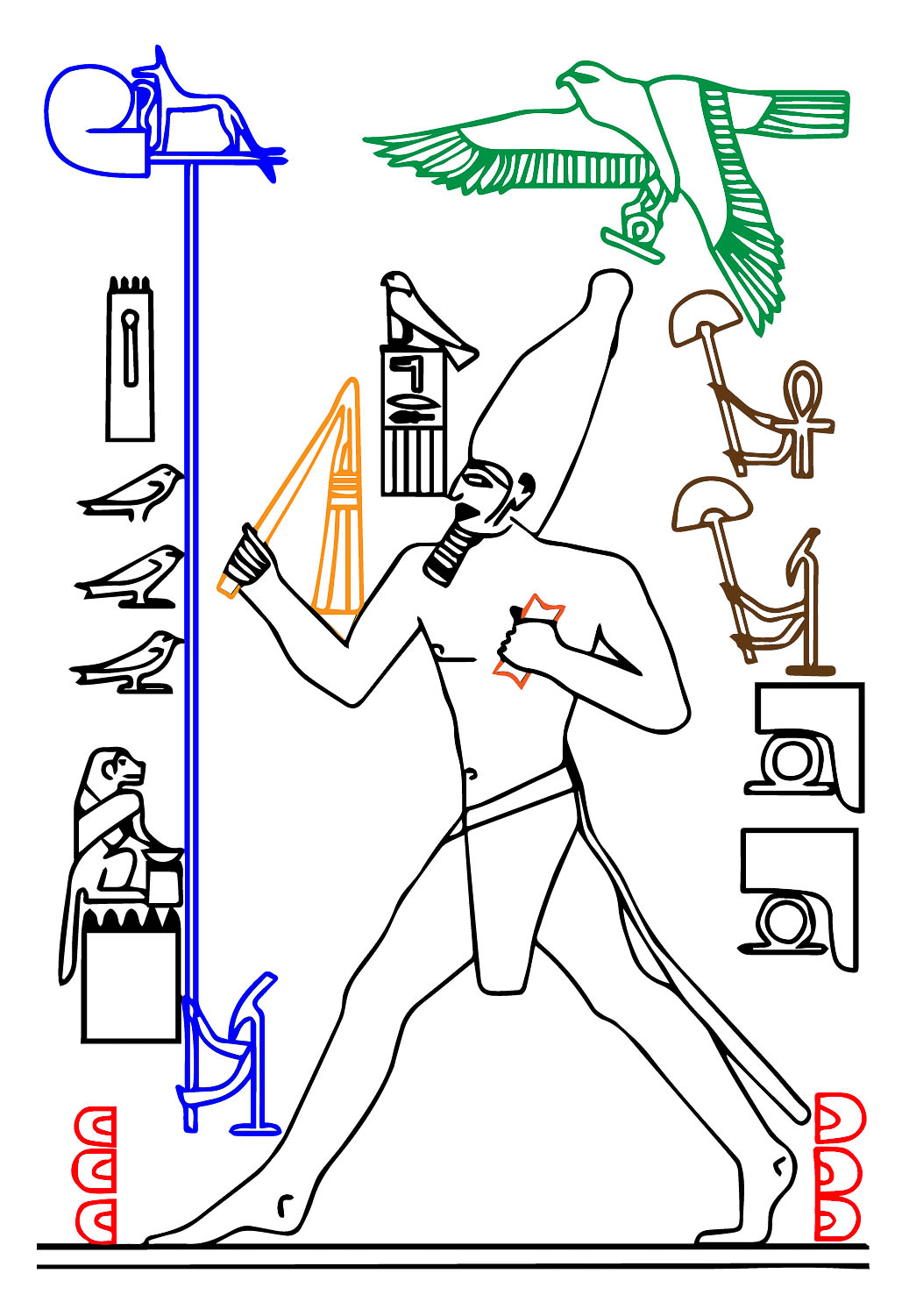
Top Left: A scene from Narmer’s macehead discovered in the ‘Main Deposit’ at Hierakonpolis. It shows prisoners being paraded between six moon shaped territorial cairns. Seated in front of the cairns is a woman in a portable sedan (the queen?) while the king is seated on a throne situated on a raised platform in the courtyard. Bottom Left: A wooden label belonging to King Den (First Dynasty). In the first scene the king is shown seated on his throne under a canopy. In the second scene the king is shown striding between a pair of cairns for the Sed Festival. Right: A carved wall relief from a gallery beneath Djoser’s pyramid complex, it shows the king striding between a pair of territorial cairns for the Sed Festival.
Left Top and Bottom: Firth and Quibell, Excavations at Saqqara: The Step Pyramid, Plates XV & XXVI.b. , Right: Petrie, The Royal Tombs of the Earliest Dynasties: Part One. LinkStatues of the gods were brought from their temples throughout Egypt to Memphis for the Sed festival. They were placed in shrines specially constructed for the occasion in the “court of royal appearances,” the central courtyard of the palace. A platform was also constructed for the king who took his seat among the gods of Egypt. The stage for this pageantry was recreated in Djoser’s funerary complex at Saqqara. The courtyard, the shrines for the gods, the platform for Djoser’s throne, are all there, but like everything else in Djoser’s funerary complex, they are purely representative. The shrines are solid blocks of masonry!

One can see in the foreground the platform for the king’s throne and the dummy shrines for the statues of the gods which were brought to the capital for the Sed festival.
Kemp, B. J.
Ancient Egypt : Anatomy of a Civilization.
New York: Routledge, 2006. Link
Montet, Pierre.
Eternal Egypt.
London: Phoenix Press, 2000.
Strouhal, E. “Re-investigation of the Remains Thought to be of King Djoser and Those of an Unidentified Female from the Step Pyramid at Saqqara.” Anthropologie 32, no. 3 (1994): 225-242. Link