
Picture was taken above cemetery HK6 looking southwards, up the Wadi Abu Sufian. HK6 is the site of an elite cemetery at Hierakonpolis. Significant remains of settlement and industry have been found in the vicinity of HK11, including several large breweries, discussed in a previous entry.
Archaeologists working in the elite cemetery, HK6, located across the wadi from HK11, discovered a number of important tombs. One the largest, Tomb 16, was recently brought to light by Renee Friedman of UC Berkeley. The tomb was a rectangular, brick-lined pit measuring approximately 14 feet long, by 8 feet across, and 5 feet deep. Radiocarbon analysis of animal bones recovered from the tomb returned dates ranging from 3660 to 3640 BC.1Hierakonpolis Online, Accessed 4/24/2025 These dates may probably be lowered considerably if the results of radiocarbon analysis are not accepted prima facie.

HK6 is located approximately a mile up the Wadi Abu Suffian (‘wadi’ is Arabic for ‘canyon’).
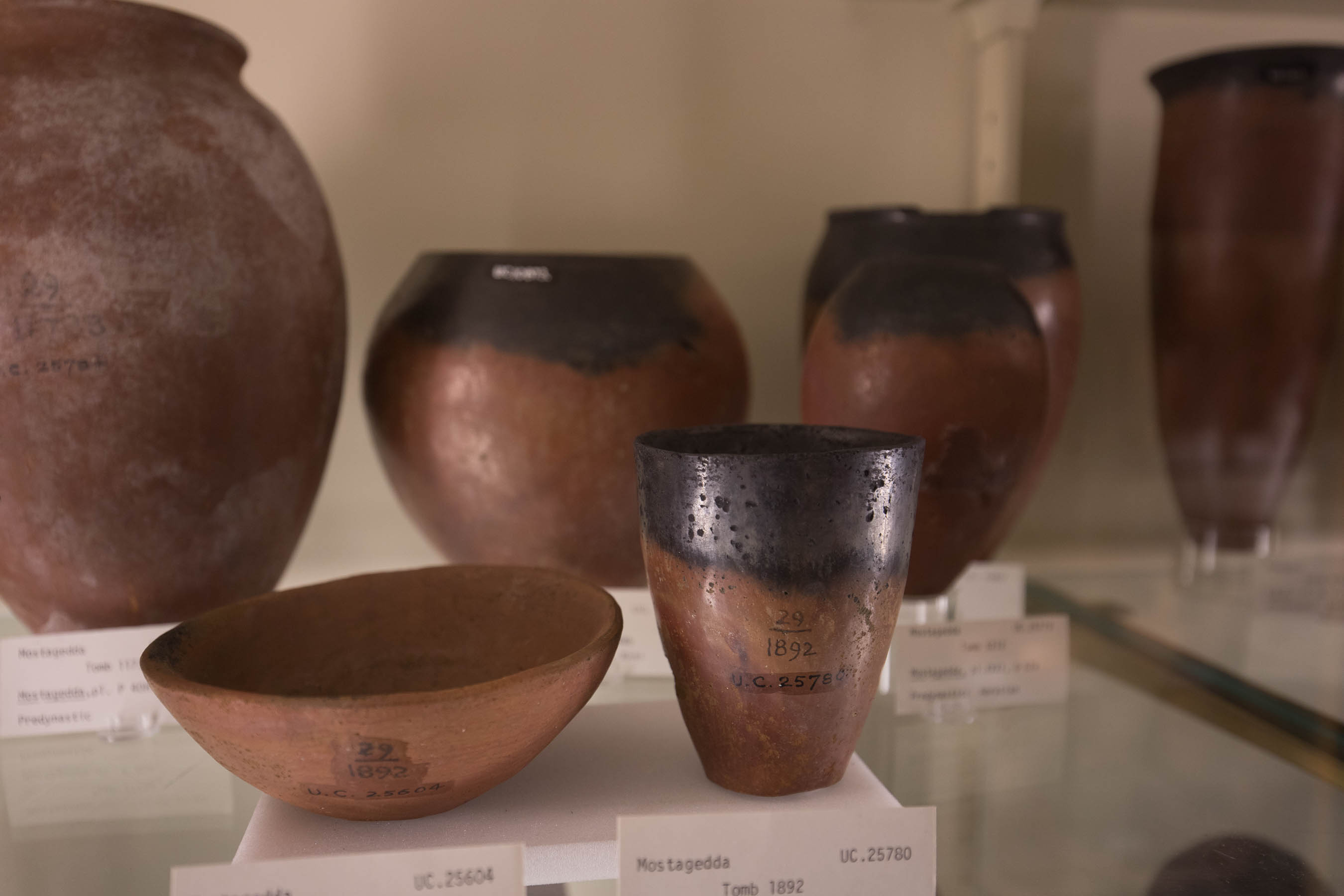

Black-topped vessels like the ones pictured above were found in Tomb 16.
Undoubtedly, the most intriguing aspect of Tomb 16 was the large number of animal burials, 52 in total, found in shallow pits around the main burial chamber. Numbered among them was a baboon, hippopotamus, hartebeest, elephant, two aurochs (wild bulls), and a variety of domesticated animals such as cattle, dogs, and cats.3Friedman 2011, 39
The wild and exotic animal burials are quite remarkable, but special mention should also be made of the twelve cows buried in a single long trench next to the tomb. This many cows buried whole represents a considerable amount of wealth. Other tombs in the cemetery show a similar pattern of subsidiary burials.

The central tomb (Tomb 16) was surrounded by animal and human burials. Wooden post holes surrounding some of the burials suggests that they were covered by wooden structures.
The presence of wild African animals in an Egyptian cemetery raises many questions since today the African savannah does not extend north of Khartoum in the Sudan, more than 700 miles south of Hierakonpolis. One way to explain the presence of these animals at Hierakonpolis is that the animals were captured in distant lands and brought to Hierakonpolis where they were kept in a kind of zoo near the royal palace—a “royal menagerie.” Healed bone fractures have been cited as evidence that at least some of the animals were held in captivity for a period of time.4“HK6,” Hierakonpolis Online, accessed December 20, 2023 But this theory cannot account for the large number of exotic animals buried in the cemetery. A more compelling explanation, in my opinion, comes from the climatological research of William McHugh, who argued that the African savannah must have extended north into Upper Egypt during the Predynastic period. McHugh calculated that the region around Hierakonpolis received around 10 inches of rain per year. Today the region receives almost no rain at all.5Hoffman 1993, 162-163 This would account for the appearance of animals such as the auroch, elephant, hartebeest, wild ass, etc. on rock art and artifacts of the period. By the end of the Early Dynastic period these animals have mostly disappeared from the repertoire of figurative art employed by Egyptian craftsmen.


Left: A slate palette showing giraffes feeding on the tender leaves of a palm tree. Right: Pottery decorated with ostriches and an elephant.
The exotic animals buried at Hierakonpolis raises more questions than answers. Were the animals sacrificed in some sort of mortuary ritual? Were they supposed to accompany the deceased into afterlife? Unfortunately, we will never get definitive answers to these questions since there are no written documents from the period. It is worth noting, however, that the tendency of the ancient Egyptians to attribute divinity to animals may, perhaps, already be on display at Hierakonpolis with these animal burials.
Servant Burials
In addition to the animal burials, archaeologists found thirty-six “subsidiary graves” around Tomb 16. One belonged to a dwarf, most of the others belonged to young women under the age of fifteen or young warriors armed with weapons.6“HK6,” Hierakonpolis Online, accessed December 20, 2023
The bodies were almost certainly buried at the same time as the primary occupant of Tomb 16. Their age militates against a natural cause of death. We are forced, therefore, to conclude that these individuals were chosen to accompany their master into the afterlife. This gruesome ritual, known as “retainer sacrifice,” has been documented in other places and periods, but we will save a fuller discussion of it for our entry on The Royal Cemetery of Ur.

A satellite image of cemetery HK6 showing the post holes that would have once supported the building designated “Structure 7.”
Mortuary Temples
Wooden structures were constructed over the tombs. These may have served as the home of the deceased spirit, on the analogy of later Egyptian tombs.
Another structure in the cemetery, designated “Structure 7,” looks as though it served as a mortuary temple. The layout of its post holes gives the appearance of a pillared hall, with 24 pillars arranged in 4 rows of 6. Perhaps this humble, tent-like structure was the genesis of the gargantuan hypostyle halls of future periods. Structure 7 is one of several pillared halls in HK6 which appear to have functioned as temples in service of the dead. The most impressive artifacts from the cemetery were discovered in and around Structure 7. These include very finely knapped flint animals and a falcon sculpted from a greenish-colored stone called malachite.
Surprisingly, Structure 7 can still be seen on Google Earth.

These finely knapped flint animals were found beneath the foundations of Structure 7 in cemetery HK6.
“Cemetery HK6.” Hierakonpolis Online. December 19, 2023. Link
Friedman, R.
“Hierakonpolis,” in Before the pyramids : the origins of Egyptian civilization, edited by E Teeter.
Chicago, Ill: Oriental Institute of the University of Chicago, 2011. Link
Hardtke, Frederick. “The Place of Rock Art in Egyptian Predynastic Iconography – Some Examples from the Fauna.” Rock Art Research 30, no. 1 (2013). Link
Hardtke, F. E. “Rock Art Interpretive Approaches – Devising Frameworks to Maximally Utilize Independent Lines of Evidence.” Journal of Arid Environments 143 (2017): 22-47.
Hoffman, Michael.
Egypt Before the Pharaohs: The Prehistoric Foundations of Ancient Egypt.
New York: Barnes and Noble, 1993.
Kemp, B. J.
Ancient Egypt : Anatomy of a Civilization.
New York: Routledge, 2006. Link
Quibell, J. E., F. W. Green.
Hierakonpolis. Vol. II vols.
London: Bernard Quaritch, 1902. Link
Quibell, J. E., F. W. Green.
Hierakonpolis. Vol. I vols.
London: Bernard Quaritch, 1900. Link