
The Adda Seal cylinder depicts a mythological scene featuring several important deities in the Mesopotamian pantheon. Ig was cut from “greenstone” a generic term for serpentine.
The art of seal cutting reached its apex during the Akkadian period. Only the much later seals of the Persian period can compare for detail, realism, and aesthetics. Instead of horror vacui (“fear of empty space”), figures are treated individually and given space. In this regards, Akkadian seals share more in common with the large, finely cut, royal seals of the Uruk period than with seals of the Early Dynastic and Jemdet Nasr periods. The seals are often cut from serpentine, a green-colored stone of medium hardness that looks like jade, but not as hard and does not take such a bright polish.1Source Serpentine is sometimes also referred to simply as “greenstone.” Harder and more precious stones were also used, such as hematite (black), chalcedony (translucent), carnelian (red), jasper (green and yellow), and lapis lazuli (blue).
Engraving such hard stones presented a major technological challenge. One of the great frustrations for the archaeologist is that so few of the tools required to cut these stone seals have been found. Tiny bronze tubular drill bits have been found at Chanhu-daro, in the Indus Valley, and at Ur. Sir Mortimer Wheeler describes them as “very carefully made with tiny cupped points to hold the abrasive and water that gave the drill the necessary bite.”2Wheeler 1962, 80 Judging by the evidence left by tooling marks, cutting discs were also utilized.3Gorelick and Gwinnet 1981, 28 Rustic seals such as those produced during the Jemdet Nasr period made no attempt to disguise the tooling marks, but no tooling marks are visible on the finer seals of the Akkadian period. These capture such fine details as the musculature of the body and the texture of the beard, in hard stone!
Motifs
The motifs displayed on Early Dynastic seals carry forward into the Akkadian period, except banqueting scenes. These disappear. Conversely, contest scenes between heroes, bull men, and lions become very prominent. Although we do not have any seals that can be tied directly to the kings of Akkad, the contest scenes are particular finely cut and seem to have belonged exclusively to individuals connected to the royal court.

This seal was masterfully cut from lapis lazuli. The finest are inscribed with the name of their owner.

The bull man engaged in a contest with a lion or the hero wrestling a bull man are favorite themes of the Akkadian period. These seals appear to have been dynastic seals which belonged to kings and queens. The dark black stone is hematite, a relatively hard stone.

The zebu begins to make an appearance on Akkadian seals, not doubt as a result of extensive trade between Akkad and the Indus valley.
The Adda Seal
Akkadian seals are full of obscure mythological motifs without parallel in literary works of the period, and thus difficult to interpret. The Adda Seal is an example of such a seal. However, through an analysis of its parts, we may take a step towards comprehension.
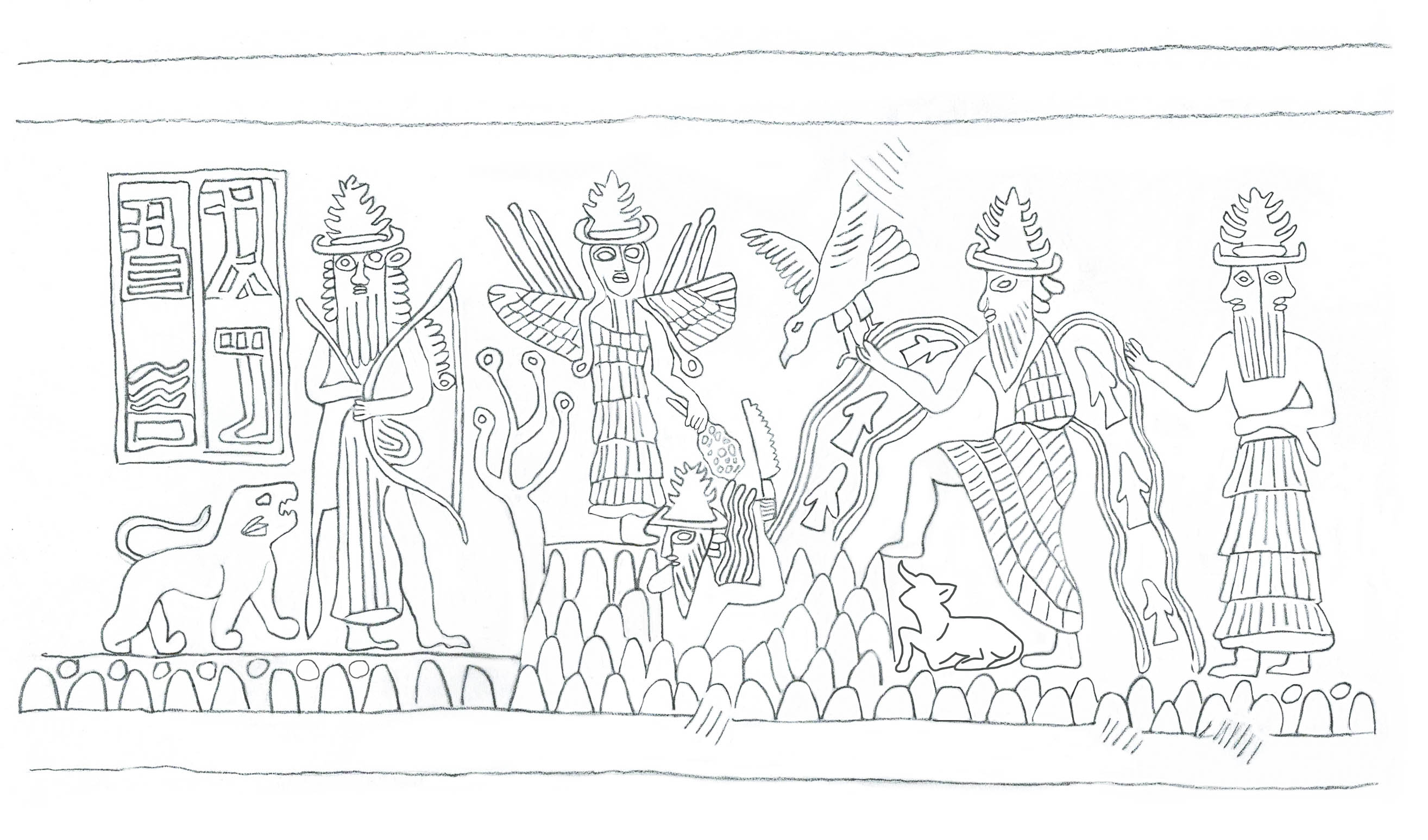
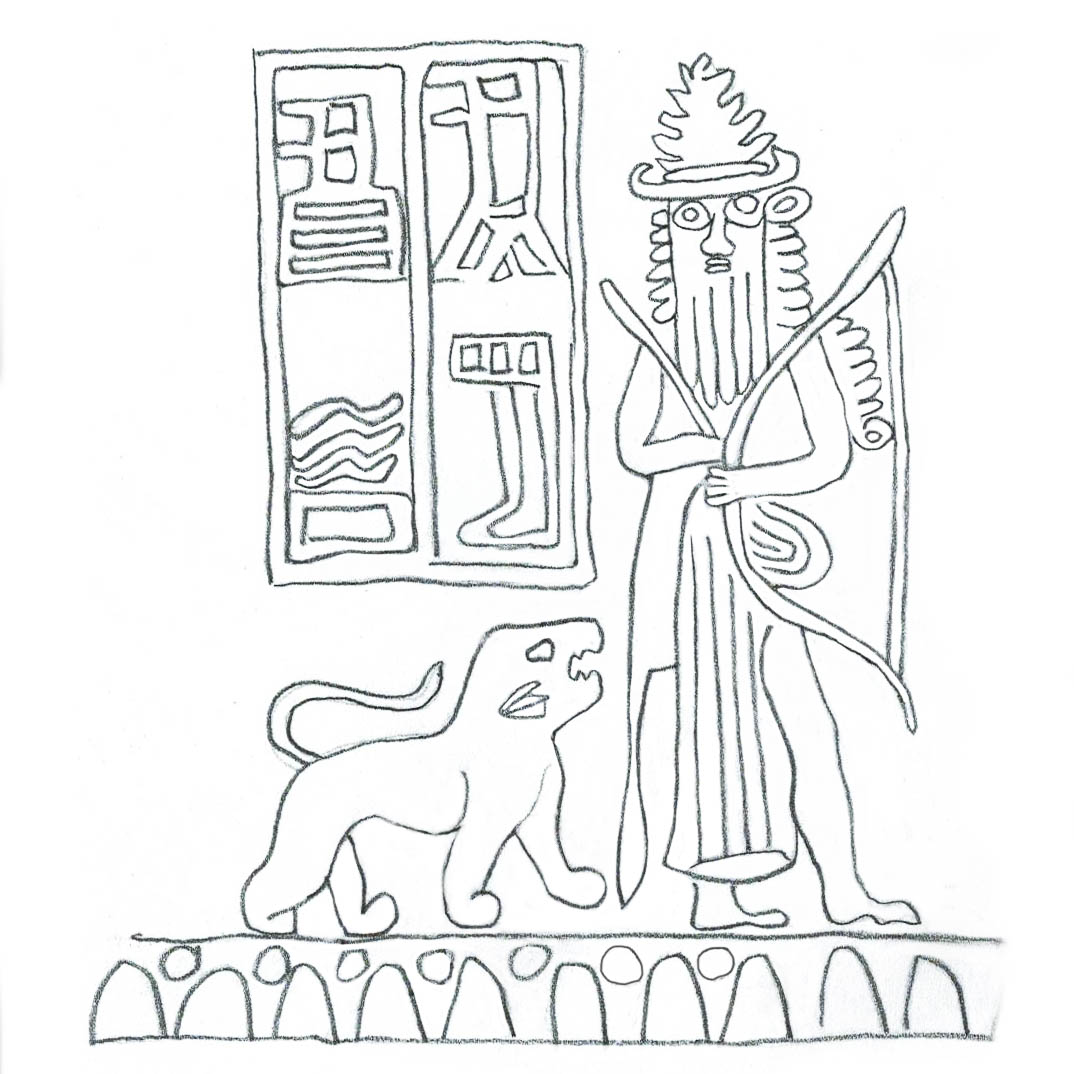
An inscription in the upper-left corner of the seal, reads: “Adda, scribe.” Presumably this was the owner of the seal. Next to the inscription stands Ishkur, a warrior god, holding a bow and arrow, wearing what appears to be an animal skin tunic and a robe girt for action. This god, known also as Adad or Hadad, was a Semitic storm god known in later periods as Baal. Presumably, the position of this god next to the name of the scribe, Adda, is not an accident. The presence of the lion next to Ishkur recalls to mind Akkadian texts which liken the king to a roaring lion.
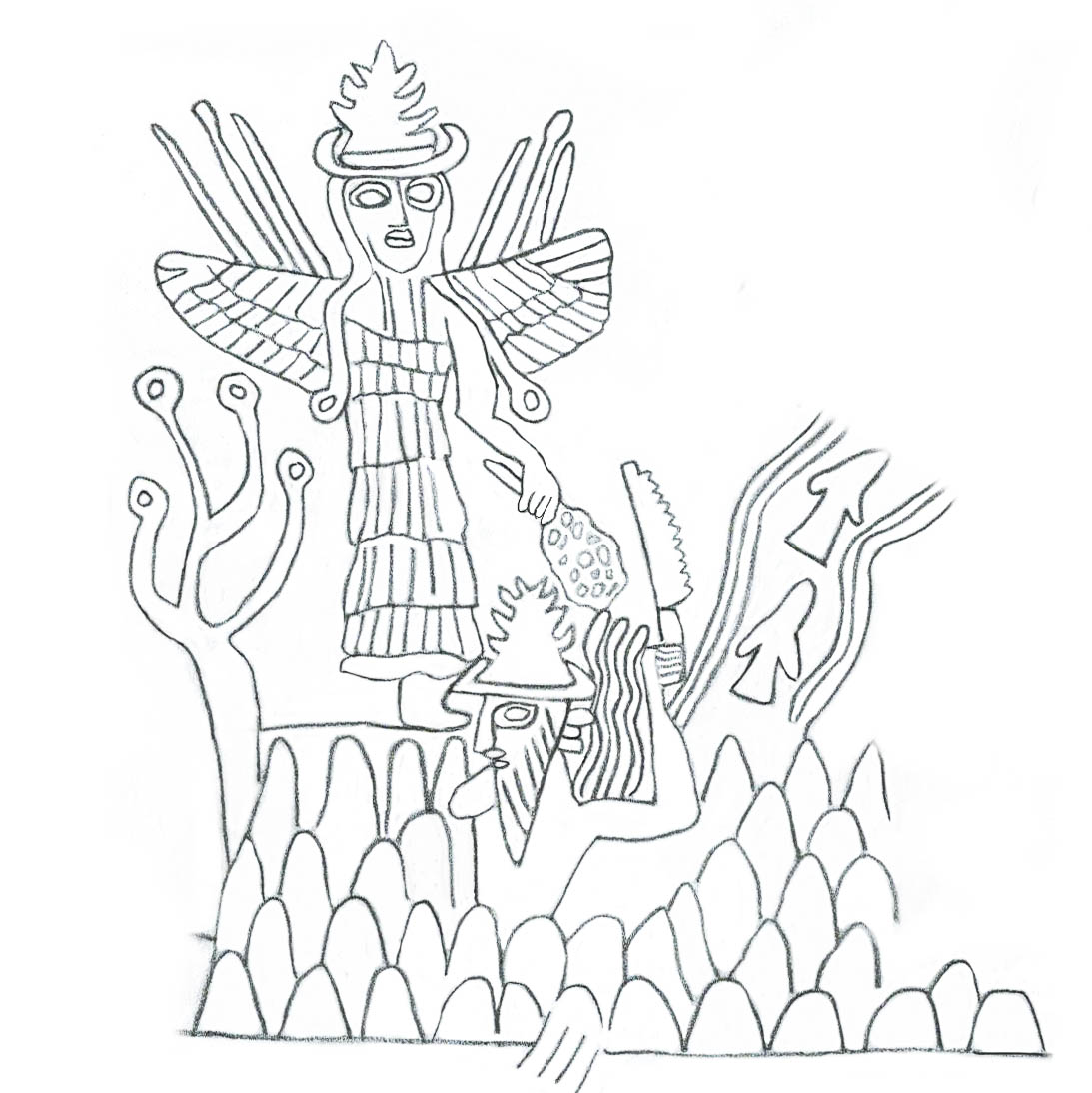
At the center of the seal are two square topped mountains, forming the gate of the eastern horizon through which the sun god Shamash emerges, holding a saw-toothed knife in his hand. The god is identifiable by the rays of the sun extending from his back. Next to him stands the goddess Ishtar, holding a bunch of dates in one hand. Maces and battle axes extend from her back—a reminder that she is both a fertility goddess and a war goddess.
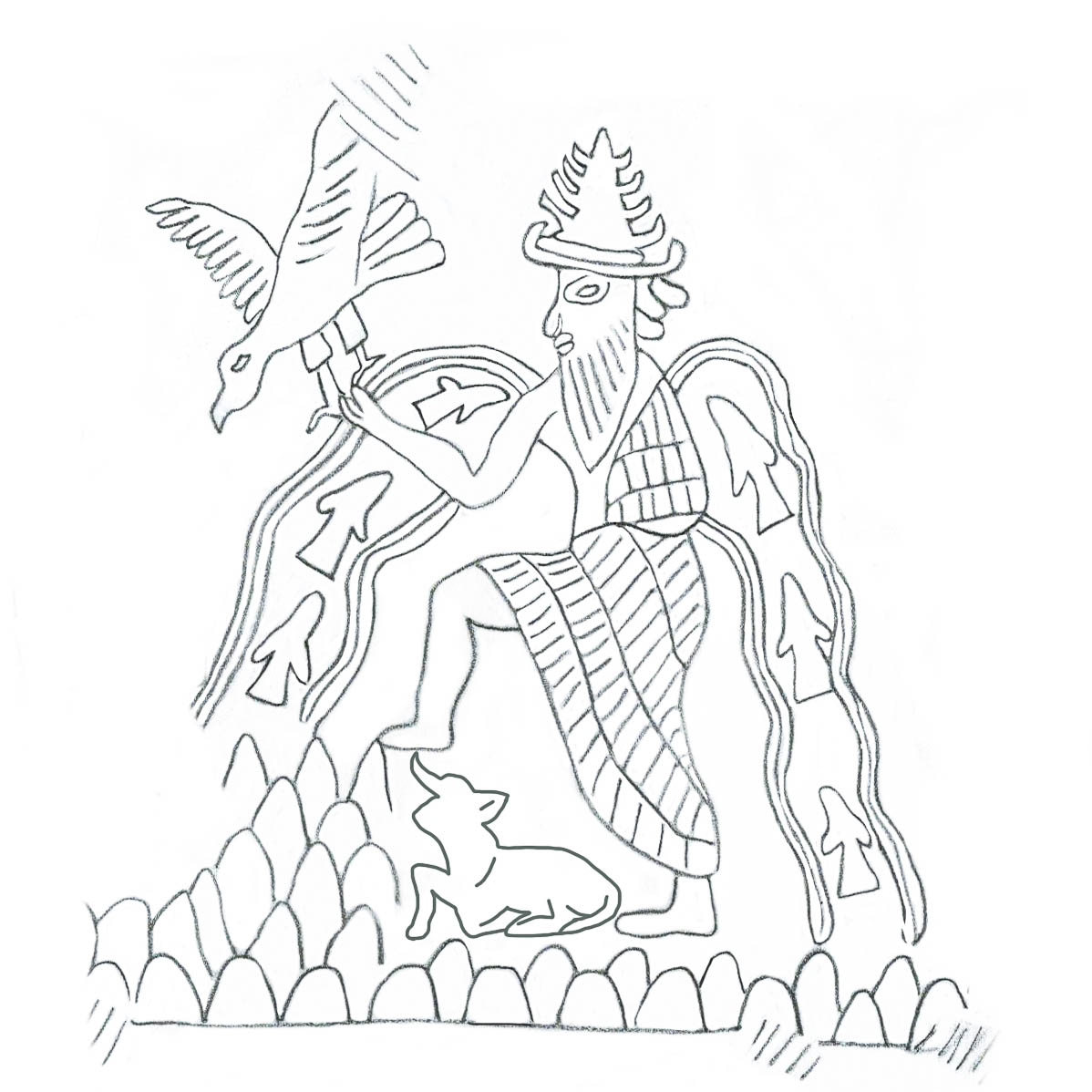
The water god, Ea (Sumerian=Enki), is standing on the mountains. Two rivers, presumably the Euphrates and Tigris, flow from his shoulders while an eagle swoops down next to him. The god is shown climbing a mountain, indicating perhaps the origins of these rivers in the mountains of Armenia. The bull lying at his feet is perhaps connected to Sumerian myths which liken the vivifying water of the Euphrates to the virility of Enki, who is described in Sumerian texts as a bull mating a cow.
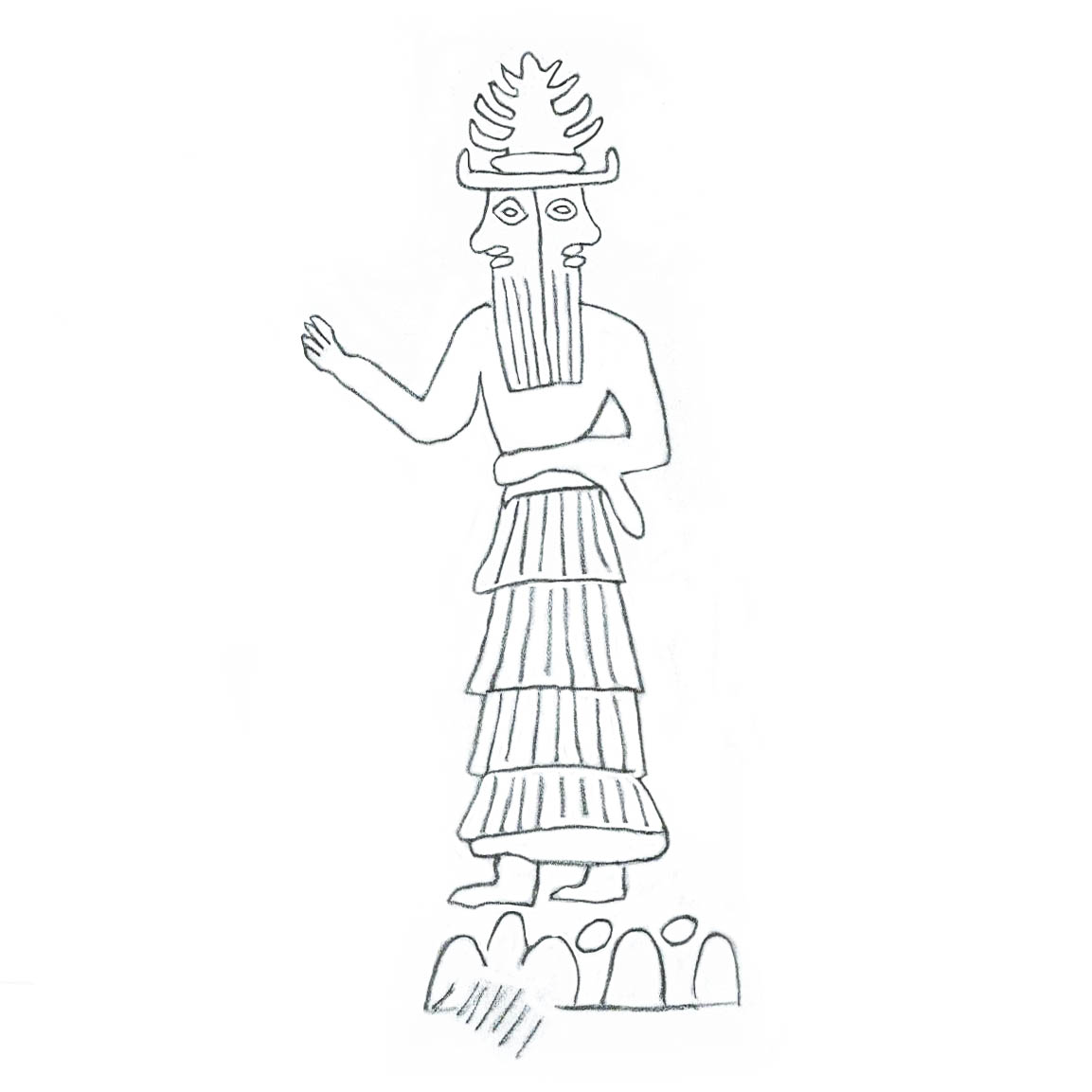
In Sumerian myth, the two faced god, Isimud, acts as an attendant to the god Ea. Perhaps his two faces have a meaning similar that of the Roman god Janus, a god of the gateway and threshold, after whom the month of January is named.
The seal may depict the revival of new life in the winter and spring months, after a long, dry summer. The arrival of rain in the spring time is represented by Ishkur, the floods by Ea, and the date harvest by Inanna. The New Years festival which falls in March or April could perhaps be represented by the two-faced god, Isimud. The rising of Shamash between the gates of the horizon might have some astronomical significance linked to the calendar.
This seal illustrates how the Akkadians perceived the gods to inhabit the world. Another seal of this type appears to depict the cycles of nature in terms of two gods poling through the marshes in a boat.

The god Shamash is shown seated in a reed boat while another god with a forked punt pole propels them through the marshes. A “sphinx” is tethered to the prow of the ship. The meaning of this seal is lost to us but it is noteworthy that the Egyptians also had the concept of a boat which carried the sun through the sky. We’ve observed a similar phenomenon in the Cyclades and Denmark.
Semitic Names
A commoner could not have possessed a fine seal such as the Adda Seal, whose value was probably measured in ounces of gold. Thus while the seal may inform us about the beliefs of an official in the Akkadian court, we learn very little about the beliefs of the common people. However, there is a potential source of information about Akkadian religious beliefs that is reflective of Akkadian society as a whole—and that is the thousands of Akkadian names preserved in receipts and contracts. These have been compiled by scholars into lists known as onomastica (sing. onomasticon). A quick scan of the onomasticon for the post-Sargonic period reveals that Akkadian children were named after a variety of gods which represent different aspects of nature, such as Shamash (“the Sun”), Suen (“the moon”) and Ada (“the storm”). Children may also be named after more abstract gods, such as Ea (“life”) and Irra (“death”), or they may be named after gods associated with specific cities, rivers, and mountains. Their names reveal a blend of Semitic and Sumerian religious ideas.
However, the names of Akkadians who lived before Sargon’s time present a very different picture. In a study of 305 pre-Sargonic names, Aage Westenholz, an Assyriologist at the University of Copenhagen, notes that only 11 contain the names Suen, Enlil, or Shamash, while Adad and Ea—so common later in the Akkadian period—are entirely absent. The primary god found in Akkadian names before Sargon is Ilum, which is just the Akkadian word for ‘god’—the equivalent of El in Hebrew—and Ishtar. Westenholz makes the following interesting observation with regards to Ilum and Ishtar.
“The outstanding characteristic of the pre-Sargonic Ilum and Ishtar is that they were not local deities, they were not tied down to a specific place, nor do they seem to have had very specific functions. They were apparently universal.”4Westenholz 2004, 103
Westenholz concludes,
It appears then, that the Pre-Sargonic Akkadians basically worshiped only the two gods, Ilum and Ishtar, being the masculine and feminine aspect of the divine. That Ishtar is overshadowed by Ilum in the names we have is surely because we have so few names of women.5Westenholz 2004, 103
Westenholz is not arguing that pre-Sargonic Akkadians were monotheistic. But maybe their beliefs were closer to monotheism than those of their descendants. Just as Greek gods were introduced into the Roman pantheon after the Roman conquest of Greece, a similar dynamic could have been at work in Akkad after the conquests of Sargon and his successors. Westenholz’s observations about Akkadian religion remind us that culture is not a monolithic or static thing, and it does not necessarily progress from animism—belief in spirits which inhabit nature, to polytheism—belief in many gods who are aspects of nature, to monotheism—belief in one god separate from nature, to humanism—man is the rule of all things. This is an evolutionary paradigm, as though what people believe about the world today has progressed and cannot be undone. But many theories accepted as science today are essentially animistic.
Collon, Dominique.
First Impressions : Cylinder Seals in the Ancient Near East.
Chicago, Illinois: University of Chicago Press, 1988.
Westenholz, Aage.
“Personal Names in Ebla and in Pre-Sargonic Babylonia,” in Eblaitica : Essays on the Ebla Archives and Eblaite Language, edited by C. H Gordon, Gary Rendsburg, Nathan H. Winter.
Winona Lake, Indiana: Eisenbrauns, 1987.