The site of Khirbet el-Kerak (Bet Yerah) gave its name to a unique type of red and black burnished pottery. This pottery, says Ruth Amiran, represents “an element entirely foreign to the Palestinian pottery of the Early Bronze period.”1Amiran 1969, 68 Although the vessels appear to be made from very fine clay, they are actually made from poor clay and then covered with a thick slip (a fine, clay paste) which was allowed to get leather-hard before burnishing (rubbing with a smooth rock) and firing. The end result was a pot with a bright metallic finish.
Characteristics:
- Handmade: Khirbet Kerak Ware was not produced on a wheel.
- Carinated: Cups and bowls often have a distinct line where the sloping sides of the pot meets the neck.
- S-curve: Instead of carination, larger jars have a cyma “wave-like” profile
- Narrow base: The pots were made to sit in holes hollowed from the earth or to be cradled on pottery stands.
- Knobs: the pots are often decorated with knobs or protrusions along the shoulder.
- Red and black coloration: This was achieved by controlling which surfaces of the pot were exposed to air during firing.


Khirbet Kerak and Anatolian Pottery Types
Khirbet Kerak Ware was found at Bet Yerah together with portable pot supports (“andirons”) decorated with human faces, and hourglass-shaped pottery stands. As you may recall, these are also characteristic of the Kura-Araxes culture which first appears in the southern Caucasus before spreading to eastern Anatolia and the Amuq valley of Syria. The appearance of this material culture in the Galilee suggests that people living in the Caucasus migrated to Canaan, most likely via the Amuq valley, carrying their Red and Black Burnished pottery with them. In the southern Levant this pottery tradition evolved into Khirbet Kerak Ware.
Northern Israel has long been home to “northerners” who spoke Indo-European or isolate languages completely unintelligible to Semitic speaking peoples. From their perspective, these were the goiim (“the nations”) whose association with the Galilee may be traced back to Early Bronze period, if not even earlier (Gen. 14:1,9; Jos. 12:23, Isa 8:23, also Judges 4:13).


These small handmade black burnished vessels share in common a flaring rim and linear decoration.


The linear decoration is not incised but modeled.

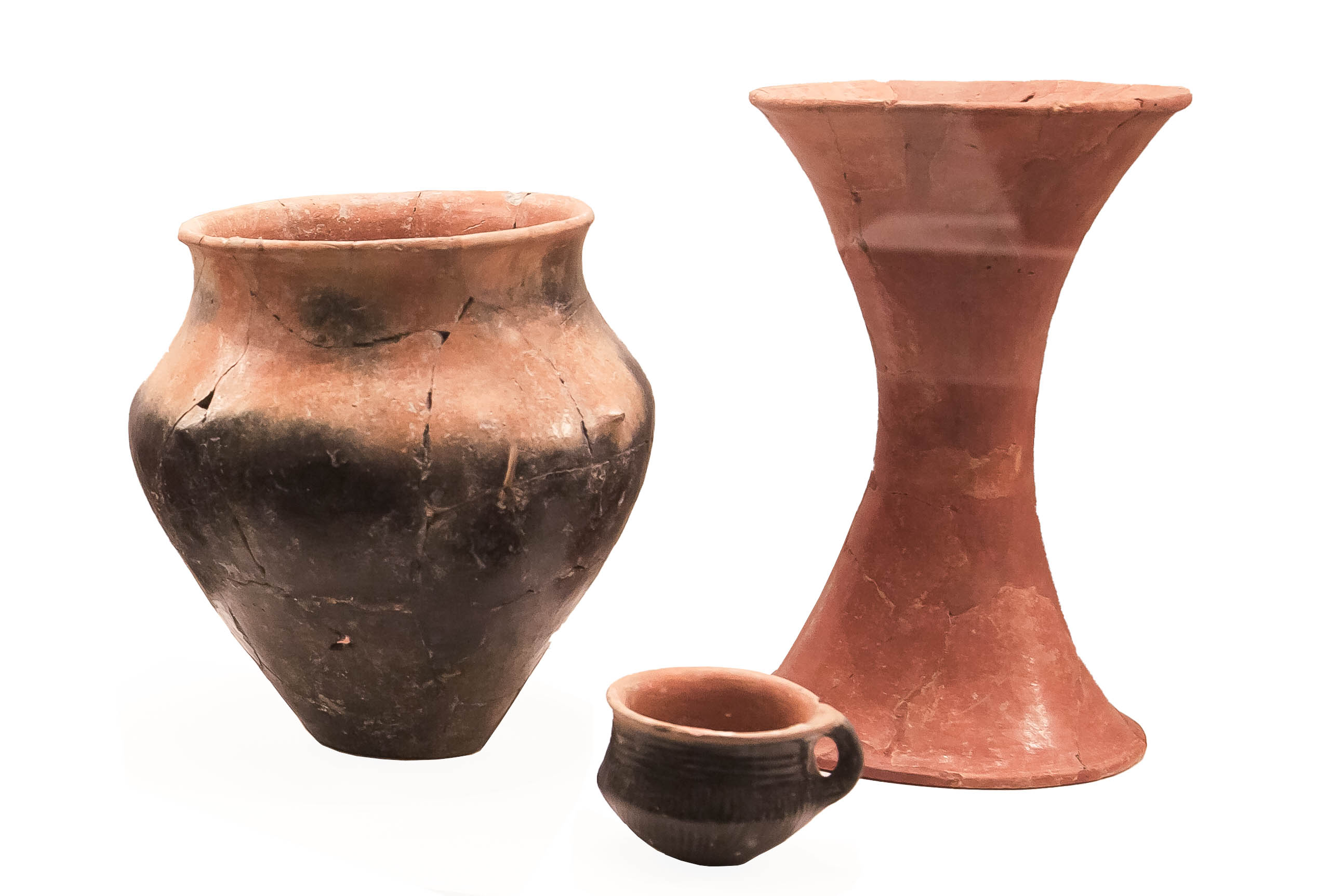

Note the “s-curve” profile of the large jars and their narrow base. These jars were made to rest on tall pottery stands shaped like an hourglass.
KKW at Beth Shean
The presence of Khirbet Kerak Ware (KKW) in the southern Levant presents something of an anomaly. Its similarity to the Red and Black Burnished Ware produced in the Caucasus suggests that the appearance of KKW in the southern Levant belongs to the first half of the Early Bronze period. However, it appears at Beth Shean in Stratum XII, directly beneath Middle Bronze II strata. Either there is a very long gap in the sequence of strata at Beth Shean, or this pottery style persisted over a remarkably long period of time. Here is how Robert Fitzgerald, the director of the excavations at Bet Shean, describes the problem:
Stratum XII… has for its dominating characteristic an abundance of lustrous burnished pottery quite unlike anything found in the levels below. The appearance of this pottery (called Khirbet Kerak ware, from a site at the lower end of the Sea of Galilee where it was first noticed) seemed at first sight to constitute our only possible starting point for the first period of the Middle Bronze Age (MB I), since it lay immediately below the MB II strata. On the other hand, the types found with it in our excavations included some such as were found in Tomb A at Jericho, which Professor Albright is disposed to assign to the Early Bronze Age (EB III).2Fitzgerald 1935, 15

The Gilboa Mountains are on the horizon in the south while the Wadi Herod forms a canyon separating the tell from a large Early Bronze cemetery (hillside in foreground).
Fitzgerald notes that if the long span of years assigned to the Early Bronze III and MB I periods by the standard chronology is correct, then Bet Shean had to lie unoccupied for a number of centuries. Although FitzGerald does not offer any solutions, he was nevertheless inclined to “question the length of these periods…”3FitzGerald 1935, 20 The problem has only grown more acute in recent years, with new C14 dates pushing back the date for the appearance of KKW in the southern Levant into the EB II (c. 2750 BC).4Graham and Millard 2000 But this serves only to widen the gap in the pottery sequence at Beth Shean.
If the arrival of Red and Black Burnished Ware overlaps with the appearance of Simple Ware in the Amuq Valley, as Braidwood observed5Braidwood 1960, 522-523, then its arrival in the Amuq Valley should probably be dated to the period of Ebla’s flourishing (Mardikh IIB1). Its arrival in the southern Levant probably does not date much later. Thus the appearance Red and Black Burnished Ware at Bet Yerah probably dates to the end of the Early Bronze III period. By that time, the granaries at Bet Yerah were likely already broken down and dilapidated. This would explain why kilns and ovens containing KKW were constructed in and around the granary platform at Beth Yerah.6Maisler 1952b, 228 The Khirbet Kerak people simply adapted an existing space to a new purpose, like an old warehouse converted into a restaurant.7Currid 1985, Note 51 If the KKW people resided at Bet Yerah during the EB IV, then one needs only allow a short time gap between them and the arrival of new peoples during the MB I and II.
Amiran, R.
Ancient Pottery of the Holy Land; from its Beginnings in the Neolithic Period to the end of the Iron Age.
New Brunswick, N.J.: Rutgers University Press, 1970.
Braidwood, Robert J, Linda S. Braidwood.
Excavations in the Plain of Antioch I, The Earlier Assemblages Phases A-J.
Chicago, Illinoi: The University of Chicago Press, 1960. Link
Currid, John D. “The Beehive Granaries of Ancient Palestine.” Zeitschrift Des Deutschen Palästina-Vereins 101, no. 2 (1985): 97–110. Link
FitzGerald, Gerald M. “The Earliest Pottery of Beth-Shan.” The Museum Journal XXIV, no. 1 (March 1935): 5-30. Link
Greenberg, Raphael, Ron Shimelmitz, Mark Iserlis. “New evidence for the Anatolian origins of ‘Khirbet Kerak Ware people’ at Tel Bet Yerah (Israel), ca 2800 BC.” Paléorient 40, no. 2 (2014): 83-201. Link
Maisler, B, M. Stekelis, M. Avi-Yonah. “The Excavations at Beth Yerah (Khirbet El-Kerak) 1944-1946.” Israel Exploration Journal 2, no. 4 (1952): 218–29. Link
Maisler, B, M. Stekelis, M. Avi-Yonah, M. Steklis. “The Excavations at Beth Yerah (Khirbet El-Kerak) 1944-1946.” Israel Exploration Journal 2, no. 3 (1952): 165–73. Link
Graham, Philip, Andrew R. Millard.
“Khirbet Kerak Ware in the Levant : the Implications of Radiocarbon Chronology and Spatial Distribution,” in From the Euphrates to the Caucasus: Chronologies for the 4th-3rd millennium B.C.. Varia Anatolica, 11 vols.
Istanbul: Institut Français d’Études Anatoliennes-Georges Dumézil, 2000. Link
Wright, Ernest G. “The Problem of the Transition Between the Chalcolithic and Bronze Ages.” Eretz-Israel: Archaeological, Historical and Geographical Studies (1958): 37-45. Link