Unfortunately Tomb U-j, like all of the other tombs in the cemetery, was robbed in antiquity, probably not long after it was dug. It was not a total loss, however, for although the precious objects were stolen, the bone labels attached to them were left behind in the tomb. These labels were inscribed with symbols which appear to have functioned as precursors to Egyptian hieroglyphics.
Scholars still debate whether the symbols carved into the bone tags constitute actual writing or not. One school of thought argues that they are merely “pictograms”—the symbols represent objects, places, or people—while others argue that at least some of the tags display real phonetic writing—the symbols represent sounds which spell words.

These labels were attached to precious items in the tomb. In addition to simple numeric symbols, the labels incorporate symbols which probably indicate place of origin. Approximately 160 such labels were found in Tomb U-j.
Phonetic Writing?
Günter Dreyer makes what I think is a convincing argument that at least some of the labels preserve the earliest known examples of writing discovered so far in Egypt.1Dreyer 2011 Dreyer points to one tag in particular, which was inscribed with the symbols of a stork and a chair. According to later Egyptian writing convention, the hieroglyph for “stork” has a sound value of “ba” while the “chair” has the sound value of “st.” Together they spell “Bast” which is the name of a city in Lower Egypt. Dreyer notes that whenever these symbols appear on tags, the stork and the chair are always orientated in the same direction. Thus it seems that the symbols were written according to certain grammatical rules.

Dreyer argued that these bone tags spell “Bast” (stork = ‘ba’ + chair = ‘st’).
The rebus principle (which we discussed in a previous entry) may have been introduced into Egypt from Mesopotamia, where we encounter a writing tradition which probably predates Tomb U-j. It is noteworthy, in this regards, that similar labels have been found at Uruk (Uruk IV), inscribed on clay, which appear to have had a similar function.
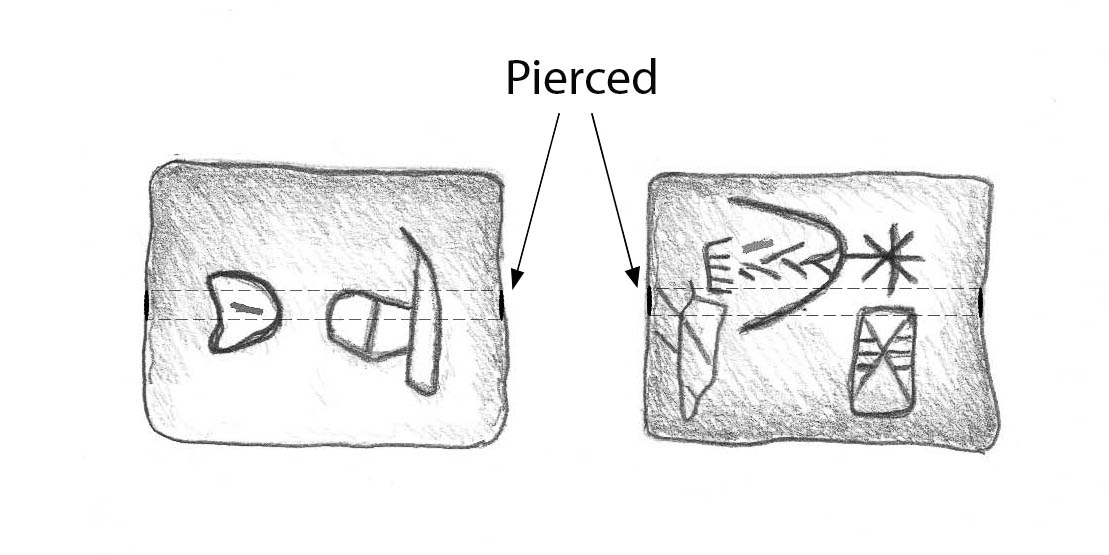
Clay tags found at Uruk (Uruk IV) were pierced lengthwise. They must have functioned similarly to the Egyptian bone tags.
Bestock, L.
“The First Kings of Egypt: The Abydos Evidence,” in Before the pyramids : the origins of Egyptian civilization, edited by E. Teeter.
Chicago, Ill.: Oriental Institute of the University of Chicago, 2011. Link
Dreyer, G.
“Tomb U-j: A Royal Burial of Dynasty 0 at Abydos,” in Before the pyramids : the origins of Egyptian civilization, edited by E. Teeter.
Chicago, Ill.: Oriental Institute of the University of Chicago, 2011. Link
Hooker, C. B. F.
“Cuneiform,” in Reading the Past: Ancient Writing from Cuneiform to the Alphabet.
New York: Barnes and Noble, 1990.