
The cemetery known to locals as Umm El Qa’ab (“mother of pots”) gets its name from the huge mounds of pottery in the area. The main cemetery lies at the foot of the cliffs in the distance, next to the guard booth. The gap in the western mountains at center marks the passage through which the departed spirit was thought to travel on its way to the next world.
The royal tombs of the First and Second dynasties were not located at Hierakonpolis or Naqada, despite the central role played by both during the Predynastic period, but at Abydos. The cemetery is located next to a gap in the western cliffs which gives entrance to a canyon connecting the Nile floodplain to the high desert plateau. It has been suggested that the Egyptians buried here perceived this gap to be an entrance to the underworld, known as the Duat, which according to the Egyptian understanding of sacred geography, was located on the western horizon.1Wilkinson 1990, 221 This would also explains why most of the tombs in Egypt are located on the west bank of the Nile.
The cemetery at Abydos was divided into two areas: Cemetery U, which contains predynastic tombs, and Cemetery B, where the tombs of the First and Second dynasties are found. A progression may be traced in these two cemeteries, with the tombs growing larger and more elaborate as time passes. One of the largest tombs in Cemetery B, the tomb of King Djer of the First Dynasty, was venerated as the tomb of the god Osiris by later generations of Egyptians. On the occasion of certain festivals, Egyptians would bring offerings of food and drink to the tomb in clay pots and spend the night in the cemetery, hoping thereby to receive a dream from the god. As a result, mountains of discarded pottery accumulated next to the cemetery, giving the place its Arabic name “Umm el-Qa’ab” which means “Mother of Pots.”


The burial area known as Umm el-Qa’ab was located in the desert near Abydos.
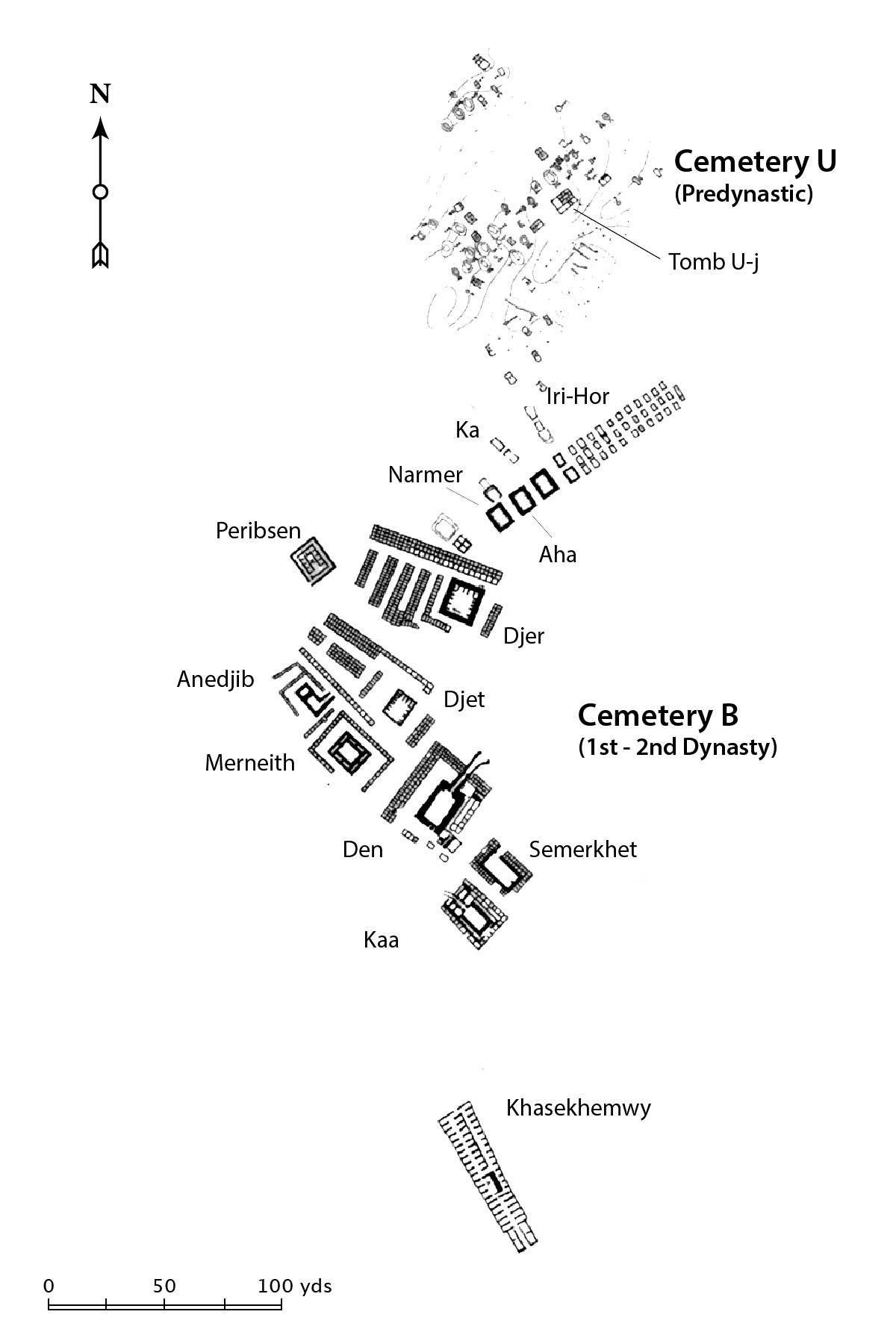
Map of the Predynastic and Early Dynastic cemeteries. The Predynastic cemetery (Cemetery U) was comprised mostly of smaller tombs.

Mountains of pottery are found in the vicinity of the tombs at Umm el-Qa’ab, which means “Mother of Pots.”
Manetho
The division of Egyptian history into dynasties may be traced back to Manetho, an Egyptian priest living in the 3rd century BC who wrote a history of Egypt known as the Aegyptiaca. Egypt was at that time ruled by Greek kings and so Manetho wrote his history in Greek even though he himself was an Egyptian. Tradition makes him a priest at Heliopolis. He must have had some privileged position for he clearly had access to temple archives and, more importantly, was able to read the documents at a time when knowledge of the hieroglyphic script was rapidly declining.
Although we lack a complete copy of Manetho’s work, we have the early works of Josephus (1st century AD) and of later Christian authors, Africanus and Eusebius (4th century AD), who quote large portions of Manetho’s history verbatim. Although the Aegyptiaca is quite late by Egyptian standards, and the sources which preserve his work are even later, it is nevertheless the primary source for reconstructing the chronology of ancient Egypt.
Manetho began with primordial time when “gods, demigods and spirits of the dead” ruled Egypt. Then came the rule of men, beginning with a certain “Menes of Thinis,” whom Manetho credits with uniting Egypt and founding the First Dynasty. Menes is said to have enjoyed a long reign before meeting with an unfortunate end when he was carried off “by an hippopotamus.”2The length of his reign is given as 62, 60 or 30 years depending on the source. See Verbrugghe and Wickersham 1991, 131.


This bust of an Egyptian priest of Serapis is often likened to Manetho, whom tradition holds to have been a priest of Serapis in Alexandria.
The following is an excerpt from Manetho’s Aegyptiaca that lists the rulers of the First Dynasty, beginning with Menes:
After the dead and the demigods came the First Dynasty, with 8 kings of whom Menes was the first. He was an excellent leader. In what follows are recorded the rulers from all of the ruling houses in succession.
Menes of Thinis, whom Herodotus calls Men, and his 7 descendants. He ruled 62 years. He led the army across the frontier and won great glory. He was killed by a hippopotamus.
Athothis, his son. He ruled 57 years. He built the palace in Memphis. He was a skilled physician and wrote books on anatomy.
Kenkenes, his son. He ruled 31 years.
Ouenephes, his son. He ruled 23 years. In his reign a great famine gripped Egypt. Also he built the pyramids around Kokhome.3The location of these pyramids is unknown.
Ousaphaidos, his son. He ruled 20 years.
Miebidos, His son. He ruled 26 years.
Semempses, his son. He ruled 18 years. In his reign there were many extraordinary events, and there was an immense disaster.
Bienekhes, his son. He ruled 26 years. Altogether they ruled 253 years.4Verbrugghe and Wickersham 2001, 131-132
Manetho locates Egypt’s first capital at Thinis (also spelled “This”), a city in Upper Egypt, located somewhere in the vicinity of Abydos. The impressive early dynastic tombs discovered at nearby Umm el-Qa’ab supports Manetho’s claim. Besides a list of names and reign lengths, Manetho includes several historical vignettes, including a foreign campaign undertaken by Menes and a famine during the reign of Ouenephes. He also alludes mysteriously to “extraordinary events” and an “immense disaster” which occurred during the reign of Semempses. Unfortunately, Manetho does not elaborate further on any of these. We don’t know where Menes campaigned or what extraordinary events occurred which led to an immense disaster!
Bestock, L.
“The First Kings of Egypt: The Abydos Evidence,” in Before the pyramids : the origins of Egyptian civilization, edited by E. Teeter.
Chicago, Ill.: Oriental Institute of the University of Chicago, 2011. Link
Dreyer, Gunter, E.-M. Engel, Ulrich Hartung, Thomas Hikade. “Nachuntersuchungen im fruhzeitlichen Konigsfriedhof.” Mitteilungen des Deutschen Archaeologischen Instituts, Abteilung Kairo 52 (1996): 11-81.
Wilkinson, Toby.
Early Dynastic Egypt.
London and New York: Routledge, 1999.