Arguably the most important objects found on the Eastern Slope of Megiddo were six cylinder seal impressions recovered from Stage V, a level which probably corresponds with Stratum XIX on the tell.

The cylinder seals were found in Stage V on the east slope of Megiddo. Note that the colors and side brackets with chronological information were added by the author.
The cylinder seal impressions found at Megiddo are indicative of Mesopotamian influence on the region, perhaps via Syria.1Beck notes the striking similarities between these seals and seals from Jericho and Byblos. See Beck 2002, 237 ff. Repeating and interlocking rows of animals, like those depicted on the Megiddo seal impressions, are typical of Mesopotamian seals belonging to the Jemdet Nasr and Early Dynastic I-II periods.2Shipton and Engberg 1934, 37; K. Kenyon 1966, 98 As noted in a previous entry, seals of this type have also been found in predynastic tombs in Egypt.
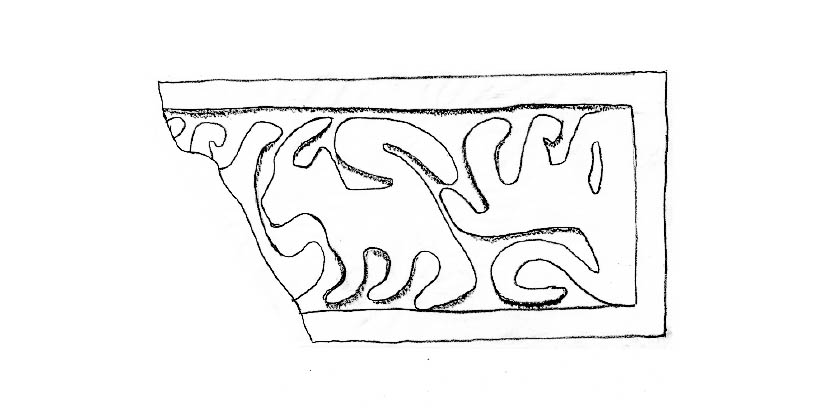
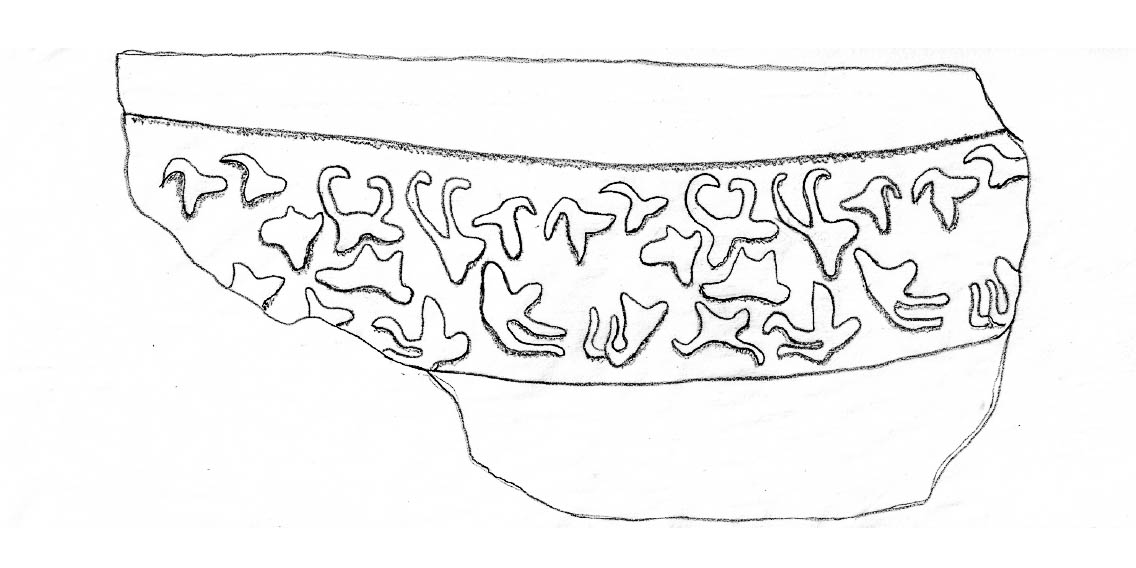
Two cylinder seal impressions discovered in Stage V of the Eastern Slope. Left: The animal is shown tête-bêche which is French for ‘head-to-tail’. Right: Animal heads fill the space in a somewhat disorderly and crude manner.

A typical Mesopotamian cylinder seal of the Jemdet Nasr period.
Elephantine Cylinder Seal
However, the most interesting seal impression from Megiddo was not discovered by the Chicago expedition on the Eastern Slope, but by a team of archaeologists from the Tel Aviv University working on the tell during the years 2004-2008. What they found was an actual cylinder seal, made of ivory. Although in poor condition, the design of the seal can readily be made out. It shows an elephant standing on three hills flanked by three men, each carrying a short dagger.3Short copper daggers have been found in EB1b tombs in the southern Levant. (See Mack et al. 2023) As you may recall, the symbol of an elephant standing on three hills has been found inscribed on bone labels that were subsequently deposited in Tomb U-j at Abydos.4See: Per-wer The “three hills” hieroglyph probably represents “desert cliffs” or “foreign land.” When combined with the elephant, the two hieroglyphs are thought to have spelled “Elephantine,” a city in Upper Egypt.5Brandl 2013, 996
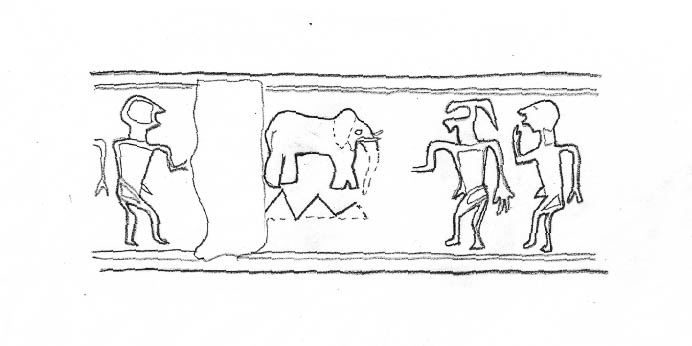
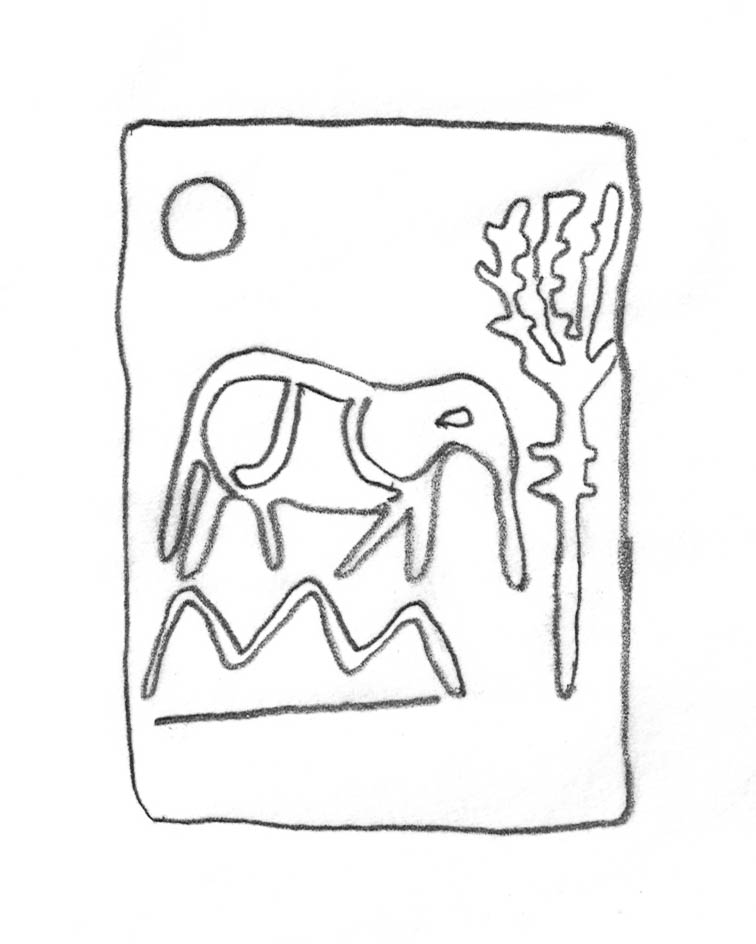
Left: A seal impression from an ivory seal found in Stratum XV of Megiddo (J-6a). Right: A bone tag from Tomb U-j of Abydos. The elephant standing on three hills probably represents the city of Elephantine.
Left: Adapted from Brandl, “The Sealing and the pr-wr Labels from Tomb U-J at Umm el-Qa’ab, Abydos Reconsidered,” Fig. 18.1. Link , Right: Adapted from Dreyer, “Tomb U-j: A Royal Burial of Dynasty 0 at Abydos.” LinkUnfortunately, the seal was found in Stratum XV, which dates to the EB III, much too late to bear any relation to Tomb U-j, which dates to the EB I. We would expect to find a cylinder seal of this type in Stratum XIX instead. There are several ways to explain the 800 year gap between the seal and its findspot.
- The seal is a heirloom that was “kept in the family” for many centuries before arriving at its final resting place in Stratum XV.
- The seal was dug up from some other part of the tell and deposited in Stratum XV.
- The symbol of the elephant standing on three hills had a very long life.
- The chronology needs to be revised to fit this new pieces of evidence.
1, 2 and 3 are possible. I have not seen anyone advocate for the 4th option. We should also consider the possibility that the amount of time which passed between Stratum XIX and XV may not be so great as is generally supposed. The Kfar Monash Hoard, as we will see, presents a similar anomaly.
Beck, Pirithiya .
“The Cylinder Seal Impressions from Megiddo Stage V, and Other Related Problems,” in Imagery and Representation : Studies in the Art and Iconography of ancient Palestine : Collected Articles, edited by Pirithiya Beck, Nadav Naʾaman, Uzah Zevulun, Irit Ziffer.
Tel Aviv: Emery and Claire Yass Publications in Archaeology, 2002.
Brandl, B.
“Cylinder Seals,” in Megiddo V : the 2004-2008 seasons, edited by M. J. Adams, I. Finkelstein, D. Ussishkin, E. H. Cline.
Tel Aviv: Emery and Claire Yass Publications in Archaeology, 2013. Link
Brandl, B.
“The Sealing and the pr-wr Labels from Tomb U-J at Umm el-Qa’ab, Abydos Reconsidered,” in Egypt at its origins 4 : proceedings of the fourth International conference “Origin of the State: predynastic and early dynastic Egypt”, edited by M. D. Adams.
Leuven – Paris – Bristol, CT: Peeters, 2016. Link
Engberg, R. M, G. M. Shipton.
Notes on the Chalcolithic and Early Bronze Age Pottery of Megiddo.
Chicago, Ill.: The University of Chicago press, 1934. Link
Kenyon, Kathleen.
Archaeology in the Holy Land.
London: Methuen, 1965.
Shipton, Geoffrey M.
Notes on the Megiddo Pottery of Strata VI-XX. SAOC 17 vols.
Chicago: University of Chicago Press, 1939. Link
Yahalom-Mack, N, V. W. Avrutis, Y. Erel. “New evidence for long-distance trade in arsenical copper during the Early Bronze Age in the southern Levant: analysis of weapons from the Nesher-Ramla cemetery.” Levant 55, no. 1 (2023): 119–131. Link