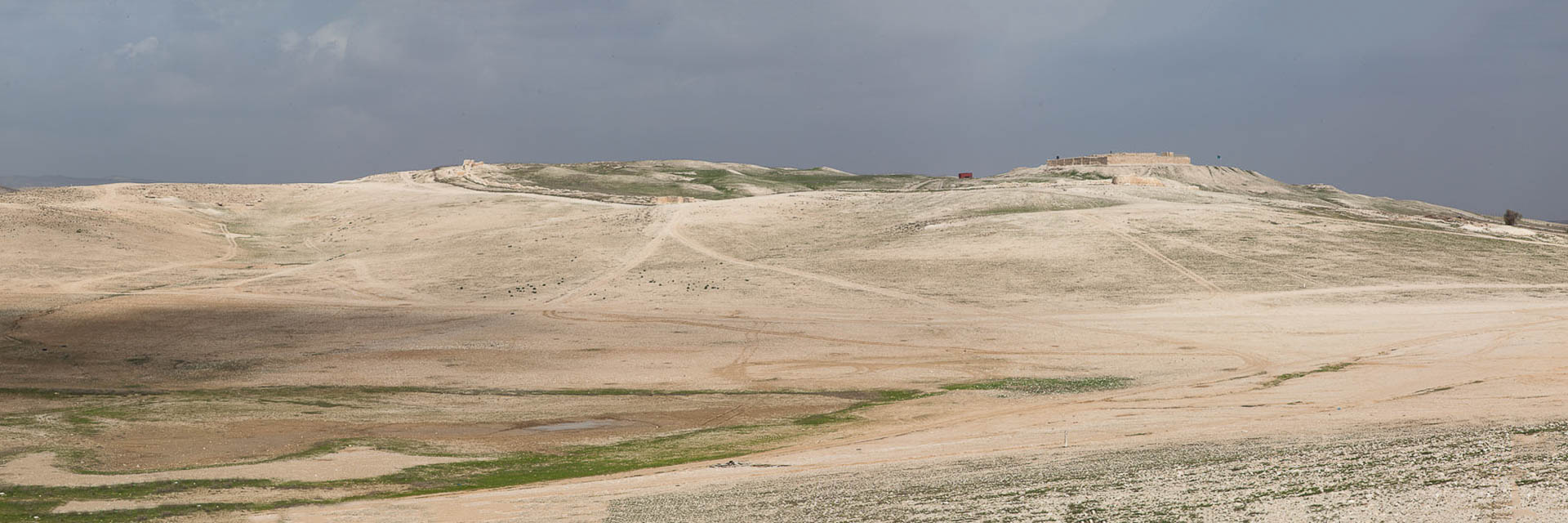
The city of Arad in the northern Negev of Israel was an important city during the first half of the Early Bronze period. An iron age Judaean fortress is visible on the crest of the hill to the right.
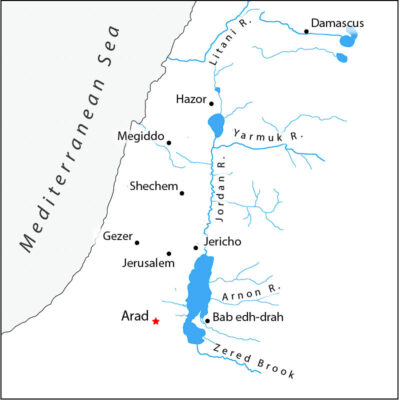
Arad was excavated by the Israeli archaeologist, Ruth Amiran, in the 1960’s. Covering an area of approximately 22 acres, Arad was an important city in the southern Levant during the EB II period. The primary source of Arad’s prosperity must have been its location on a trade route connecting Egypt to Canaan and the Transjordan. This trade route seems to have been particularly active during the First Dynasty of Egypt.
Arad began as a Ghassulian village. Its lowest stratum, Stratum V, preserves all of the hallmarks of the Ghassulian culture, including cornets, V-shaped bowls, fenestrated stands, and pottery churns. Thus Arad should be included with other Ghassulian sites in the Beersheva Valley such as Shiqmim, Bir es-Safadi, Abu Matar, and Gilat.
Stratum IV marks a clear break with the Ghassulian culture.1Amiran 1978, 116 Amiran thought it was contemporary with the reigns of Narmer and Hor-Aha in Egypt.2Braun argues that this stratum predates these rulers and is contemporary instead with Tomb U-j (Braun 2009, 32 ff). Amiran did not find any evidence for a lengthy gap between Stratum V and IV or between IV and III. This is a problem for a fifth and early fourth millennium date for the Ghassulian culture since such an early date would require a gap of half a millennium or more between Stratum V and IV.3The latest C14 dates from Gilat and Shiqmim fall within the mid to late fifth millennium and the early fourth millennium See: Levy 2006, 832-835

A rubble wall in the city of Arad with the cities fortifications in the background.
The population of Arad grew rapidly until it reached a size by no means inferior to other major cities in the southern Levant. Estimating its population to have been between 5,000 and 10,000 people, Amiran notes that the appearance of a significant city in the harsh environment of the Negev is “somewhat hard to comprehend.”4Amiran 1978, 10 This is especially true if one accepts the conclusions of M. Rosenan of the Israel Meteorological Service who argues that “the climate of the Northern Negev in the Early Bronze age differed little from that of the same region in recent times.”5 N. Rosenan in Amiran 1978, 14; See also Finkelstein (1990, 38-39) who briefly discusses the “climate change” hypothesis. Noting the divergence of views on the topic, Finkelstein concluded that the theory of a wetter climate during the Early Bronze period should be treated with caution. This seems to be the approach taken by most scholars today, who are inclined to ignore the evidence of a significantly wetter climate during the first half of the Early Bronze period. This view is contradicted by the mere existence of cities such as Arad and the many smaller settlements in Arabia, the Arabah, and the Sinai, which could not have existed there unless there was sufficient water to support them.
Evidence for higher rainfall in the region also comes from the significant amounts of charred grain and flax seeds recovered during excavations in the city. It has been suggested that the flax seeds were imported since, unlike barley, flax requires ample water to grow. However, it is unlikely that flax seeds were transported to Arad instead of its secondary product, linseed oil, which could be transported much more efficiently. It seems, therefore, that both barley and flax were cultivated in the Beersheva Valley at this time.6Bar-Adon hypothesizes that flax could have been grown around the spring of En-Gedi, but it is doubtful that this resolves the problem of the appearance of flax and its products in the Negev. (Bar-Adon 1980)
Narmer in Arad?
A potsherd inscribed with the serekh of Narmer was discovered in either stratum IV or III of the city, depending on which authority you follow.7Braun 2009, 32 ff. Narmer’s serekh has been found at other sites in the southern Levant. It may be wondered, therefore, if Narmer may not have conquered as far north as Arad? The following historical vignette, preserved by Manetho, suggests it as a possibility:
He led the army across the frontier and won great glory. He was killed by a hippopotamus.8Verbrugghe and Wickersham 2001, 131
Although there is no evidence that the Egyptians exercised direct control over Arad, there was an Egyptian colony at En Besor and probably also at Tel Erani, on the Mediterranean coast near Gaza, approximately 50 miles west of Arad. An Egyptian presence at these cities goes back to the Predynastic period and continued into the Early Dynastic.9Czarnowicz et al. 2014, 242-243 Situated as it was on an important trade route, Arad must have benefited from its proximity to these Egyptian colonies. Its strategic position is illustrated also by the account in the book of Numbers which tells how the Israelites sought to enter Canaan from the south but were repulsed by the “king of Arad” (Numbers 21:1).
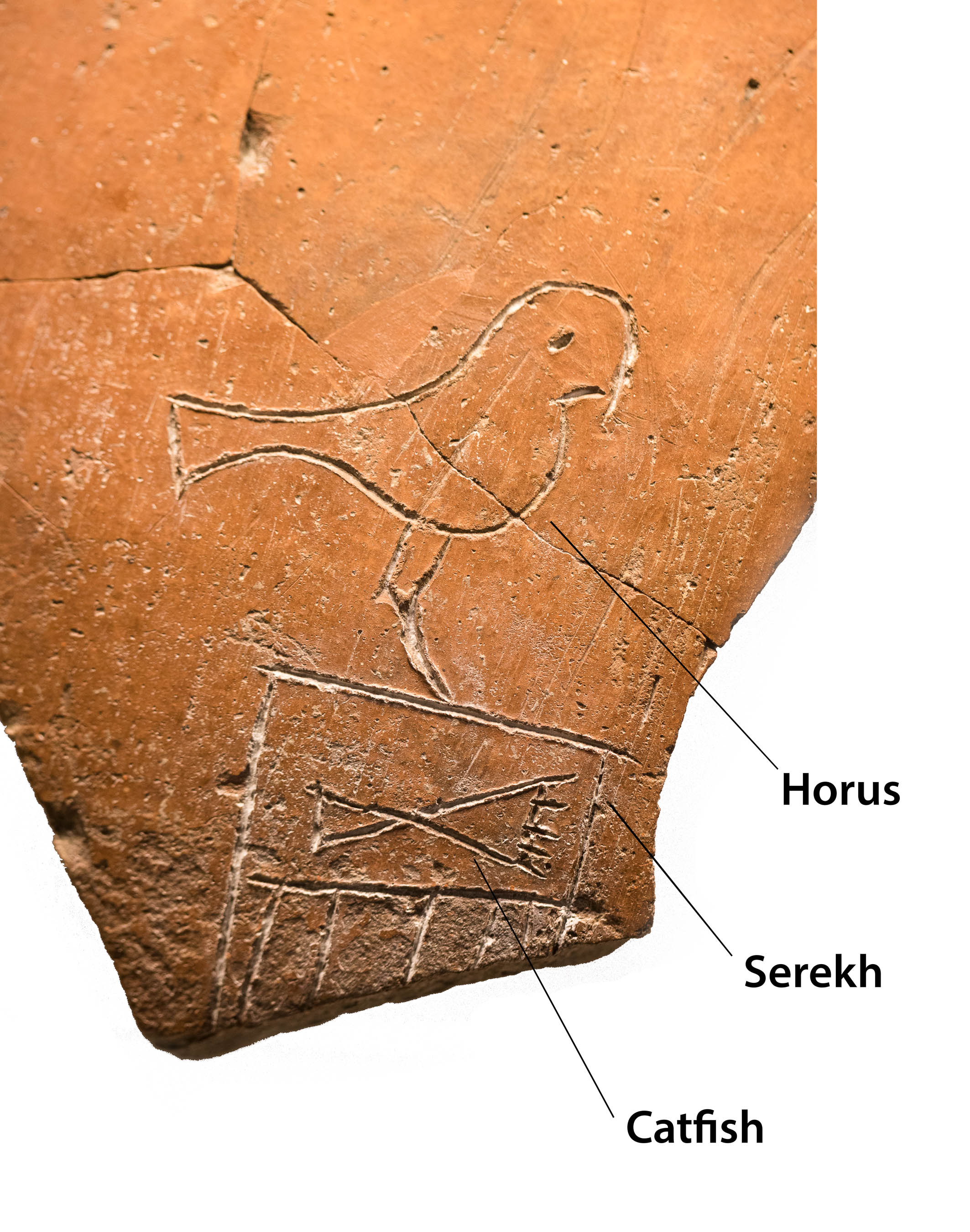
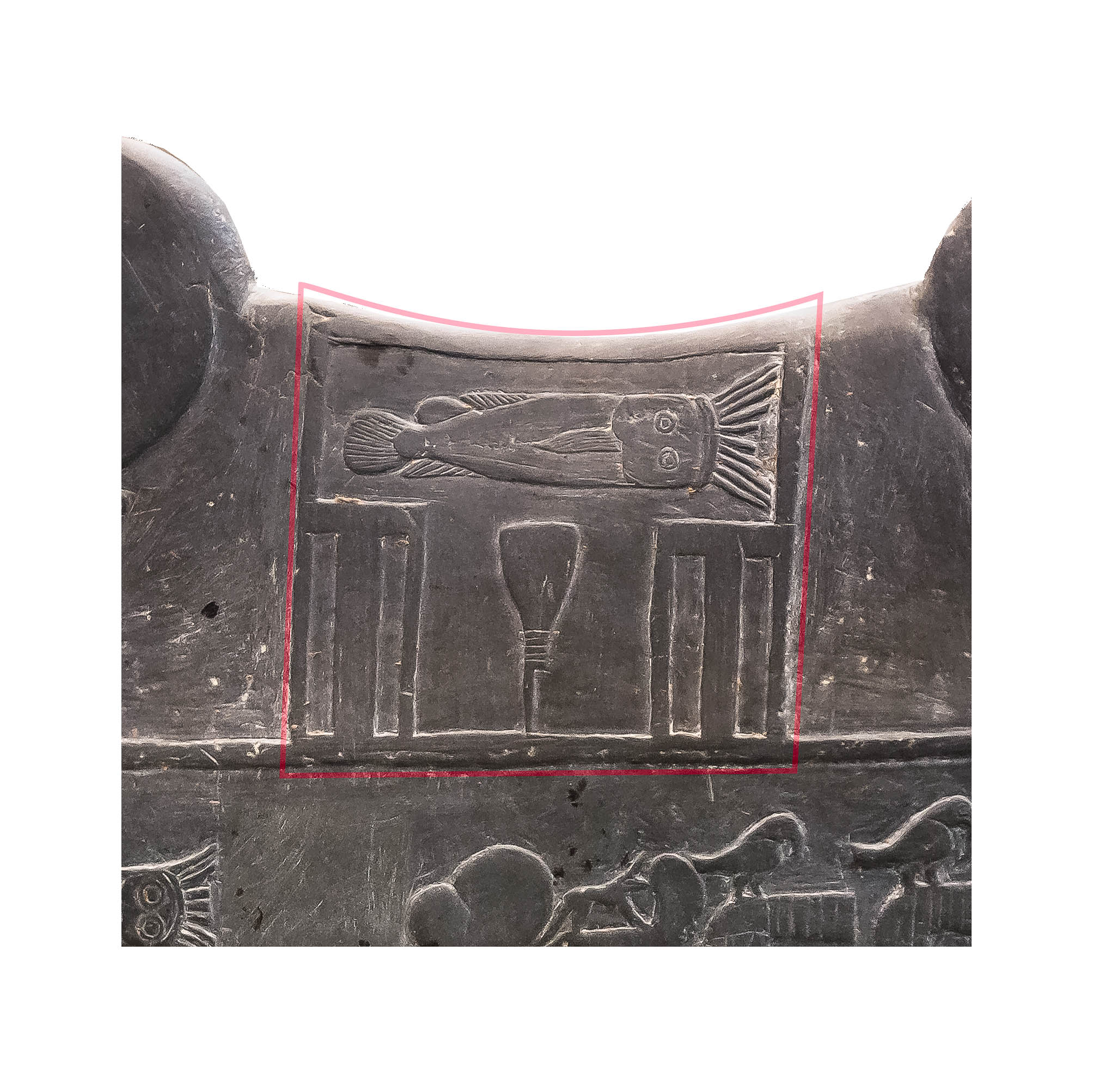
A pottery shard was found at Arad inscribed with the serekh of Narmer.
Fortifications
An impressive stone fortification wall was erected around Arad in Stratum III and maintained for the whole of Stratum II. Surprisingly well preserved, the wall was built with projecting towers of a kind which appears also to be depicted on the Narmer Palette. The end of Stratum II coincides with the destruction and abandonment of Arad, probably towards the end of the Early Bronze II period. Although Arad functioned as a southern outpost in later periods, it never attained anything like its former glory. Many small settlements in the Negev and Sinai were also abandoned towards the end of the Early Bronze period, probably due to an increasingly arid climate.

The walls of Arad are estimated to have been three quarters of a mile long and encompassed an area of 22 acres.1Amiran 1968, 11
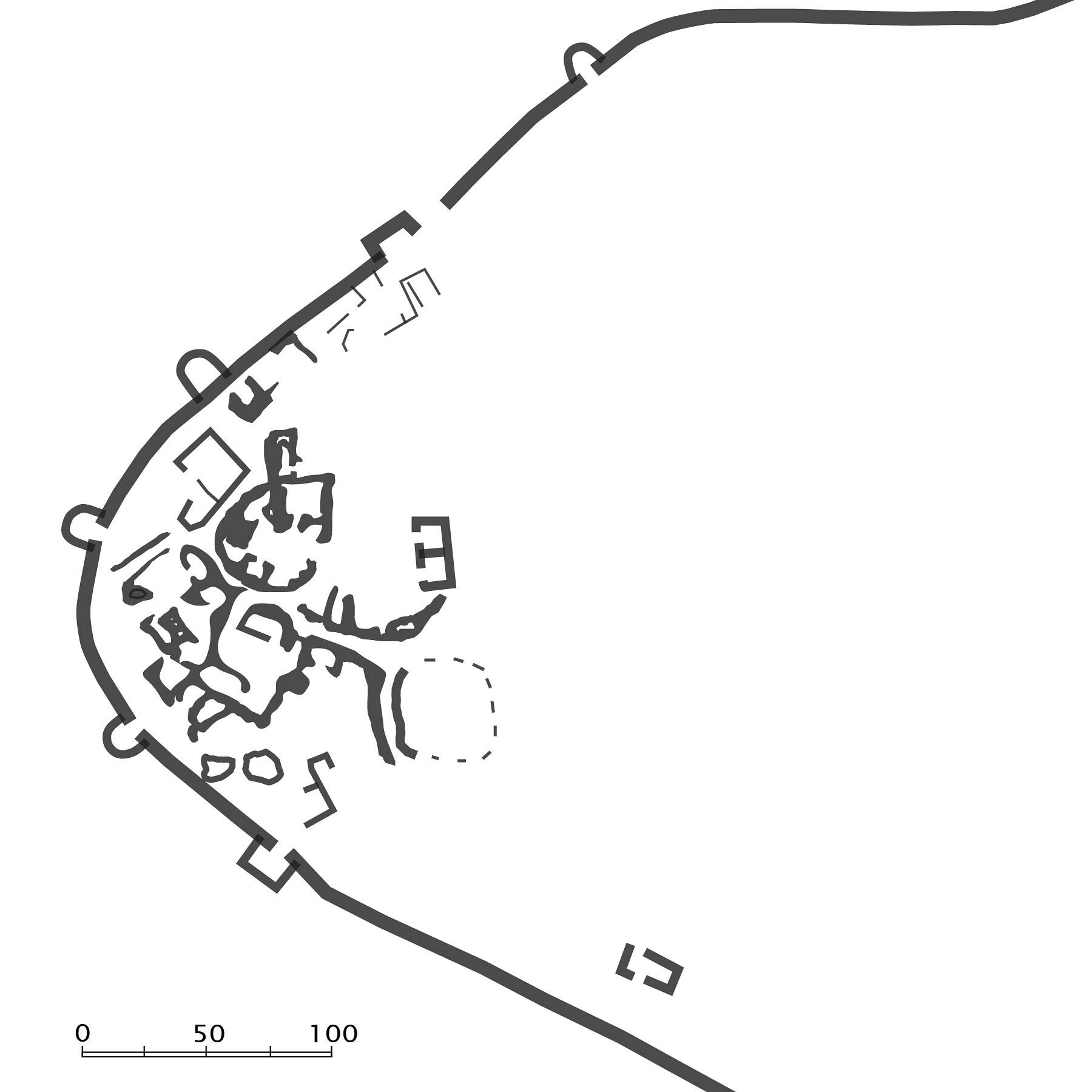
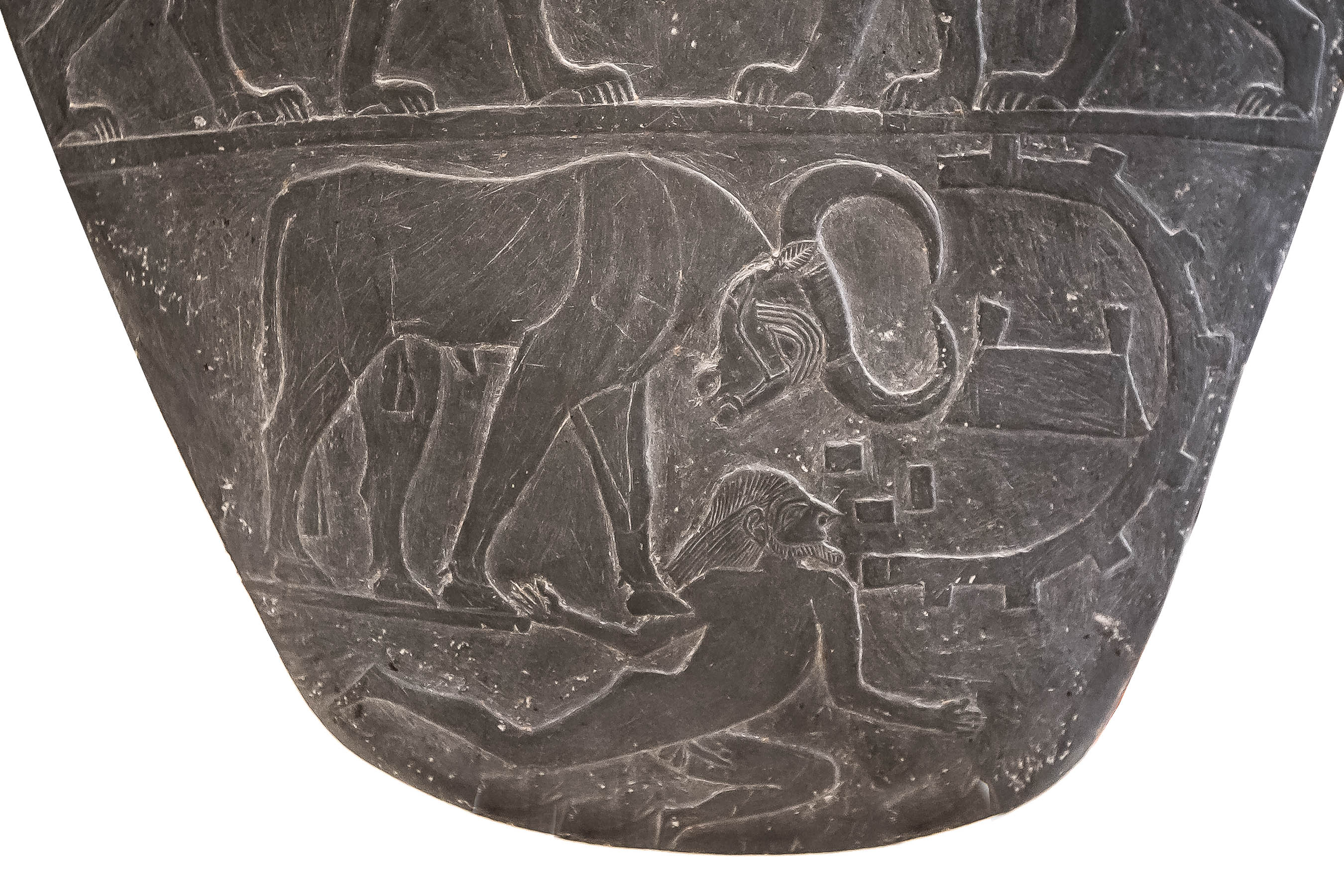
The city wall of Arad incorporates projecting towers, a style of architecture unique to this city in the southern Levant. Note the similar style of city wall depicted on the Narmer Palette.
Amiran, Ruth.
Early Arad: The Chalcolithic Settlement and Early Bronze City.
Jerusalem: The Israel Exploration Society, 1978.
Bar-Adon, Pesach.
The Cave of the Treasure: The Finds from the Caves in Nahal Mishmar.
Jerusalem: The Israel Exploration Society, 1980.
Braun, Eliot. “South Levantine Early Bronze Age chronological correlations with Egypt in light of the Narmer serekhs from Tel Erani and Arad: New interpretations.” British Museum Studies in Ancient Egypt and Sudan 13 (2009).
Czarnowicz, Marcin, Martin Pasternak, Agnieszka Ochał-Czarnowicz, Jakub Skłucki. “The Egyptian Presence at Tel Erani.” Aegyptus Est Imago Caeli: Studies Presented to Krzysztof M. Cialowicz on His 60th Birthday (2014): 235 – 243. Link
Finkelstein, Israel. “Early Arad: Urbanism of the Nomads.” Zeitschrift Des Deutschen Palästina-Vereins 106 (1990): 34–50. Link
Levy, T. E.
Archaeology, Anthropology and Cult: the Sanctuary at Gilat, Israel.
London ; Oakville, CT: Equinox, 2006.
Yadin, Yigael.
The Art of Warfare in Biblical Lands in the Light of Archaeological Study.
New York: McGraw-Hill, 1963.