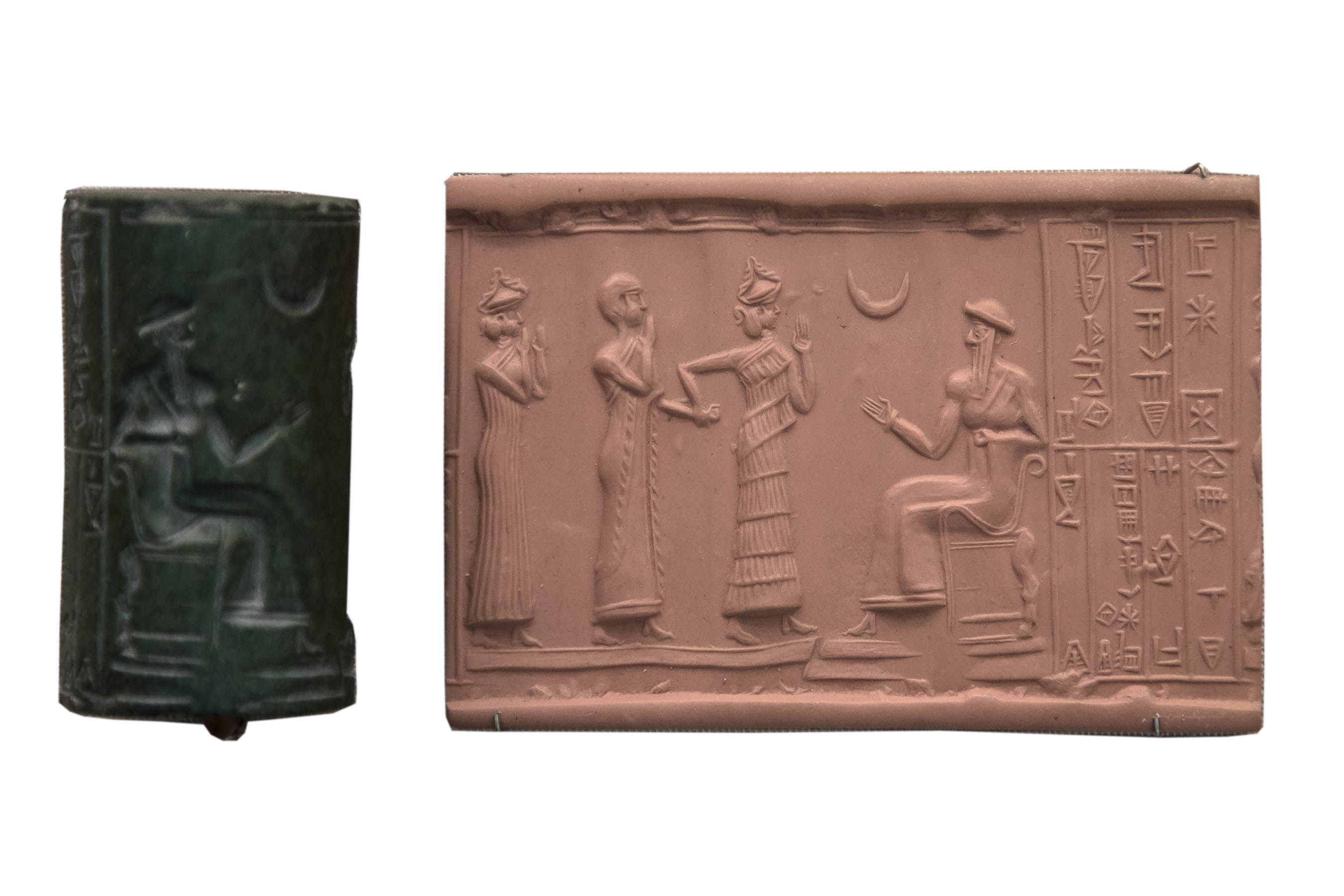
A governor named Hashamer is conducted into the presence of Ur-Nammu(?). Presentation scenes such as the one displayed on the Seal of Hashamer first began to appear during the Akkadian period and became the dominant motif on seals of the Ur III period.
Whereas during the Akkadian period, green serpentine was the favorite material for seal-cutting (40% of all seals) it was replaced with slightly softer chlorite during the Ur III period. We’ve seen how Dilmunite and Harappan seal cutters made exclusive use of this material or steatite—its close relation. The Cylinder Seal of Hashamer, now on display in the British Museum, is a very fine example of an Ur III period cylinder seal. The cuneiform inscription on the seal reads:
‘Ur-Nammu, strong man, king of Ur: Hash-hamer, governor of the city of Ishkun-Sin, is your servant’.
Remarkably, in order for the the cuneiform text to be readable when impressed into clay, it had to be inscribed backwards on the seal. The seal shows a bald and beardless man, wearing a fringed cloak slung over one shoulder, like the cloak worn by Gudea. A goddess wearing the traditional Sumerian flounced skirt conducts the man into the presence of a king or deity seated on a throne. The throne has an elaborate curved back and hoof-shaped rear legs. Illuminating the scene is a crescent moon. Another goddess, wearing a striped skirt, trails behind. The horned caps of two women betray their divine status.


The horned goddess at front wears the traditional kaunakes. Everyone else in the scene wears woven garments with elaborate fringes.
Interpretation
The scene depicted on this seal mirrors a ceremony performed at the inauguration of a new king for which descriptions have been found in texts of the Ur III period. According to one of these texts, the goddess Inanna grasps the hand of the king of Ur and conducts him to the Ekur (“House of the Mountain”) at Nippur. Whereupon the goddess implores Enlil for a blessing. Predictably, the king of the gods blesses the king and grants him the lofty ‘me‘—the laws governing human society which make civilization possible.1Kramer 1956, 278; In actual fact, the king is blessed by both An and Enlil, who both appear to reside in the Ekur at this time.
Enlil has perfected for you the might of the land, Son of Ninsun, king, shepherd Shulgi, may your scepter reach afar.2Kramer 1956, 278
The cylinder seal of Hashamer appears to be an exact depiction of this ceremony, except the god depicted on the seal is Nanna, indicated by the crescent moon, while the enthroned figure is almost certainly Ur-Nammu, the king of Ur. This interpretation comes from the seal inscription itself, which names Hashamer and Ur-Nammu. One may therefore reasonably assume that these are the two individuals depicted on the seal.
The seal highlights the subservient status of the governors of the Sumerian city-states, who were reduced to royal functionaries, while the kings of Ur were accorded divine status.3Although there is no direct evidence that Ur-Nammu claimed divine status, his successors did. Nissen 1990, 195 The centralization of power in Ur brought incredible wealth into royal coffers, but it also made Sumerian civilization brittle and liable to collapse.
Collon, Dominique.
First Impressions : Cylinder Seals in the Ancient Near East.
Chicago, Illinois: University of Chicago Press, 1988.
Kramer, S. N.
The Sumerians: Their History, Culture, and Character.
Chicago: University of Chicago Press, 1963. Link
Nissen, H. J. R.
The Early History of the Ancient Near East, 9000-2000 B.C..
Chicago: University of Chicago Press, 1988. Link