
These administrative documents are the earliest known papyri found in Egypt.
The Abusir Papyri were discovered in the pyramid temple of King Neferirkara, a ruler of the Fifth dynasty of Egypt. The papyri probably date slightly earlier than Neferirkara, to the reign of his predecessor, King Isesi (c. 2340-2312 BC). They are the earliest known papyrus manuscripts, written using the cursive script known as “hieratic” instead of the more picturesque “hieroglyphic” script better suited for inscribing stone.
The Egyptians made their paper from the soft, pithy core of the papyrus reed which grew in abundance along the banks of the Nile in Lower Egypt. It was exported in later periods to Greece and Rome where it served as the primary writing medium until it was eventually replaced by parchment made from animal skins, in the 4th century AD. Our word “paper” comes from the name for this plant.
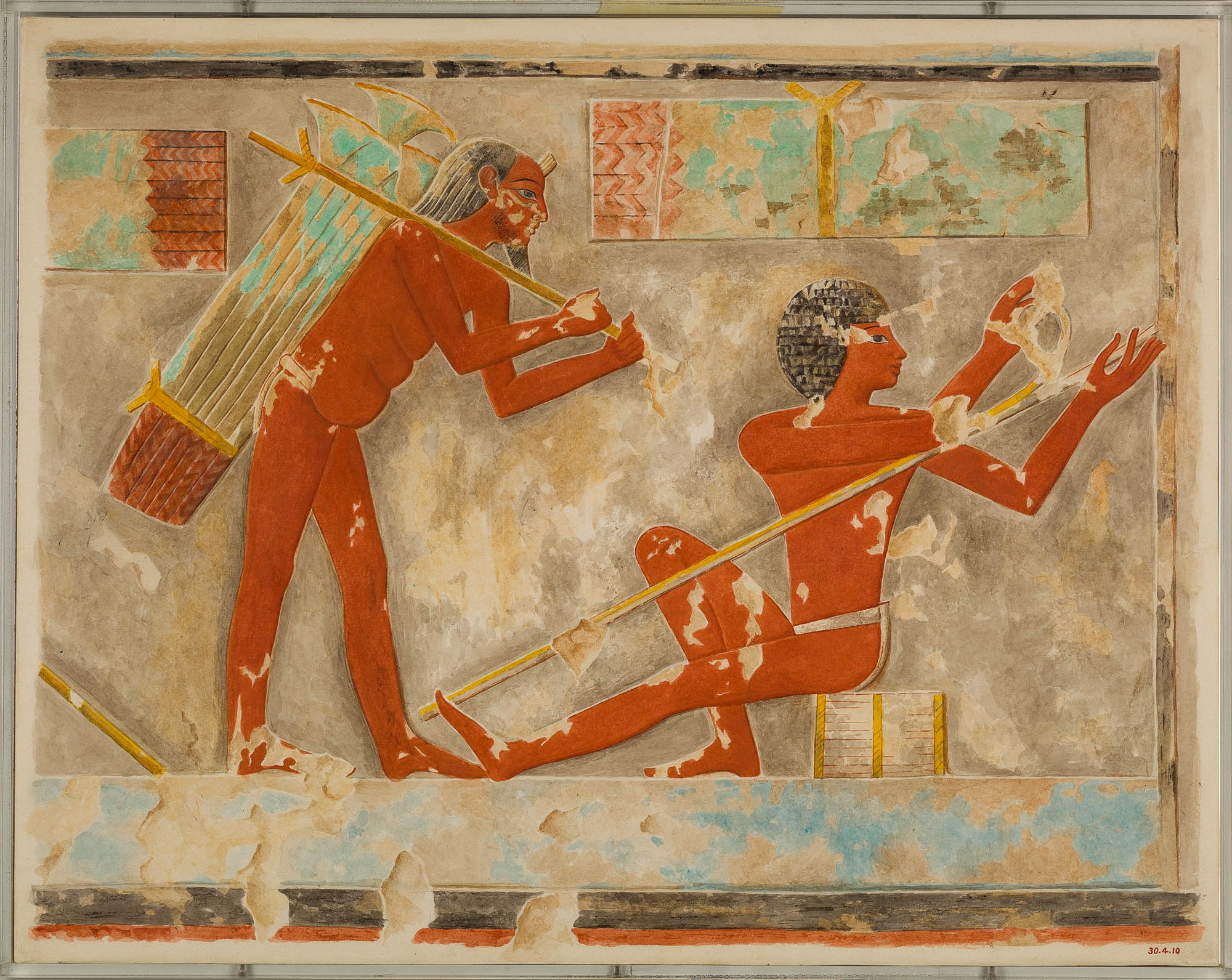

Left: Egyptians carrying and splitting papyrus reeds to make paper. The white fibers were laid crosswise, dampened, and pressed together. The plant has a natural sap that causes the fibers to stick together when dried. Right: Papyrus reed growing in the Oxford Botanical Gardens. Large plants may grow 15 feet tall and attain a girth of 2 inches in diameter.
The Greek term “hieratic” means “sacred,” a somewhat misleading name for the Egyptian cursive script which was primarily used for administrative documents. It wasn’t until much later, around 650 BC, that hieratic began to be used to record sacred texts while a new form of cursive script, known as “demotic,” began to be used instead for administrative use.

A close-up of the hieratic script from a papyrus scroll that dates to the end of the New Kingdom period (c. 1200 BC).
Ancient Accounting
As noted previously, the Egyptians employed an army of scribes to assess taxes and wages. As in Sumer, wages were usually paid with rations instead of money. A common soldier, for example, might earn two-thirds a hekat of barley and one hekat of wheat for each ten day period of service. By some estimates, this amounted to 1.3 lbs of grain per day, which is considerably less than the 2 lbs of grain paid to a Roman soldier.1Kemp 2006, 169 Equaling approximately 1925 calories, it falls under the 3000 calorie threshold required by an active person. Thus it seems that Egyptian grain rations only supplied a portion of the soldier’s caloric intake. Perhaps the rest came from the beer ration. The rations received by men of higher rank could be 5x, 10x, or even 20x that of a common laborer or soldier.2Kemp 2006, 169
The amount paid in rations was calculated down to the fraction of a loaf, jug, and heqat of grain. It is doubtful that individuals were actually paid in fractions of a loaf; it was just an accounting entry, a form of credit, that could be used to purchase something else. Ancient Egyptians seem to have had an intuitive sense of the relative value of things, such that a certain amount of linen cloth was worth so many heqats of barley.3Kemp 2006, 178 This system of exchange was facilitated through credit maintained at the temple, which essentially functioned as a commercial bank. In palatial economies the produce of the land belongs to the palace or temple and is distributed from there. The masses subsist on rations while those closest to the king benefit from the wealth flowing into royal coffers. For the system to function, accurate records must be kept, of which the Abusir Papyri are the earliest known examples in Egypt.
.jpg)
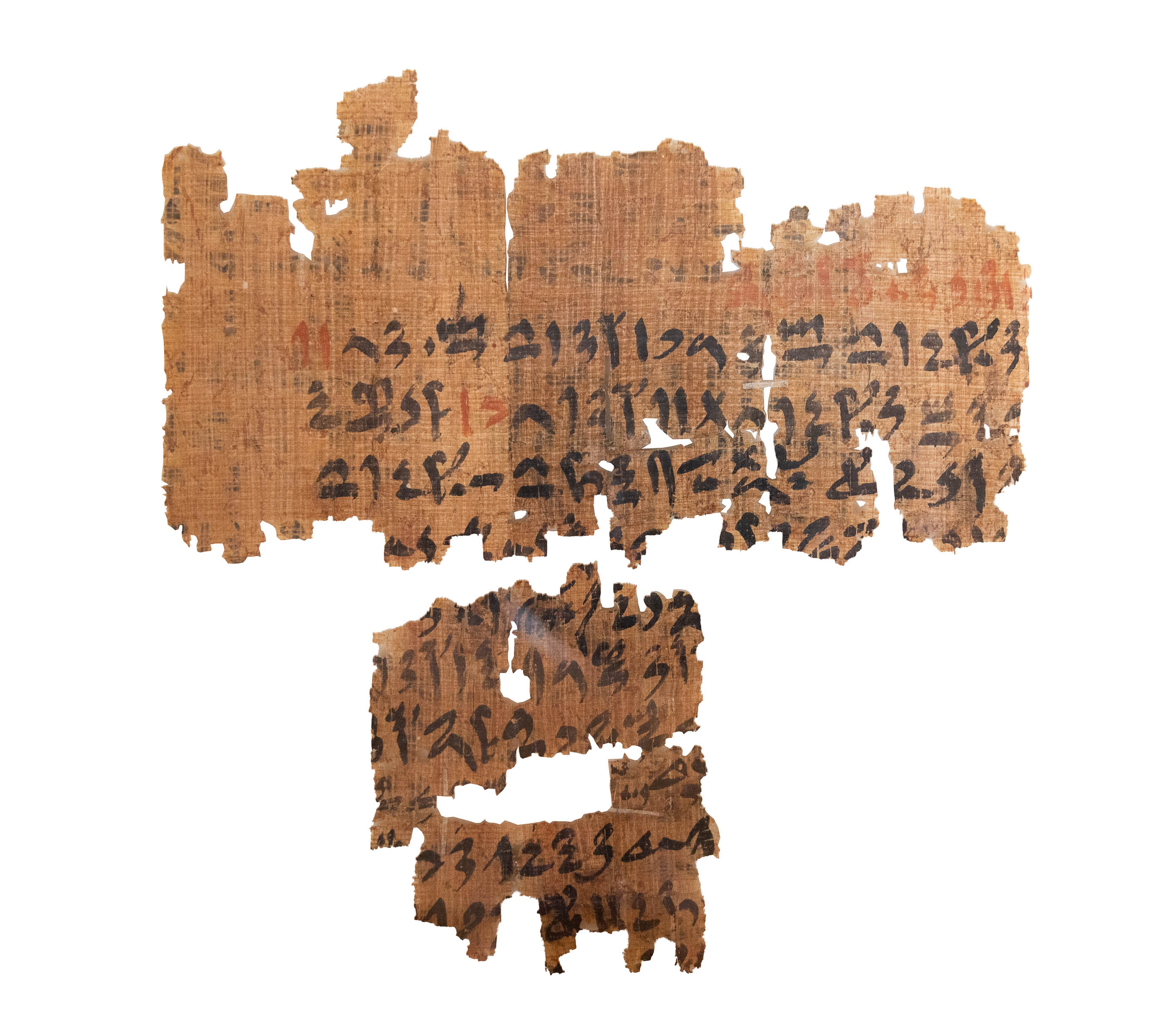
This fragment of a handbook with mathematical calculations dates to the Middle Kingdom (12th Dynasty).
Mathematics
Egyptian scribes mastered all sorts of practical calculations that were needed to track the buying and selling of commodities. One especially interesting text, the Rhind Mathematical Papyrus, reveals the high level of competency attained by Egyptians scribes, who were able to calculate the volume of a cylinder and get an answer very close to the answer we would get using π.
Here are the calculations:
A circular container of 10 by 10 cubits.
* Egyptian scribes were capable of calculating difficult fractional amounts, but prefer to maintain a numerator of 1.
Take away 1/9 of 10, thus 1 1/9; remainder 8 2/3 + 1/6 + 1/18.*
Multiply the 8 2/3 + 1/6 + 1/18 by 8 2/3 + 1/6 + 1/18; result 79 1/108 + 1/324.
Multiply the 79 1/108 + 1/324 by 10; it becomes 790 1/18 + 1/27 + 1/54.
Add a half to it: it becomes 1185.
Multiply the 1185 by 1/20, giving 59 1/4. This is the amount that will go into it in quadruple-hekats namely 59 1/4 hundreds of quadruple-hekats of grain.4Kemp 2006, 173. The Rhind Mathematical Papyrus shows that Egyptian scribes had a well-developed system for calculating fractions.
The ledger maintained by the scribes was at the heart of the “palatial economy.” No money exchanged hands in this centralized economy; just credits and debits on a balance sheet. For the system to function properly, scribes needed not only to be proficient at reading and writing, they also need to be adept mathematicians.5But what about those those who were not a part of the system, who were not registered on the temple lists? How were foreign or casual laborers paid? In Mesopotamia, during the Old Babylonian period, foreign and temporary workers were paid in shekels of silver, whereas native and full-time workers were paid with grain rations. See Leemans 1950
Breasted, J. H.
A history of Egypt, from the earliest times to the Persian conquest.
London: Houghton & Stodder, 1927. Link
Kemp, B. J.
Ancient Egypt : Anatomy of a Civilization.
New York: Routledge, 2006. Link
Leemans, W. F.
The Old Babylonian Merchant : his business and his social position.
Leiden: Brill, 1950.