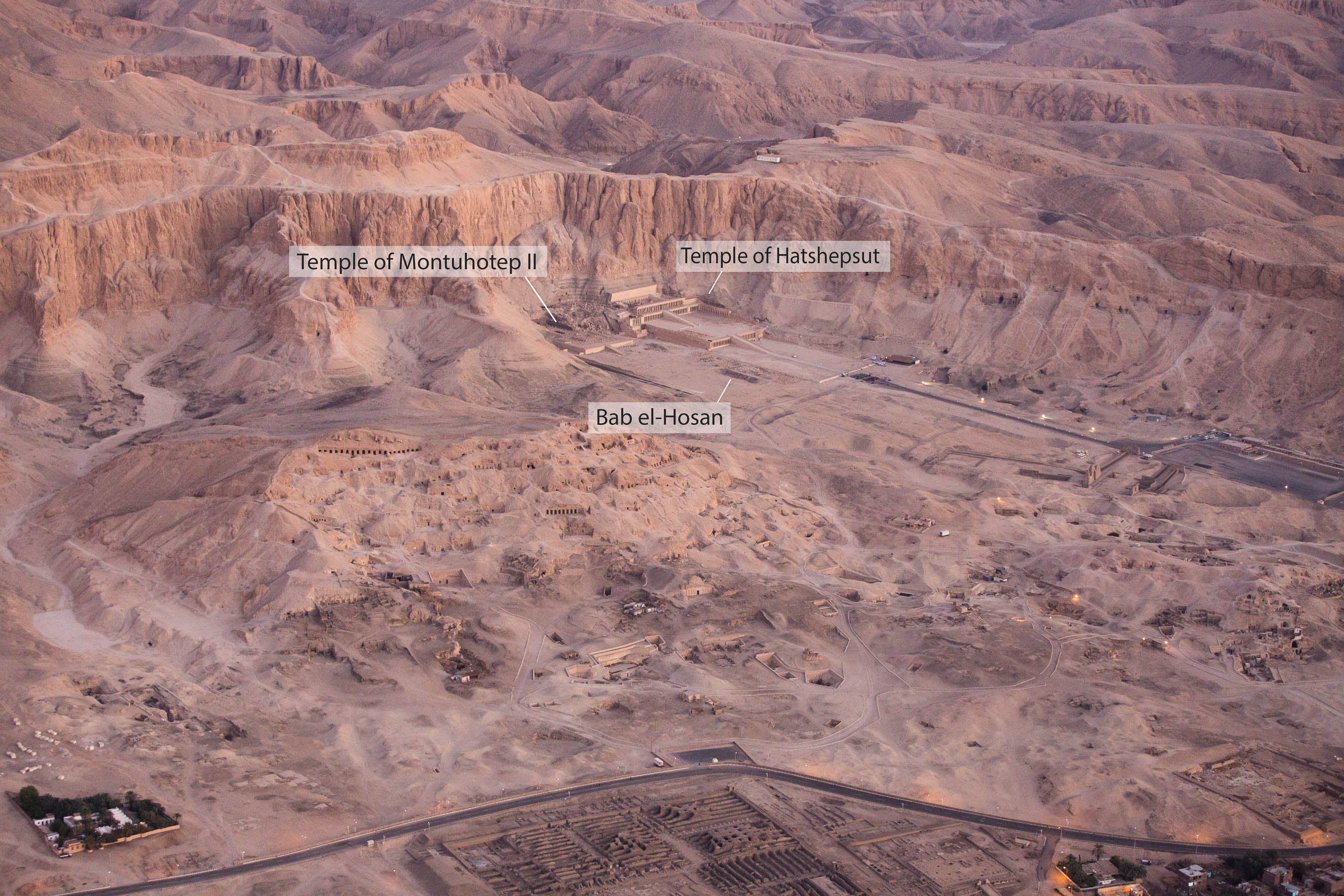
The area where Carter was riding his horse when he stumbled on the tomb of Mentuhotep II.
A new dynasty of rulers arose in Thebes, all of them named Intef or Mentuhotep. Numbered the Eleventh, the kings of Thebes fought a running battle with the kings of the Tenth. It remained for a Theban ruler named Mentuhotep II Nebhepetre to defeat Heracleopolis and bring all of Egypt under his control. His victory marks the end of First Intermediate Period and the beginning of the Middle Kingdom.
A remarkable statue of Mentuhotep II Nebhepetre was discovered by Howard Carter in 1889. (The same archaeologist would become famous twenty years later for the discovery of Tutankhamen’s tomb.) While riding in the desert one morning, west of Thebes, Carter’s horse sank into a hole which proved to be the entrance to a tomb. Thus it was purely by chance that Carter discovered Mentuhotep II’s tomb in the forecourt of his funerary temple. Hatshepsut would return to the place several hundred years later to construct her famous temple next to Mentuhotep’s.

Carter stumbled upon the burial while riding through the forecourt of the Temple of Montuhotep II at Deir el-Bahari, near Thebes.

Known as Bab el-Hosan (“Gate of the Horseman”), the opening Carter discovered that morning gave entry to a 500 foot long passageway that terminated with a single tomb chamber. It contained an empty sarcophagus and, lying on its side next to the sarcophagus, a seated statue of Mentuhotep II (below). The body of the king is painted black, a color associated with the earth and Osiris, the god of the underworld, but he wears a sed festival cloak, associated with rejuvenation. He is crowned with the red crown of Lower Egypt.

The sandstone statue stands 40 inches tall.
Breasted, J. H.
A history of Egypt, from the earliest times to the Persian conquest.
London: Houghton & Stodder, 1927. Link