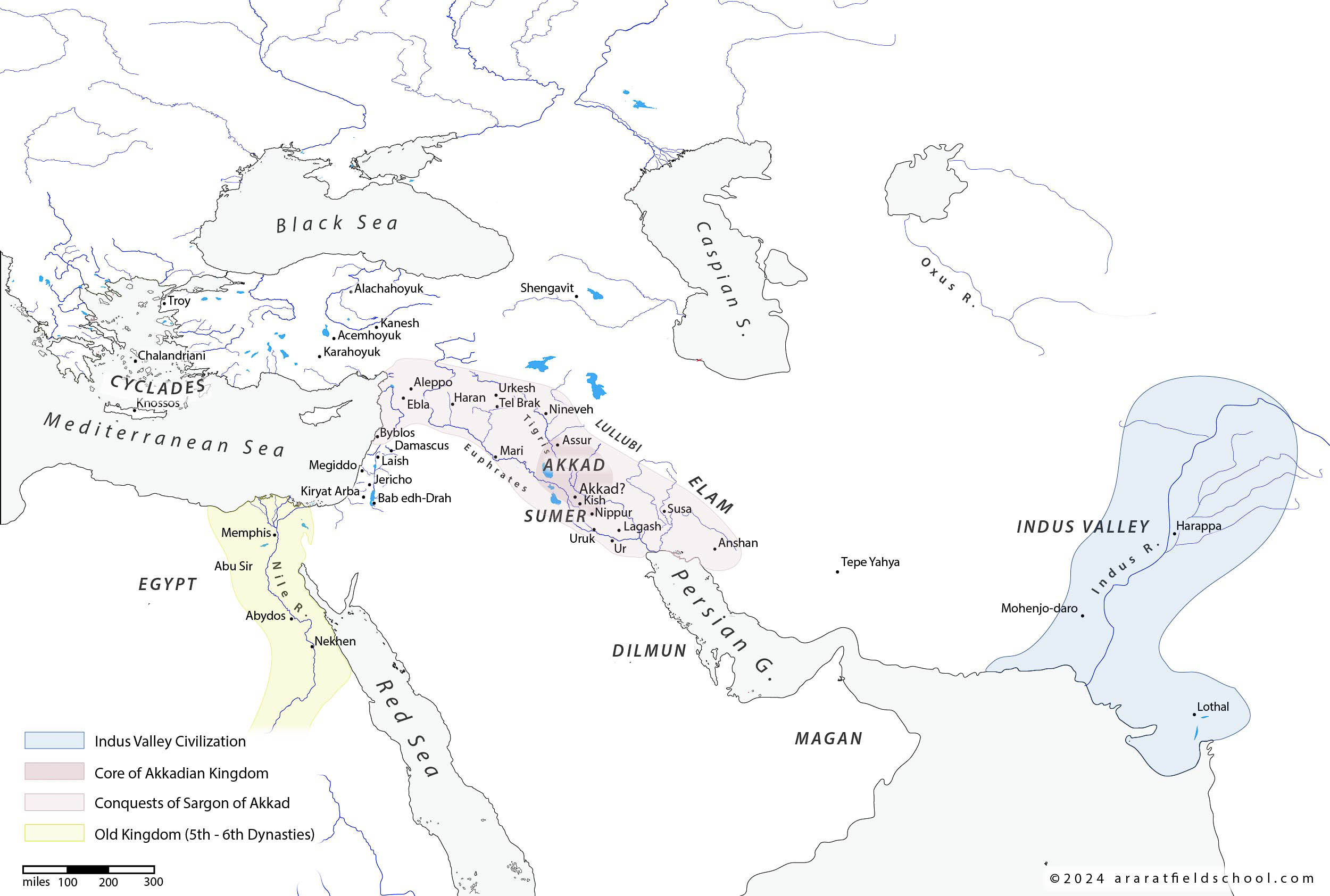
If the EB III gave rise to powerful kings and queens, buried in magnificent monuments with unspeakable riches, then the EB IV produced the first real empire, ruled by Sargon of Akkad. Egypt during the reign of Pepi I also extended the territory under its rule, in the southern Levant and Nubia.
Regions separated by vast distances were brought into direct contact during this period, either through warfare or trade. Ships of Dilmun, Magan, and Meluhha shuttled precious cargo between Mesopotamia, Arabia, and the Indus Valley. The ruins of their elusive cities have been located in Bahrain, the United Arab Emirates, and Oman, while further to the east, archaeologists have uncovered a third great riverine civilization, in Pakistan and India.
The wars of empire ended with the collapse of Akkad and the disintegration of the Egyptian Old Kingdom. Chaos ensued when highlanders from the eastern Zagros seized control of the Mesopotamian floodplain. But out of the chaos there arose, during the MB I, a new Sumerian epoch, first in Lagash (Lagash II) and continuing in Ur (Ur III).
The MB I is marked by protracted drought which likely contributed to the abandonment of urban centers in the Levant and the breakdown of central authority in Egypt. Amorites, from the fringes of settled lands, gained control of entire regions. Growing in strength and numbers, and carrying potent new weapons, they posed a threat to both Egypt and Mesopotamia. An alliance between the Amorites and Elamites brought the defeat of Ur, thus bringing the Sumerian epoch to an end, and the MB I.
Places:
- Qala’at al-Bahrain
- Umm an-Nar
- Mohenjo-daro and Harappa
- Megiddo
Artifacts:
- Victory Stele of Naram-Sin
- Priest-King of Mohenjo-daro
- Dilmun Seals
- Barbar Ware
- Fenestrated Eye Axe
- Grey and Red Oman Fine Ware
- Akkadian Cylinder Seals
Architecture:
- Barbar Temple
- Ziggurat of Ur
- Shaft Tombs of Jericho
- Mastaba of Mereruka
Literature:
- Lions of Urkesh
- The Flood Tablet
- The Lament for Sumer and Ur
- Weld-Blumdell Prism
Technologies:
- Weight Standards
- Tin-Bronze Casting
- Ziggurats
- Developments in writing and literacy
Political and cultural events:
- Conquests of the Akkadian kings
- The expansion of Guti, Hurrian and Amorite tribes
- Abraham in Canaan
- The First Intermediate Period in Egypt
- The Fall of Ur
Chronology of the EB IV – MB I
| Period | Standard Chronology | AFS Chronology | Comments |
|---|---|---|---|
| Chalcolithic / Early Bronze I | 4500-2900 BC | 3500-2700 BC |
|
| Early Bronze II | 2900-2650 BC | 2650-2500 BC |
|
| Early Bronze III | 2650-2300 BC | 2500-2150 BC |
|
| Early Bronze IV | 2300-2150 BC | 2150-2000 BC |
|
| Middle Bronze I | 2150-2000 BC | 2000-1850 BC |
|
Map of the Ancient Near East