
A Ghassulian basalt bowl discovered in the Irbid Region in the north of Jordan. A similar bowl from Wadi Zeita (Jordan) stands approximately 12 inches tall and measures 16 inches in diameter at its rim.
Basalt is among the most useful stones given to man. Its toughness and rough surface texture makes it an ideal material for grinding and pounding.1The millstone was used for grinding grain using a rotary action whereas the mortar and pestle were used with a hammering action, the grain being placed in the mortar and pulverized with the pestle. It is also a difficult stone to carve. However, this fact does not seem to have discouraged Ghassulian stonecutters from producing large numbers of basalt bowls and stands.2It is noteworthy that basalt footed vessels are found at Maadi in Lower Egypt that date to Naqada I-II. These basalt objects are unique to the Ghassulian period in the southern Levant.3Basalt bowls were also found in the EB I tombs at Bab edh-Dhra but these are likely a carryover of the Ghassulian culture.


Examples of “V-shaped” basalt bowls and stands. The “fenestrated” stands have windows opened in the side of them.

The ceremonial function of these basalt bowls was highlighted by a cache of objects discovered in a pit at Bir es-Safadi in the Beersheva Valley. Objects from the cache included an ivory “Pinocchio figurine,” several ivory wands, and two basalt bowls. The association of ivory “wands” with a “Pinocchio” figurine and two basalt bowls suggests that these objects were used in magic rituals, perhaps related to divination.
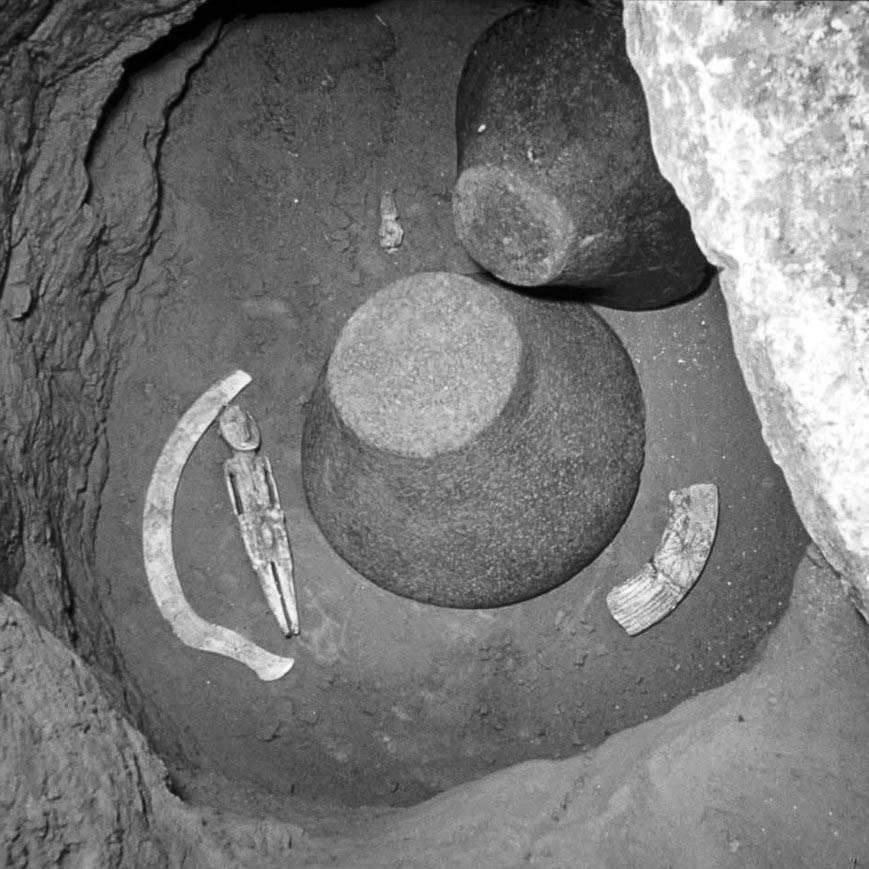
These bevel-shaped bowls were found buried in a pit next to an ivory “Pinnochio” figurine and an ivory wand.
The practice of “divination” is well known from Mesopotamian texts. The most ancient method, which is described in Old Babylonian texts, involved pouring oil on water. A priest trained to read the movements of the oil on the surface of the water sought thereby to divine the future. An allusion to this practice appears in Genesis when Joseph frames his younger brother, Benjamin, by having his special silver cup placed in his luggage. The cup is described as having been used for both drinking and divination.
Is it not from this that my lord drinks, and by this that he practices divination? You have done evil in doing this.’ (Gen. 44:5 ESV)
Perhaps the Ghassulian basalt bowls were also used for divination. The dark basalt would have made an ideal backdrop for studying the movements of oil on the surface of water, or perhaps even for gazing in a trance-like state. Thus diviners sought to discover the portents and signs which revealed the future.
In Cicero’s, On Divination, the Roman politician and philosopher gave a lengthy dissertation on the methods and means of divination, for which Y. Kaufmann offers the following helpful summary:
Man is able to know the future either through a study of omens over a long period of time, or by a kind of supernatural instinct or sense. Omens are based on long experience of an invariable sequence of certain signs and events. Like the other sciences, divination is grounded on experiment and conjecture. He says explicitly that nature can indicate the future without special divine interference, and that it, therefore, can be discovered without recourse to the gods. Dreams and prophecy are explained as the product of natural faculties of the soul. To be sure, this faculty is not activated except when the soul parts from the body and comes into contact with divine powers. These powers are found everywhere; sometimes within man, sometimes without.4Kaufmann 1960, 52)
It follows from this that divination was more of a technique and a “science” than an act of piety. It sought to connect with “divine powers” embedded in Nature to which even the gods may be subject.

These horn-shaped copper cups were found in the Nahal Mishmar hoard. Their function is unknown but perhaps they too were used for drinking and divination.
Basalt Stands
There is another style of Ghassulian basalt object that was found at sites in the Golan heights such as Rasm Harbush (see map above). They took the form of a solid basalt pedestal with a shallow, hollowed-out bowl on top. The pedestals were carved with abstract, anthropomorphic features, with knobs for ears, a large nose, and sometimes also two horns. This type of offering stand began to appear in the Golan with the Ghassulians and disappeared with them.


These basalt stands were carved with long noses and small nobs for ears. Sometimes they were given a pair of horns. From Rasm Harbush in the Golan Heights.

This model shrine from Crete (Late Bronze, 1550 BC) illustrates how offering stands were used to present offerings in a temple. The gods or ancestors are seated at the back of the shrine while two kneeling figures present offerings or burn incense on offering stands similar to the ones from Rasm Harbush.
Brink, E.C.M. van den, Y.M. Rowan, E. Braun. “Pedestalled Basalt Bowls of the Chalcolithic: New Variations.” Israel Exploration Journal 49, no. , no. 3/4 ( 1999): 161–83. Link
Kaufmann, Yehezkel, Moshe Greenberg.
The Religion of Israel, translated by Moshe Greenberg.
Chicago: University of Chicago Press, 1960.
Perrot, Jean. “Les Ivoires de la 7c Campagne de Foilles a Safadi pres de Beersheva.” Eretz-Israel Archaeological, Historical and Geographical Studies 7 (1964).