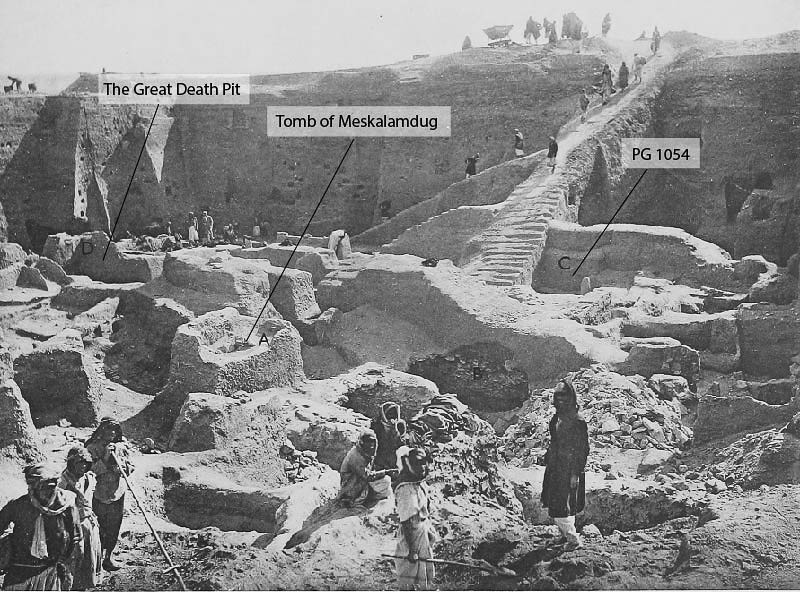
Most of the tombs excavated by Woolley in the cemetery of Ur were pillaged in ancient times, probably not long after the bodies were buried, since the tomb robbers seem to have known exactly where to go. However, the robbers must also have been in a hurry, for they left many objects behind. Even their scraps constitute a treasure of inestimable worth. But before looking at the treasure, it will be helpful to have some idea of how the tombs were constructed. We will begin with one of the best preserved of the royal tombs—numbered PG 1054.
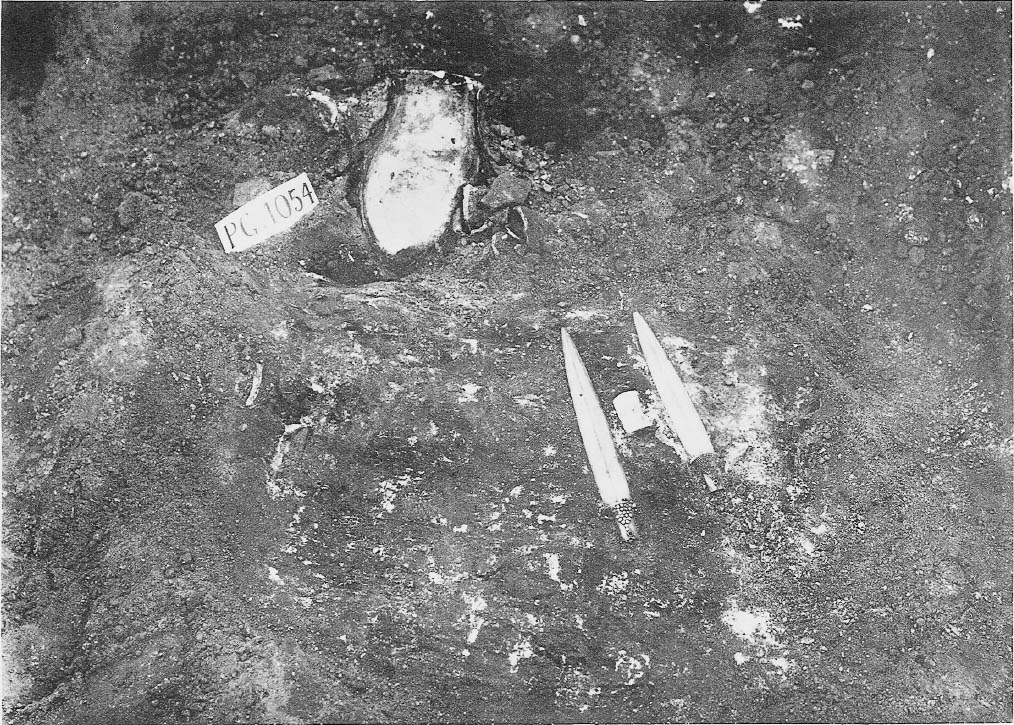
As with other tombs in the Royal Cemetery, several daggers were placed at the entrance to the tomb “PG 1054” along with a seal made of shell (between the daggers) that was inscribed with the name “Meskalamdug.”
PG 1054
PG 1054 may have belonged to the wife of Meskalamdug since a woman was found in tomb chamber, and a seal with his name on it was discovered in what was probably once a wooden box, now decayed, alongside two beautiful daggers. (Note: these are not the same daggers recovered from PG 580 which we looked at in a previous entry.) The tomb chamber was a vaulted chamber, made of limestone, constructed approximately 25 feet below ground level. The discovery of stone came as something of a surprise since this material was rarely used as a building material in southern Mesopotamia. The skeleton of a woman, perhaps the wife of Meskalamdug, and four of her servants were found inside the tomb chamber. Five more skeletons were found in the levels directly above the tomb, all belonging to young men. We may suppose the male and female servants were sacrificed in order to accompany their queen into the afterlife, a practice known as “retainer sacrifice.” Grave goods were placed inside the vaulted tomb chamber and in the layers of earth above it.

This cross-section shows how the grave goods and sacrificial offerings were placed in the layers of earth that covered the tomb chamber.

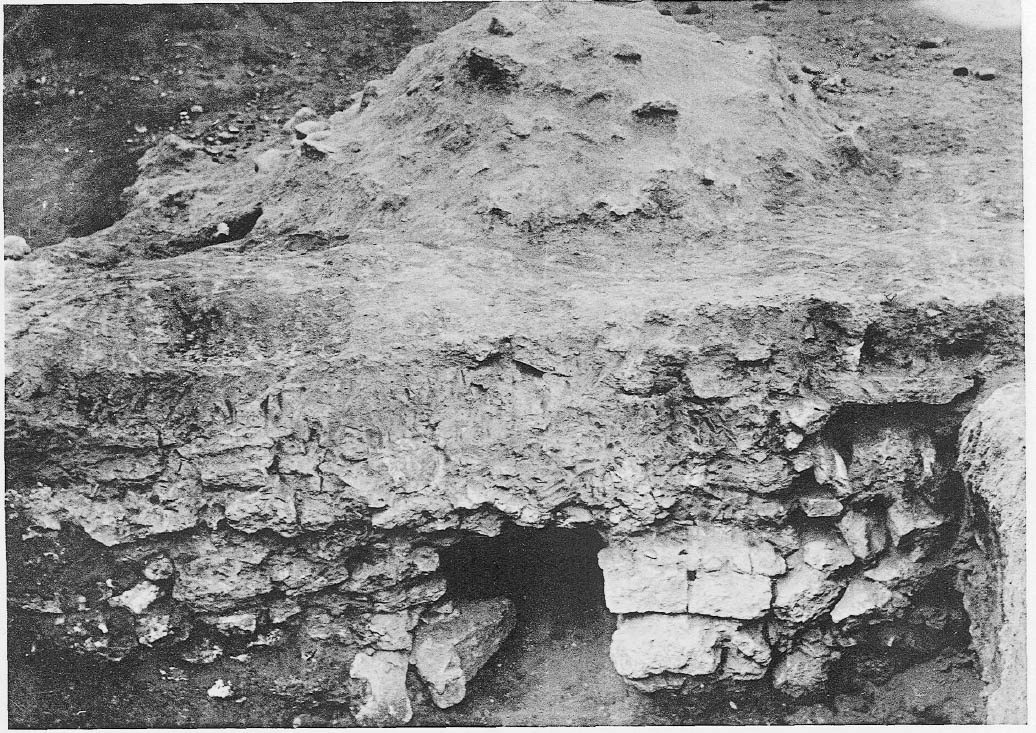
The roof of PG 1054 is an early example of vaulted architecture. It is reminiscent of the Jebel Hafit beehive tombs, except the tomb chamber was constructed 20 feet below ground!

Gold rings (left) were found near the head, which suggests they were used as hair rings. A gold cylinder seal and necklaces made from gold, carnelian, and lapis lazuli prove that the woman buried in PG 1054 had royal status.
PG 1237 “The Great Death Pit”
The largest tomb excavated at Ur was PG 1237. Skeletons belonging to 78 individuals—6 men and 72 women—were found in a courtyard next to the tomb chamber. Clothed in royal finery, their bodies were carefully arranged, side by side, in rows, all of them holding a cup to their mouth except for several musicians, who were found with their arms draped across their harps instead. Woolley, who had a flair for the dramatic, dubbed the courtyard next to PG 1237 the “Great Death Pit.” It has been suggested that the tomb belonged to Mesannepada since it is one of the largest and richest n the cemetery. An analysis of the bones and teeth of the retainers reveal that they were all young when they died.


These elaborate headresses and necklaces were worn by some of the young women in the Great Death Pit. Others were adorned more simply with strands of silver in their hair.
The young women were dressed in bright red garments fringed with gold. Although the fabric was decayed, scarlet threads could still be seen woven into the golden fringe of the garment. Young warriors were positioned near the entrance of the tomb armed with copper daggers and carrying spears fitted with gold and silver spearheads. Groomsmen were also found nearby, lying next to their oxcarts.
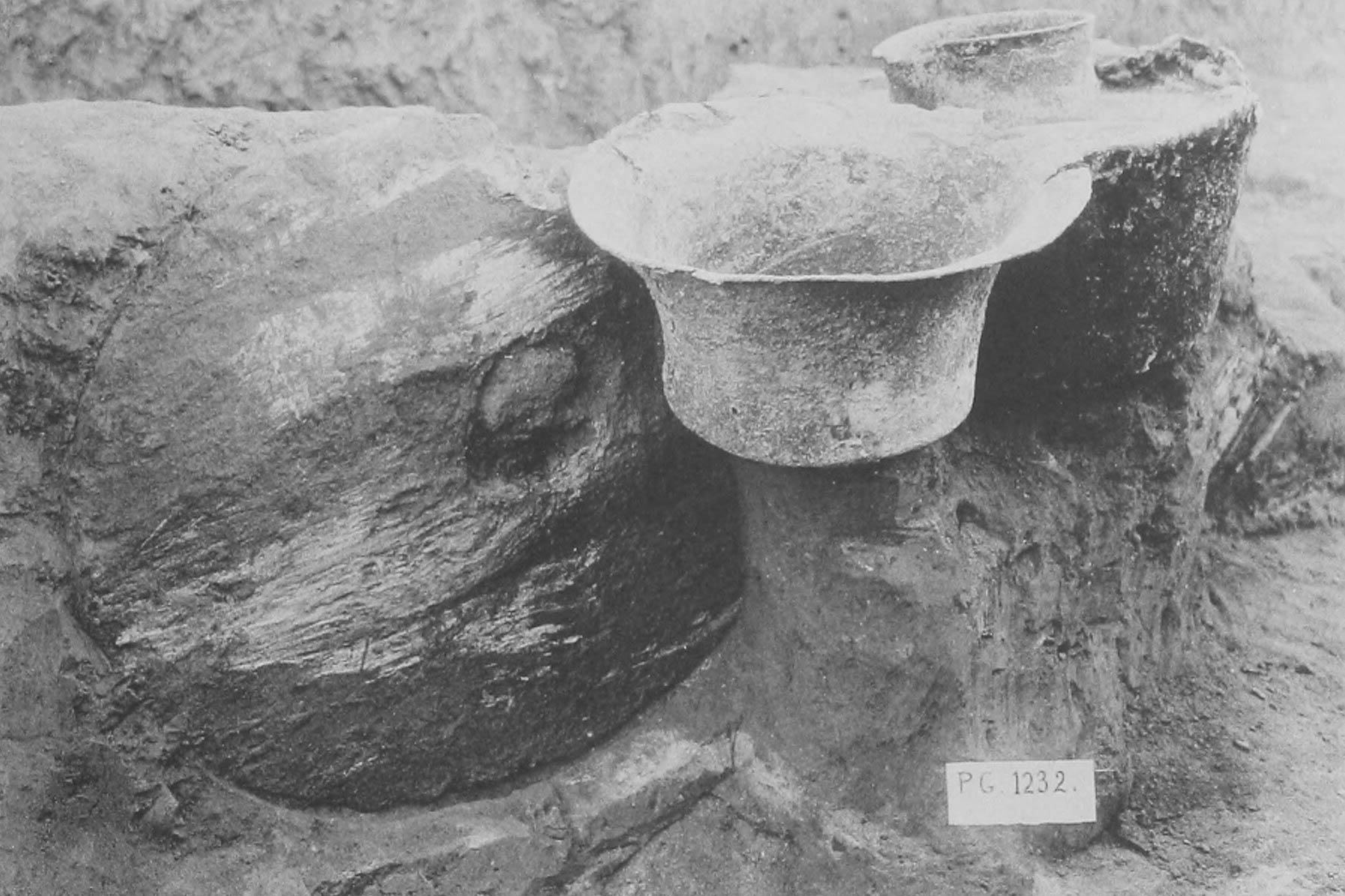
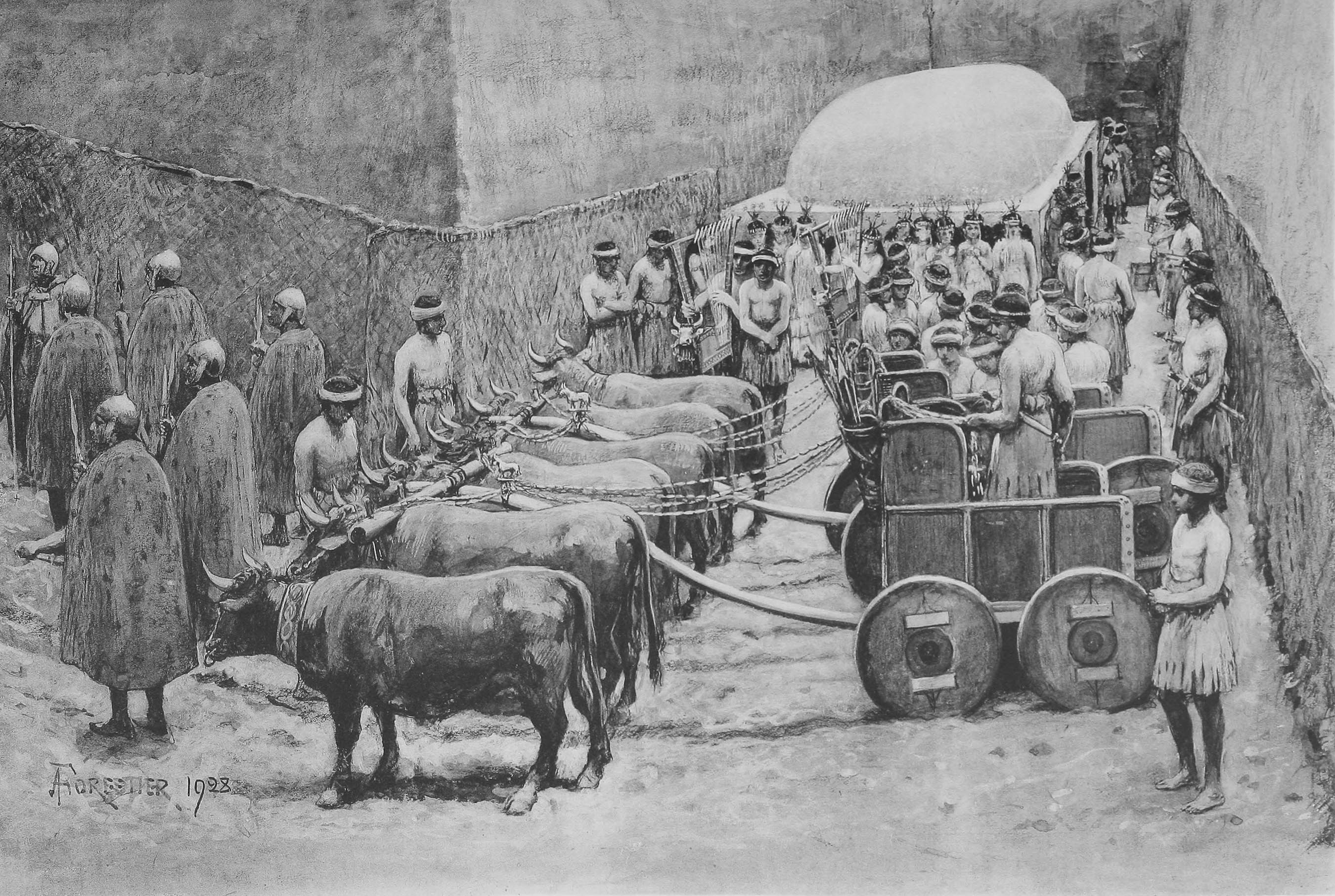
Left: Although the wooden wheel of the oxcart was completely gone, the wood grain is still discernible from the impression it left behind in the ground. Right: An artist’s impression of the moment before the courtiers were slain in the Great Death Pit.
The entire scene in the courtyard of PG 1237 has the appearance of a ghastly banquet to which only the doomed were invited. Woolley believed the bodies belonged to royal courtiers who willingly went to their deaths, perhaps after drinking wine laced with opium. Other researchers paint a more gruesome picture the involves the intentional crushing of skulls, etc.

The skeletal remains of the courtiers were found in such a decayed state that only the outline of the bones could be discerned in the soil. However, the gold and silver jewelry they wore was well preserved.
It does not seem like the burial rituals represented by the Royal Cemetery continued for any great length of time since nothing like them has been found elsewhere in Mesopotamia. However, we do find some interesting parallels with Egypt, where tombs of the First and Second dynasties likewise display evidence of retainer sacrifice, and on a similarly grand scale. The practice of retainer sacrifice raises many questions. How did a state function when so much talent was extinguished and so much wealth buried whenever a sovereign died? Who were these kings and queens that they should have wielded such complete mastery over their subjects? In the end, it must be admitted that the burials represent something quite unfathomable.


So named by Woolley, this pair of goats was found in the Great Death Pit. Standing approximately 18 inches high, they may have originally flanked a cult statue. Each goat has a socket in its back that supported an offering table. (See also the Warka Vase for an example of this kind of stand.) The goat’s horns and fleece are made from lapis lazuli and shell. The rest of its body is covered in gold except for its belly, which was covered in silver. The goats reside today in the Penn Museum (left) and the British Museum (right).


All that remains of this magnificent lyre is the gold head of a bull, its lapis lazuli beard, and a frontspiece divided into four registers filled with grotesque scenes of mythic animals playing instruments and enacting various rituals whose meaning is no longer understood. The display of animals engaged in human activities suggests some Elamite influence. See the Kneeling Bull-man for another example.
It is worth reflecting for a moment on why we find the idea of retainer sacrifice so difficult to comprehend and repugnant. The people of early dynastic Sumer and Egypt clearly did not find it so. In Egypt, the practice continued into the Roman period, howbeit in a curtailed fashion, with the placing ushabti figurines in the tomb to represent servants. Retainer sacrifice has also been documented among other groups, such as the Hyksos during the Late Bronze Age, and the Scythians during the Iron Age. In more recent times, one could cite the sutee ritual in India in which the wife of the deceased would go to the funeral pyre of her husband and offer herself up to the flames, either willingly or coerced. Similar practices are known among certain tribes in Papua New Guinea, where I used to live. It is not the span of time which separates us, nor ethnicity that renders the act incomprehensible, but religion—the cultus in culture.