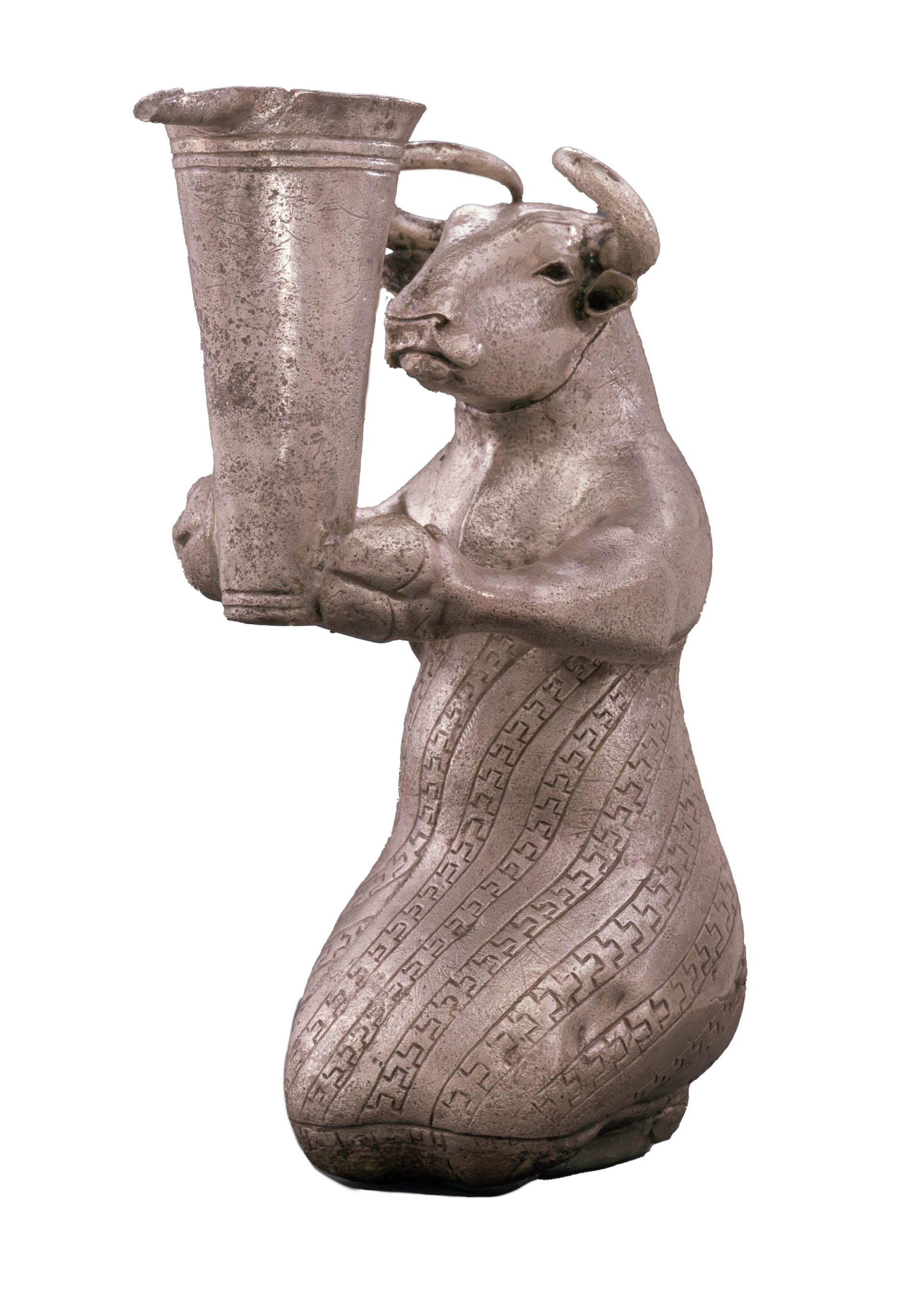
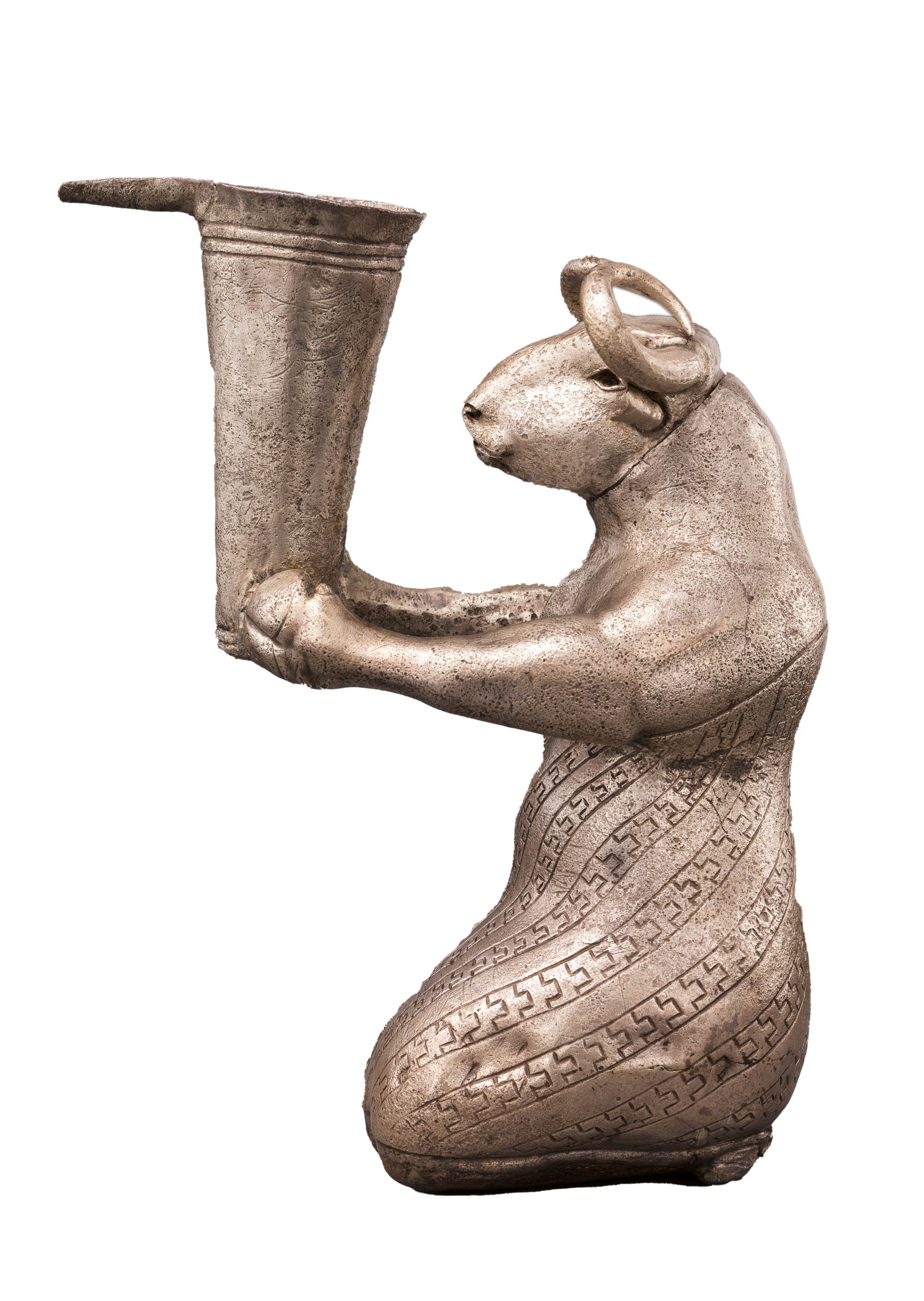
The bull is cast from ~99% pure silver in four pieces that were subsequently soldered together. It stands approximately 6 1/2 inches tall.
One of the characteristic features of Elamite iconography was the depiction of animals posing as human beings. No object is more illustrative of this than the kneeling bull-man. Made from pure silver, the bull-man is holding a tall vase with a long trough spout. The head of the bull is remarkably realistic while its neck and shoulders morph seamlessly into the shape of a man. The tall vase clasped between the cloven hoofs of the bull appears ready to topple at any moment. It may be wondered if the advanced metalsmithing required to produce the bull man does not belong to a much later period and mistakenly attributed by archaeologists to an earlier one, but depictions of this kneeling bull are commonly featured on objects that definitely belong to the Proto-Elamite period. The significance of this hybrid creature is completely unknown.

This tablet was impressed with a cylinder seal featuring two kneeling bull-men.
Silver
Perhaps the most interesting aspect of this object is not its shape, but the ~99% pure silver from which it is made.1Moorey 1994, 239 Unlike copper, gold, and tin—which are found as nuggets of pure metal—silver must be smelted from ore.2Native or “dry” silver ores do exist but they are “20% as abundant as gold; .2 percent as abundant as native copper” (Moorey 1994, 232). The smelting and refinement of silver is a complex process which was, apparently, mastered by Elamite metalsmiths at an early date. Silver-bearing ore is thought to have been mined and smelted in the mountains of northeastern Iran during the 3rd millennium BC.3Moorey cites evidence of the smelting of silver-bearing lead ores at Tepe Hissar. (Moorey 1994, 234-235). The bull shape was achieved by casting the figurine in four pieces that were subsequently soldered together. Soldering involves fusing the pieces together using a third metal which melts at a lower melting point and may therefore be made to flow into the space between the two pieces.
Guennol Lioness
Like the Egyptians, the Elamites had a penchant for depicting the spirit world with monstrous hybrid forms, like the bull-man. Another famous example is the Guennol Lioness. Made from ivory, the lioness stands approximately 3 1/2 inches tall. The sculptor has skillfully combined the muscular body of a man with a small, naturalistically-rendered, head of a lioness. The mane of the lioness blends imperceptibly with the torso of the man, as though it were meant to be. The Guennol Lioness and the Kneeling Bull-man have been compared with other hybrid creatures known from Mesopotamian art, such as the colossal bull-men statues which stood guard at the gates of Assyrian palaces. But Assyrian sculptors committed the lesser transgression of affixing a human head to the body of an animal and not the other way around!
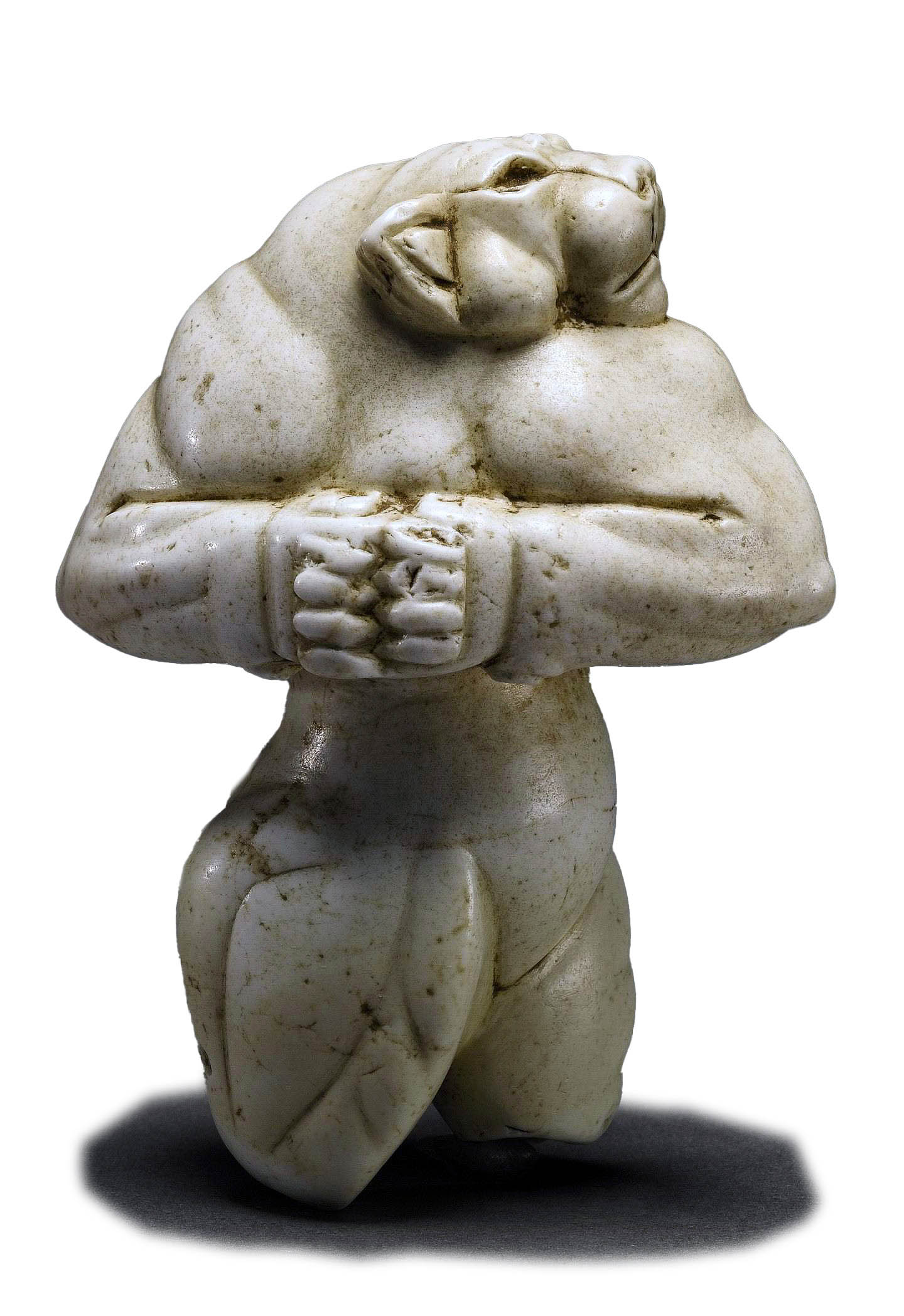

Left: The Guennol Lioness displays the Elamite penchant for human hybrid creatures. Right: The impression of a cylinder seal on a Proto-Elamite tablet depicting a bull-man and a lion-man as “master of animals.”
Hansen, Donald, Kate C. Lefferts, S. M. Alexander. “A Proto-Elamite Silver Figurine in the Metropolitan Museum of Art.” Metropolitan Museum Journal 3 (1970): 5–26. Link
Moorey, P. R. S.
Ancient Mesopotamian Materials and Industries.
Oxford: Clarendon Press, 1994.