The Egyptian priest, Manetho (early 3rd century BC), was the first to divide Egyptian history into dynasties. Generally speaking, he ended one dynasty and began another whenever there was a break in the father / son succession. However, the transition between the Fourth and Fifth dynasties is less clear. The first king of the Fifth Dynasty, Userkaf, may actually have been a son of Shepsekaf, the last king of the Fourth Dynasty, although some sources insert several shadowy rulers between them.
The Westcar Papyrus, probably written during the Fifth Dynasty, tells an interesting story about this transitional period. A magician named Djedi was called upon to provide entertainment for Khufu, the greatest of the Fourth dynasty kings and builder of the Great Pyramid. Djedi did what any magician would do in that situation; he indulged the king by restoring the severed head of a duck to its body. Delighted, Khufu turned to more serious matters. Could Djedi reveal to him the secrets kept in a chest in the Sun Temple of On (Heliopolis)? The magician replied that only the eldest son of a certain woman named Ruddedet, wife of a priest of Re, was allowed to open that box. Djedi further revealed that this same woman was pregnant with triplets, sired by Re, and that they were destined to rule Egypt. Djedi nevertheless quickly assured Khufu that his son and grandson, Khafre and Menkaure, would be allowed to complete their reigns before the eldest of the three sons of Ruddedet assumed the throne.
As we noted in a previous entry, Khafre and Menkaure constructed pyramids on the Giza plateau next to Khufu’s. They were followed by Shepsekaf, the final king of the Fourth Dynasty, whose lineage is unclear and who did not reign very long. His burial monument at Saqqara is a testament to the declining fortunes of the Fourth dynasty.
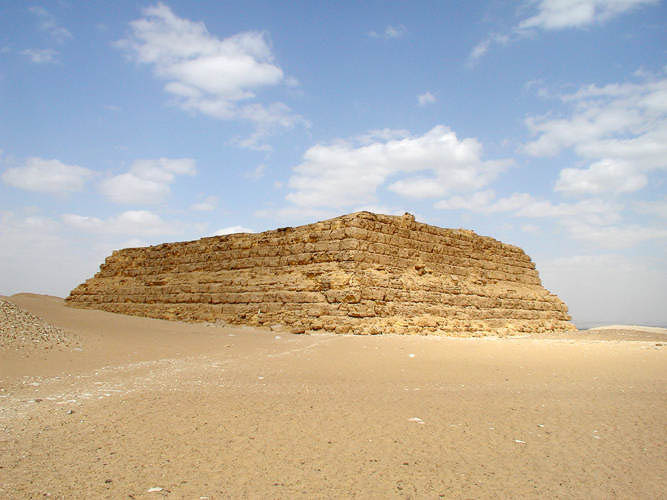

The tomb of Shepsekaf. The last king of the Fourth Dynasty, Shepsekaf, broke with tradition and built a mudbrick mastaba at Saqqara instead of a stone pyramid at Giza.
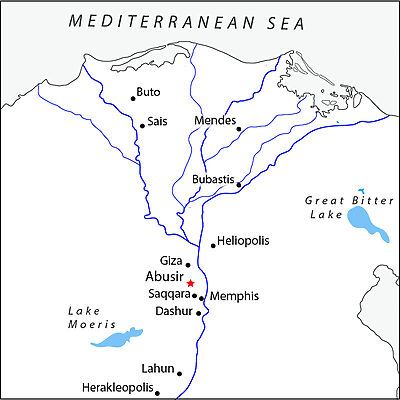
As it happened, the triplets of Ruddedet—named Userkaf, Sahure, and Kaki—did indeed ascend to the throne of Egypt—or so the Westcar Papyrus would have us believe. The ascension of Userkaf marks the beginning of the Fifth Dynasty. The papyrus further highlights the increasingly close relationship enjoyed by the king with the sun god, Re, whose main temple was at On (Heliopolis). According to the solar theology of Heliopolis, the king of Egypt was the direct offspring of Re. The custom of Egyptian kings adopting the title “Son of Re” may be traced to this period. The cult of Re would continue as the state religion of Egypt until the Christian era. The pyramids of Kakai and Sahure are located at Abusir, between Giza and Saqqara. Userkaf’s is located at Saqqara. We will come back to these pyramids shortly.
Sun Temples
A unique style of temple was introduced during the Fifth Dynasty in response to the new solar theology. Its focal point was a large pillar or “obelisk” and an altar placed in a courtyard in front of the pillar. Only the fragmentary remains of two of these sun temples have been excavated, at Abu Ghurab directly north of Abusir. But six are thought to have existed, all of them constructed during the Fifth Dynasty.

Artist’s depiction of a Fifth dynasty sun temple constructed at Abu Ghurab, just north of Abusir.
Breasted, J. H.
A history of Egypt, from the earliest times to the Persian conquest.
London: Houghton & Stodder, 1927. Link