
This fertile oasis in the Hajar mountains was a site of copper mining and smelting during the Early Bronze Age. Note the location of a white watchtower, just visible on the right side of the photo behind the agricultural fields.
Sumerian texts refer to Magan as the land of copper. It may be wondered, therefore, if there is any evidence for copper mining and smelting in the Hajjar Mountains of the United Arab Emirates (UAE) and Oman? The answer is found in the Wadi al-Hilo (“Sweet Valley”), a fitting name for the beautiful oasis nestled in the Hajjar mountains approximately 60 miles southeast of Sharjah.1Hauptmann 1981, 132 Shallow wells supply the valley with water year round. Periods of heavy rainfall transform the dry riverbed at the bottom of the wadi into a raging flood which has swept away more than one unwary traveler.
The most prominent landmark in the valley is an Islamic period watchtower. A grassy knoll next the tower was excavated in 2007, revealing a typical Early Bronze structure, constructed on a circular plan, like the tombs on Umm an-Nar. However, this structure was identified as a watchtower rather than a tomb, such as have been found at other Early Bronze settlements in Oman.2Kutterer 2013, 127

Evidence of an early bronze occupation was found on the flat gravel terrace next to the river bed.
It is remarkable to find two watchtower, side by side, separated by thee or more millennia. Their location in the valley suggests they may have been used as agricultural towers, such as were constructed to keep an eye on valuable vineyards. Isaiah refers to this type of tower.
He dug it and cleared it of stones, and planted it with choice vines; he built a watchtower in the midst of it, and hewed out a wine vat in it; and he looked for it to yield grapes, but it yielded wild grapes. (Isa. 5:2 ESV; cf. Mk. 12:1)

An Umm an-Nar style building was constructed from black field stone. An Islamic period watchtower is located nearby.
Copper Land
Archaeologists found an estimated 50-200 tons of slag on the terrace north of the watchtower. They also found a “plano-convex” copper ingot in a nearby structure identified as a workshop.3Kutterer 2013, 63-65, 104 Radiocarbon analysis of ashy pits excavated in the structure returned dates ranging from c. 3900-3700 BC.4Kutterer 2013, 68 These look much too high. Probably the most that can be said is that copper was mined and smelted at the site during the Early Bronze Age.
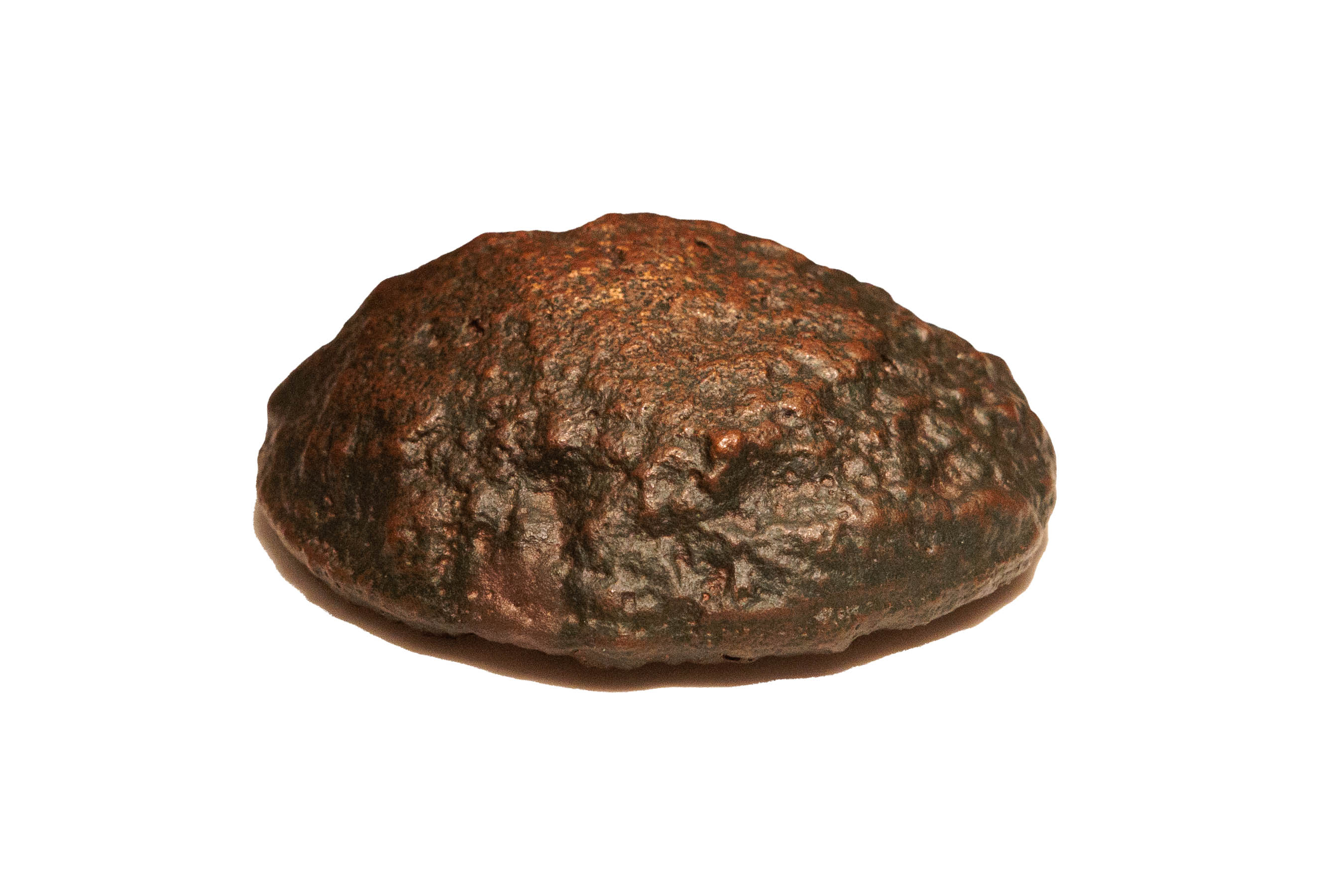
A circular “plano-convex” copper ingot found at the Bahla Oasis in Oman. An identical ingot was found at Wadi al-Hilo.
The Sumerians traded their textiles and grain for the products of Magan, such as copper, wood, various types of stone, and a certain type of “Magan reed.” The ships of Magan and Meluhha—the latter should probably be identified with the Indus Valley—were constructed with reeds coated in bitumen (tar) and rigged with a square sail. Unfortunately, we don’t have any well preserved boats from Mesopotamia such as the ships found in Egypt next to the pyramid of Khufu. However, pieces of bitumen have been found at sites in the Persian Gulf which still bear the weave impressions created by the reed hull of the ship.


Left: The famous merchant ships of Magan and Meluhha conducted a bustling trade between Sumer, Arabia, and the Indus Valley.
For reasons which remain unclear, maritime trade between Mesopotamia, Magan, and Meluhha tapered off towards the end of the Early Bronze period. By the first quarter of the 2nd millennium BC, references to Meluhha have all but disappeared from Mesopotamian accounting tablets. Magan disappears shortly thereafter. Maritime trade between Mesopotamia and regions beyond the Persian Gulf will not resume again until the Persian period (5th century BC).5Oppenheim 1954, 64
Hauptmann, A, G Weisgerber. “Third Millennium BC Copper Production in Oman.” Revue d’Archéométrie III (1981): 131-138. Link
Kutterer, Johannes.
The Archaeological Site HLO1: A Bronze Age Copper Mining and Smelting Site in the Emirate of Sharjah (U.A.E.).
Tubingen: Eberhard-Karls-Universit (dissertation), 2013. Link
McGrail, Sean.
Boats of the World : From the Stone Age to Medieval Times.
Oxford: Oxford University Press, 2002.
Oppenheim, A. L.. “The Seafaring Merchants of Ur.” Journal of the American Oriental Society 74, no. 1 (1954): 6–17. Link
Potts, T. F. “Foreign Stone Vessels of the Late Third Millennium B.C. from Southern Mesopotamia: Their Origins and Mechanisms of Exchange.” Iraq, no. 51 (1989): 123–64. Link