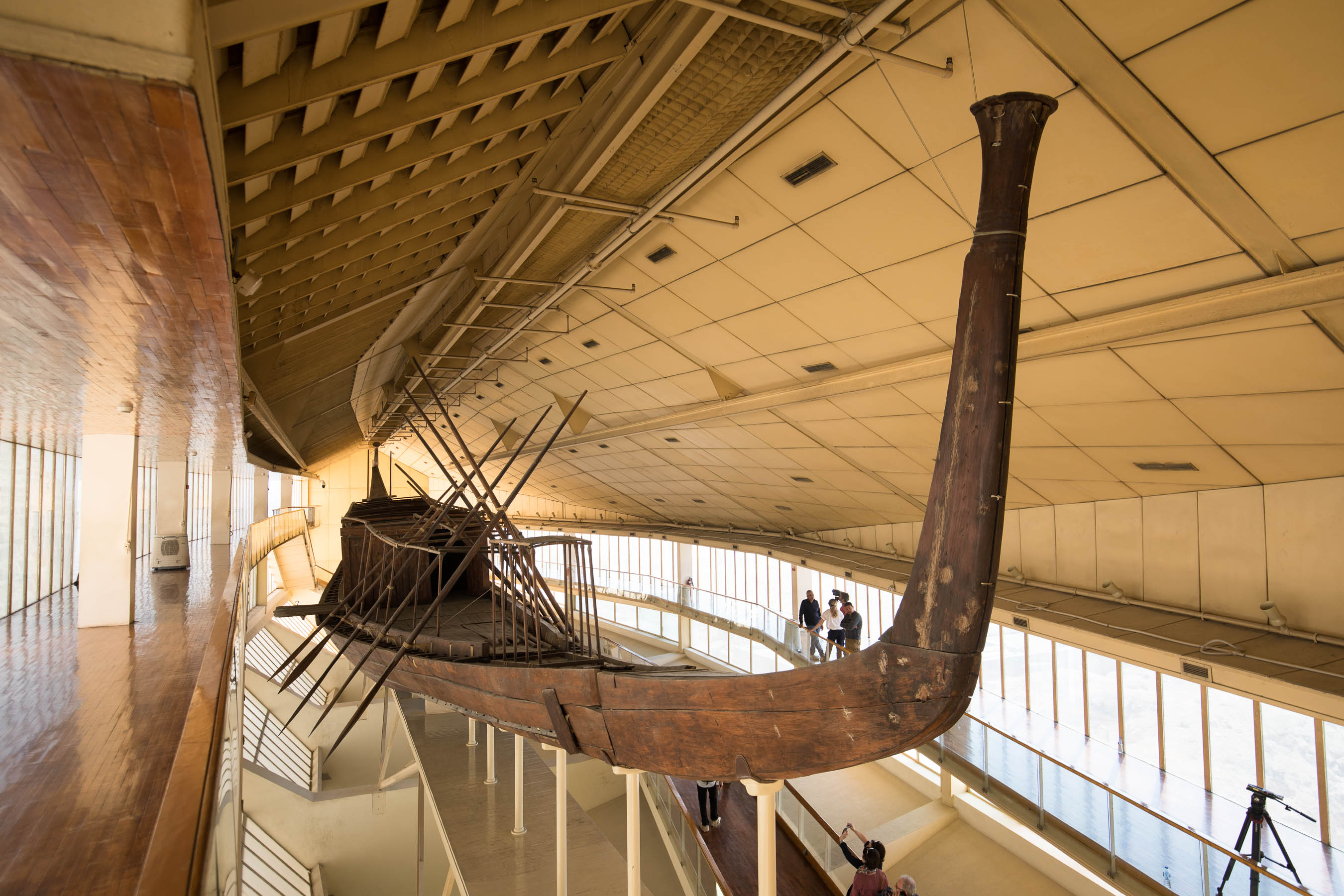
This cedar boat was found buried in a specially constructed pit next to the Great Pyramid.
In 1954 the young archaeologist, Kamal el-Mallakh, was given the inglorious task of clearing away mounds of rubble from the southern side of the Great Pyramid. It did not seem like the sort of task that would lead to a great discovery. But in the process of clearing the rubble from the base of the pyramid, el-Mallakh and his men made an unexpected discovery: a long, narrow pit covered by large stones, each weighing around 16 tons. There was no way to know what the pit contained without cutting a hole through one of the stones. Unfortunately, the discovery coincided with a military coup in Egypt, forcing el-Mallakh to wait until the political situation was resolved. When the new government formed by Gamal Abdel Nasser finally granted permission to proceed, el-Mallakh and his men eagerly chiseled a hole through one of the massive covering stones and lowered a camera into the pit. The picture taken that day revealed a stack of carefully arranged cedar planks and many yards of rope. As el-Mallakh suspected, the narrow pit contained a giant wooden boat.

The boat pits (highlighted in red) were found next to Khufu’s pyramid. Only one was opened. The other remained sealed until 2009 when it was finally opened and a second boat removed. As of 2022 this boat is still being restored.

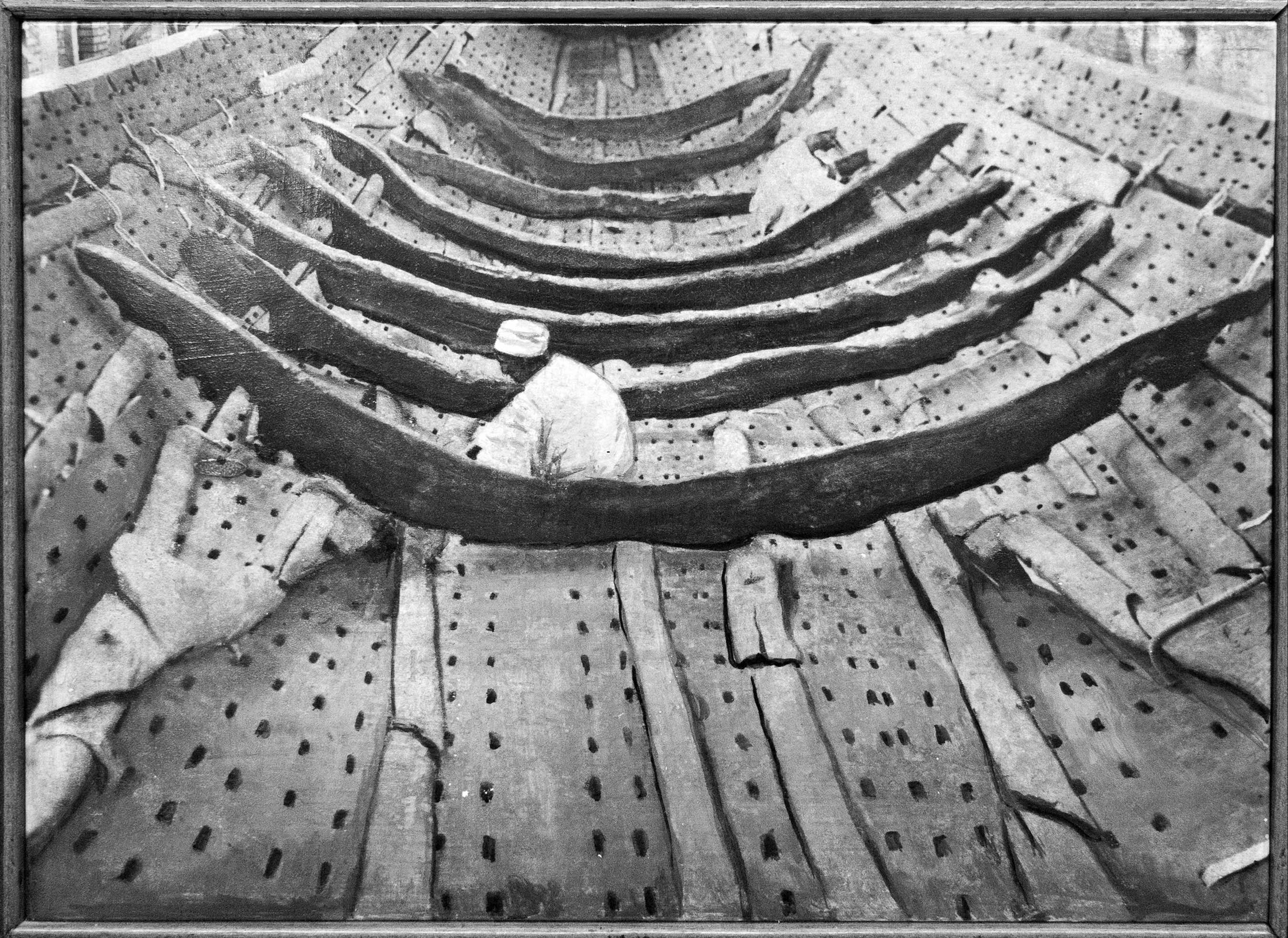
A picture from inside the pit shortly after it was opened.
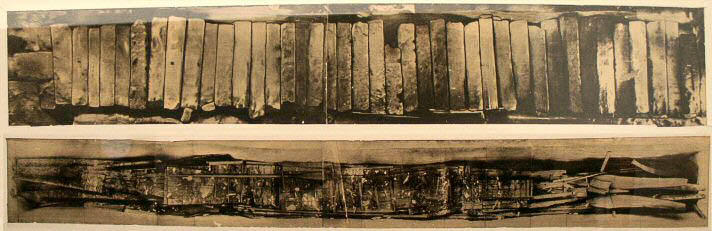
The boat pit before its heavy stone covering blocks were removed (above), and after they were removed (below).

This model of Khufu’s ship displays the profile of a typical Egyptian river boat, with its shallow hull and the absence of a keel. The ship was was powered by ten oars and had two steering oars at the stern.
Construction
What they discovered that day was essentially a 4500 year old, life size, boat builders kit, without the instructions. The task of assembling it was entrusted to Hag Ahmed Youssef Moustafa, an experienced restoration expert. His first step was to unpack and record the 651 separate pieces of the boat that were stacked in the pit thirteen layers deep.1Jenkins 1980, 8 The process of reassembly took more than ten years of painstaking effort. Moustafa and his team quickly discovered that the ship was not built in the typical way, with a center keel and side ribs, to which planking was attached. Instead, the Egyptian craftsmen sewed the planks of the hull together with rope. Each board had to be cut with great precision so that, when whetted, it would expand to create a watertight joint with the adjoining plank. Evidently this method of construction was still used in Herodotus’ day (5th century BC); the historian notes with surprise that Egyptian ships “have no ribs” and are “sewn together.”2Herodotus, History 2.96; The ship of Khufu does in fact have ribs of a sort, but not of the kind that would provide a rigid skeleton useful for attaching planks.
The ship of Khufu was made from cedar, a wood highly prized for its strength and lightness imported from Lebanon. Its aromatic resin makes it naturally resistant to decay. This could explain why Khufu’s ship was found in such good condition despite the passage of over four millennia! The length and breadth of the boards used to construct Khufu’s ship (up to 72 feet long) reveals something of the magnificence of the trees which once blanketed the mountains of Lebanon.
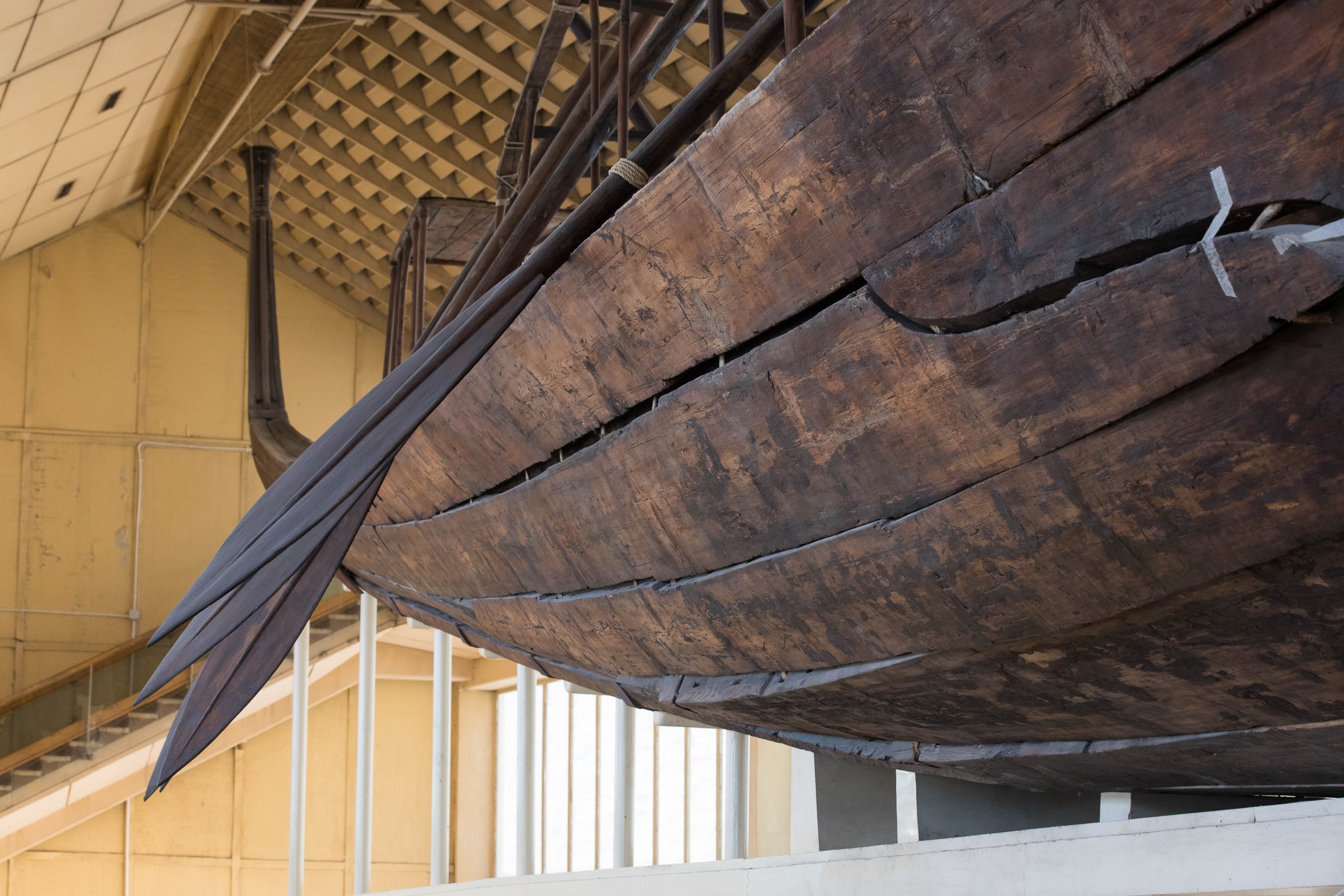

Left: The boards were precisely cut to fit. The task was made more difficult by the fact that each board had to be bent to the shape of the hull without a keel and ribs to hold the planking in place. End joints were ‘scarfed’ to give them strength (a scarfed joint is visible in the upper right corner). Notice also the square ‘mortises’ visible on the edge of the board. These were fitted with ‘tenons’ used to lock the boards into position. Right: Hundreds of yards of rope twisted from grass fiber were found in the boat pit.
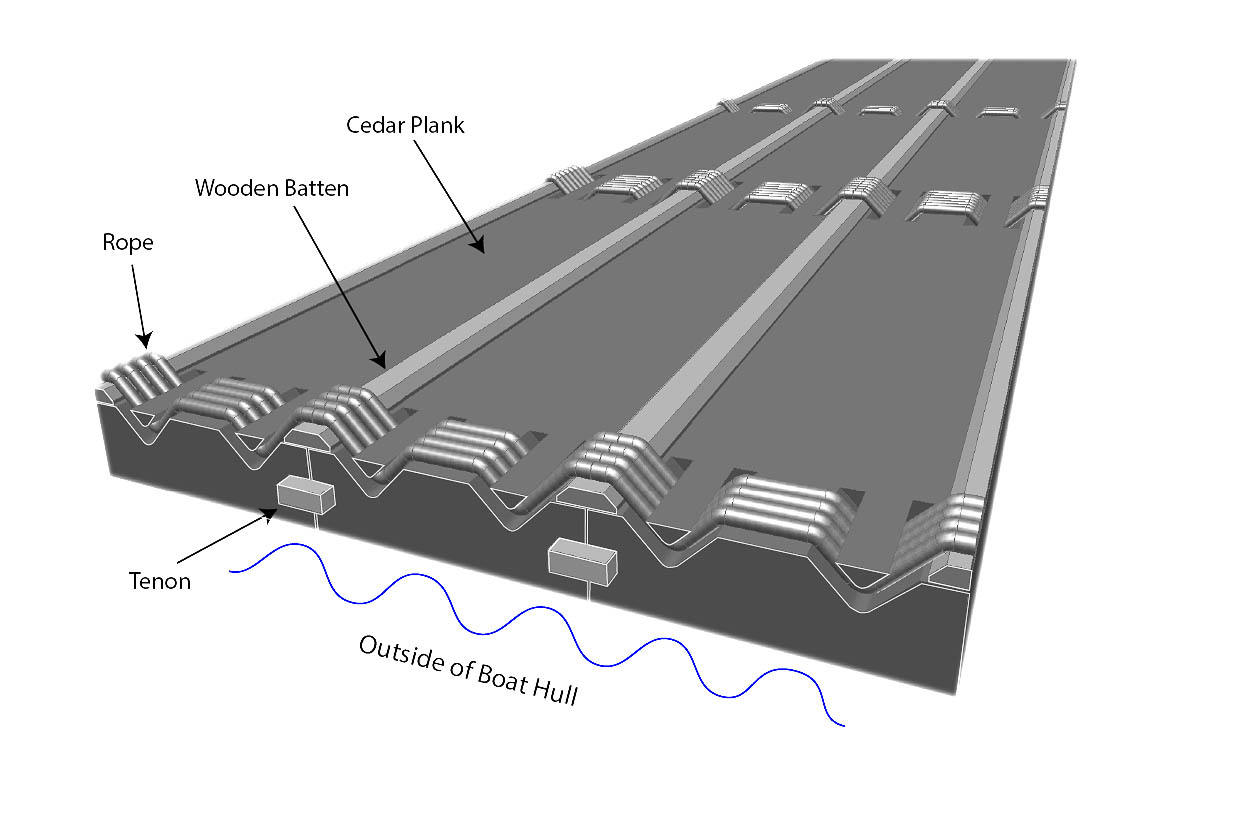
No metal fasteners of any kind were used to build the hull. Every board was carefully fitted together with mortise and tenon and lashed together with rope. Its seams were caulked with papyrus.
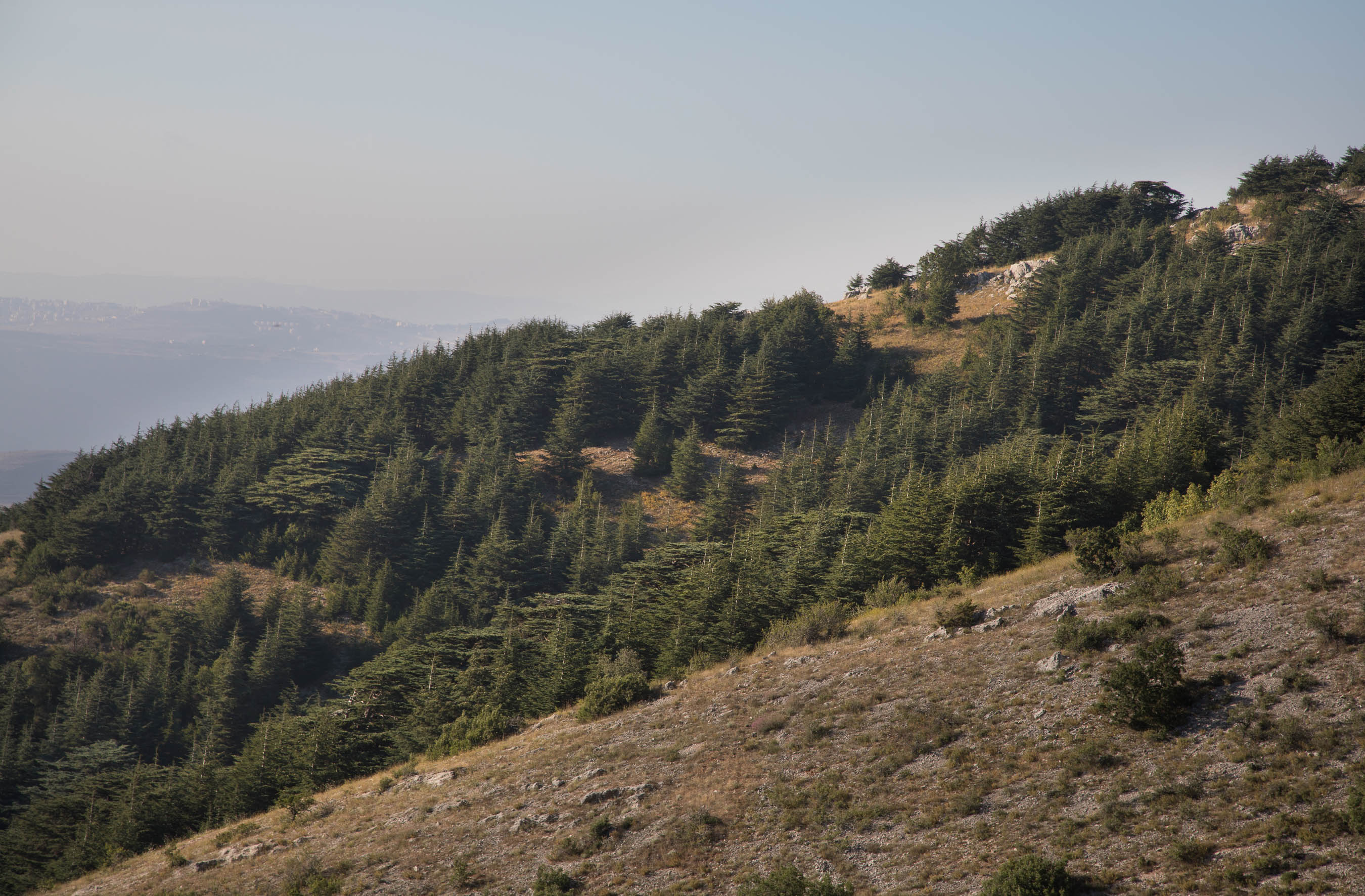

Left: A mixed forest of flat-topped cedars and pointy conifers planted in the Barouk Forest of Lebanon. The forests were already depleted in ancient times. Right: A cedar of Lebanon planted on the grounds of the palace of Versailles in France. It is more than a century-and-a-half old.
Purpose
As noted previously, a whole fleet of boats was found buried next to the Shunet el-Zebib at Abydos, and boats have been found in other cemeteries as well, but none compares to the magnificence of Khufu’s ship. It is a worthy complement therefore to his equally impressive pyramid. The boat was probably never intended for daily use. It was made to carry Khufu across the sky to the western horizon where he could join the setting sun.


Khufu’s boat mimics the shape of a papyrus raft. Its bow and stern, for example, were carved to look like a bundle of reeds lashed together.
The Palermo Stone composed during the Fifth Dynasty of Egypt (more on this later) marks each year with an important event. Although badly broken, it preserves the following event in the reign of Sneferu (the father of Khufu).
[Reign of] Sneferu. Year …The building of tuataua ships of mer wood of a hundred capacity, and 60 royal boats of sixteen capacity.3The Palermo Stone
Khufu’s ship likely qualifies as a royal boat with a capacity of “sixteen.” The tuataua ships, with a capacity of “one hundred,” would have had six times the displacement. Thus we get a sense of how large these tuataua ships would have been.
Casson, L.
Ships and seamanship in the ancient world..
Baltimore: Johns Hopkins University Press, 1995.
Herodotus, G. Rawlinson.
The Histories.
New York: Everyman/Alfred A. Knopf, 1997.
Jenkins, N. H.
The Boat Beneath the Pyramid : King Cheops’ Royal Ship.
New York: Holt, Rinehart and Winston, 1980. Link