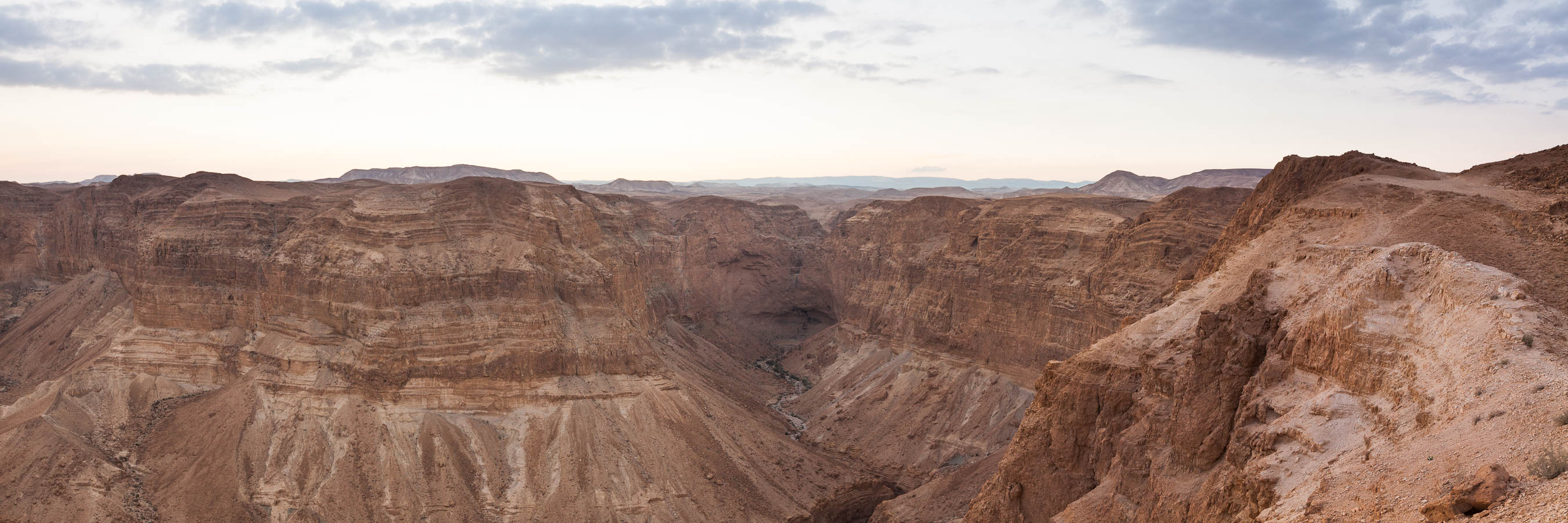
This picture was taken from above Ein Gedi looking west. The city of Hebron is in the hills on the far horizon. Nahal Mishmar is a neighboring canyon located approximately 6 miles south of Wadi Arugot. The Hebrew term nahal and the Arabic term wadi have the same basic meaning of “canyon.”
In the early 1960’s the Israeli archaeologist, Pesah Bar-Adon, and his team lowered a rope ladder one hundred and thirty feet down the vertical cliff face of Nahal Mishmar, one of the many deep canyons which carries water from the Judaean mountains to the Dead Sea. The region had already produced many spectacular discoveries, including the Dead Sea Scrolls, which are the earliest known copies of the Bible. Pesah Bar-Adon hoped it would produce one more.
Having clambered down the face of the canyon, they entered a sizeable cave which did indeed show signs of occupation. However, their explorations were hindered by a giant boulder which blocked access to the rear of the cave. It took the concerted effort of all of the soldiers attached to the expedition to pry loose the stone and break it into pieces. With the way now cleared, they began to excavate the deepest parts of the cave. After eight days of digging, two of the team members uncovered a crevice at the back of the cave covered by a flat rock. Pesach Bar-Adon recounts what happened next.
“This covering stone was flawed at the edges, so that at the very first glance several metal objects could be seen glinting through the cracks. We at once set about clearing away the loose earth all around the stone, until the whole of it was exposed. Then darkness forced us to stop working for the night. Early the next morning we started to lay bare the hoard.”1https://www.timesofisrael.com/unexpected-beauty-and-unanswered-riddles-from-a-desert-cave/
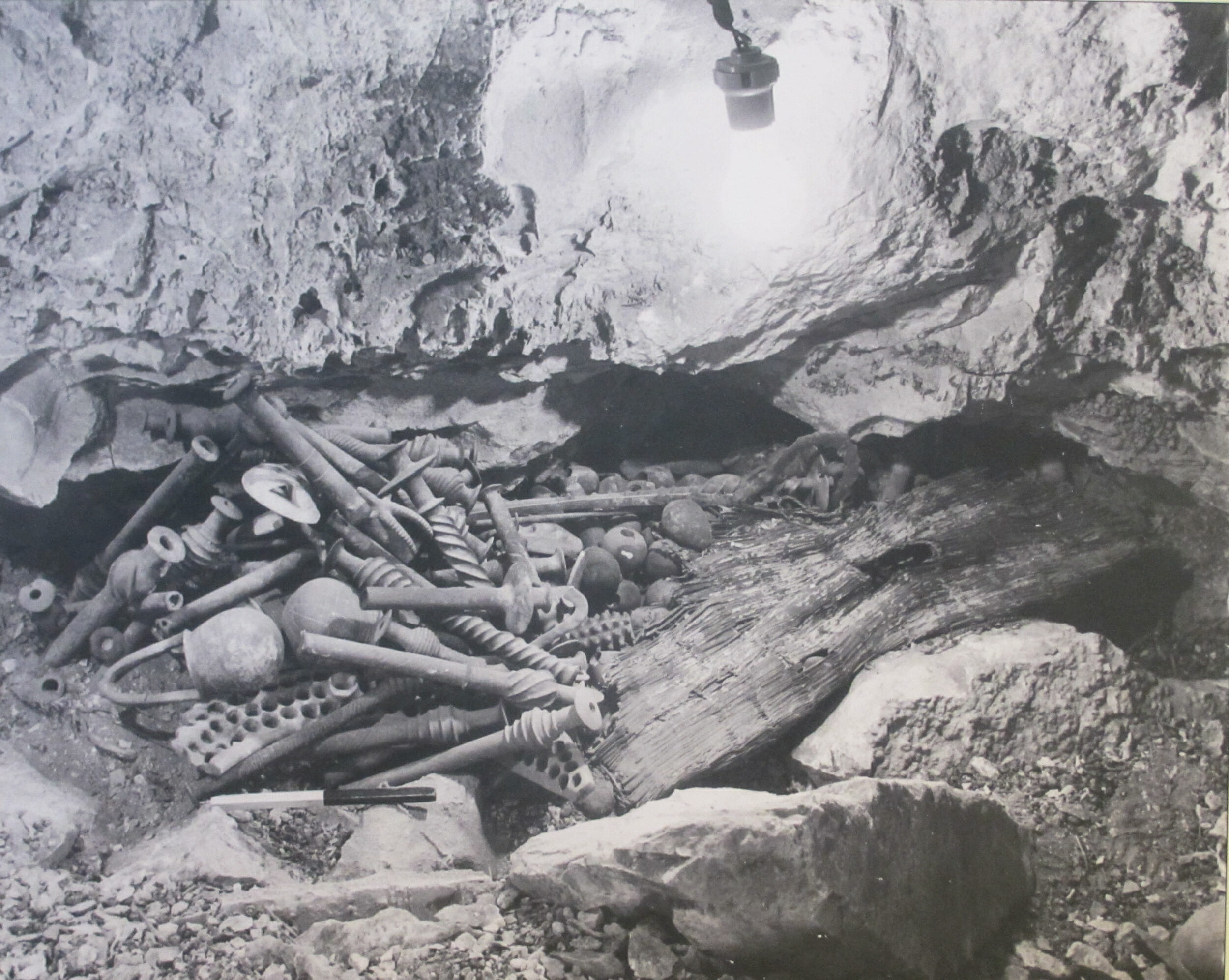
The next day Pesah Bar-Adon and his team discovered a spectacular hoard of over four hundred copper and ivory objects wrapped in a reed mat and hidden in the rock crevice.
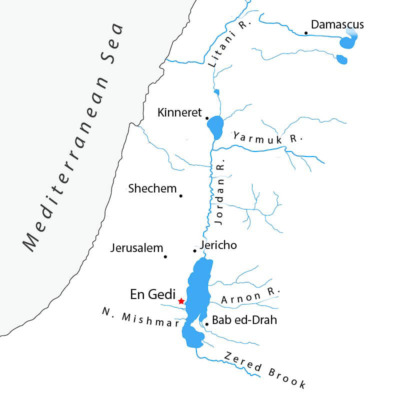
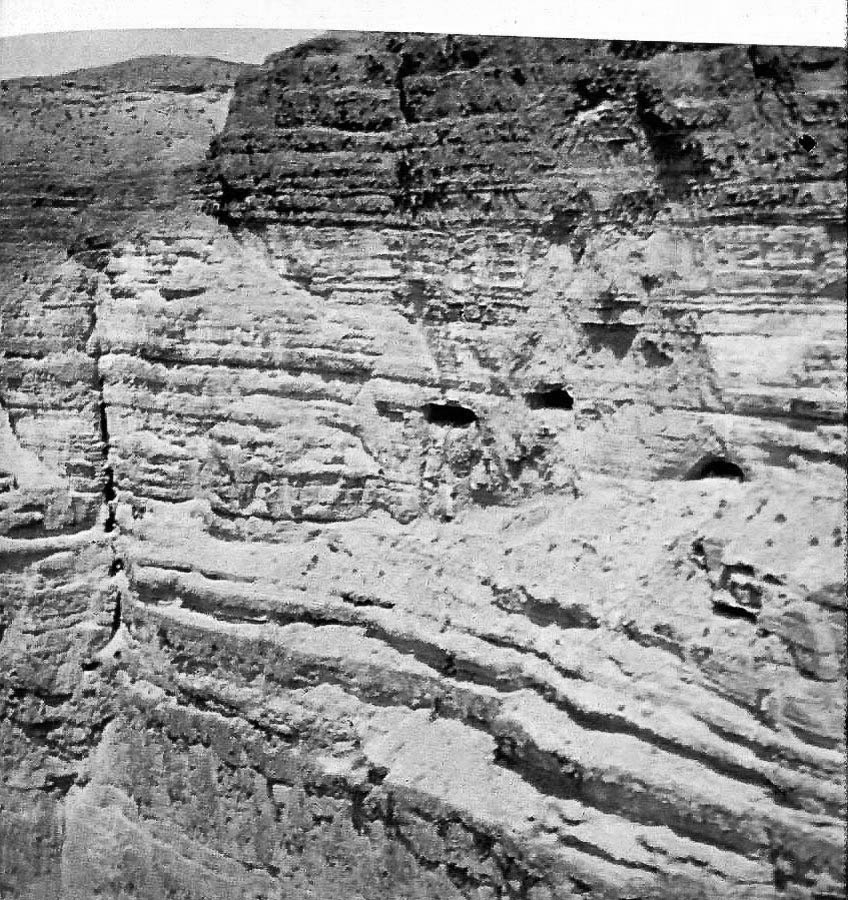
The cave was situated high up on the canyon wall. Nahal is the Hebrew word for ‘canyon’.
Another Israeli archaeologist, David Ussishkin, proposed that the objects discovered in the cave at Nahal Mishmar may have originated from the nearby temple of En Gedi whose stone foundations are still visible today on a hilltop overlooking the Dead Sea. Perhaps these objects were hidden in the cave during a period of unrest and were never retrieved?

This picture was taken from above the Ghassulian temple looking south. Nahal Mishmar is located approximately 6 miles south of Ein Gedi.
Metallurgy
The copper objects from Nahal Mishmar may be classified into two broad categories: 1) tools such as axes, adzes, and chisels; 2) prestige objects such as maces, “crowns,” and standards. The tools were cast from almost pure copper whereas most of the prestige objects were cast from copper alloyed with arsenic (5-12%) and smaller amounts of antimony (lead).


Counterintuitively, those objects which could have benefited most from the addition of arsenic to the copper (ie. the tools) were cast from pure copper.
The addition of arsenic to copper makes it stronger and easier to cast. Ancient metallurgists would eventually replace arsenic with tin to produce true “tin bronze” but tin was not mined in any great quantity at this early period. The source of the arsenic and the means by which it was alloyed with the copper remain a matter of debate. It has been suggested that arsenic may have been naturally present in the copper ore before it was smelted. However, the prestige objects from Nahal Mishmar contain as much as 9-12% arsenic, which is much higher than the trace amounts of arsenic naturally occurring in ore. Certainly, the craftsmen who produced these objects must have understood the benefits of arsenical copper and how to take advantage of it. The copper used to cast the prestige objects is thought to have originated in the Caucasus or Azerbaijan since this region is well known for its arsenical copper ores.2Tadmor, et. al. 1995, 141 However, the objects themselves appear to have been produced locally since they display typically Ghassulian motifs.


Various styles of metal vessels found in the Nahal Mishmar Hoard. The vessels are decorated with hatched lines. One of the horns appears to terminate with a “dragon’s head.”
Cire Perdue
The ceremonial objects in the Nahal Mishmar hoard exhibit a mastery of metallurgy and knowledge of the cire perdue (“lost-wax”) technique of casting metal; a technique still used today for casting jewelry and precision parts. The essential elements of this method haven’t changed over the millennia.
- A precise representation of the object is carved from wax. This is the wax pattern.
- Wax rods are attached to the pattern. These will form the flue through which the metal is poured and the vents that allow air to escape.
- The wax pattern, with its flues and vents, is coated with multiple layers of clay mixed (“tempered”) with crushed burnt bones, sea shells, etc. The clay (‘”refractory”) must be able to withstand high temperatures.
- The clay is heated until the wax melts leaving behind an empty cavity.
- The clay mold is fired until it forms a hard shell with an inner cavity. Now we have a clay mold.
- Molten metal is poured into the mold cavity.
- Upon filling the mold with metal, it is doused in cold water causing the clay fracture and break away from the metal casting.
- Each mold is only good for one casting and then the process must be repeated again.
The discovery of such fine metal castings in the Nahal Mishmar hoard, produced using the cire perdue method, came as a complete surprise to scholars who study ancient metallurgy. Here is how one group of researchers describe the advanced casting technology exhibited by the hoard,
The Judean Desert hoard is unique in every respect, but none is more outstanding and puzzling than its metallurgical aspects: first, the very existence of hundreds of metal objects at such an early date and in an unexpected location; and foremost, the outstanding capability of the ancient smiths, which finds an undisputed testimony in this superb assemblage.3Tadmor et al. 1995, 100
Maceheads and Scepters
Maceheads are among the most numerous items in the Nahal Mishmar Hoard. They are typically “piriform” (Latin. “pear-shaped”) although disc-shaped mace heads are also represented. Both styles of mace heads were used in Egypt during the Late Predynastic period.


Both piriform and disc-shaped maceheads were found in the hoard. The amount of metal used to cast the maceheads represents an incredible amount of human energy.
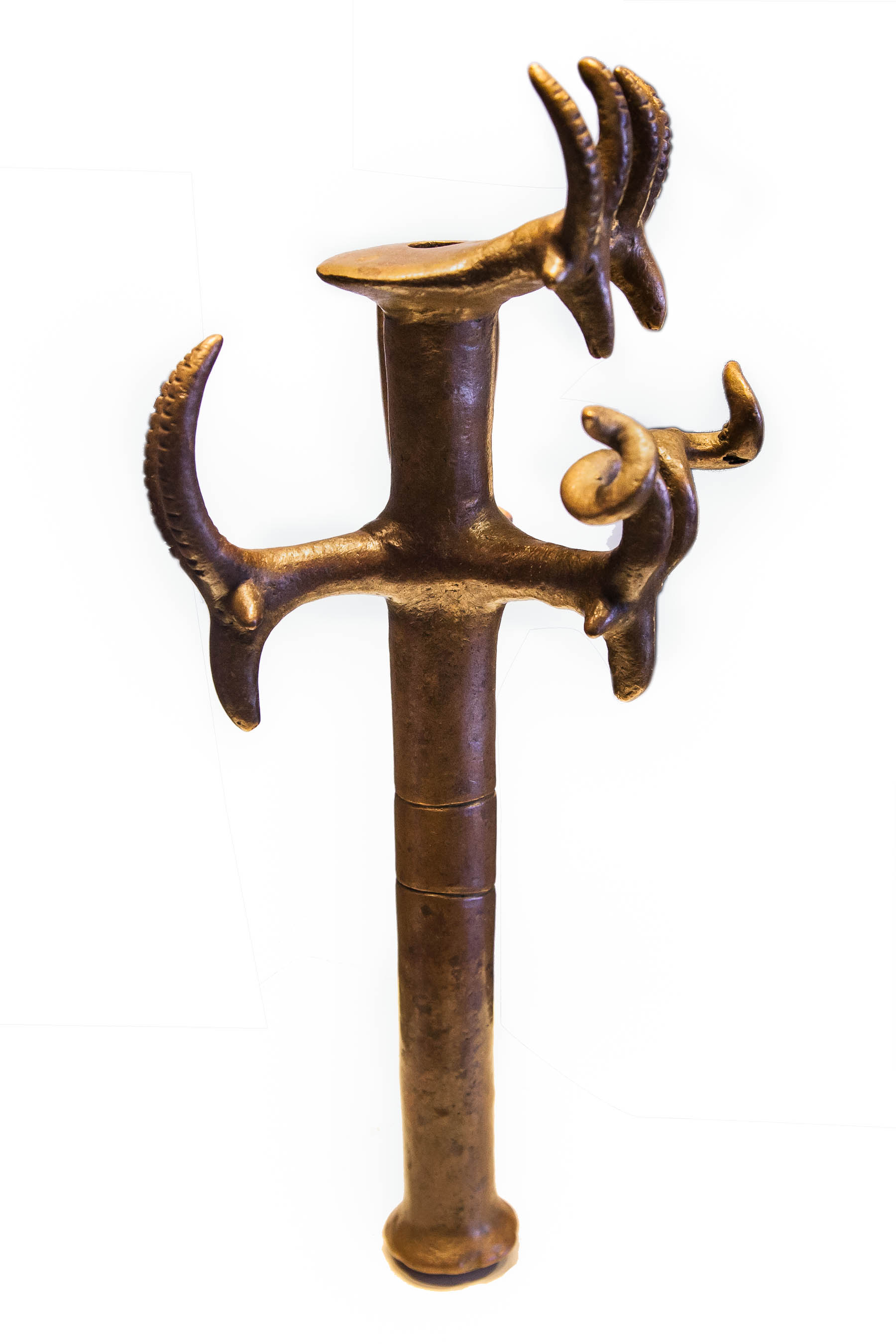
Another class of object are what might best be termed “scepters.” They took the form of long narrow tubes decorated with peculiarly shaped knobs and geometric patterns. The thinness of the walls of the tubes are such that even today’s metallurgists would have a difficult time casting them.4Tadmor et al. 1995, 144 These ornate scepter heads, if that is what they are, must have been attached to a small wooden shaft.
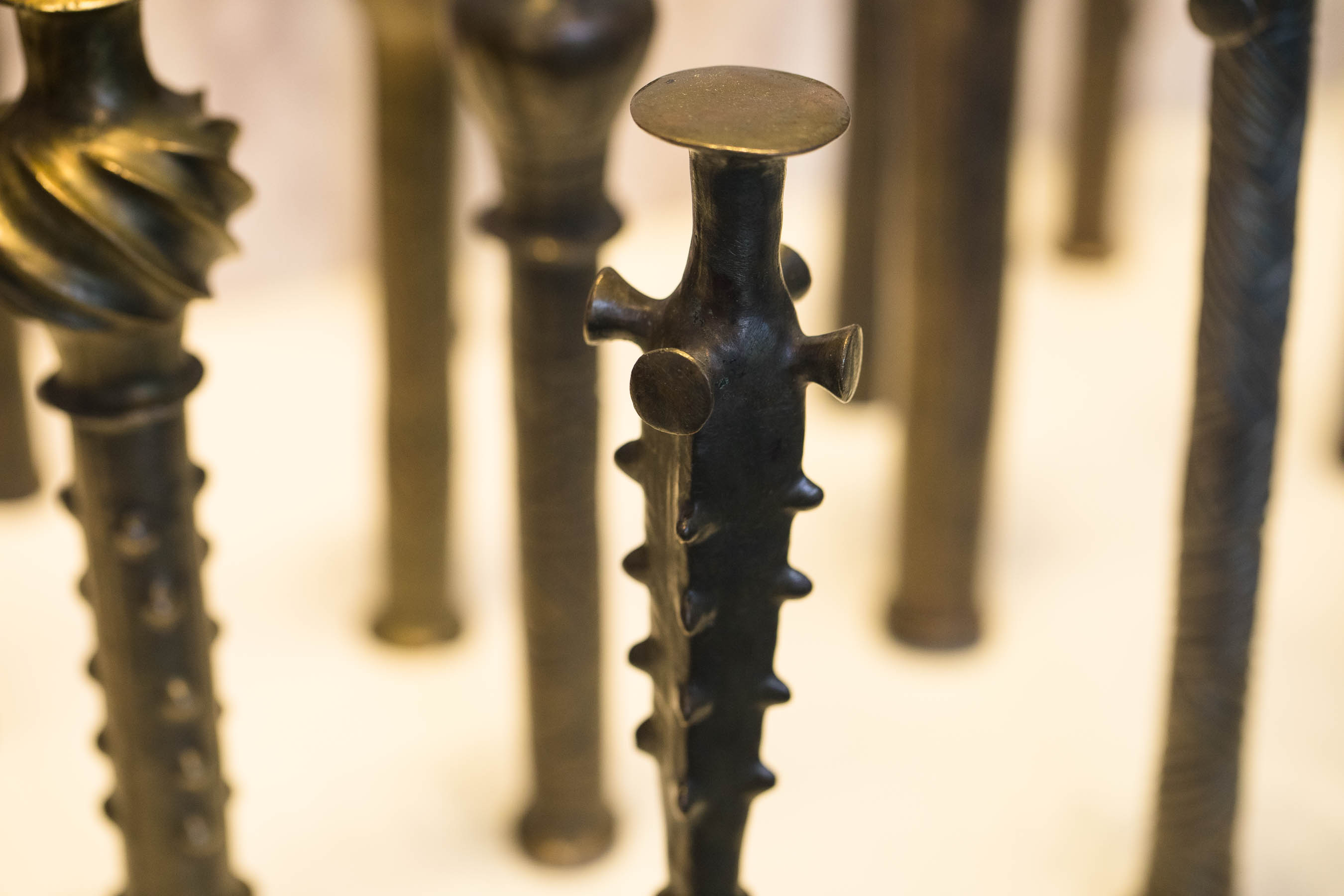
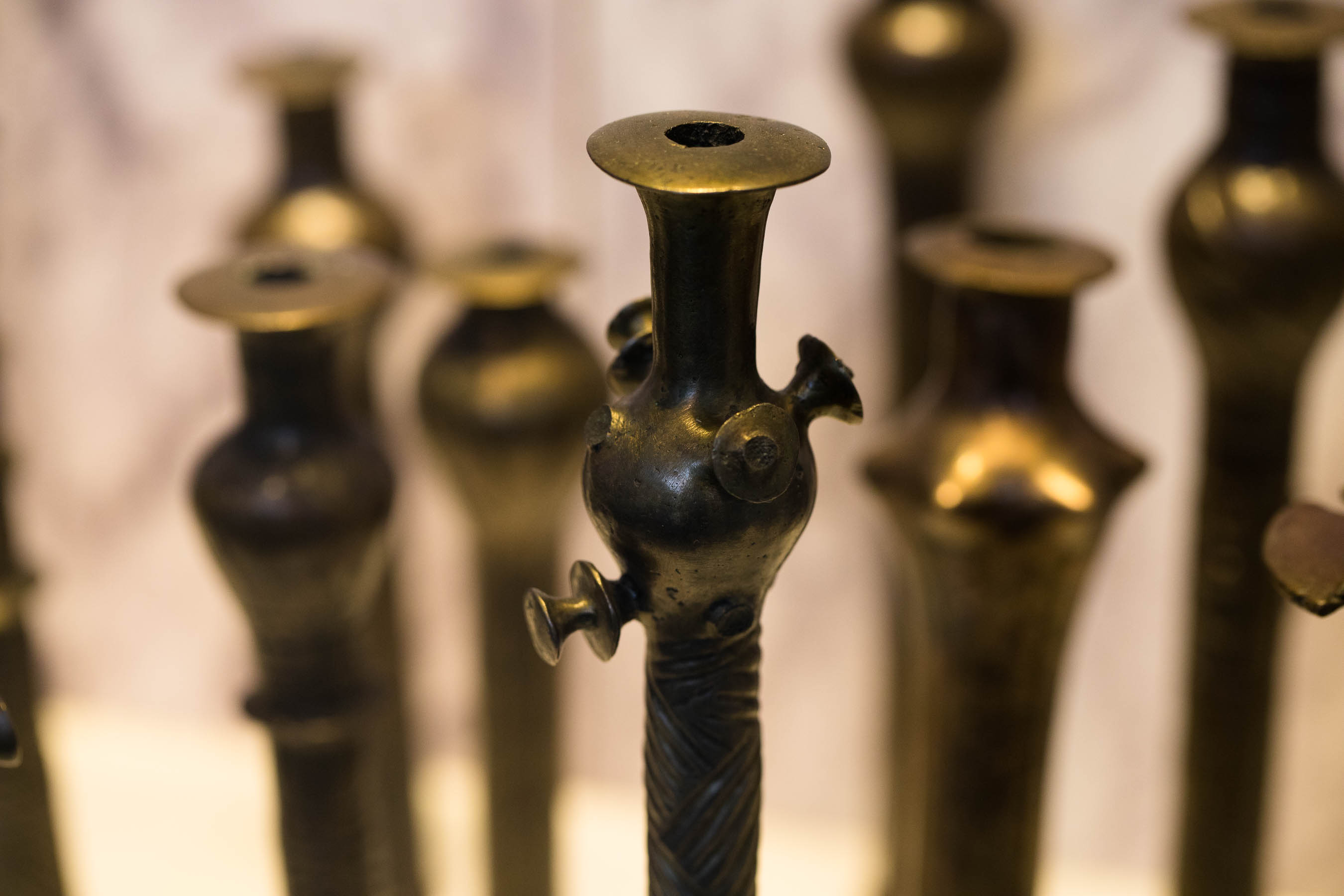
These take the form of long, hollow tubes. The significance of the protruding knobs is unknown.
The maceheads and scepters were probably votive offerings dedicated to a deity like Nisaba, a Mesopotamia warrior goddess who is often depicted on cylinder seals with maceheads extending from her back. Ceremonial maceheads and scepters like those found at Nahal Mishmar are often found in early bronze temples in Egypt, Mesopotamia, and Iran.
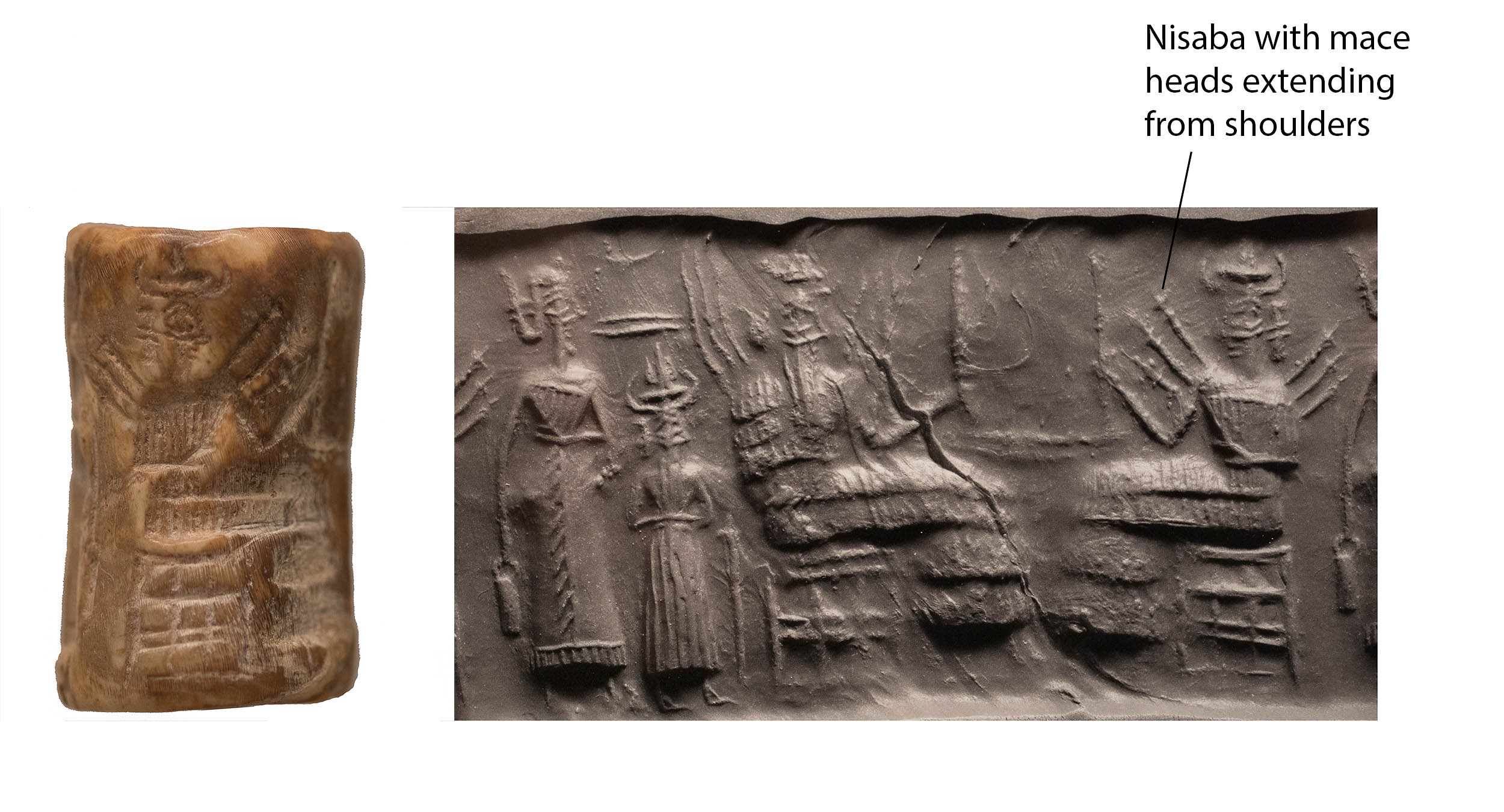
This cylinder seal depicts the Sumerian goddess, Nisaba, with maceheads extending from her back. She is seated across from Shamash, the sun-god, who is shown with the rays of the sun extending from his back.
Standards
Many of the items from the Nahal Mishmar Hoard seem to have been fitted to a longer shaft that was carried overhead. Some appear to be stylized plants or reeds while others took the form of animals such as the ibex or eagle.

The knobs and branches seem to be inspired by plant motifs.
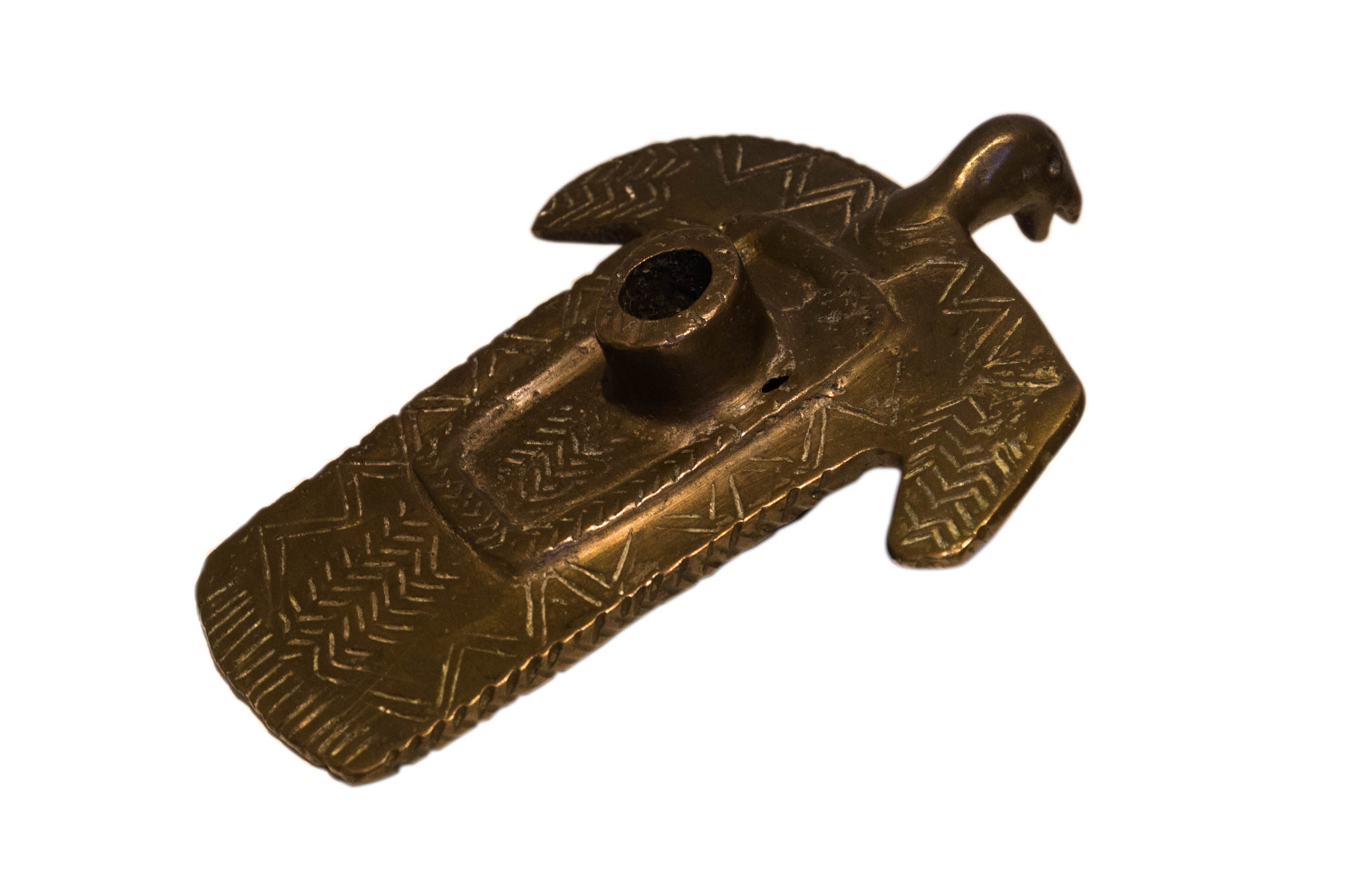
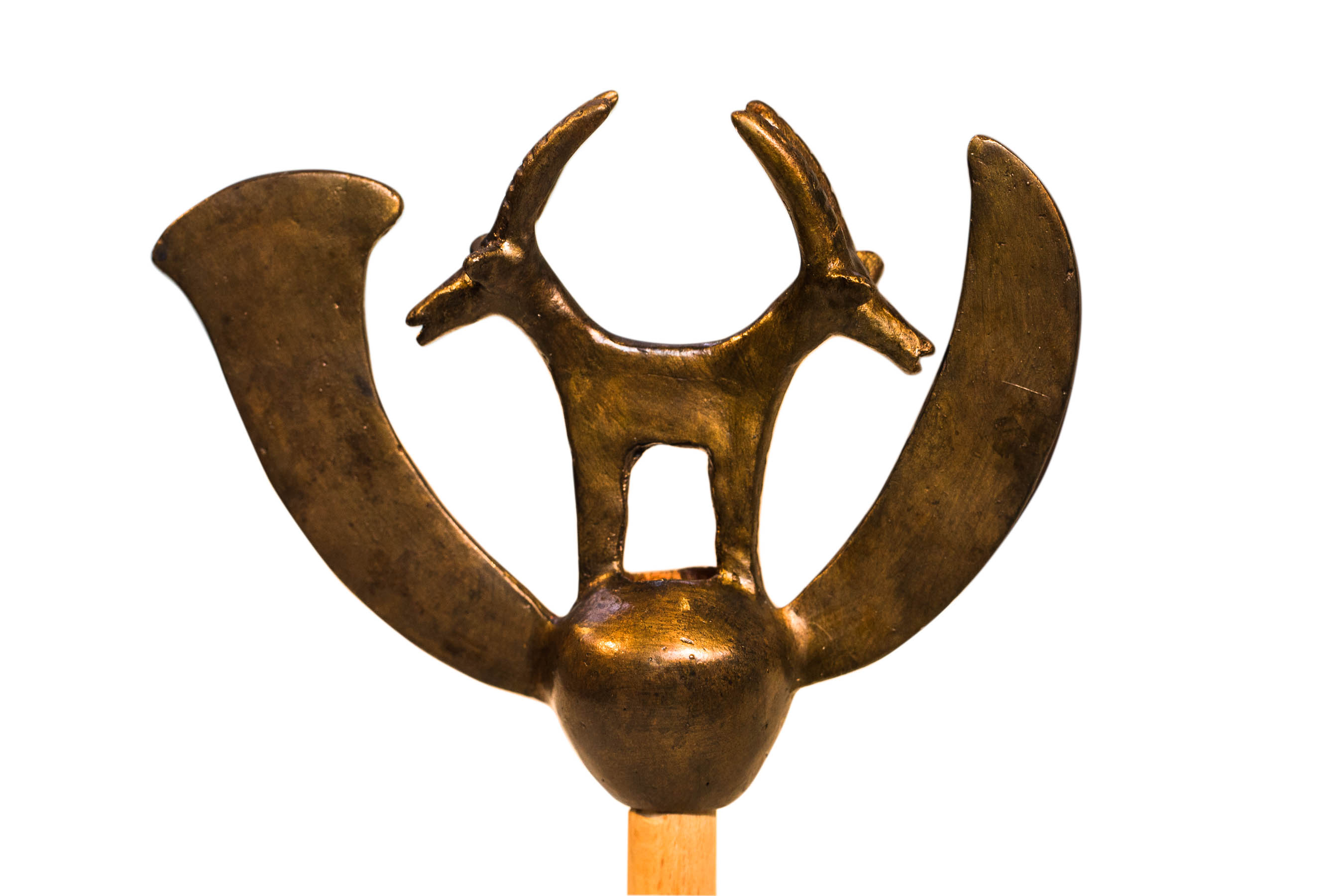
These are the only animals represented in the Nahal Mishmar hoard. They seem to have functioned as “totems”—sacred animals adopted by a tribe.

This ram and ibex standard is one of the most iconic objects from the Nahal Mishmar hoard. Ibex are still commonly found at En Gedi, which means the “Spring of the Goat.”
Several mysterious objects made from hippopotamus ivory appear to have functioned as a standard of some kind since they have a socket made to fit to a pole. The purpose for the holes drilled in the tusks is unknown.
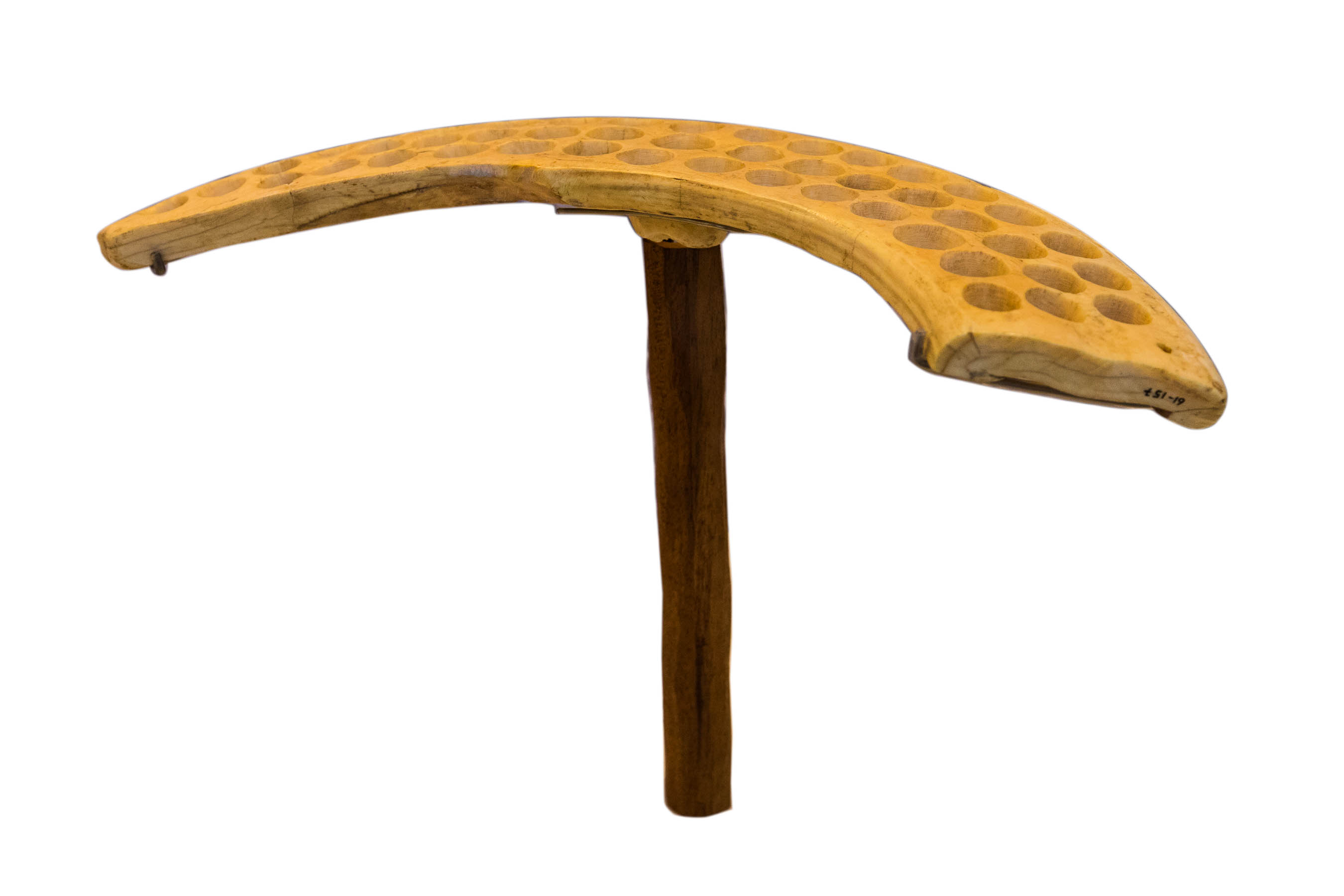
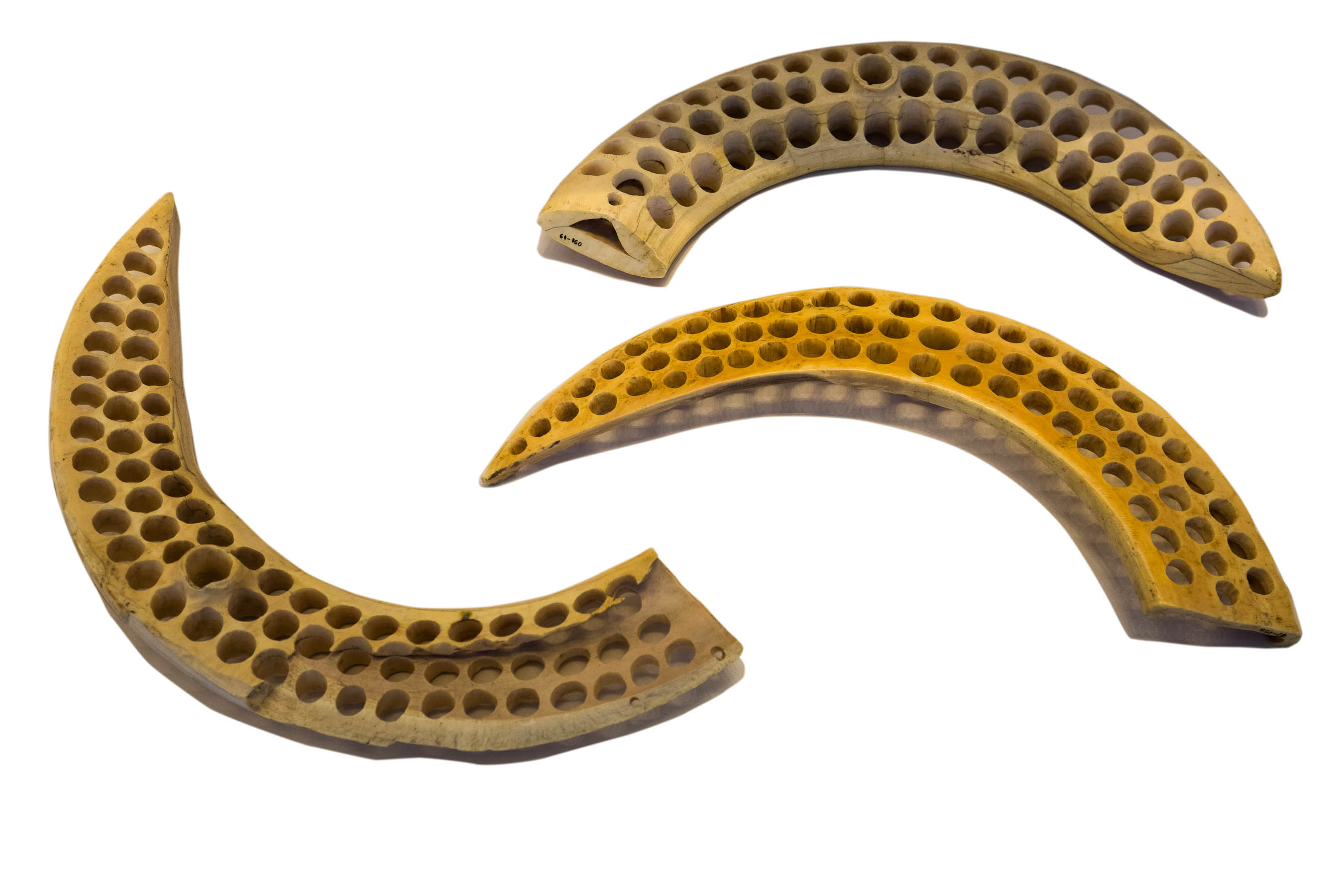
The lower canines of the hippopotamus grow on average 24 inches long and weigh six pounds each. The ivory from these animals was especially sought after because of its white color, which retains its whiteness for longer than other types of ivory.1Horwitz and Tchernov 1990, 67
Copper Rings
There is much more that could be said about this hoard, but we will conclude with a brief discussion of nine enigmatic rings cast from arsenical copper. As noted previously, the addition of arsenic improved the fluidity of the metal during casting, allowing craftsmen to cast difficult shapes such as these rings, which present a unique challenge. On several rings the metalsmith was forced to patch the holes using what appears to be soldering—the fusing together of two metal objects using a third metal which has a lower melting point than the metal it is fusing together.

These enigmatic copper rings were among the objects belonging to the Nahal Mishmar Hoard.
One ring has two ibex heads attached to it while another has an eclectic group of objects attached to its rim, including two birds, a “knob”, and two rectangular frames which probably represent the doorway of a shrine. A pair of ibex horns are attached to the top of the doorway and four knobs to each doorpost. The use of knobs for decoration is characteristic of Ghassulian artifacts in general. The eagle(?) and the ibex also seem to have been special objects of veneration.


The ring is decorated with birds and what appears to be a doorway into a temple surmounted by ibex horns.
Various interpretations of the rings have been offered. One possibility is that they represent a sacred shrine.5Moorey 1988, 179 A “wheel” arrayed with wild gazelle is depicted on the wall of Tomb 100 at Hierakonpolis. Its meaning is unknown but it may represent a sacred shrine associated with gazelle, just as the pr-wr was closely associated with the elephant. In Uruk we find similar shrines flanked by reed-ring poles and cattle. The copper rings may be model shrines associated with the ibex and the eagle.

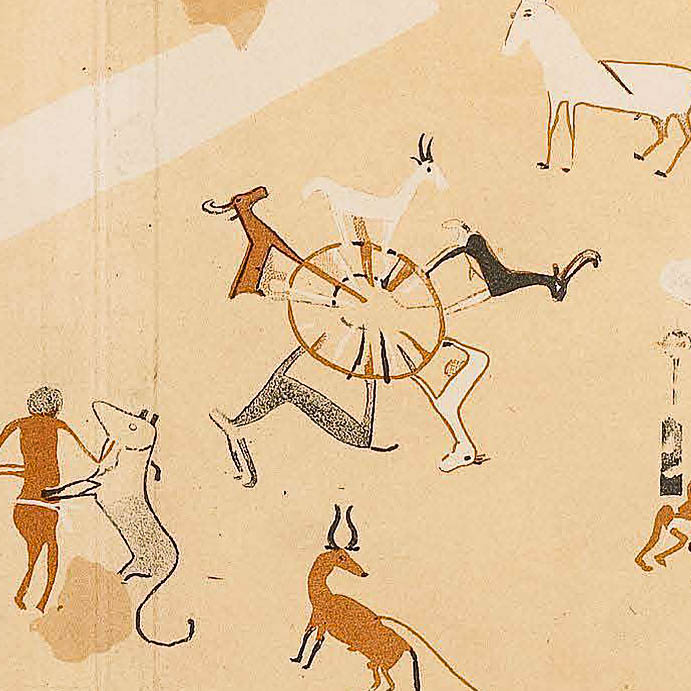
Left: An animal trough from Uruk depicts a sacred “cow shed.” Right: Gazelle shown in profile with straight legs, as though they were “attached” to a ring. From the mural in Tomb 100 at Hierakonpolis. The emblem may be interpreted as some kind of animal corral, comparable, perhaps, to the Sumerian “cow sheds.”
How old are they?
Due to the very hot and dry climate around the Dead Sea, the reed mat used to transport the hoard to the cave in Nahal Mishmar was found in remarkably good condition. It was woven from papyrus, a plant native to the Nile Delta and the upper Jordan Valley around Lake Huleh. Perhaps papyrus could still be found in the lower Jordan Valley during the Early Bronze period.


The objects at Nahal Mishmar were found wrapped in this remarkably well preserved reed mat.
Radiocarbon analysis of the basket material returned dates of ~ 4350 BC.6Rowan and Golden 2009, 45 The hoard is now therefore generally dated to the end of the fifth millennium, a date which falls squarely in the middle of the Chalcolithic period according to the Standard chronology.7Gilead and Gošić write, “…it seems that the dating of the hoard to the Fifth Millennium is established since eight out of the nine recent dates [C14] are in the Fifth Millennium.” Gilead and Gošić 2014, 233 This is an exceptionally early date for the hoard since objects produced using the cire perdue method of casting are otherwise unknown from the period. Not only do these castings exhibit advanced casting techniques for their time, they also exhibit advanced knowledge of alloying and possibly soldering as well. There is good reason, therefore, to question such an early date.8See Guil 2018 for a helpful overview of the problem.

This small copper ram mounted to the top of an Uruk period cylinder seal is the next earliest example of the cire perdue method of casting metal.
It is also worth noting that the pottery found in the lowest levels of the cave was dated by Bar-Adon to the Early Bronze I period.9Gošić and Gilead 2014, 228 Archaeologists digging at Ashkelon Afridar on the southern coast of Israel likewise found fragments of pottery churns, basalt stands, cornets, and other typically Ghassulian artifacts in levels which otherwise clearly date to the Early Bronze I period.10Golani writes, “The material culture from excavations of the early EB I at Ashqelon Afridar (Areas E, F, G, J, M, N and Area 10) and in the early phases of settlement at Ashqelon Barnea, included finds typical of the early EB I such as curvilinear architecture, gray-burnished bowls (in small amounts) and Canaanean flint blades. However, alongside all these, typical Late Chalcolithic Ghassulian ceramic forms, including cornet bases and churns, Chalcolithic flint tools and basalt vessels, are also present in the same occupational contexts.” (Golani 2013, 98) This evidence contradicts a 5th millennium date for the hoard. Stylistically the Nahal Mishmar hoard may be compared to ritual objects found at Alacahoyuk in central Turkey and Tepe Hissar in Iran. The cumulative evidence points to a date in the Early Bronze I for the production of the Nahal Mishmar Hoard.
Bar-Adon, Pesach.
The Cave of the Treasure: The Finds from the Caves in Nahal Mishmar.
Jerusalem: The Israel Exploration Society, 1980.
Gosic, M, I Gilead. “Fifty Years Later: A Critical Review of the Stratigraphy, Chronology and Context of the Nahal Mishmar Hoard.” Journal of the Israel Prehisoric Society 44 (2014): 226-239. Link
Guil, Schlomo. “Alternative Dating of the Prestige Items of Nahal Mishmar.” (March 2018). Link
Horwitz, L. K, E Tchernov. “Cultural and Environmental Implications of Hippopotamus Bone Remains in Archaeological Contexts in the Levant.” Bulletin of the American Schools of Oriental Research, no. 280 (1990): 67-76. Link
Moorey, P. R. S. “The Chalcolithic Hoard from Nahal Mishmar, Israel, in Context.” World Archaeology 20, no. 2 (1988): 171-189. Link
Moorey, P. R. S.
Ancient Mesopotamian Materials and Industries.
Oxford: Clarendon Press, 1994.
M., Tadmor, et al . “The Nahal Mishmar hoard from the Judean Desert: Technology, composition, and provenance.” Atiqot, no. 27 (1995): 95-148. Link