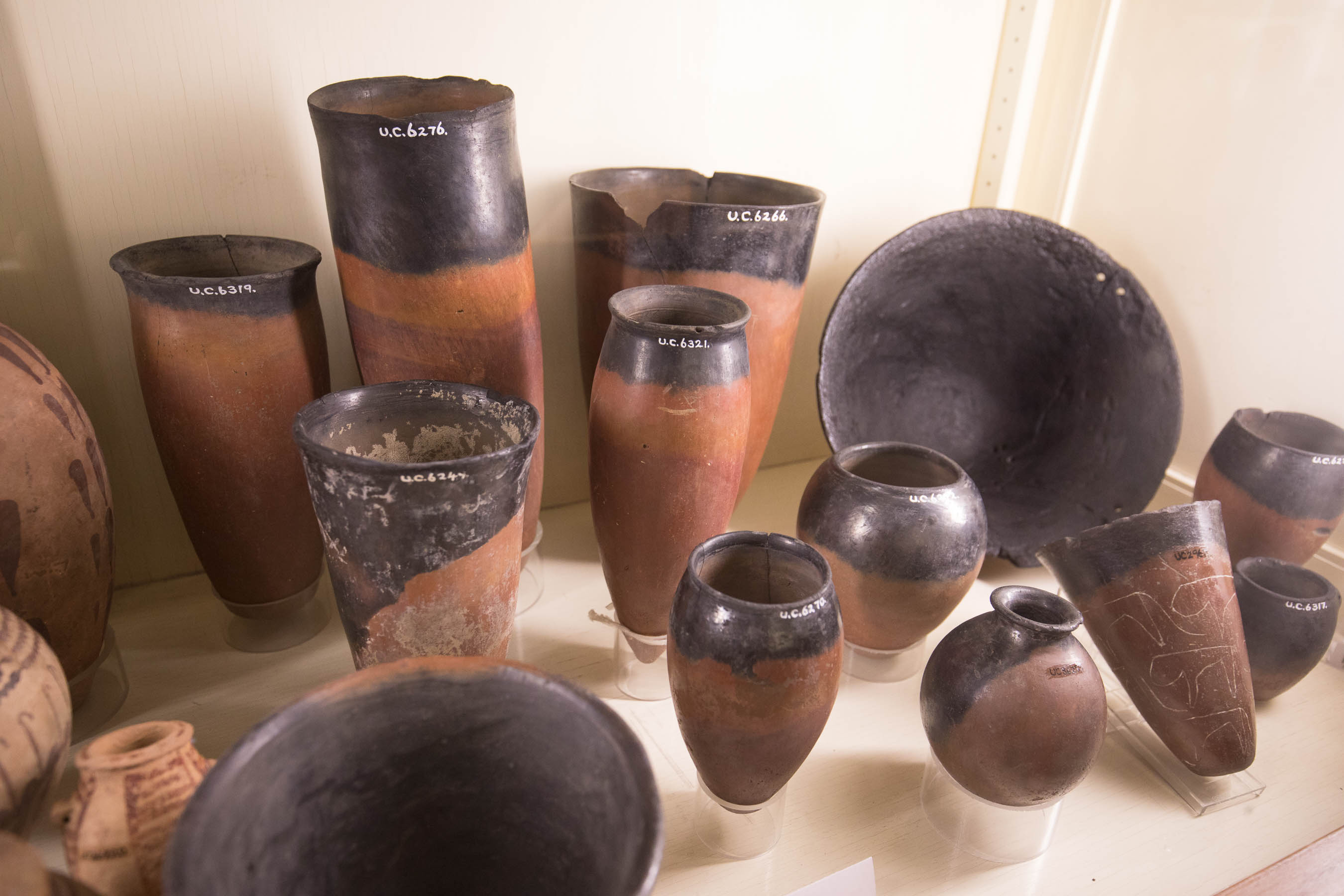
Vessels such as these are typically found in Predynastic tombs.
Black-topped vessels are one of the most easily recognized forms of predynastic Egyptian pottery. They were made from the clay of the Nile that was well “levigated” —the clay was washed to remove impurities. The vessels were formed by hand and allowed to air dry. Once leather-hard they were burnished by rubbing with a smooth stone, giving them a glossy appearance. During firing, the rim of the vessel was buried in ash. Those parts of the vessel that were buried turned black whereas the rest of the vessel turned bright red due to the iron oxide present in Nile clay. The end result was a red and black vessel with a bright metallic finish.
During excavations in the Naqada cemetery, Petrie began to create a “pottery sequence” for the predynastic period. This sequence is illustrated in the chart below, with the earliest pottery at the top (Naqada I) and the latest at the bottom (Naqada III).

This simplified chart of Petrie’s pottery sequence divides the Predynastic period into three sub-periods: Naqada I, II and III. The black-topped vessels are assigned to Naqada I and II. The Decorated Ware and Wavy Handled Jars are dated a little later.


The pots on the left were found at el-Badari, the type-site for the Badarian period, which archaeologists generally date to the 5th millennium BC. This makes the Badarian vessels approximately a millennium older than the pots on the right, which are of a type found at Hierakonpolis—if you accept the prevailing chronology for these periods.
Black and Red
The color of these vessels may have been more than decorative since, in Egypt, the desert was called “the red land” whereas the fertile Nile Valley was called “the black land.” Life flourished in the Nile Valley whereas the desert was associated with chaos and death.1Sowada 1999, 102 The black and red color of the beakers and jars, which are found exclusively in tombs, may have had a symbolic connection to Egypt’s sacred landscape, with the black color being associated with the fertile Nile soil, and therefore with life.

This is one of six “mummies” discovered in shallow graves at Gebelein, in Upper Egypt. The body was naturally mummified when it was placed in the hot sand. Compare the pottery in the tomb and its location in Petrie’s pottery sequence chart and it immediately becomes apparent that pottery forms supposedly exclusive to the Naqada I or II period may nevertheless be found together in the same tomb.
Friedman, R.
“Hierakonpolis,” in Before the pyramids : the origins of Egyptian civilization, edited by E Teeter.
Chicago, Ill: Oriental Institute of the University of Chicago, 2011. Link
Sowada, Karin N. “Black-Topped Ware in Early Dynastic Contexts.” The Journal of Egyptian Archaeology, no. 85 (1999): 85–102. Link