
These pottery stands were found in a burial cave at Peqi’in in northern Israel. The stands are decorated with vertical or horizontal red bands and applied ropework around the base of the bowl.
Ghassulian pottery stands were essentially a “V-shaped” bowl attached to a “fenestrated” stand—the latter being a technical term for “window.” Large numbers of these stands were found in Ghassulian funerary contexts, such as the burial cave at Peq’in in northern Israel where archaeologists found stands that still bore traces of ash leftover from burning incense. The stands were often decorated with applied ropework around the neck and painted with red bands.
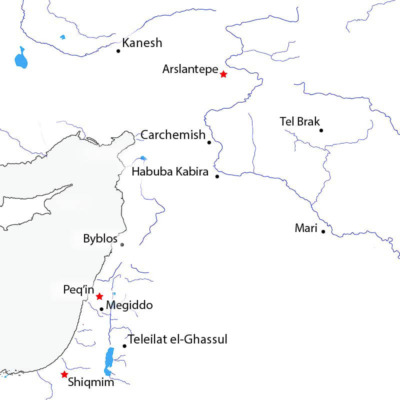
Nearly identical fenestrated pottery stands were found in Stratum VIA at Arslantepe. The city at this time functioned as a northern outpost in the vast network of Uruk trading colonies which grew up during the Late Uruk period. The similarities between the stands from Arsalntepe and Peq’in suggests that they are contemporary. This is another reason to lower the chronology of the Ghassulian culture approximately a millennium in order to make it contemporary with the Late Uruk period. The similarities between the pottery stands from the two regions also points to a cultural connection between the two during the EB I.

These fenestrated stands likewise display applied ropework and simple painted decoration with red stripes. They belong to Stratum VIA which is the “Proto-Urban Phase” at Arslantepe (EBI).
Frangipane , Marcella.
“The Late Chalcolithic IEB I sequence at Arslantepe. Chronological and cultural remarks from a frontier site,” in From the Euphrates to the Caucasus: Chronologies for the 4th-3rd millennium B.C. Varia Anatolica, 11 vols.
Actes du Colloque d’Istanbul: Institut Français d’Études Anatoliennes-Georges Dumézil, 2000. Link