The Great Temple of Megiddo was probably destroyed or abandoned during the Early Bronze II.1The excavators of the temple dated its destruction to the end of the Early Bronze I period (EB IB) which they dated to c. 2900 BC. If correct, then the temple was destroyed at the end of the Predynastic period (Adams et al. 2014, 294ff). It seems to me that the Great Temple was probably built around the same time as the fortification wall at Megiddo, which the Chicago expedition dated to the EB II. After a period of abandonment, a round altar was constructed on the rubble of the old temple.

This is the first altar of its kind discovered in Canaan. A large number of animal bones were found in the vicinity.
Measuring approximately 26 feet in diameter and 5 feet high, the altar was accessed by a stairway. Large quantities of animal bones in the area prove that it was indeed used as an altar—the first of its kind discovered in Canaan. A temple was constructed next to the altar (Temple 4040), and then a pair of temples (Temples 5192). Sharing identical layouts, all three temples seem to have stood together for a period of time despite their awkward arrangement.

Three temples belonging to Stratum XV may still be seen at Megiddo today.
The altar appears in Stratum XVII (EB III) and continues in use until Stratum XIV (EB IV). Thus it spans the Early Dynastic III and Akkadian periods in Mesopotamia and the Fourth and Fifth Dynasties of Egypt.
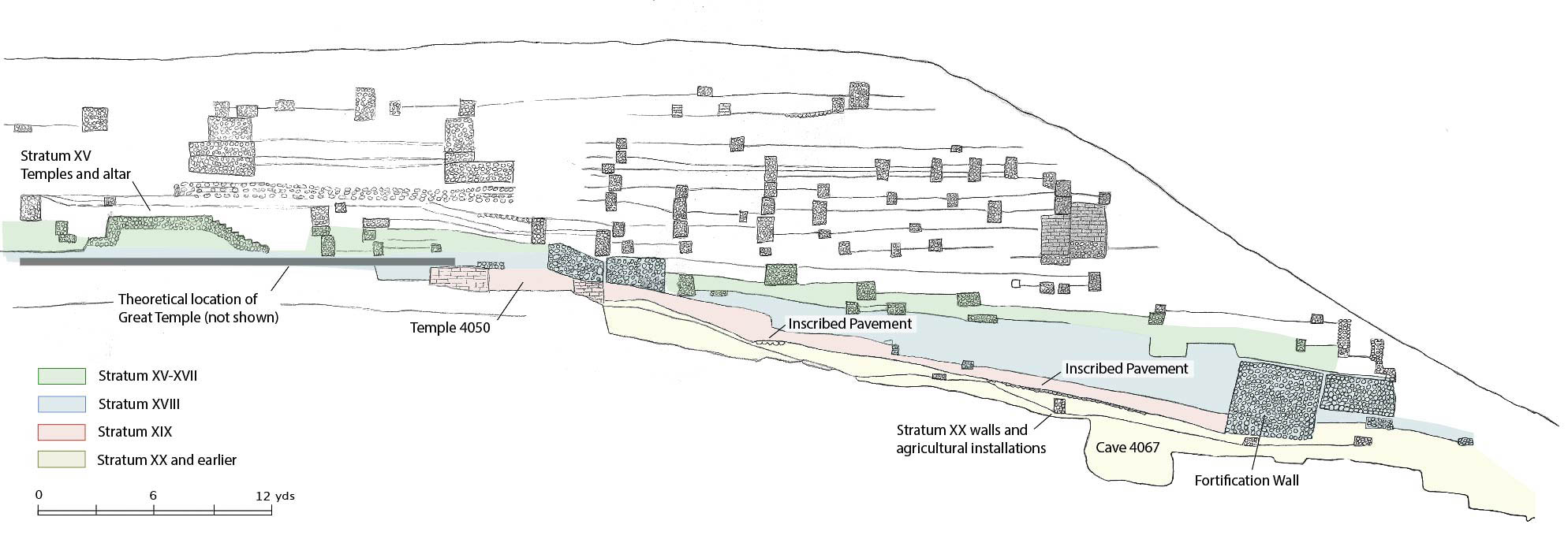

The strata of Megiddo discussed so far in this course.
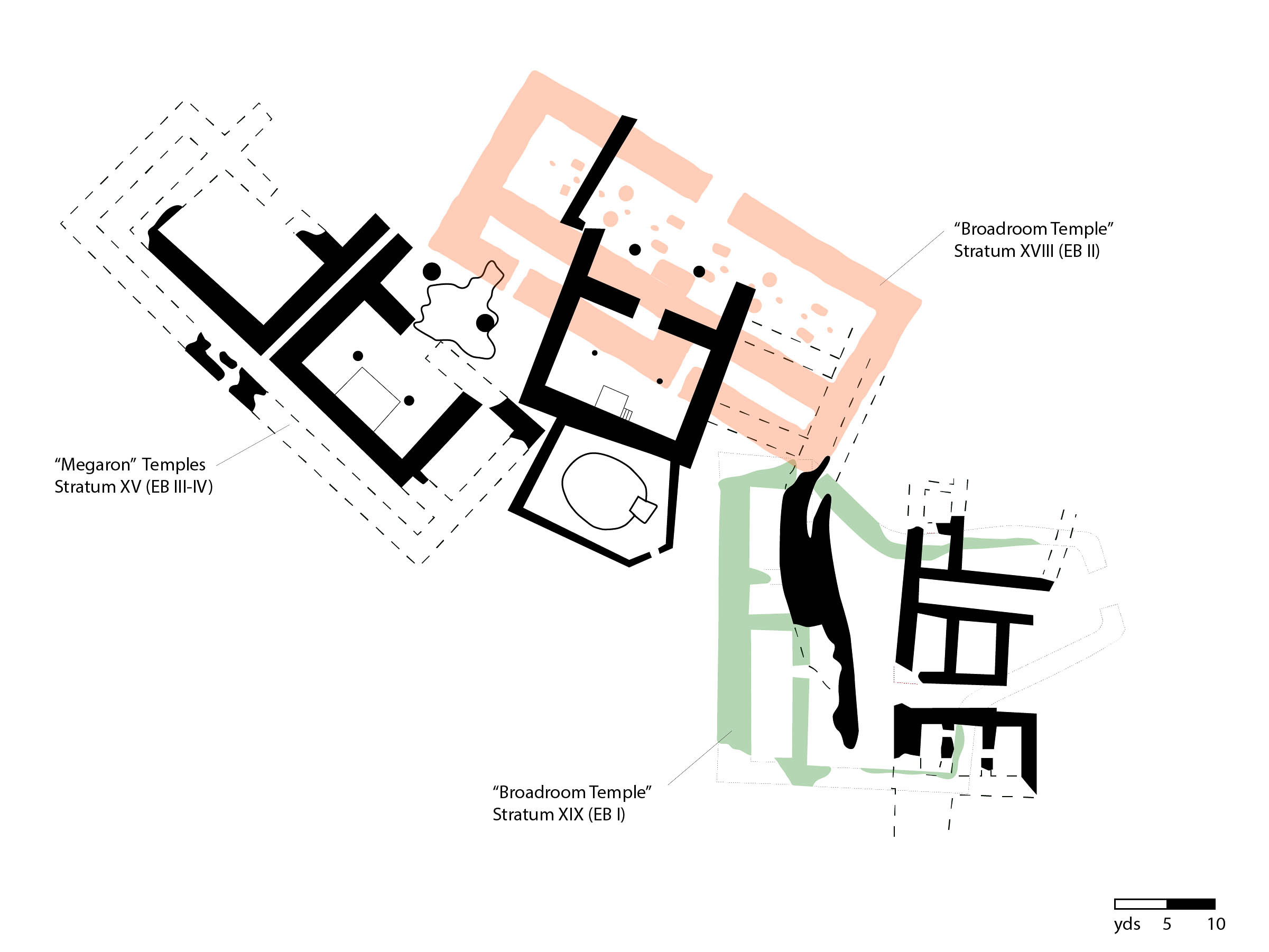
Three temples and the altar of Stratum XV were constructed above earlier broadroom temples (colored blue and red).
Chronology of the Early Bronze III in the Levant
| Period | Standard | Ancient List | Comments |
|---|---|---|---|
| Chalcolthic / EB I | 4500-3150 BC | 3500-2750 BC |
|
| EB II | 3150-2700 BC | 2750-2500 BC |
|
| EB III | 2700-2350 BC | 2500-2200 BC |
|
| EB IV | 2350-2100 BC | 2200-2060 BC |
|
| MB I | 2100-2000 BC | 2060-1900 BC |
|
“Megaron” Temples
The temples of Stratum XV were built according to a different ground plan than the preceding broadroom temples. They are narrower buildings, accessed through a porch flanked by two pillars. Although they stand side by side, they do not share a wall. Their layout resembles the megaron-type structures on the citadel of Troy II which we looked at in a previous entry. Their presence suggests new cultural influences at Megiddo, emanating from Anatolia or the Aegean where this style of architecture originated.
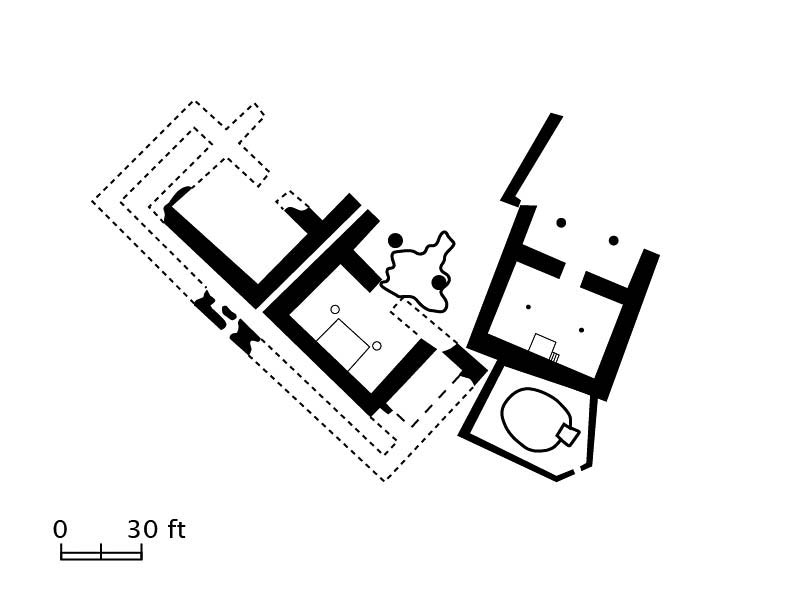
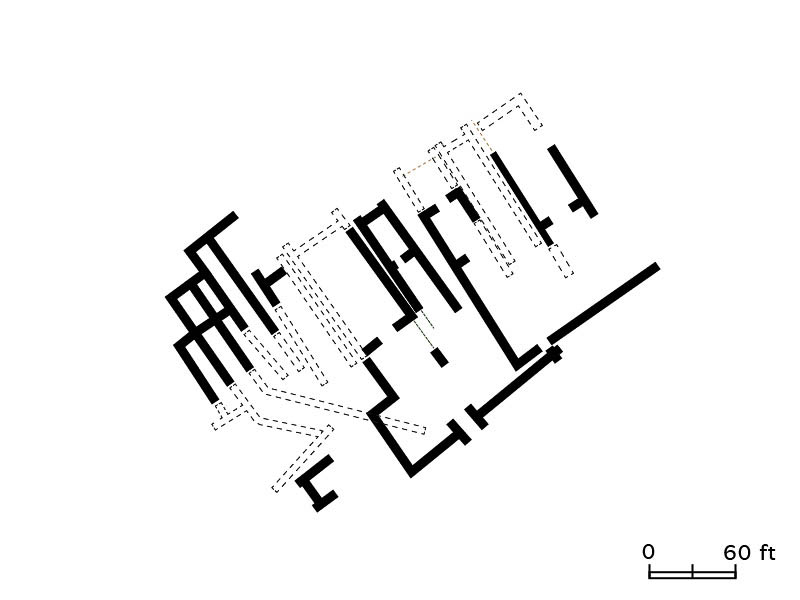
Left: Megaron-type structures at Megiddo. Note the adjacent but separated walls of the two temples, and the porch with flanking pillars. Right: Megaron structures on the citadel of Troy II.