This somewhat crude bronze casting of a bull’s head was found in the Barbar Temple. It measures approximately 8 inches tall from nose to tip of horns.
After three weeks in the spring of 1879, Captain Edward L. Durand was the first European to explore Bahrain. His log is full of colorful descriptions of the places he visited, such as this spring on Bahrain’s northern coast.
The water where it rises in this deep spring, whose basin artificially banked is some 22 yards across by 40 long, is as clear as crystal with a slightly green tinge and very beautiful. It holds a shoal or two of large fish and many water tortoises.1Durand 1879, 22
This was one of several perennial springs which once supplied the island with water but have since disappeared. Today Bahrain gets most of its water from deep wells and desalination plants, but in former times Bahrain was most famous for its freshwater springs. According to the Sumerian text, Enki and the World Order, the springs were given to the island by Enki, the god of the apsu. The same text describes how the goddess Ninhursag made eight plants grow on the island but before they could propagate, Enki had plucked and eaten them. Whereupon he grew deathly ill.
Infuriated by her husband’s indiscretion, Ninhursag departed the island, threatening never to return again until Enki was dead! With the order of the cosmos hanging in the balance, a sly fox saved the day by convincing Ninhursag to return to the island and heal Enki. She somehow gave birth to eight gods and goddesses, one to cure each of Enki’s ailments. The last was Enshag, who became the tutelary deity of Dilmun. Remarkably, Captain Durand was shown a stone imbedded in the wall of a inner room of a mosque on Bahrain that was inscribed with the name of this god. The Durand Stone, as it is known, dates to the Kassite period (c. 1400 BC).
The inscription on the stone reads:

The inscription names the god “Inzak,” who was said to be a son of Enki and god of Dilmun. The green branch was likely associated with the fertility.
Palace
of Rimum,
servant of the god Inzak [Sumerian “Enshag”],
man of (the tribe of) Agarum.2Bibby 1984, 37
Thus we have an early testament linking this deity with Bahrain.
Bibby and Glob excavated an Early Bronze temple approximately four miles due west of Qala’at al-Bahrain which was likely dedicated to Enshag. However, since no Early Bronze texts were found on the island, it is impossible to say for sure to which god the temple was dedicated. Bibby and Glob were initially attracted to the site by several large limestone blocks lying exposed exposed on the surface of a low mound.3Bibby 1984, 85 ff. Subsequent excavations showed that these stones, with had square sockets cut in them, were used as bases for statues or standards that were erected in the entrance of the temple. Sheets of copper pierced with little copper nails were found inside the sockets and traces of bitumen used to cement into place whatever was once inserted into them. Evidently the objects had been made of wood and covered with copper that was held in place with copper nails.4Glob 1955, 191 Socket stones were also found at the site which were used to support stone pillars. The pillars were found lying on the ground next to the socket stones.


Left: The “tethering stones” are thought to have been used to tether sacrificial animals brought to the temple. Right: The stone pillars may be compared to the standing stones or “massebot” erected in Canaanite temples.
ARC/Ancient List

The ruins visible today mostly belong to strata II and III which date to the last half of the 3rd millennium BC and the early 2nd millennium BC.
ARC/Ancient ListArchaeologists discovered three phases of the temple, the earliest of which they dated to c. 2500 BC (some prefer to date it a little later). Mysteriously, the whole temple was buried under a huge heap of clean sand, ten feet deep. The sand was not sourced locally and therefore must have been carried in for that purpose.5Bibby 1984, 87 One of the unique features of this temple is a subterranean stone basin accessed via a monumental stairway. A stone channel brought water to the basin from a local spring. Seven early Dilmun stamp seals were found in the layers of silt covering the bottom of the basin.

Three strata in total were excavated, all of which are thought to correspond to City II of Qal’at al-Bahrain.


Left: A double socket stone situated next to the tank. It must have supported a statue of considerable size. Right: The stairway leading down to the tank next to the temple.
ARC/Ancient ListTemple I was the earliest to be constructed on the Barbar mound. It was founded upon layers of clean clay. The Danish expedition found a dozen clay goblets embedded in layers of clean clay beneath the foundations of the temple. Many more goblets were left in situ on either side of the excavation trench so that the total number of goblets buried beneath the temple remains unknown. They were apparently ritually buried there, perhaps as part of a ceremony which commemorated the founding of the temple. Although not identical, they appear to be related to solid-footed goblets, such as were found in the Abu temple at Tell Asmar where they seem to have served a similar ceremonial function.6Mortensen 1956, 197

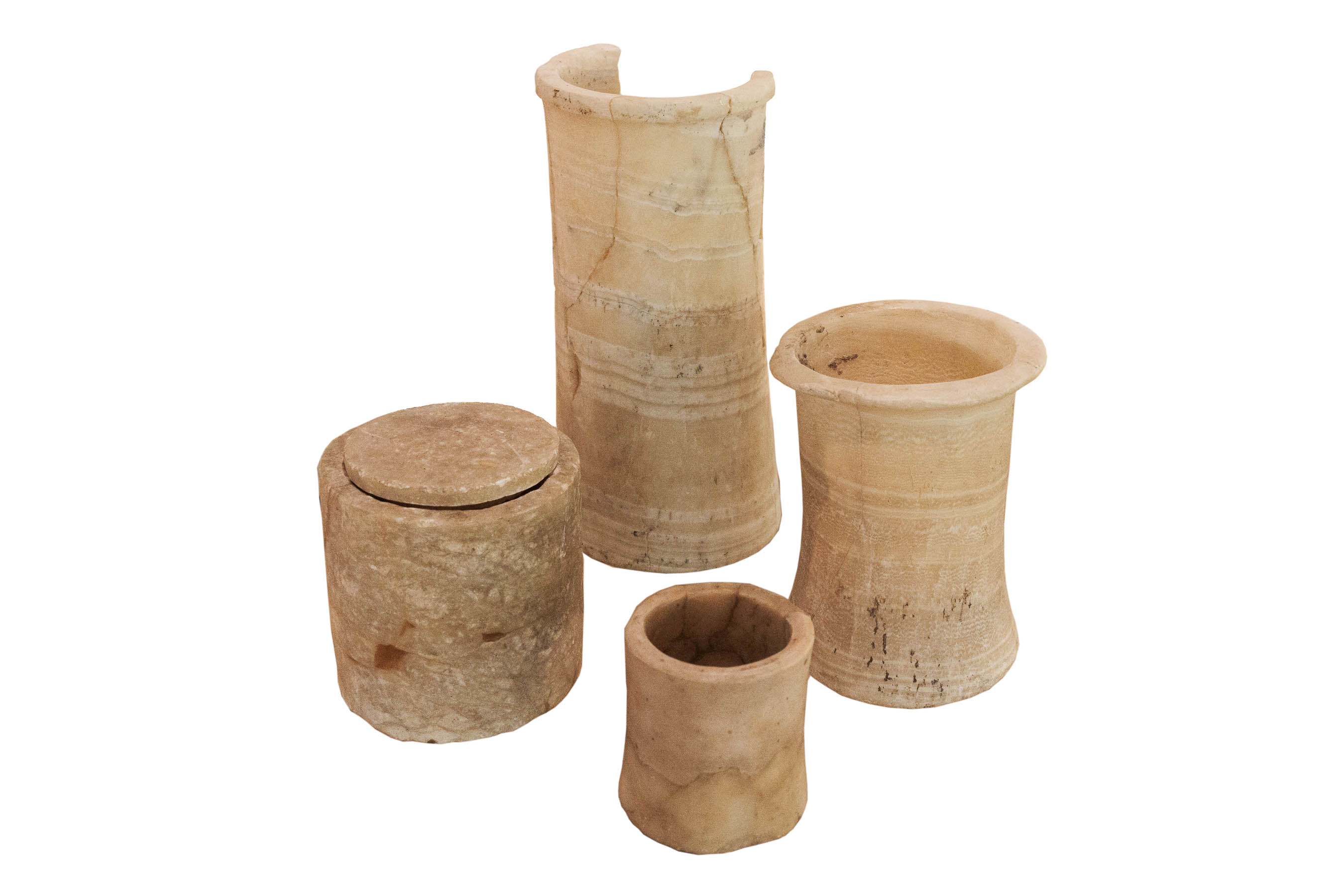
Solid-footed goblets and calcite vessels from the Barbar temple.
ARC/Bahrain National MuseumCalcite vessels were also found in the Barbar temple, several of them next to a podium located in the “uppermost temple” (presumably Temple III), and a third in the debris of Temple II (the middle temple).7Glob 1958, 144 We’ve seen identical vessels in the Royal Cemetery of Ur. Although it cannot be definitively proven, these finds suggest a date in the Early Dynastic for the temple’s founding.8During Caspers 1971, 220-221
The Bull’s Head
Undoubtedly the most spectacular discovery from Temple II was a copper bull’s head, approximately 8 inches tall—horns included. It was found beneath the flagstone floor of the temple, in its northeast corner. The head was made from pure copper using the unsophisticated method of casting in an open mold rather than the cire perdue method.9Halwachi 2020 The head is crudely fashioned compared to roughly contemporary examples from Sumer.


Bronze bull heads such as these show the importance of the bull as a symbol of power and fertility.
ARC/Ancient ListUse
Long strips of copper, four to six inches wide, were found next to the bull’s head together with a large number of little copper nails. The nails were used to attached to the strips of copper to the wooden core of something, but what exactly? Might the copper strips have been attached to the wooden core of a bull’s body? This would make sense in light of the copper bull’s head lying nearby. But Dutch archaeologist, Elizabeth During Caspers, notes that the copper strips show no signs of having been conformed to such a complex shape.10During Caspers 1971, 219 Nor does it seem likely that the bull’s head was attached to a musical instrument, like the bull-headed harps found at Ur, since nothing else that might indicate an instrument was found. Caspers suggests that the copper sheeting was used to wrap a pole which functioned as a male fertility symbol on the analogy of the “linga” stones found in the Indus Valley. Caspers cites two stone phallic symbols of this type that were found at Zallaq on Bahrain that date to the same period. If Caspers is correct, then the bull’s head was probably attached to the pole.11During Caspers 1971, 220-221
Significance
Enki was the creator and giver of fertility in the Sumerian pantheon. Kramer provides a nice explanation of how the Sumerians conceived of him and his relation to the bull.
Enki turns now from the fates of the various lands which made up the Sumerian inhabited world and performs a whole series of acts vital to the earth’s fertility and productiveness. Turning first to its physical features, he begins by filling the Tigris with fresh, sparkling, life-giving water-in the concrete metaphorical imagery of our poet, Enki is a rampant bull who mates with the river imagined as a wild cow. Then, to make sure that the Tigris and Euphrates function properly, he appoints the god Enbilulu, the “canal inspector,” to take charge of them. 12Kramer 1971, 173
The bull’s head discovered in the Barbar temple was likely dedicated to Enki or his son, Ensag (Enzak), the tutelary deity of Dilmun.
Bibby, Geoffrey.
Looking for Dilmun.
Great Britain: Penguin, 1984.
“Notes on the Island of Bahrain and Antiquities by Captain E. L. Durand.” Qatar Digital Library. March 22, 2024. Link
During Caspers, Elisabeth C. L. “The Bull’s Head from Barbar Temple II, Baḥrain A Contact with Early Dynastic Sumer.” East and West 21, no. 3/4 (1971): 217–23. Link
Glob, P. V. “Udgravninger på Bahrain. Dansk Arkæologisk Bahrain-Ekspeditions 2..” Kuml 5, no. 5 (1955): 178-193. Link
Glob, P. V. “Alabasterkar fra Bahrains Templer.” Kuml 8, no. 8 (1958): 138–145. Link
Al Halwachi, Hussain. “The Copper Bull’s Head at Barbar Temple: Chemical Composition and Casting Alloy.” Journal of Archaeological Science: Reports 32 (2020). Link
Højlund, Flemming, Pernille Bangsgaard, Jesper Hansen, Niels Haue. “New Excavations at the Barbar Temple, Bahrain.” Arabian Archaeology and Epigraphy 16 (2005): 105–128.
Kramer, S. N.
The Sumerians: Their History, Culture, and Character.
Chicago: University of Chicago Press, 1963. Link
Mortensen, Peder. “Barbartemplets Ovale Anlaeg.” Kuml (1956). Link