
These vases are from Susa IV, a period which overlaps with the Early Dynastic and Akkadian periods.
Five kings ruled the empire of Akkad: Sargon, Rimush, Manishtushu, Naram-Sin, and Shar-kalli-shari. The history of their reigns is a record of continual revolt and palace intrigue. The short, bloody reign of Rimush appears to have ended in a palace coup, perhaps organized by his brother, Manishtushu. Only one military campaign has been recorded for the reign of Manishtushu, on a tablet discovered at Nippur. It describes a campaign which he conducted against the Elamite cities of Anshan and Shirihum, followed by a seaborne invasion across the Persian Gulf (“the Lower Sea”) into Arabia (see map below).
Manishtusu, king of the world: when he conquered Anshan and Shirihum [in south-west Iran], had… ships cross the Lower Sea [Persian Gulf]. The cities across the Sea, thirty-two [in number], assembled for battle, but he was victorious [over them]. Further, he conquered their cities, struck down their rulers, and after he roused them [his troops] plundered as far as the Silver Mines. He quarried the black stone of the mountains across the Lower Sea, loaded [it] on ships, and moored [the ships] at the quay of Akkad. He fashioned a statue of himself [and] dedicated [it] to the god Enlil (R2:75-6)1Hamblin 2006, 76
This is one of the earliest recorded instances of naval warfare.2Weni’s account of his seaborne campaigns against Canaan is, perhaps, a century earlier. The use of ships for the transportation of an army requires significantly more resources and coordination than merchant shipping. Although the Gulf is only about 30 miles wide at its narrowest point (about the same width as the English Channel), the transportation of an army across it nevertheless represents an important milestone in military history.
The precise target of Manishtushu’s campaigns in Iran and Arabia are never made explicit. The text only states that he “plundered as far as the Silver Mines” and quarried black stone “across the Lower Sea.” It has been suggested that the silver mines could have been located in the mountainous Kerman province of Iran, ancient Marhashi (or Parashum n Akkadian texts).
The black stone quarried by Manishtushu “across the Lower sea” refers to diorite that must have been quarried from the mountains of Oman although large slabs of diorite have yet to be located there. Thus Manishtushu’s campaign encompassed both sides of the Gulf, and reached as far south as Oman and southern Iran.

This black diorite pyramidion records land grants to soldiers who served in Manishtushu’s army.
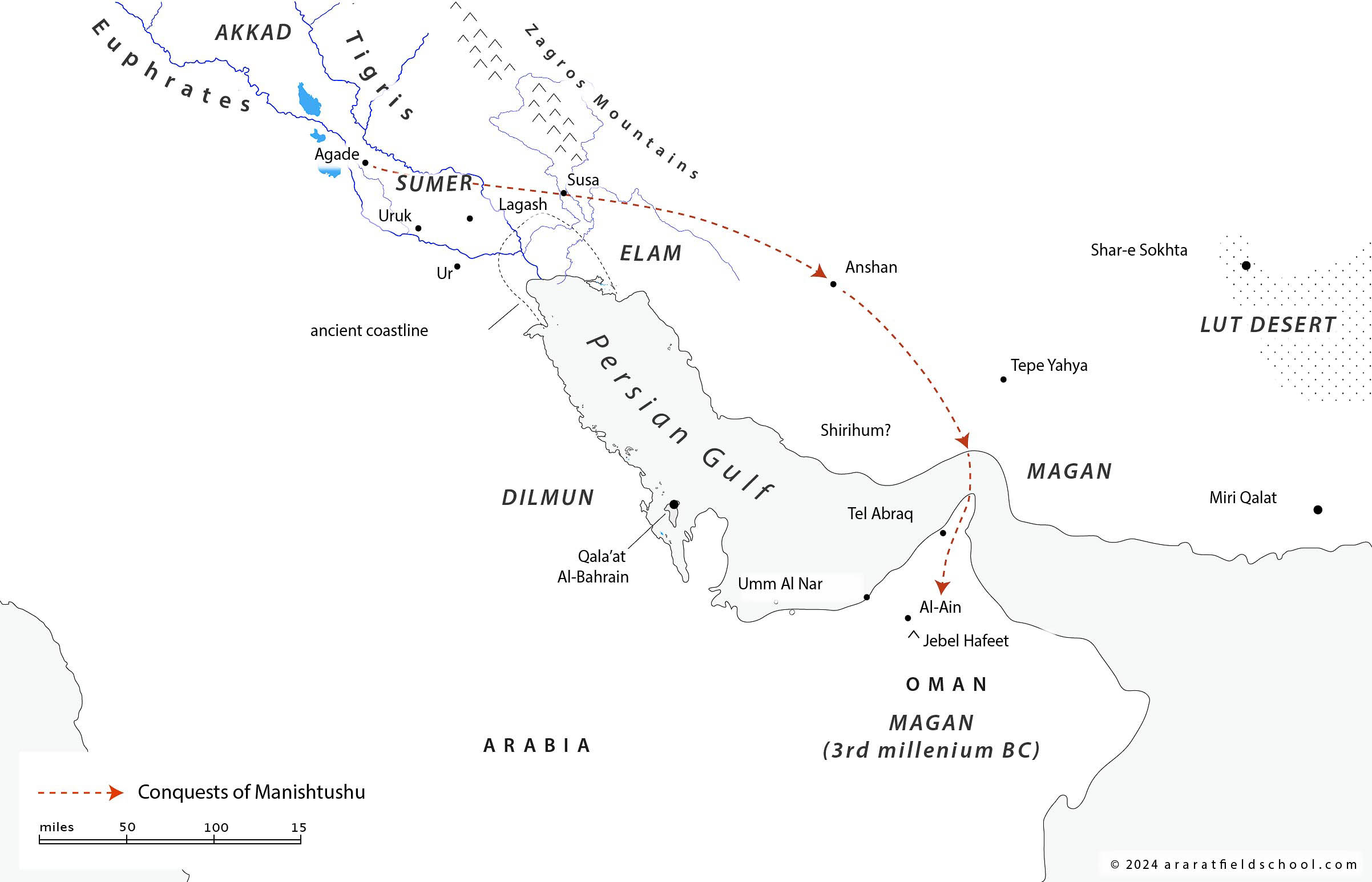
Two locations in Iran are mentioned: Anshan and Shirihum. The location of the latter is unknown. The silver mines may have been located somewhere in the mountains west of the Lut Desert (the Kerman Province of Iran). The diorite must have come from the Hajar mountains of Oman.
Conquests of Naram-Sin
Having won his throne in a palace coup, Manishtushu appears to have lost it due to another. He was succeeded by his son, Naram-Sin, whose 37 year long reign proved in no way inferior to that of his grandfather’s if measured by the amount of blood spilled and land conquered. Contemporary inscriptions refer to a series of revolts, nine in total, that occurred in a single year of Naram Sin’s reign. Known as the Great Revolt, it likely took place at the beginning of Naram-Sin’s reign although the chronology of his reign is unclear. One of the earliest and most important sources, the Bassetki Inscription, comes from an inscription recorded on the base of a remarkable copper statue discovered in the northern Iraqi village of Bassetki. Commissioned by Naram-Sin, the inscription reads:
“Naram-Sin, the mighty, king of Agade, when the four quarters together revolted against him, through the love which the goddess Astar showed him, he was victorious in nine battles in one year, and the kings whom they (the rebels[?]) had raised (against him), he captured.
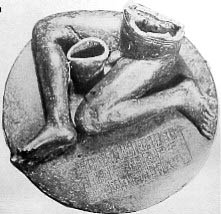
The Bassetki inscription further relates how the victorious king was thereupon acclaimed a god and a temple was dedicated to him in the city of Akkad.
In view of the fact that he protected the foundations of his city from danger, (the citizens of his city requested from Astar in Eanna, Enlil in Nippur, Dagan in Tuttul, Ninhursag in Kes, Ea in Eridu, Sin in Ur, Samas in Sippar, (and) Nergal in Kutha, that (Naram-Sin) be (made) the god of their city, and they built within Agade a temple (dedicated) to him.
This is the first clear instance of the deification of a king.

An image of Naram-Sin carved into the face of a cliff in the Zagros mountains of northern Iraq. Naram-Sin is carrying a narrow-headed battle axe.
The Attack on Magan
As noted previously, the order of Naram-Sin’s conquests is altogether unclear. We are informed of specific campaigns against the Lullubi in the Zagros, against Apishal, a city probably located in Syria, and against Magan. Information regarding the latter campaign was recorded on another statue base, discovered at Susa.
Naram-Sin, the mighty, king of the four quarters, victorious in nine battles in one year… he subjugated Magan and captured Mani[um], the lord of Magan. In their mountains he quarried blocks of diorite, and transported (them) to Agade, his city, and made a statue of himself…. and dedicated it to… (rest broken). 3Potts 1989, 135
Magan appears to have been a powerful maritime power at this time. The name of its king, Mani, was accorded the title “the mighty,” a title otherwise reserved exclusively for the kings of Akkad.4A late Babylonian chronicle reads: “(Naram Sin) who went to Magan, and vanquished [Mannu, the mighty], king of Magan.” (See Albright 1920, 89-98.) Judging by the number of references to Magan from the Akkadian period, and the absence of Dilmun, it seems that Magan was the dominant power in the Persian Gulf during this period.
Booty from Magan
Among the objects taken by Naram-Sin as booty from Magan were vessels carved from hard and soft stones. Many have been found in Mesopotamia, inscribed with the name of the king and the place from which they were taken.
Naram-Sin, king of the four quarters, bowl (from) the booty of Magan…

The inscription at center records that the bowl was brought as booty from Magan by Naram-Sin. The other inscription belongs to a later king of the Ur III period, an indication of the great value placed upon these bowls.
Although some of the bowls were made of hard stones, most were made from calcite, a white mineral. The same mineral, when acted upon by heat and pressure, forms marble. Softer versions are more commonly known as limestone or alabaster. Calcite may contain trace amounts of manganese, an element known for its ability to absorb light energy and re-emit it. The presence of trace amounts of manganese in calcite makes the material appear as though it were glowing (a property technically known as thermo-luminescence). The color of calcite is naturally white but trace impurities may change its color to red, yellow, brown, or any shade in between. Banded and mottled calcite are created by these slight impurities.5Rapp 2009


These mottled calcite bowls were found in the Early Dynastic Temple of Ishtar at Mari.
The majority of the calcite vessels bearing Akkadian inscriptions belong to Rimush—the probable predecessor of Manishtushu—who claimed to have taken them as booty from Elam and Parahshum in south-central Iran. However, a number of others were inscribed by Naram-Sin who claimed to have taken them as booty from Magan. Unlike his father, Manishtushu, who crossed the Gulf into Arabia, Naram-Sin’s campaign was probably confined to the southern part of Iran, a region known to have good calcite deposits.6Potts 1989, 138 This explains why most of the calcite vessels taken as booty were inscribed with the names of Rimush and Naram-Sin, the only two kings known to have campaigned in this region. In contrast, the focus of Manishtushu’s campaign seems to have been Oman, where calcite is rare.


Inscribed calcite vessels which identify the vessels as “booty from Magan.”
Calcite Vessels in the Royal Cemetery of Ur
Calcite vessels were also recovered by Woolley from the Royal Cemetery of Ur. He noted with surprise in his excavation reports how similar these vessels are to alabaster vessels produced in Egypt.
A good many of the shapes present striking similarities with those prevalent in Egypt in early dynastic times, and it is difficult not to see some connection between them; I had myself suggested this and had the support of Sir Flinders Petrie for the view, but the argument must be used with all caution.7Woolley 1934, 379
Both Woolley and Petrie thought the similarities between the vessels must be due to “some connection” between the two regions. The Assyriologist and excavator of Nippur, H. V. Hilprecht, made a similar observation concerning calcite vessels recovered from Tello (ancient Girsu).
It is a remarkable fact that in material, form, and technique the earliest Babylonian vases often strikingly resemble those found in the tombs of the first dynasties of Egypt.8Hilprect 1904, 252

These vessels date to the First Dynasty of Egypt.


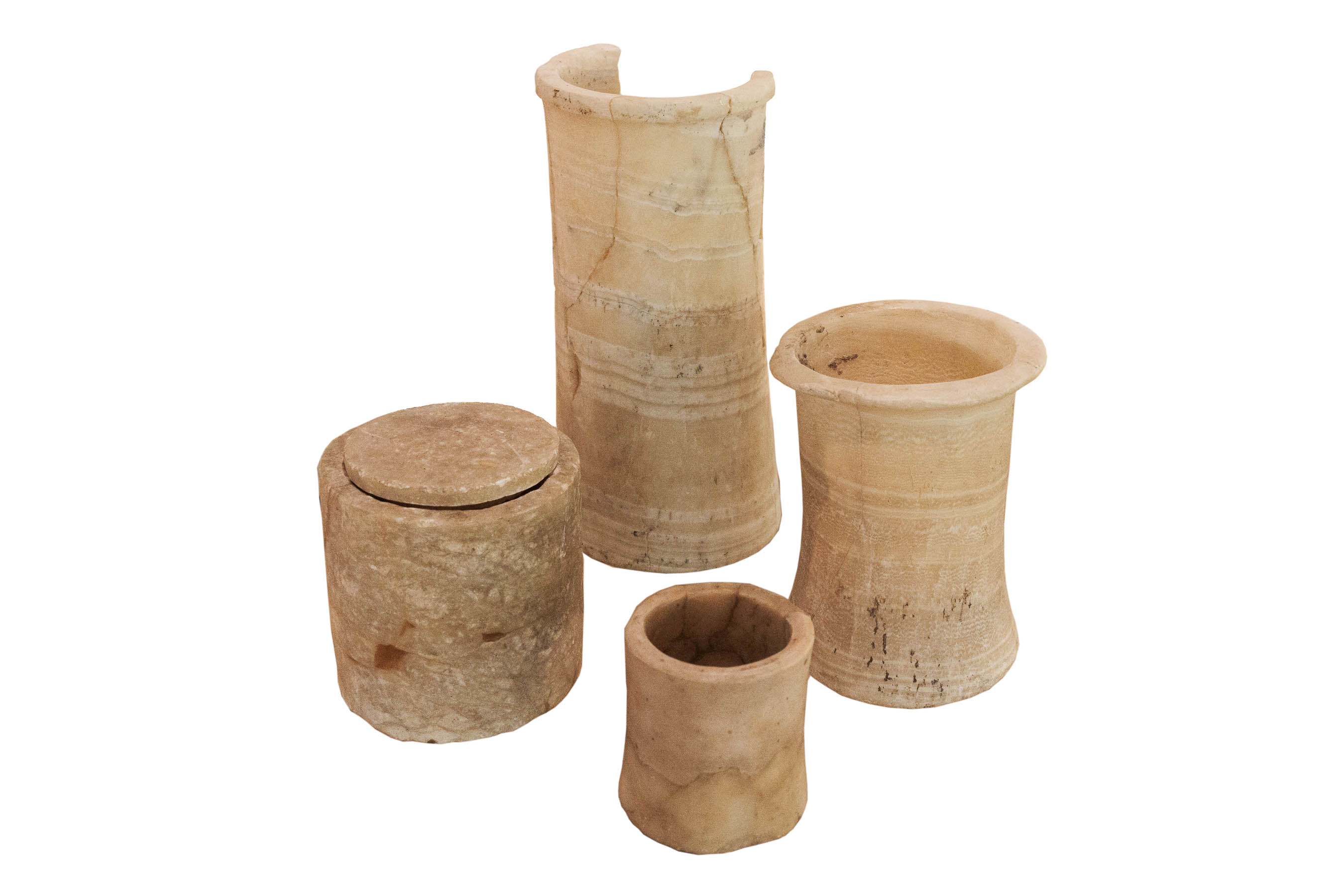
The similarities suggest some borrowing took place, although evidence for contact between the two regions during the Early Bronze III and IV is limited compared to earlier periods. As we’ve seen, numerous artifacts originating from Mesopotamia have been found in Egypt dating to the Late Uruk and Jemdet Nasr periods, but not much from the latter half of the Early Bronze period. In many respects, the Uruk Expansion was a unique event, for which no adequate explanation has yet been given.
Albright, William F. “Magan, Meluḫa, and the Synchronism between Menes and Narâm-Šin.” The Journal of Egyptian Archaeology 7, no. 1/2 (1921): 80-86. Link
Albright, William F. “Menes and Narâm-Sin.” The Journal of Egyptian Archaeology 6, no. 2 (1920): 89-98. Link
Amiran, Ruth. “More about the Chalcolithic Culture of Palestine and Tepe Yahya.” Israel Exploration Journal 26, no. 4 (1976): 157–62. Link
Foster, Benjamin. “Naram-Sin in Martu and Magan.” Annual Review of the Royal Inscriptions of Mesopotamia, no. 8 (1990): 25-44. Link
Hilprecht, H. V.
The Excavations in Assyria and Babylonia.
Philadelphia: A. J. Holman & Company, 1904. Link
Kramer, S. N.
The Sumerians: Their History, Culture, and Character.
Chicago: University of Chicago Press, 1963. Link
Oppenheim, A. L.. “The Seafaring Merchants of Ur.” Journal of the American Oriental Society 74, no. 1 (1954): 6–17. Link
Parpola, Asko.
The Roots of Hinduism: The Early Aryans and the Indus Civilization .
Oxford: Oxford University Press, 2015.
Potts, T. F. “Foreign Stone Vessels of the Late Third Millennium B.C. from Southern Mesopotamia: Their Origins and Mechanisms of Exchange.” Iraq, no. 51 (1989): 123–64. Link
Rapp, George.
Archaeomineralogy.
Berlin, Germany: Springer-Verlag, 2009.