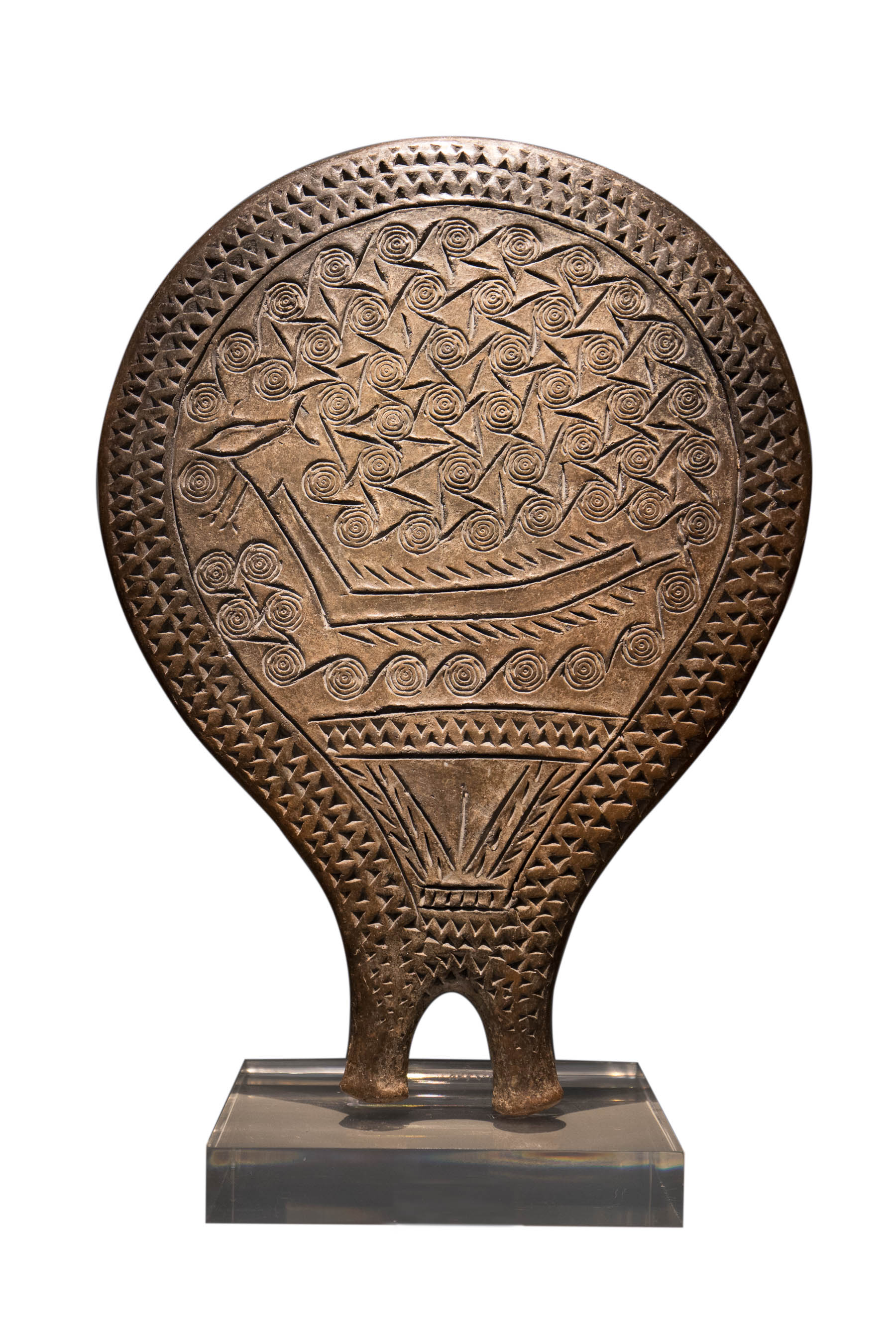
The purpose of these frying-pan-shaped objects made from terracotta is unknown. This one was found in Tomb 74 at Chalandriani. It measure approximately 11 inches long.
As mentioned previously, the largest cemetery in the Cyclades was found at Chalandriani on Syros, where approximately 600 tombs were excavated. Most of the tombs were excavated by the pioneer Greek archaeologist, Christos Tsountas, from 1898 to 1899. One of the curious type of object recovered from the tombs was a clay vessel shaped like a frying pan. They could not have actually served as frying pans since there is no evidence that they were ever placed in a fire. However, their shallow raised rim suggests they may have been used as a dish.1Coleman 1985, 202 ff. Tsountas suggested they may have functioned as ancient mirrors since the shallow pan filled with water or olive oil would have produced a highly reflective surface. It is noteworthy in this regards that a bronze mirror was found at Susa shaped like a Cycladic “frying pan” although without a lip. It dates to approximately the same time period as our “frying pans.”
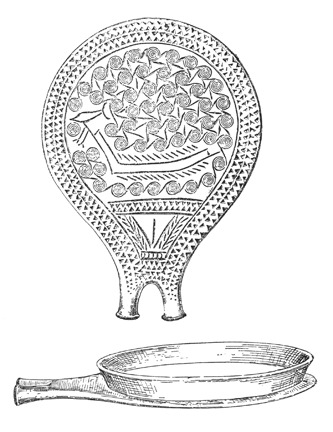


Left: A mirror from the “vase à la cachette” discovered at Susa which dates to the Early Dynastic III period (Susa IVA, mid 3rd millennium BC).
Right: A reconstruction of a bronze mirror illustrating how this material can be used to produce a highly reflective surface.
Before the introduction of polished bronze mirrors, people had only a vague impression of their appearance from looking at their reflection on water or in the glassy surface of obsidian. The Greek word for mirror (“looking down”) preserves the ancient idea of looking at ones reflection in a pool.2Papathanassoglou and Georgouli 2008, 660
Narcissus
In Ovid’s telling of the story of Narcissus and Echo, the youth, Narcissus spurns the love of the nymph, Echo, and falls in love with his own reflection in a dark pool instead.
“…now he believes that what is but a shade must be a body. And he gazes in dismay at his own self; he cannot turn away…” (Metamorphoses Book III, 413-416)
Heartsick with unrequited love, Narcissus withered away next to that deceptive pool until nothing remained except little yellow and white daffodils (Latin. narcissus) to mark the spot where he lay.
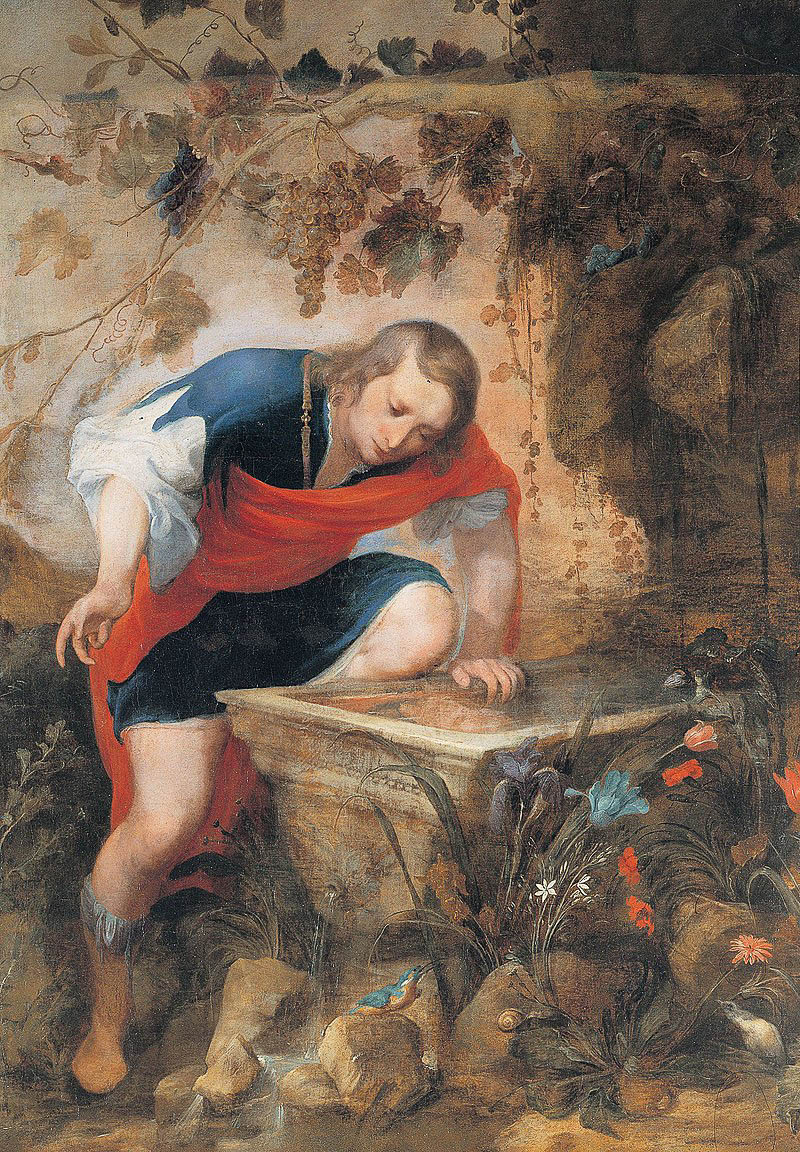
Narcissus absorbed with his reflection in a pool, the painter shows flowers growing from the place where he will expire, a warning of the dangers of self-love.
The mirror displays the “shade” of a man says Ovid. The same term may be used to refer to a person’s spirit or ghost. Perhaps this is why bronze mirrors were so often placed in tombs. A custom which may be traced back to ancient Egypt; mirrors are commonly found in Greek and Etruscan tombs. If the Cycladic “frying pans” were indeed used as mirrors then they may be included in the same tradition.
Religious Symbolism
The religious imagery displayed on the “frying pans” has been summarized by Colin Renfrew as “sex, sun, and sea.”3Renfrew 2011 Among the symbols commonly displayed is an eight-pointed “star” interpreted by Renfrew as the sun. Alternatively, it may be compared to the eight-pointed “dingir” sign used by Mesopotamian scribes to denote “divinity” in general, and the goddess, Inanna, more specifically.4Black 2011, 169-170 An eight-pointed star was also famously represented on a fresco at Teleilat el-Ghassul. Its appearance on Cycladic frying pans likely bears some relation to these other instances despite the great distances separating them.
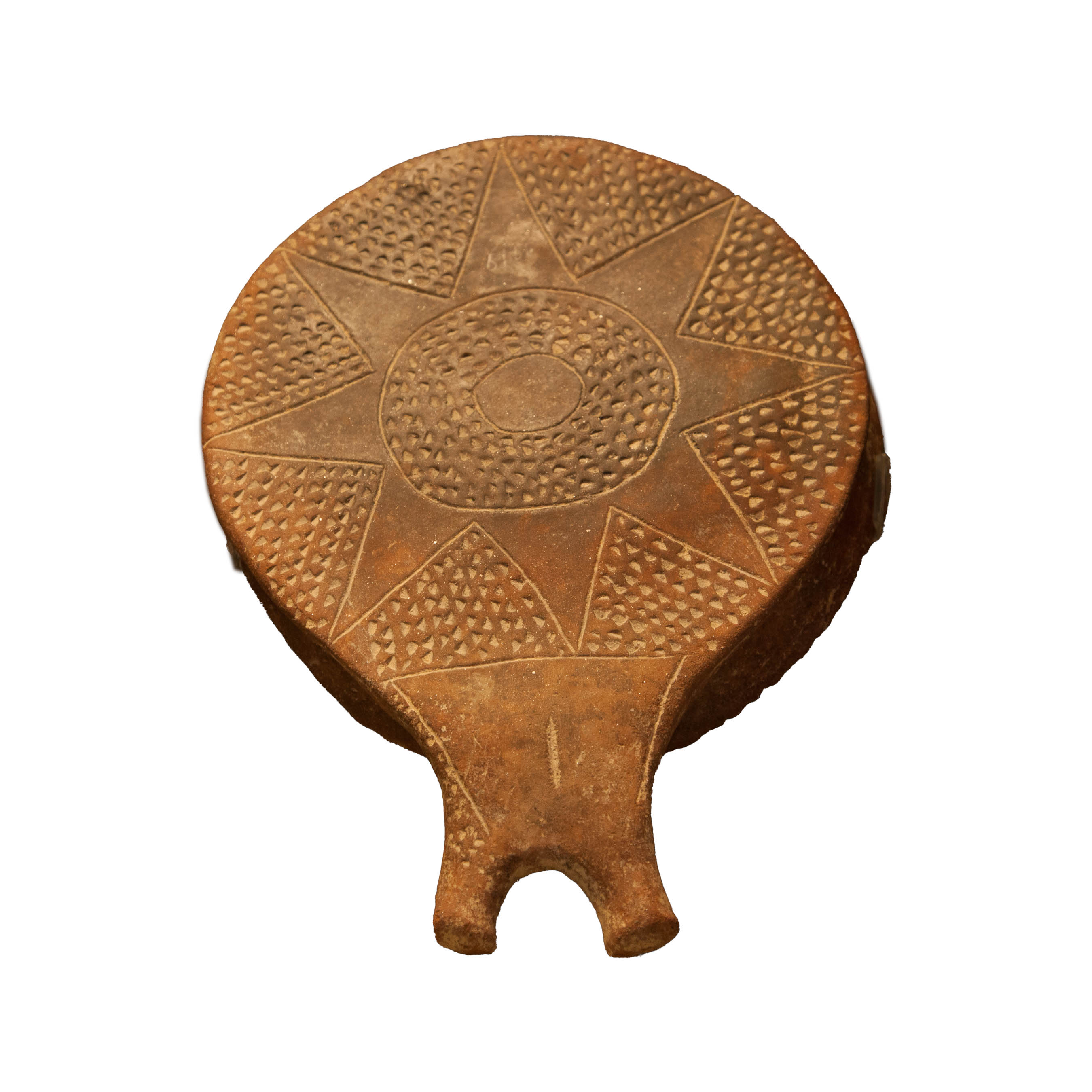

Left: A “frying pan” inscribed with a star.
Right: Spirals are used to represent water, a common motif on these unusual vessels.
The Longboat
A most interesting aspect of these Cycladic “frying pans” are the depictions of long boats found on them. Ten in total have been discovered so far. These represent the earliest known depictions of boats in the Aegean. Since none of the islands are separated by more than 25 miles, the islanders did not need deep hulled sea going vessels to get around. However, it is not clear whether they were paddled like a canoe, with the paddler facing forward, or if they were equipped with oars, with the oarsman facing backward. If oars are intended then the boats must be ancestors of the Greek triaconter (“thirty-oared”) of the Archaic period (9th-6th centuries BC). All things considered, they are remarkably similar to the triaconters and penteconters of a later age.
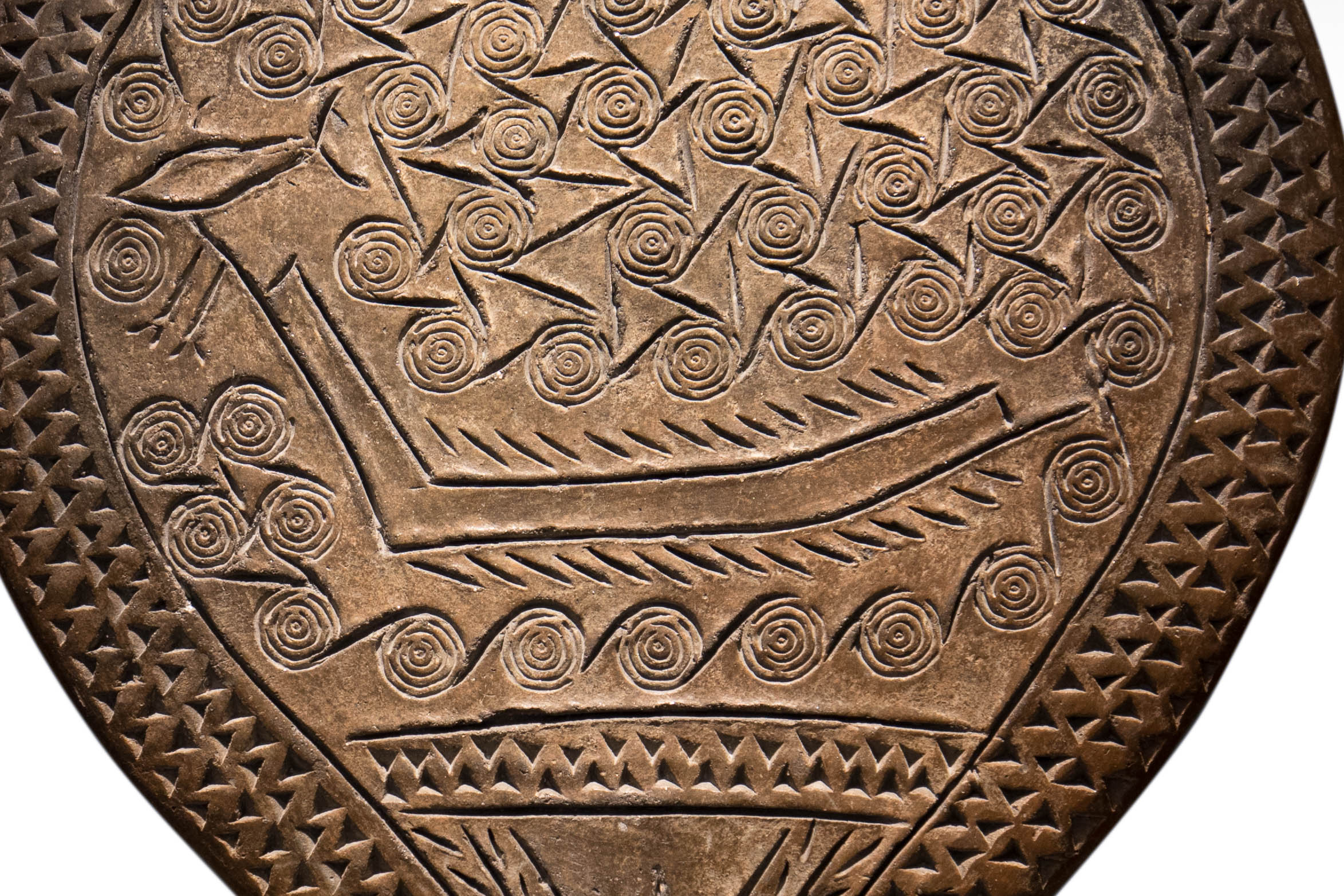
At least ten such representations have been found on Cycladic frying pans. The boat pictured above has fifteen oars to a side making for a total of 30 oars—like a Greek triaconter. The largest ship depicted on a “frying pan” has forty oars to a side.
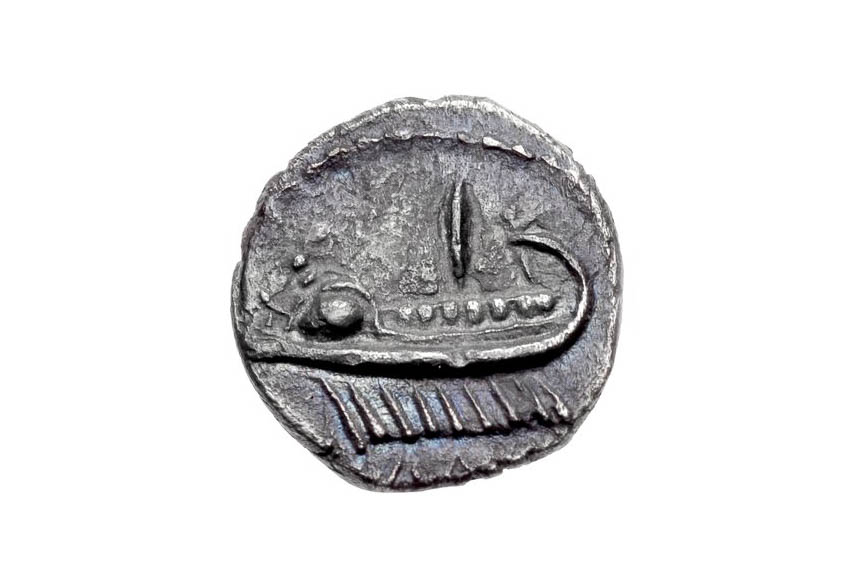
Coleman thinks it more likely that the raised end of the boat should be identified as the prow and the opposite end with the projecting spike should be its stern.5Coleman 1985, 198 The situation is not clear-cut since there are instances of similarly shaped boats, such as the one depicted in Tomb 1000 at Hierakonpolis, which have the steering ore on the raised end. In this instance the raised end must be the stern.
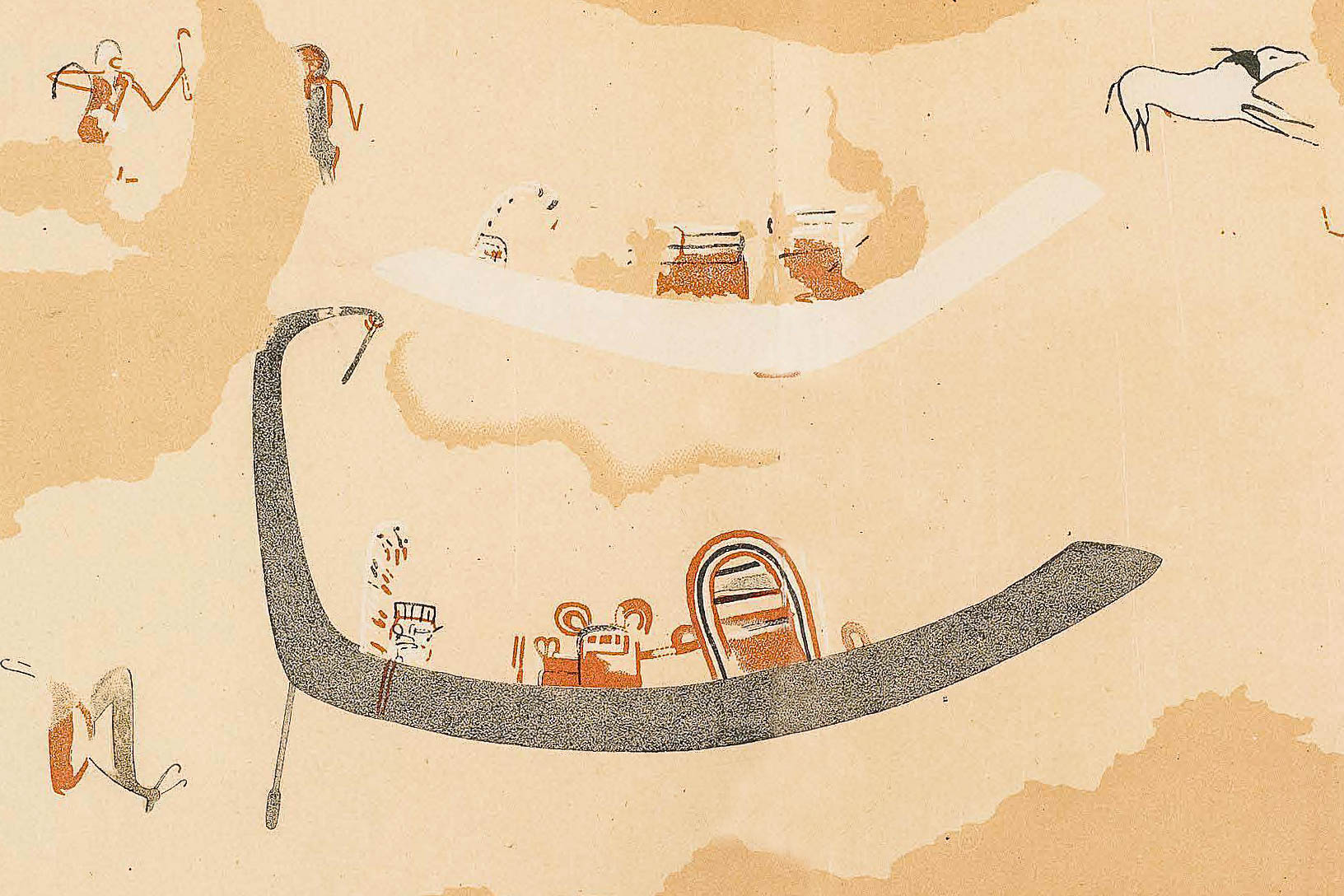
Left: A black ship with raised stern and steering paddle, from the frescoe found in Tomb 100 at Hierakonpolis.
Right: A Phoenician penteconter on a coin from Sidon with a raised stern.
At least ten “frying pans” have been found with boats depicted on them. They are always shown with a large fish attached to their raised ends. Coleman interprets the fish to be a totem—the emblem of a clan or tribe—mounted to the prow of the boat. In this case the raised end can only be interpreted as the prow since it wouldn’t make sense for the fish to be attached to the stern, facing in the direction opposite the boats travel. This is one of the primary reasons Coleman interprets the raised end as the prow.
However, it may be wondered if the fish emblem was actually attached to the prow of the boat. The fish is very large in relation to the boat and appears only to be attached by a single line. Such a configuration hardly seems possible if the fish is physical object mounted to the boat. Perhaps we are looking instead at something from Cycladic mythology rather than a physical representation. (Of course, both may be true.)
There is a striking parallel between the Cycladic “frying pans” and copper razors which have been recovered from Nordic tombs in Denmark (c. 900-700 BC).6Sorenson and Appleby 2018, 194 In this case, it has been possible to piece together a solar connection between the boat and the fish, although the details of the myth cannot be precisely worked out. According to one interpretation, at sunrise the fish hauls the sun up from the night boat and places it on the day boat so that it may continue to journey across the sky. This is not very different from an Egyptian solar myth. Perhaps the boat and fish depicted on Cycladic “frying pans” likewise has a solar connection.

A copper razor etched with a solar symbolism. From Jutland, c. 900-700 BC.
“Frying Pans” at Alachahoyuk
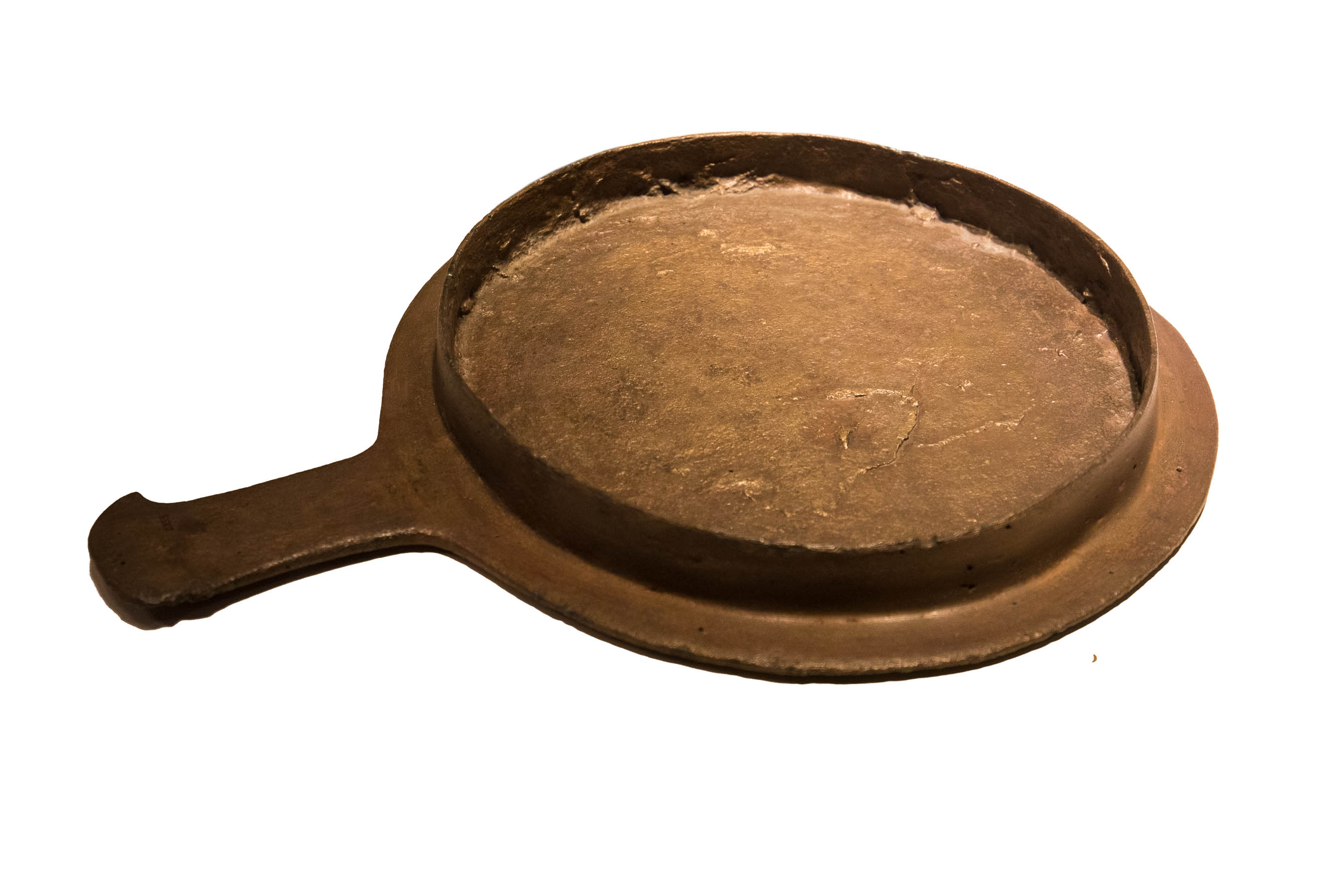
Approximately two hundred frying pans have been found in the Aegean region, thirty-two of which were found in tombs on Chalandriani.7Coleman 1985, 193 Curiously, several bronze “frying pans” have also been recovered from the royal tombs of Alacahoyuk, in central Anatolia (more on these later). The “frying-pans” are otherwise unknown in Anatolia.
#/media/File:Jan_Roos_-_Narcissus_at_the_Spring.jpg)

From Grave MA at Alacahoyuk in central Anatolia.
Broodbank, C.
“The Early Bronze Age in the Cyclades,” in The Cambridge Companion to the Aegean Bronze Age, edited by C. W. Shelmerdine.
Cambridge, New York: Cambridge University Press, 2008. Link
Coleman, John E. “‘Frying Pans’ of the Early Bronze Age Aegean.” American Journal of Archaeology 89, no. no. 2 (1985): 191–219. Link
Papathanassoglou, Dimitri , C. H. Georgouli. “The ‘Frying Pans’ of the Early Bronze Age Aegean: an experimental approach to their possible use as liquid mirrors.” Archaeometry 51 (2008): 658-671. Link
Renfrew, C.
The Emergence of Civilisation : The Cyclades and the Aegean in the Third Millennium BC.
Oxford Oakville, CT: David Brown Book Co., 2011. Link
Sorensen, Marie Louise, Grahame Appleby.
“To Decorate a Nordic Bronze Age Razor: A Design Challenge,” in Creativity in the Bronze Age: Understanding Innovation in Pottery, Textile, and Metalwork Production, edited by L. Bender Jørgensen, J. Sofaer, M. Stig Sørensen.
Cambridge: Cambridge University Press, 2018. Link