“An” was the supreme god and “god of heaven” in the Sumerian pantheon. The name was written with an eight-pointed star, which was the dingir sign in Sumerian. The same sign was used to write the word “god” or to assign the category of “godness” to a person or thing. When attached to a name, it meant that that name belonged to a god. Thus the generic term for god (“an”) was also the name of the highest god in the Sumerian pantheon (“An”). The same is true also in Hebrew, where the word for god (“el”) is also the name of God (“El”). Such usage is implicitly monotheistic, certainly in the Hebrew Bible, but perhaps also in some vague sense in Sumer also, although whatever incipient monotheism existed in Sumer certainly is not manifested in their mythology. Indeed, the opposite is true. In Sumer, An’s role was usurped by the storm god, Enlil, and later by the Babylonian god, Marduk. Even in Uruk, it seems that An’s place was largely taken by Inanna (see below).

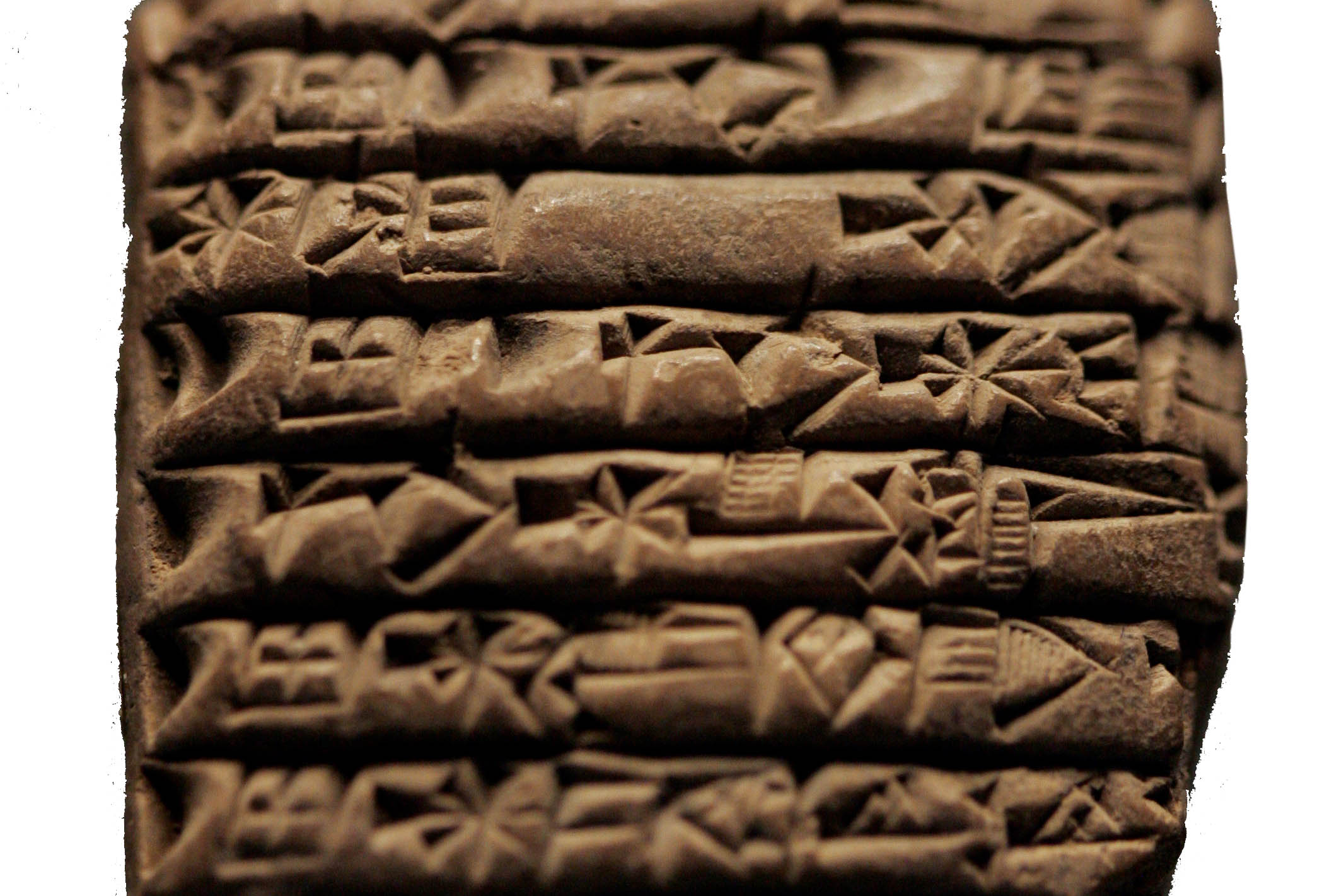
The tablet is a list of names of gods. The dingir sign appears before the name to indicate divinity.
According to the Sumerian theogony (the generation of the gods), An had two wives, Nammu and Ki, the primeval sea and earth respectively. Nammu (Sea) gave birth to Enki, the god of fresh water, while Ki (Earth) gave birth to Enlil, the god of air and storm. In addition to these, we should also mention two goddesses. The first was Ninhursag (nin “queen,” hursag “mountain”), the Sumerian equivalent to “mother earth,” and the second was Inanna (nin “queen,” anna “of heaven”), the goddess of fertility and war, who appears alternatively in Sumerian texts as the daughter of An or of Nanna, the moon god.
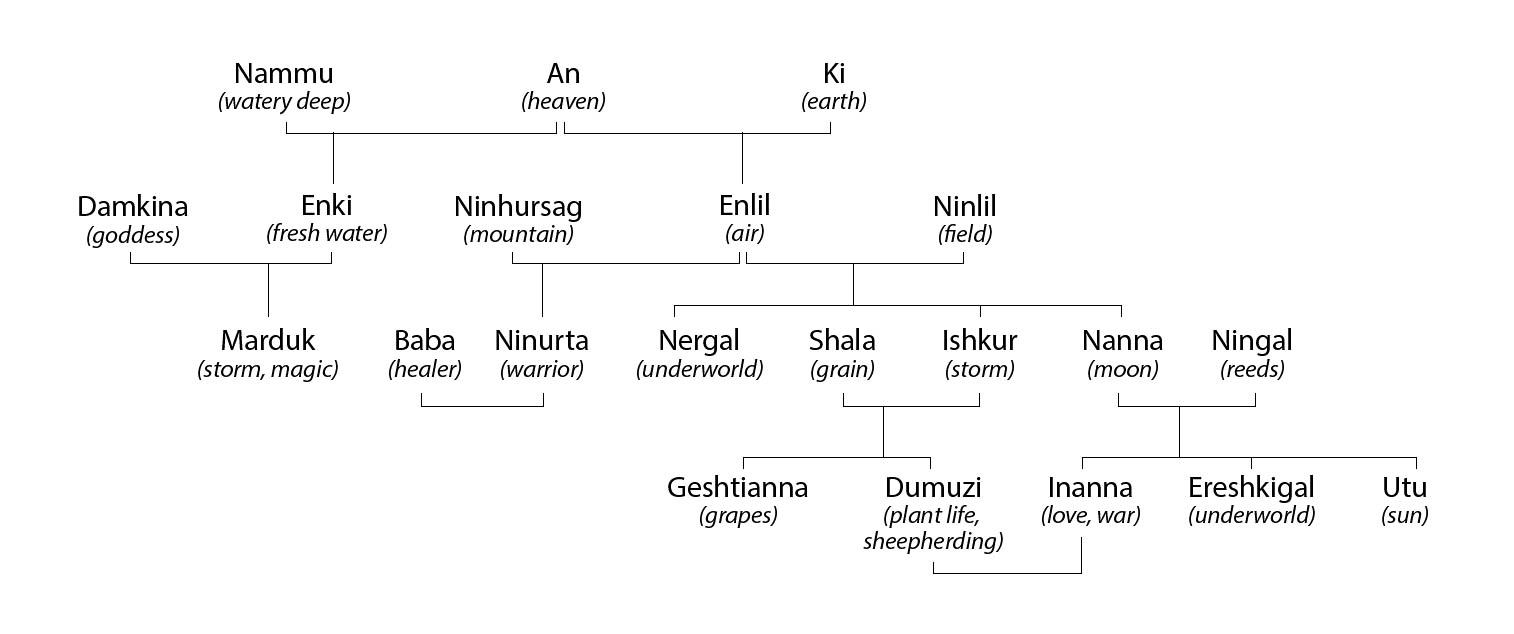
This very schematic representation of the Sumerian pantheon shows the first four generations of Sumerian gods.
Eanna and Kullaba
Each Sumerian city had a temple dedicated to one or more Sumerian god. Enlil had his temple in Nippur; Enki’s was in Eridu, while both An and Inanna had a temple in Uruk. Thus the opening lines of the Gilgamesh Epic credit the king with building two temples in Uruk.
In Uruk he built walls, a great rampart, and the temple of blessed Eanna for the god of the firmament Anu, and for Ishtar the goddess of love.1Lloyd 1985, 49
When German archaeologists began excavating on the mound of Uruk, their major discoveries were concentrated in two main areas which they named the Eanna Precinct and the Anu Ziggurat. In the latter area they found a very well preserved temple constructed on a high terrace. There is no definite proof that the temple belonged to An but a Seleucid temple (3rd century BC) dedicated to An was constructed in the same location and thus may preserve an ancient tradition that connects the site with An.2Krul 2018, 10 The White Temple was reached by a single set of stairs situated along one side of the terrace.

This plan shows the two major districts of Uruk: Kulaba and Eanna. The White Temple was located in the Kulaba district.

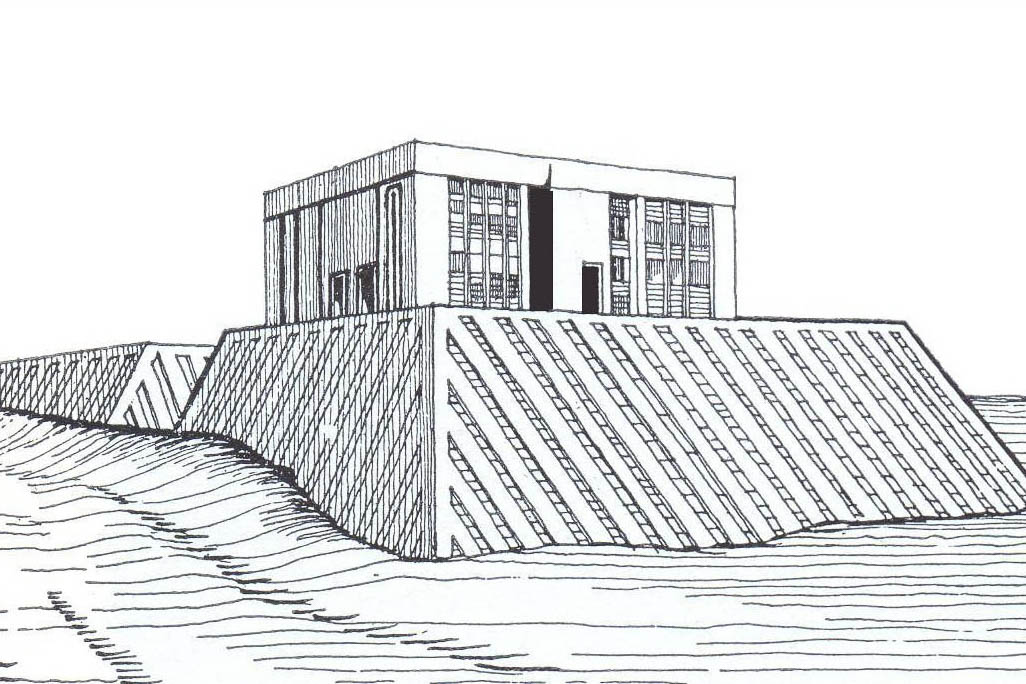
A plan of the “Anu Ziggurat” and an artist’s depiction of how it may have looked.
A Trench through Kulaba
Archaeologists cut a trench through Kulaba, revealing a succession of terraces that can be traced back to the Ubaid period. The White Temple stood the final one of these terraces (shaded green below) until it too was eventually levelled and built over by a much larger terrace (dotted lines) constructed during the Ur III period, over a millennia later. Recent C14 analysis of cedar beams from the White Temple and its supporting terrace dates the White Temple to the 35th or mid 34th centuries BC.3van Ess 2015, 18; 21-22 This is quite a bit earlier than the Jemdet Nasr period (3100-2900 BC) traditionally assigned to the White Temple. If correct, then the White Temple stood on this terrace for approximately 1500 years before it was finally levelled and something new constructed in its place. It seems altogether unlikely, however, that one of the most important temples of the city should have been left in a state of disrepair for such a long period of time. A later date for the White Temple would go some distance towards resolving this conundrum, the results of C14 dating notwithstanding.

A trench dug through Kulaba revealed several major reconstructions of the temple platform (colored layers) before the whole complex was buried beneath a larger terrace constructed during the Ur III period (dashed lines).
The Niched Facade
The walls of the White Temple were constructed with a “niched facade”— a term used to refer to the vertical buttresses and recesses used to break up the broad expanse of the otherwise flat mud-brick walls of the temple. The walls were coated with gypsum plaster which must have shone brilliantly in the sunlight, thus giving the temple its name.

The recessed and buttressed walls of the temple, known also as a “niched facade,” was a distinctively Mesopotamian building style.
Pristine Mountain
Sumerian texts poetically describe Kulaba as a mountain whose summit reaches to the heavens.
Brickwork rising out from the pristine mountain—Kulaba, city which reaches from heaven to earth; Unug [Uruk], whose fame like the rainbow reaches up to the sky, a multicoloured sheen, as the new moon standing in the heavens.4Enmerkar and En-suḫgir-ana in Black 2004, 4
This text captures the main idea behind the staged towers, known as ziggurats, constructed in Mesopotamia during the Ur III period (c. 2000-1900 BC). Henri Frankfort considered the White Temple to be a precursor of the ziggurats, but instead of a stepped structure, it took the form of a single high tower constructed on an elevated terrace.5Frankfort 1954, 6 An image of this style of temple was preserved on a fragment of a clay bullae impressed with a cylinder seal discovered at Susa. (We will look more closely at these bullae in another entry.) The bullae shows a temple with a niched facade, constructed on a high terrace.


A depiction of a temple tower impressed in clay. Note the niched facade.
Black, J. A.
The literature of ancient Sumer.
Oxford, New York: Oxford University Press, 2004.
Crüsemann, Nicola, Margarete van Ess, Markus Hilgert, Beate Salje.
Uruk, First City of the Ancient World.
: Getty Publications, 2009.
Eichmann, Ricardo.
Uruk Architektur I, Von den Anfangen bis zur fruhdynastischen Zeit, edited by Rainer Michael Boehmer. Band 14 vols.
Rahden: Deutsches Archaeologisches Institut Orient-Abteilung, 2007.
Frankfort, H.
The Birth of Civilization in the Near East.
New York: Doubleday Anchor Books, 1956.
Frankfort, H.
The Art and Architecture of the Ancient Orient.
Harmondsworth, Middlesex : Penguin Books, 1954.
.
.
.
Jordan, Julius. “Zweiter Vorlaufiger Bericht uber die von der Notgemeinschaft der Deutschen Wissenschaftin Uruk Unternomennen Ausgrabungen.” Abhandlungen der Preussischen Akademie der Wissenschaften 4 (1931).
Kramer, S. N.
The Sumerians: Their History, Culture, and Character.
Chicago: University of Chicago Press, 1963. Link
Krul, J..
The Revival of the Anu Cult and the Nocturnal Fire Ceremony at Late Babylonian Uruk.
Leiden, Boston: Brill, 2018. Link
Lloyd, Seton.
The Archaeology of Mesopotamia.
London: Thames and Hudson, 1985.
Strommenger, Eva. “The Chronological Division of the Archaic Levels of Uruk-Eanna VI to III/II: Past and Present.” American Journal of Archaeology 84, no. 4 (1980): 479–87. Link
van Ess, Margarete, Karl-Uwe Heußner. “Absolute Chronology of the Uruk and Jemdet Nasr Periods at Uruk, Southern Mesopotamia: The Interpretation of Additional 14 C Samples .” Zeitschrift für Orient-Archäologie 8 (2015). Link