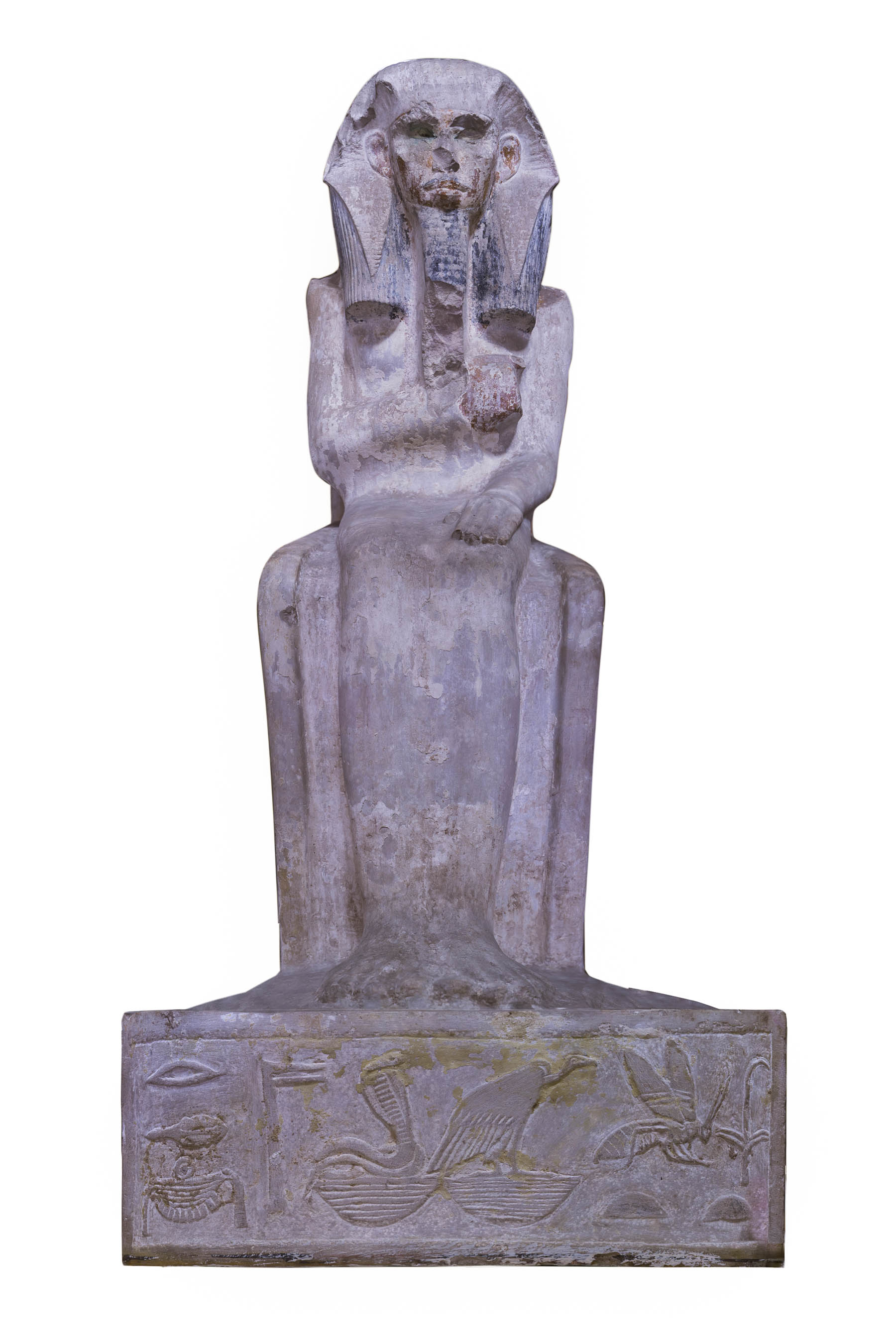
The statue was carved from fine limestone. It stands approximately 56 inches tall.
Widely considered the founder the of Third Dynasty, Djoser ascended the throne sometime around the middle of the 3rd millennium BC. His ascension marks the end of the Early Dynastic and the beginning of the Old Kingdom in Egypt. Although he appears as “Djoser” in king lists; contemporary inscriptions refer to him by his throne name Netjerikhet (“divine of body”). This is the name which appears, for example, on the base of his statue.

The hieroglyphs spell the pharaoh’s titles and his name “Netjerikhet” which means “divine of body.” Writing in Egypt at this time was still limited to recording names, titles, and other types of basic information. Lengthy literary texts do not yet appear.
A number of firsts may be credited to Djoser. He was the first ruler of Egypt to build on a monumental scale with stone, he was the first to build a pyramid, and his limestone statue is the first life-sized stone sculpture of a man. The statue of Djoser reside today in the Cairo Museum.


The statue was carved from limestone, plastered, and then painted. Although they are now missing, the eyes were presumably made of colored stones. Djoser is wearing a tight-fitting garment associated with the Sed festival (of which we will have more to say in the next entry) and the nemes headdress, which is the traditional head covering worn by the pharaoh.
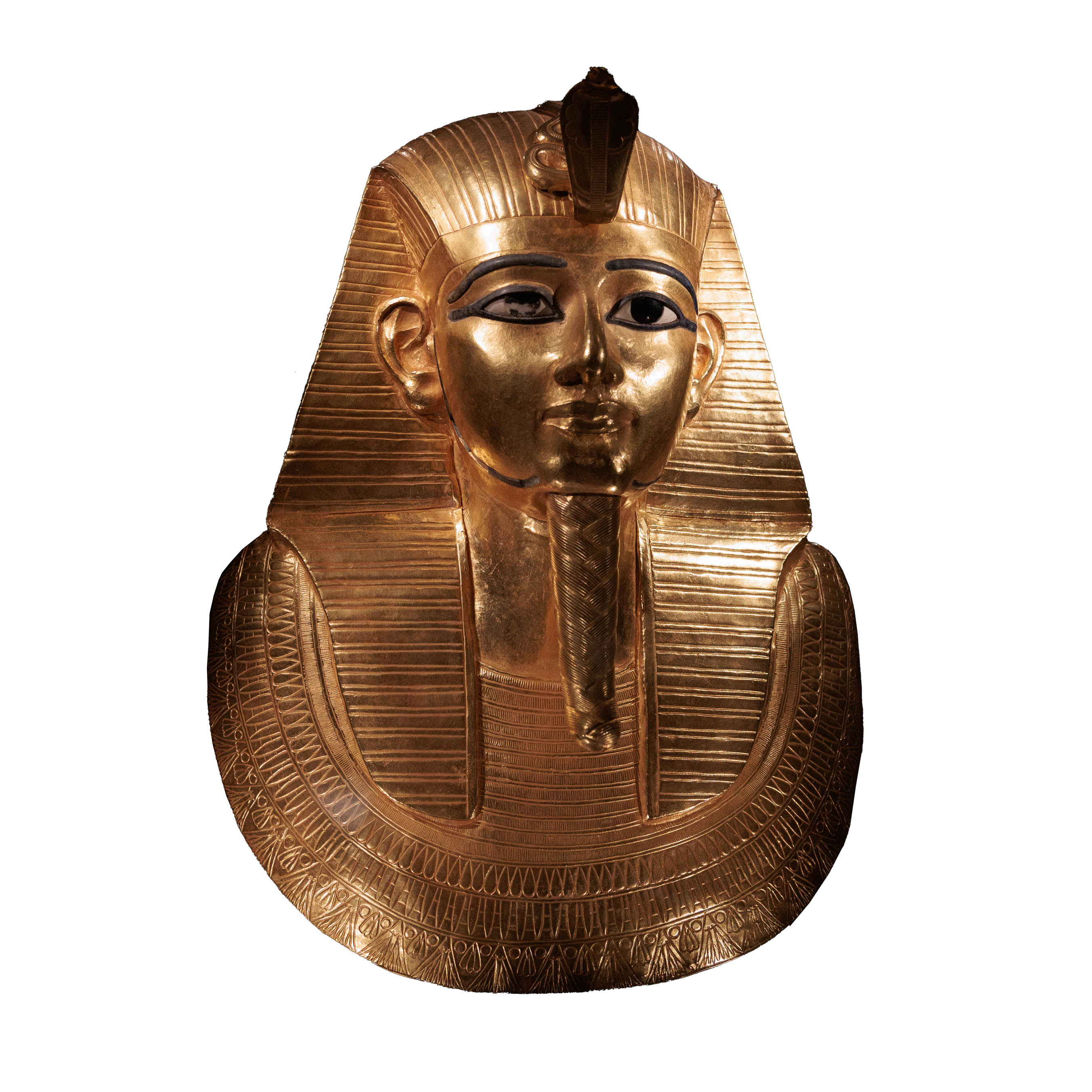

The nemes headcloth is one of the most identifiable Egyptian fashion accessories, and the longest lasting. It makes its earliest appearance on an ivory tablet from the reign of Den (First Dynasty) and continues in use into the Roman period, culminating in the somewhat humorous statue of the Roman emperor, Caracella (early 2nd century AD) wearing the nemes.
Glazed Bricks
The wall of bluish-green glazed bricks displayed behind the statue were actually found in a gallery beneath Djoser’s pyramid. The glazed bricks represent something of a mystery. Glazing is closely associated with the production of “faience,” a glassy substance created by melting silica sand with a fluxing agent such as potash. The production of faience during the Old Kingdom period is generally limited to small glass beads and amulets whereas larger faience objects do not appear until the Middle Kingdom, more than half a millennium later. Exceptional in this regards are these glazed tiles found in the galleries beneath Djoser’s pyramid. Not only do they represent an advanced knowledge of faience production but also knowledge of how to make glass adhere to a pottery substrate, which is no small feat since the two materials have different rates of expansion and contraction. The Babylonians and Persians would master the art of glazing bricks but this lay several millennia in the future when the art of glassmaking was well understood.1Dayton 1978, 196

The blue and green colors were achieved with mineral pigments derived from copper.
Serdab
The statue of Djoser was discovered in a partially buried chamber on the north side of Djoser’s pyramid at Saqqara. This telephone booth-sized chamber is known as a serdab (Arabic “cellar”). The two small peepholes on the front wall of the serdab were provided for the statue so that it could look on as rituals were performed there.2Assmann 2005, 106


The statue was found inside a stone chamber known as a “serdab”. The two holes drilled through the wall of the chamber enabled Djoser’s statue to observe the ceremonies performed at his tomb. The statue visible inside the serdab today is a copy. The original is in the Cairo Museum.
The Ka
As Pierre Montet once observed, “The Egyptians did as much for their dead as they did for their gods, perhaps even more.”3Montet 2000, 166 Nothing illustrates the truth of this statement better than the one hundred or more pyramids constructed on the west bank of the Nile. Although these pyramids functioned as tombs, they also served as temples, and therefore as places of worship. To understand their significance, it is necessary to briefly consider what the Egyptians believed about life after death. The Egyptians divided a person’s existence into four parts.
- Khet = body
- Shut = shadow
- Ba = spirit or ghost
- Ka = animating life force
The ba could travel outside the tomb but the ka remained inside, with the body. For the ka to retain its connection with the tomb, it needed a place to rest. One of the primary functions of a pyramid, therefore, was to provide the king’s ka with a “palace of eternity.” A statue placed inside the tomb might also serve as a place for the ka to dwell, or the body itself, if it could be preserved, could serve this purpose. This is why the Egyptians mummified their dead.
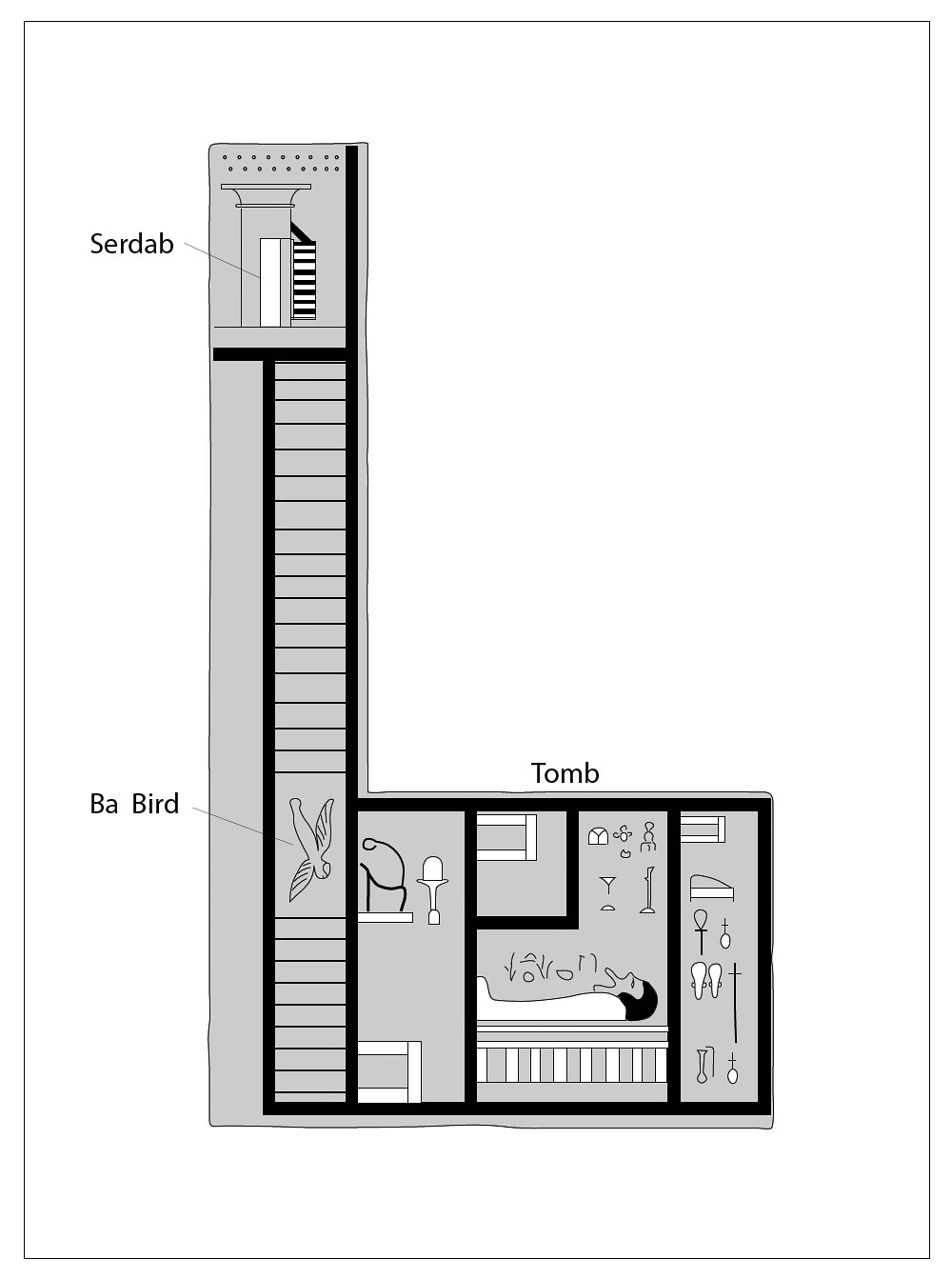
A wall mural from an Egyptian tomb shows the serdab, above ground, which housed the ‘ka’ statue. It was connected to an underground chamber via a shaft. The ‘ba’ is depicted as a bird with a human head. The wall mural shows the spirit descending the shaft to rejoin the body in the tomb.
It was the job of the priest who served in the mortuary temple connected to the pyramid to lay out food and drink on an altar for the ka of the deceased. Family members might also visit the tomb on special occasions to offer food on the altar for the deceased. The importance of these provisions is highlighted by the following inscription, engraved on a tomb, addressed to passerbys.
O you who are on earth and who pass by this tomb, pour me out some
water. Let my funerary repast appear, made up of all the things which
you are bringing with you.”4Montet 2000, 182
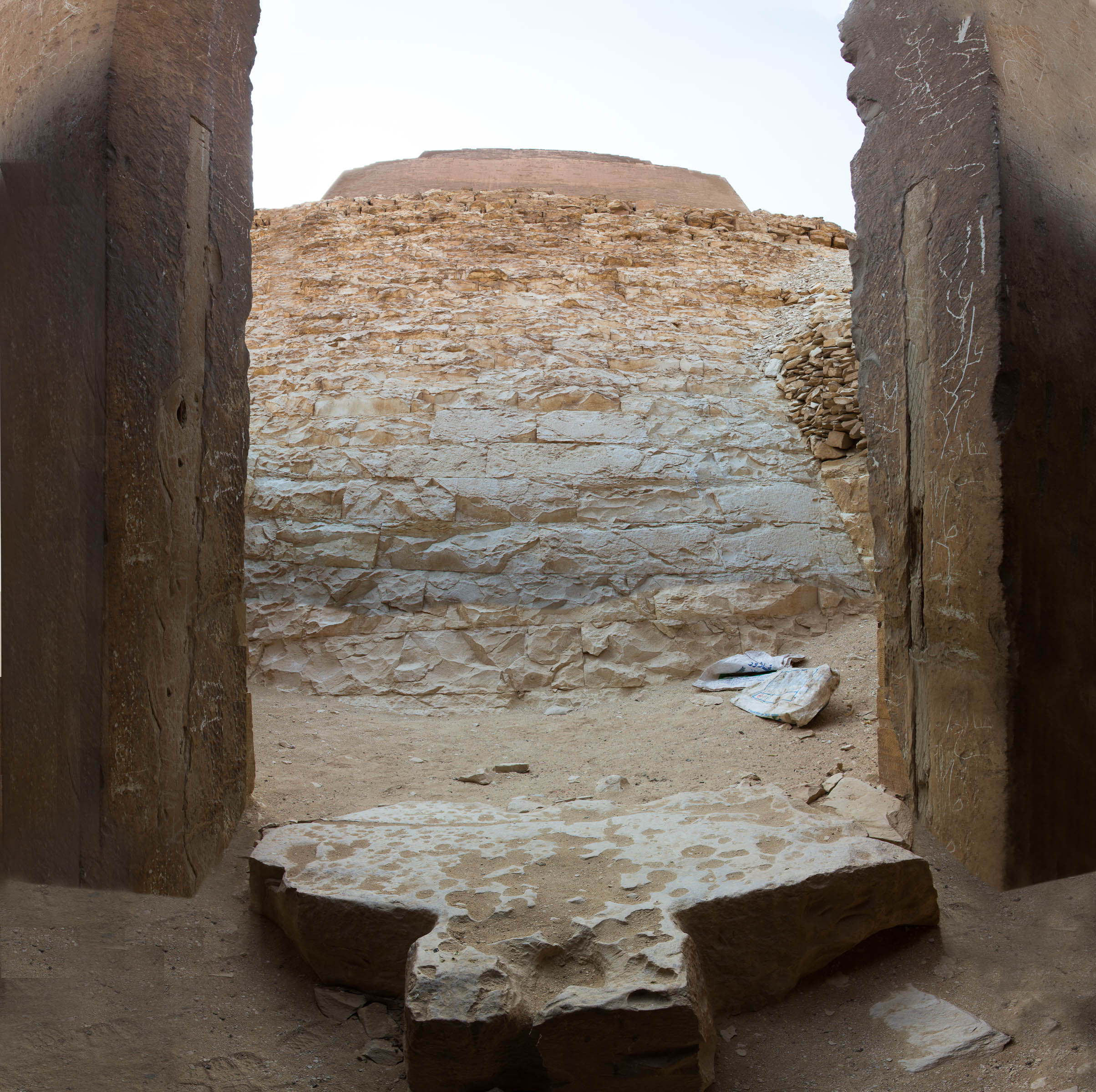
An offering table placed in front of the pyramid of Snofru (background).
Assmann, J.
Death and salvation in ancient Egypt.
Ithaca: Cornell University Press, 2005.
Dayton, John .
Minerals Metals Glazing and Man.
London: Harrap & Co., 1978.
Montet, Pierre.
Eternal Egypt.
London: Phoenix Press, 2000.