
The knife blade is made of flint and the handle from ivory. It measures approximately 10 inches long.
The Gebel el-Arak knife was purchased on behalf of the Louvre by George Benedite in 1914. Although the knife was purchased in the small Egyptian town of Gebel el-Arak in Upper Egypt, it probably originated in the Royal Cemetery of Abydos, 25 miles distant, where similar knives have been found. Its beautifully knapped flint blade attests to the great skill attained by Egyptian flint knappers who, as you may recall, also produced the flint animals and hollow-base arrowheads discovered beneath the foundations of Structure 7 in cemetery HK6.
The method used to produce these flints is known as “pressure flaking.” As the name suggests, the technique involves applying steady pressure to the surface of the flint using a piece of bone or wood until a flake is produced. A master produced the long, parallel flakes evenly spaced along the length of the Gebel el-Arak blade. The flaking is not only beautiful, but also gave the knife a serrated edge.
What is perhaps the most interesting feature of the Gebel el-Arak knife is not the fine quality of its flint blade but the scenes carved into its ivory handle.
Handle
One side of the knife handle preserves what may be the earliest known battle scene. In the upper register mostly naked men, wearing nothing more than sheaths attached to a string tied around their waist, engage in hand to hand combat with stone maces, flint knives, and clubs. Their knives are shaped like the Gebel el-Arak knife, proving that these knives were not purely ceremonial. The warriors on one side weas their hair long while the opposing side are either bald or have very short hair. Otherwise the combatants are indistinguishable from one another. The baldies are victorious.

Mostly naked men fight with stone maces, flint knives, and clubs. This is the first battle scene in recorded history.
Below the land battle, we have what appears to be the aftermath of a naval battle. Two distinct types of boats are depicted in this scene. One is a flat bottomed boat with a high prow and stern. Boats of this type are also depicted on Mesopotamian seals. The other type has the familiar gently curving keel typical of Egyptian river boats.1Stiegletz 1984, 135

Two types of boats are depicted: high-prowed, apparently foreign ships and traditional Egyptian river boats. The drowned combatants are all bald (cf. the bald men in the land battle who are shown victorious).
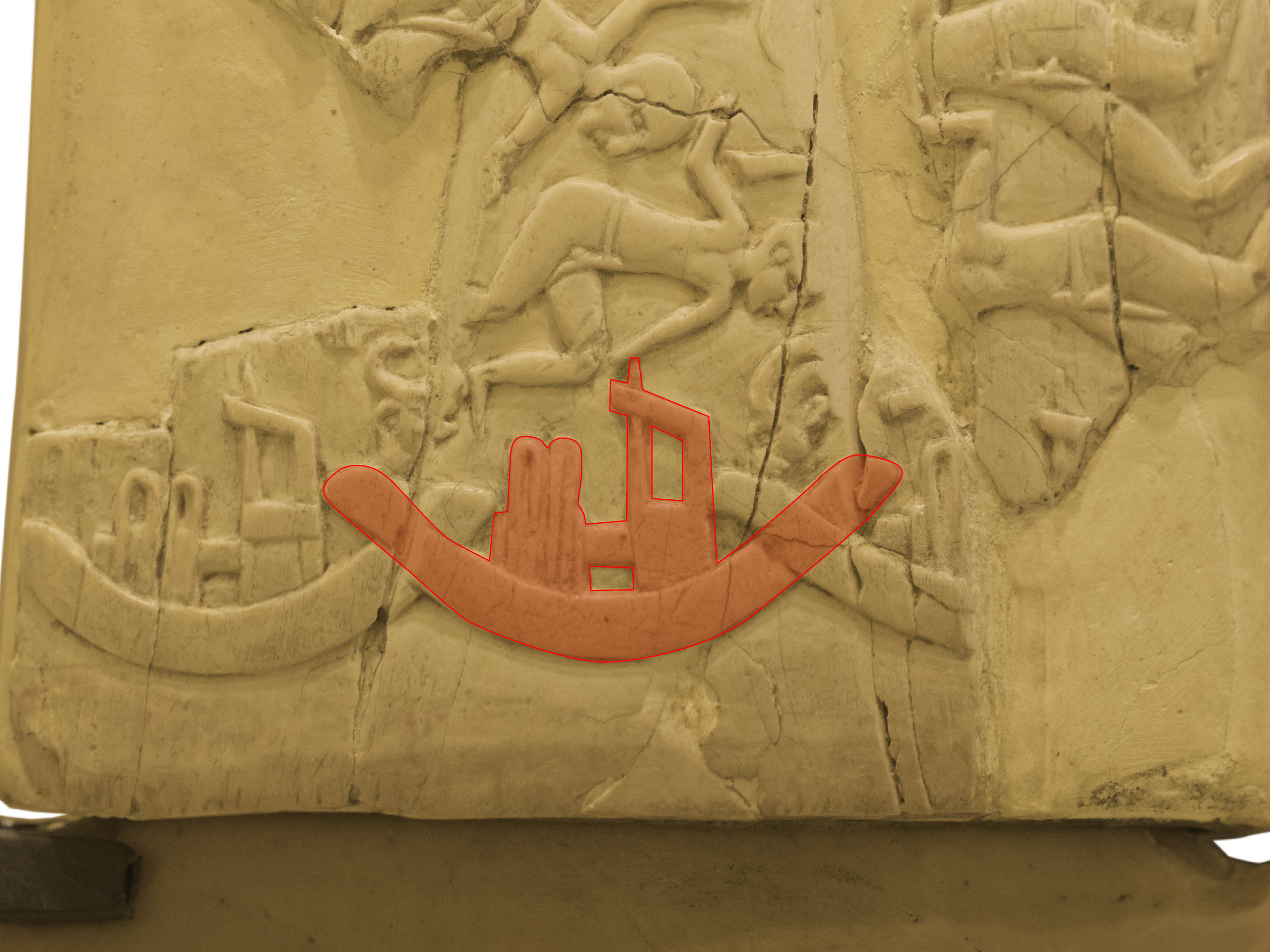

One type of boat displayed on the knife is clearly an Egyptian craft identical to the boats depicted on the wall mural in Tomb 100 at Hierakonpolis.
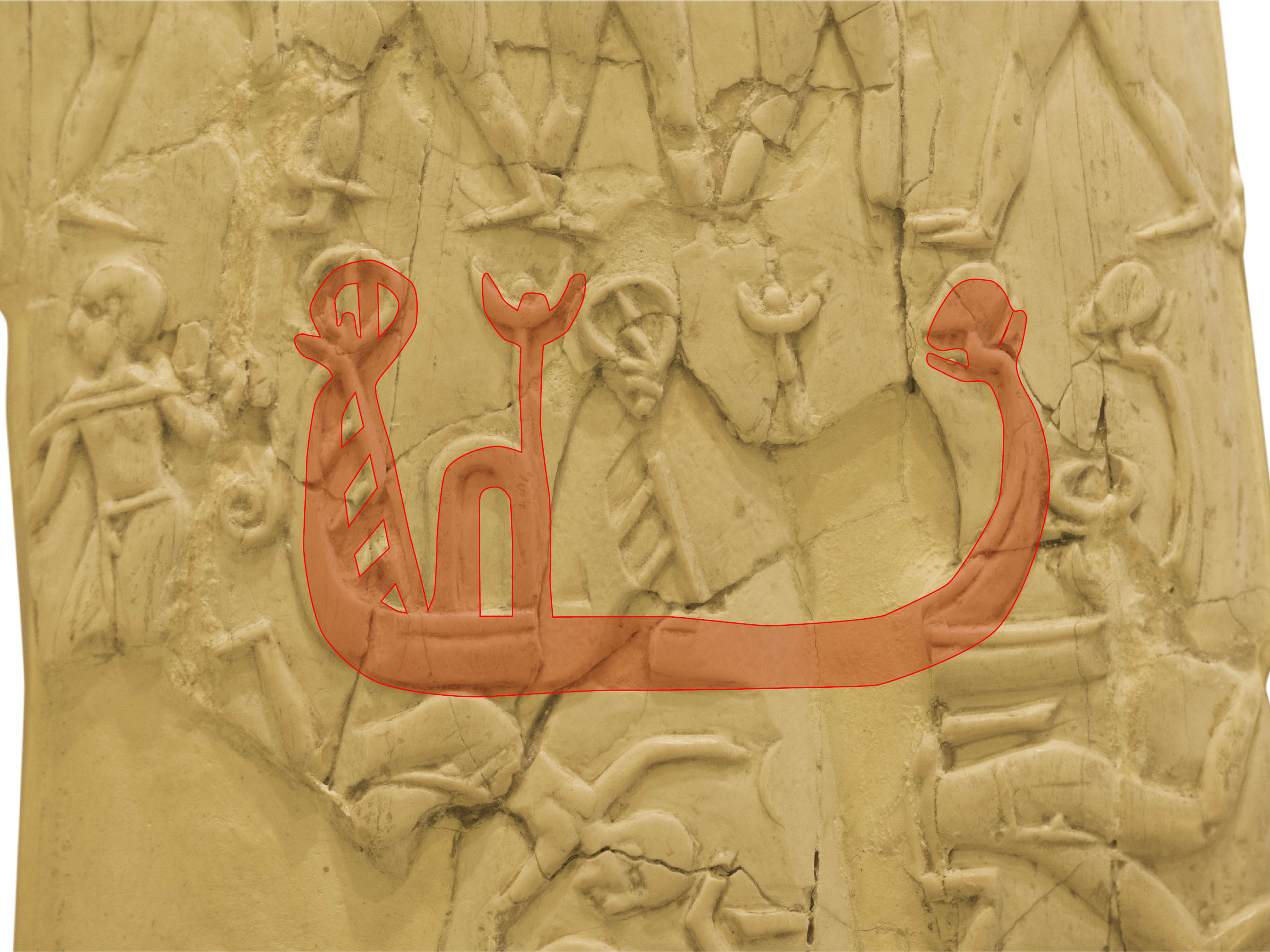
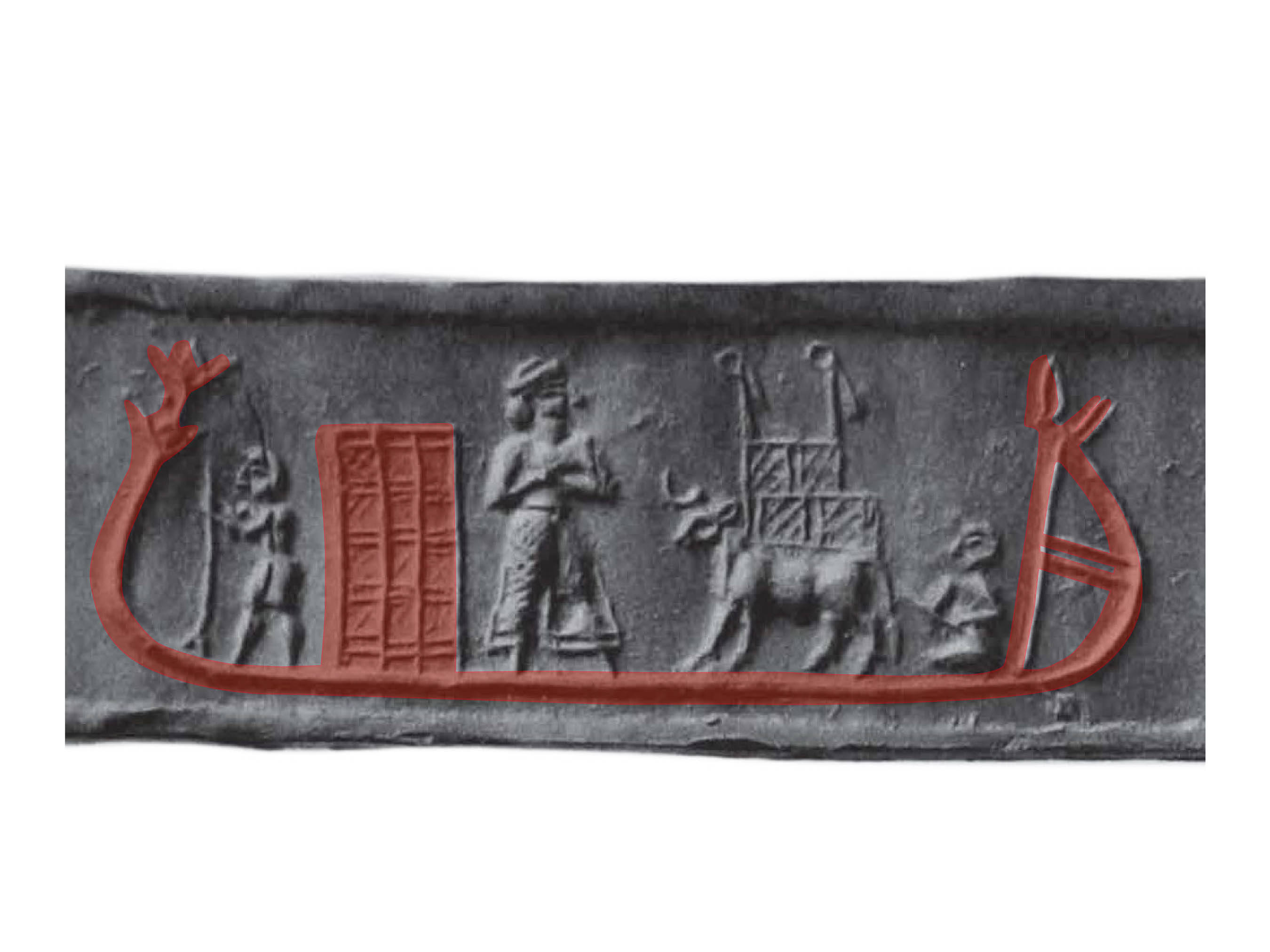
The other type of boat depicted on the knife handle is nearly identical to a Mesopotamian ship depicted on a cylinder seal that dates to the Uruk or Jemdet Nasr period. Note the tall prow reinforced with a vertical post and two horizontal braces. Note also the method of binding the reeds that form the prow and stern of the boat. The crescent-disc standard next to the ship’s cabin also has Mesopotamian analogues.1It is also worth noting that its rounded cabin is identical to the cabin on the black ship on the wall mural from Tomb 100. However the black ship in the mural only has a raised stern. There may still be a relationship between the two boats since they seem to share the same style of cabin.
The Mighty Hunter
The combatants, who are dressed and armed like primitive cavemen, present a striking contrast to the bearded figure displayed on the opposite side of the handle, who wears a full-length kilt and a cap with a rolled brim. Of the identification of this figure, there can be no doubt. His hat and dress betray his Mesopotamian origin, as does his “master of the beasts” pose. (As you may recall, this motif is also struck by a figure on the wall fresco from Tomb 100.) All of this points to a Late Uruk or Jemdet Nasr date for the knife.
Two hunting dogs rest their paws on a raised knob that is pierced for attaching to a lanyard. The lowest portion of the handle displays a chaotic scene focused on a lion attacking a cow. A hunter and his dog are barely visible at the bottom left. The king is therefore shown as a hunter who protects his herds from the wild beasts.

The knife handle displays a curious juxtaposition of Egyptian hunting dogs and Asian lions. A hunter (broken) and his dog are visible in the lower left corner.
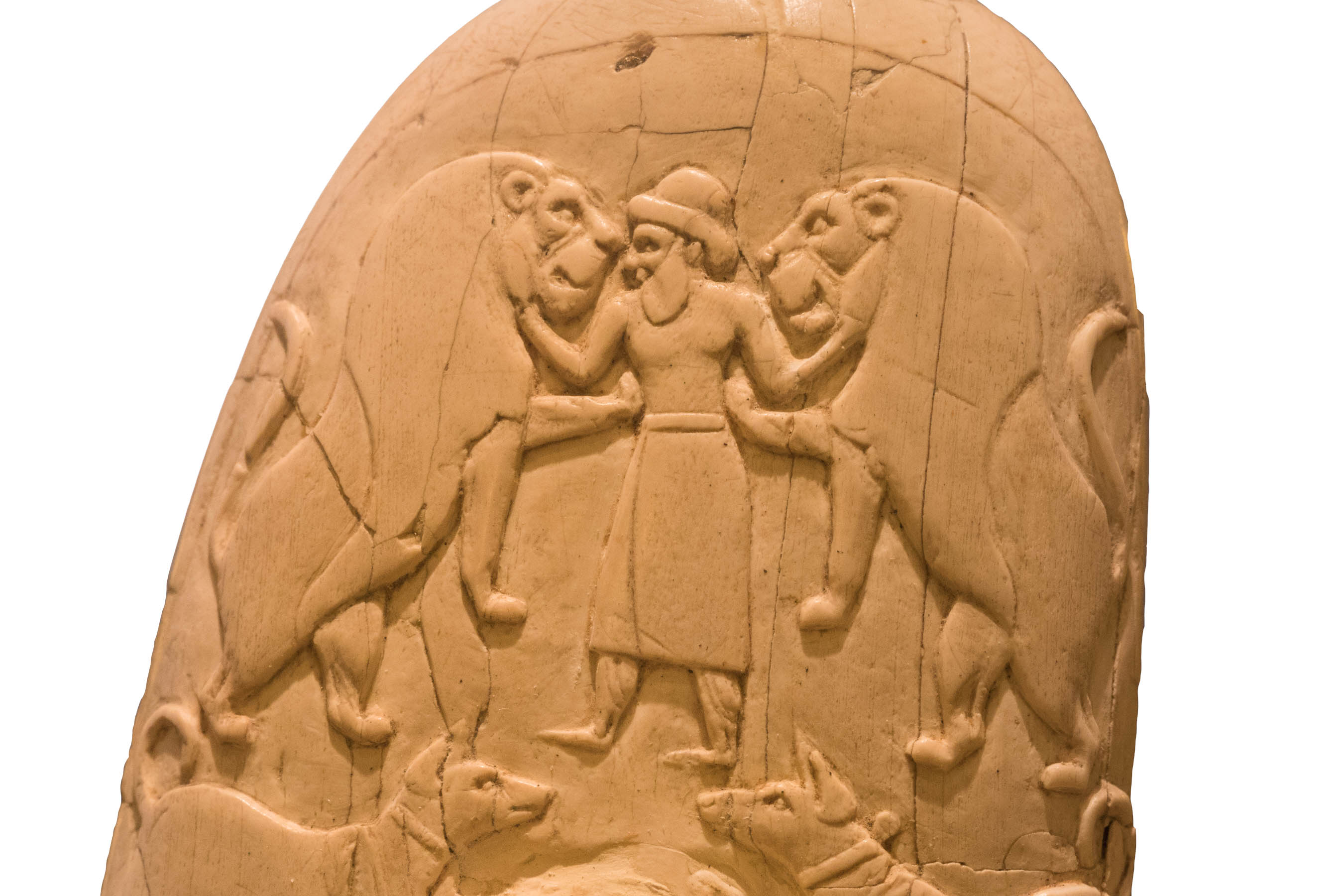
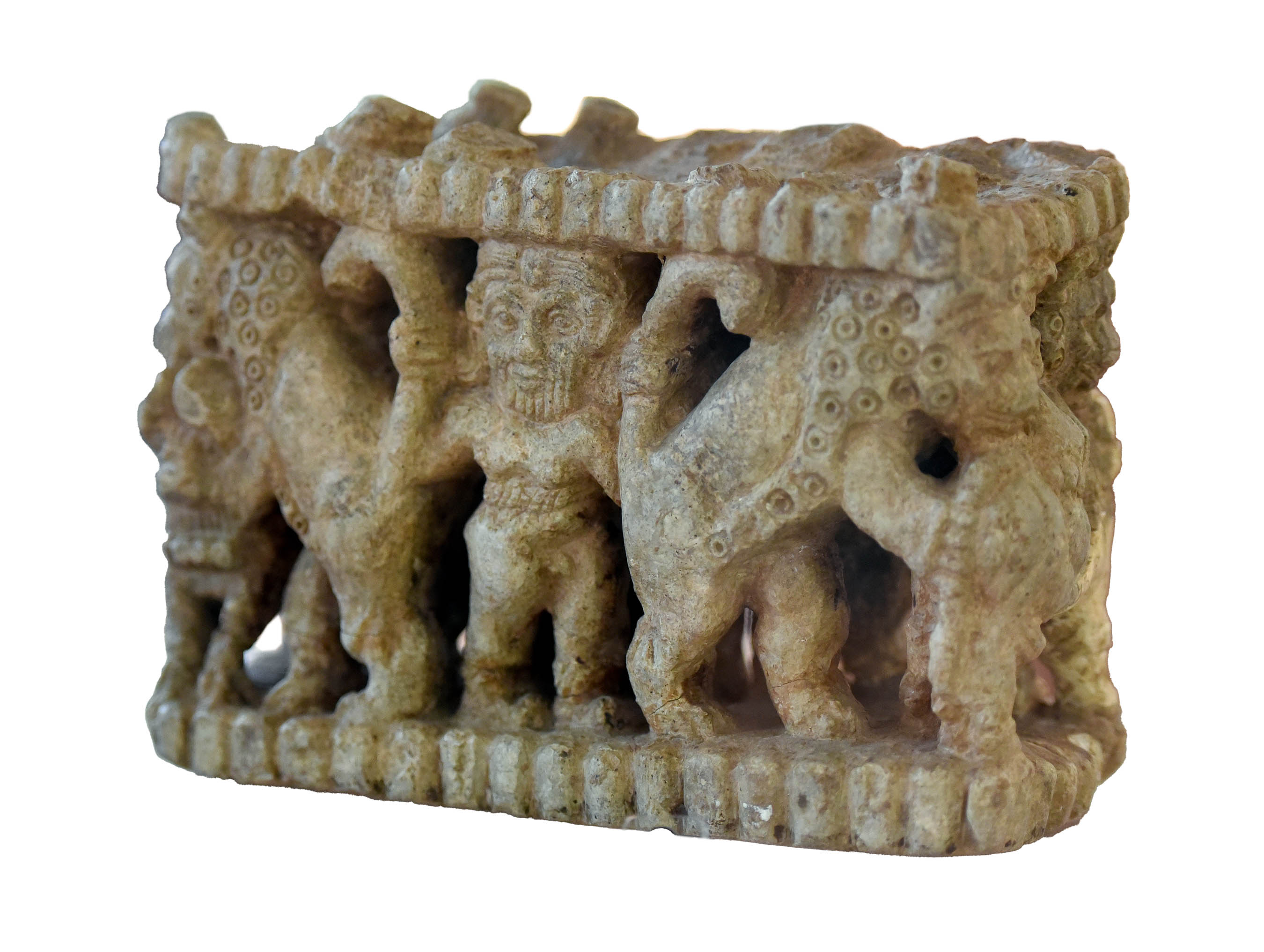

Right: The sculpted stone box from Tel Agrab in Mesopotamia (Diyala) displays the king grasping two lions. The lions, in turn, are biting the back of a cow. Left: Both the “master of the beasts” and the “lion attacking a cow” are displayed on the Gebel el-Arak knife.


Left: The ensi is shown bare-chested, sporting a long beard trimmed below the chin, and wearing the distinctive cap of a Sumerian ensi. Right: A statuette found at Uruk which probably dates to the Late Uruk period.
Interpretation
The first scholars to study the scenes from the knife handle interpreted them as evidence of a seaborne attack on Egypt by Mesopotamian or Elamite invaders. Petrie likened the knife to the famous Bayeux tapestry commemorating the Norman invasion of England.2Petrie 1939, 65 Henri Frankfort suggested that the Mesopotamians may have come into contact with Egypt via a maritime route that rounded the southern coast of the Arabian Peninsula.3Frankfort 1956, 136 These views have fallen from favor in recent years. Most scholars view the formation of the Egyptian and Mesopotamian civilization as largely independent developments. Objects of clear Mesopotamian origin, such as cylinder seals or the Gebel el-Arak knife, are thought to have been imported to Egypt via intermediaries across long distance trade networks.
There is a considerable amount of evidence, however, for more extensive contact between the two regions during the Late Uruk and Jemdet Nasr periods. The following summary is adapted from Frankfort (1956) and Emery (1961):
- Niched Facades—Egyptian architecture made use of the niched facade, a style of architecture that has a long history in Mesopotamia (ie. the White Temple) but disappears from Egypt after the Third Dynasty.
- Cylinder Seals—Egypt borrowed the cylinder seal from Mesopotamia, an object which likewise has a long history in Mesopotamia but fell out of use in Egypt by the end of the Old Kingdom period.
- Artistic Motifs—The serpent-necked feline, the lion clawing the back of a bull, and the master of beasts motif, are Mesopotamian in origin. They appear in Egypt primarily during the Predynastic period but disappear shortly thereafter.
- Writing—The impetus for writing in Egypt likely came from Mesopotamia. This explains why, when writing appears in Egypt, it appears in a more advanced state of development, whereas in Mesopotamia one can trace writing back to the clay bullae and primitive numerical tablets.4Frankfort 1956, 134; Emery 1961, 38
In a more recent publication, the Finnish Indologist, Asko Parpola, advocated for the resurrection of the “Sumerian or Elamite invasion” theory.
In this period, the Egyptians were still behind the Uruk people in cultural development, for instance in their knowledge of metallurgy, and not nearly so well organized. It should have been possible for a well-armed group of well-traveled Uruk traders—already familiar with the local conditions, people, and language (at least via interpreters)—to take over Upper Egypt. I would like to resurrect the suggestion that the first pharaohs were Sumerian or Elamite invaders, proposed by the eminent Egyptologist Flinders Petrie (1853–1942) and strongly supported by many of his colleagues until about 1960. It was then generally rejected, because of the undoubted untenability of its associated ideas: a “Dynastic race” and a sudden invasion of Egypt via a sea route from Mesopotamia through the Persian Gulf around the Arabian peninsula and into the Red Sea.5Parpola 2011, 222
Parpola notes that this was the popular view until the 1960’s when it fell from favor. The theory is barely mentioned today, not because new evidence has been found to discredit it, but because the theory itself is, oddly enough, viewed as being racist. But history is replete with examples of movements of peoples who carried new ideas and technologies into lands populated by less advanced peoples. All of Europe held this position in relation to the Romans at one time or another. Parpola also points to an account preserved in old Russian chronicle which describes how, during the 9th century AD, a tribe of Slavs lacking organized government invited three Scandinavian brothers to settle in their lands and rule over them. The sons of these Scandinavian kings adopted Russian names and rapidly assimilated into the culture of the region, while no doubt leaving a mark of their own. One could multiply examples of this sort.
That Mesopotamian influence was strongly felt in Egypt during the Predynastic and Early Dynastic periods is indisputable, but how this influence was transmitted is a difficult question. Historically, trade between the two regions has been conducted overland via the long trade route which passed along the Euphrates and through the Levant, forming a great northern arc. However, it is also possible that trade was conducted overland, across the Arabian peninsula, given the more agreeable climate that likely prevailed in the region during the first half of the Early Bronze period. (We will return to this question in our discussion of Dilmun and Magan.)
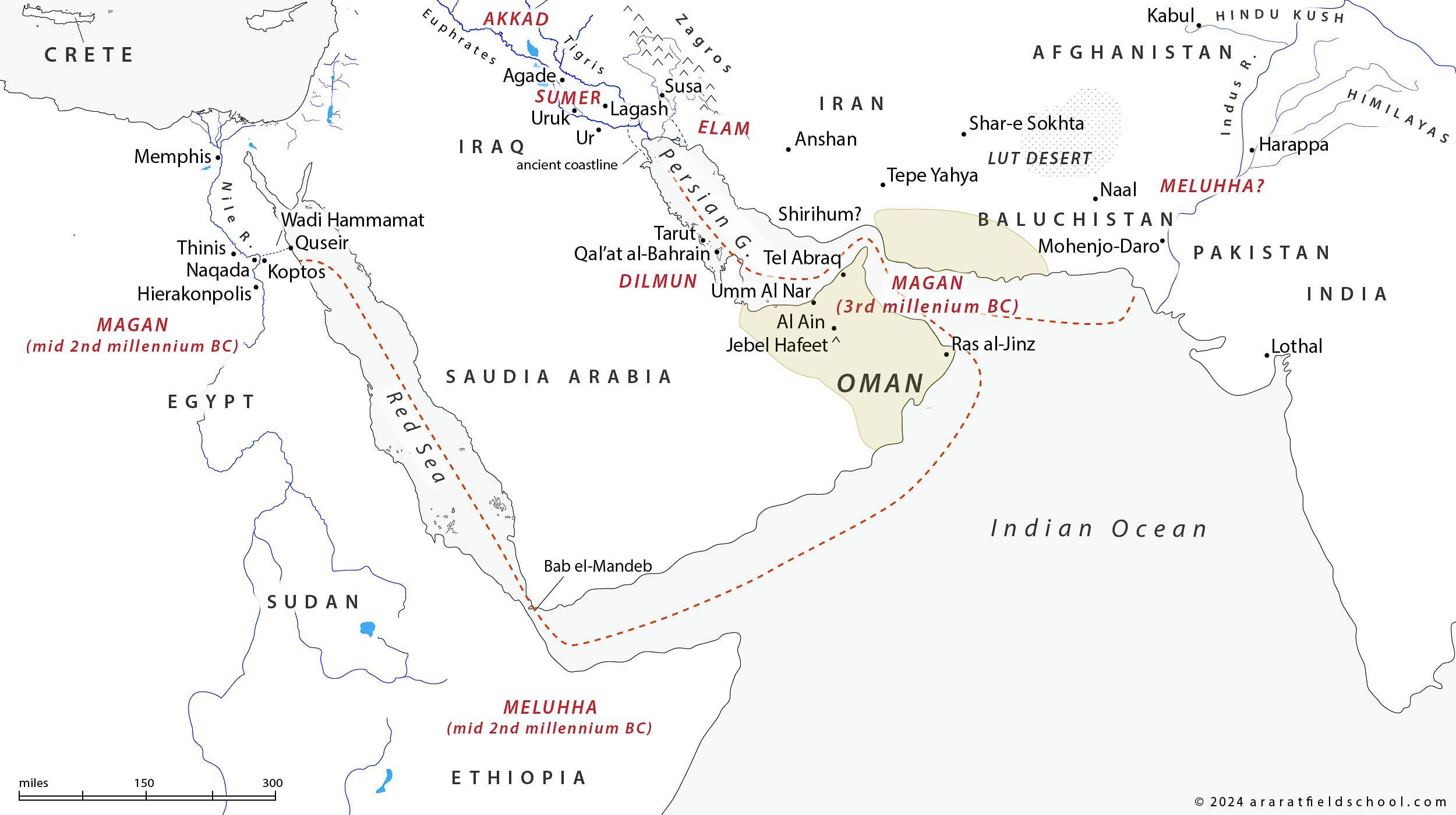
A map of the hypothetical sea routes which could have connected the Indus Valley, Mesopotamia, and Egypt.
A Maritime Route (?)
We also cannot rule out the possibility of a maritime route between Egypt and Mesopotamia. This much is suggested by the Gebel el-Arak knife itself, which seems to depict Mesopotamian boats alongside Egyptian river boats. The distance from the port cities of Mesopotamia to the entrance of the Red Sea, known as the Bab el-Mandeb (“Gate of Tears”), is approximately 2500 miles. The journey from the Bab el-Mandeb to Quseir, the Egyptian port on the Red Sea, is another 1500 miles. Thus the total length of the journey from Sumer to Egypt by sea is over 4000 miles. The journey is made more treacherous by the fact that the southern coast of Arabia lacks good ports and is susceptible to monsoon winds.6Price 1923, 48 Tidal flows through the Bab el-Mandeb are also treacherous, hence its name “Gate of Tears!”
However, the long distances involved may be significantly reduced if the port of embarkation was located further south, on the southern coast of Arabia. Furthermore, we do not know what conditions and weather patterns prevailed on the southern coast of Arabia during the Early Bronze period or whether there were other ports of call along the way which have not yet been discovered. Certainly this route was familiar to Persian mariners. And in the Roman era Strabo says that ships were regularly sailing from Berenice on the Red Sea to Sri Lanka on the southern tip of India. Whether Early Bronze boats were capable of the lesser journey around Arabia cannot be proven, but it seems plausible, at least. Certainly Gulf mariners were making the journey to Lothal, on the Indian coast, during the Early Bronze period, just as Egyptian boats were making the journey from Quseir to Punt. Perhaps Magan, famous for its seagoing ships, was capable of sailing between the two seas, even though it probably was not a regular occurrence.
In light of the extensive network of Sumerian trading colonies established during the Uruk period, it would surprising if they did not also make direct contact with Egypt, even if we do not know quite how. The relationship seems to have been primarily in one direction since no clearly identifiable Egyptian artifacts have been found in Mesopotamia from this period. Finally, it is worth noting that Mesopotamian influence was most strongly felt in Upper Egypt. This suggests that the route taken by Mesopotamian merchants was a southerly one, via Quseir, the main Egyptian port on the Red Sea, and from there up the Wadi Hammamat to Nubt (Naqada) in Upper Egypt.
Casson, L.
Ships and seamanship in the ancient world..
Baltimore: Johns Hopkins University Press, 1995.
Emery, W. B.
Archaic Egypt.
Harmondsworth: Penguin, 1972. Link
Frankfort, H.
The Birth of Civilization in the Near East.
New York: Doubleday Anchor Books, 1956.
Parpola, Asko.
The Roots of Hinduism: The Early Aryans and the Indus Civilization .
Oxford: Oxford University Press, 2015.
Petrie, W. M. Flinders.
The Making of Egypt.
London: The Sheldon Press, 1939.
Price, I.M. “The Topography of the Gudea Inscriptions.” Journal of the American Oriental Society 43 (1923): 41-48. Link
Stieglitz, R. R. “Long-Distance Seafaring in the Ancient Near East.” The Biblical Archaeologist 47, no. 3 (1984): 134-142.