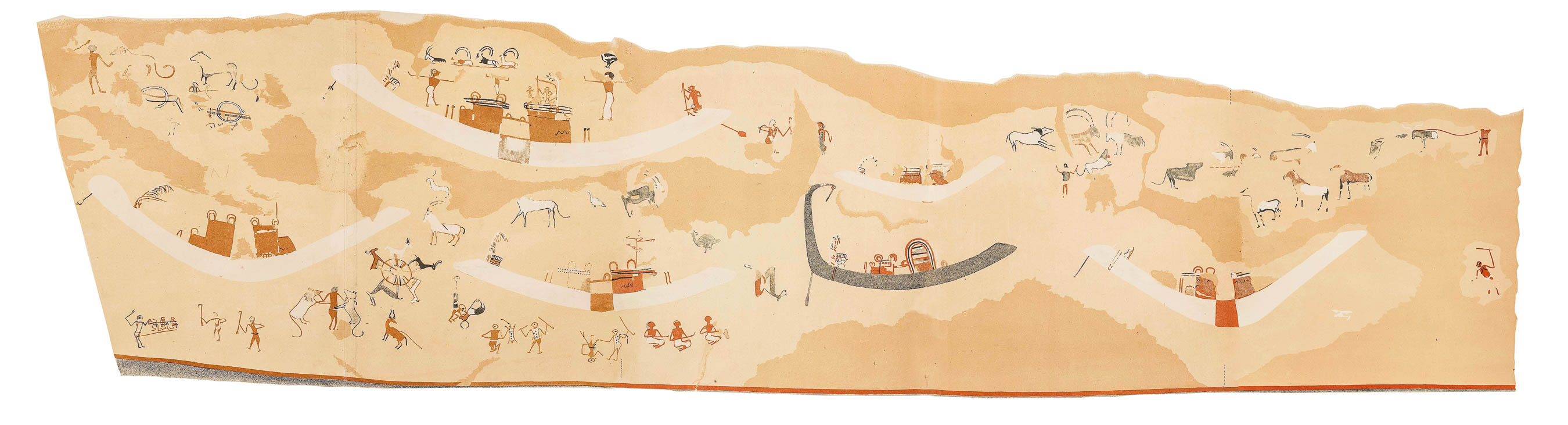
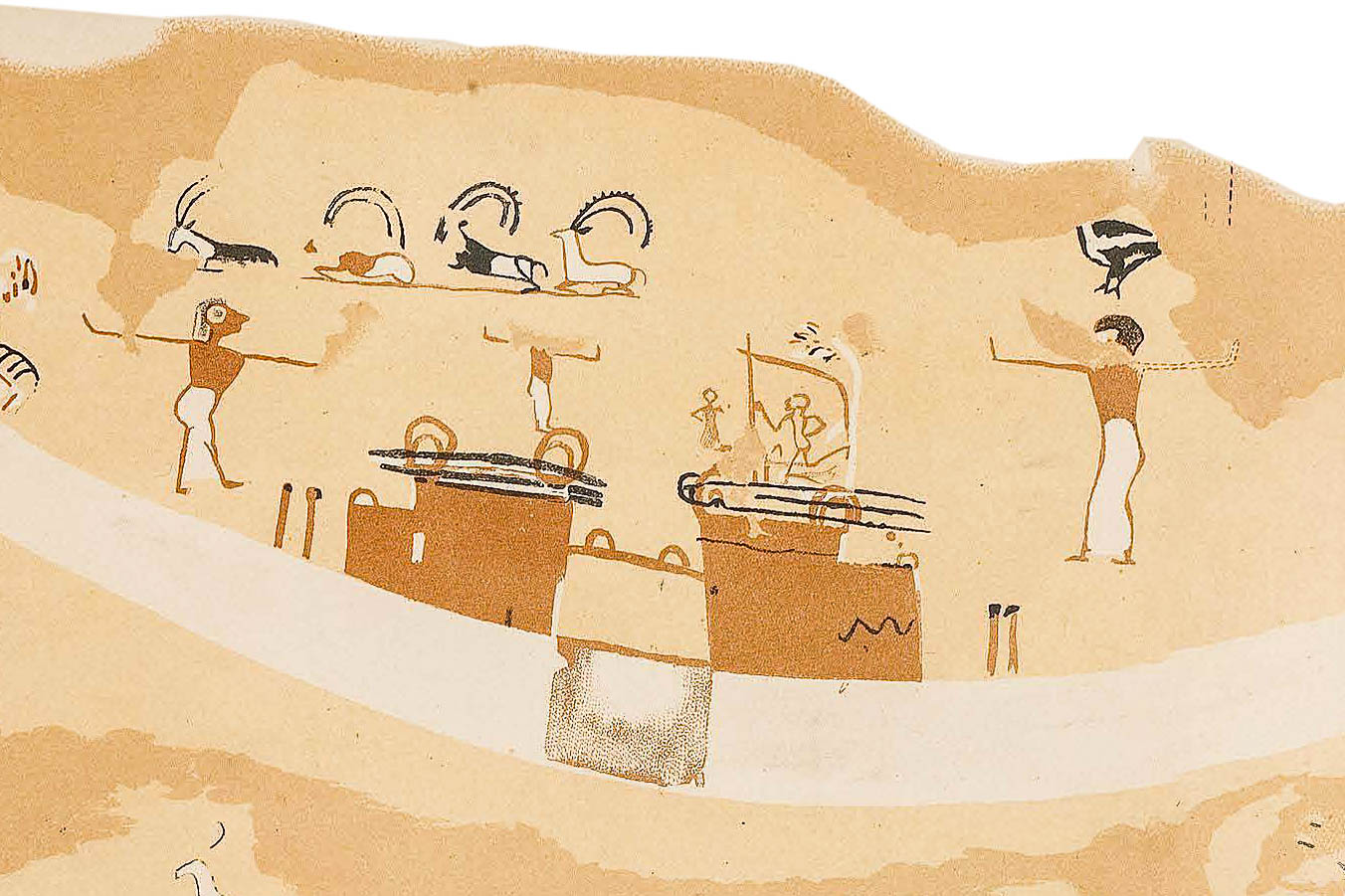
This mural was discovered in a tomb at Hierakonpolis known as “Tomb 100” or the “Painted Tomb.”
The most famous tomb excavated at Hierakonpolis is not in HK6 but closer to the flood plain in the vicinity of the Fort. It was discovered by locals during the second season of excavations at Hierakonpolis. Green named it Tomb 100 but it is more commonly known as the “Painted Tomb” after the colorful fresco decorating one of its walls. Although the exact location of the tomb is no longer known, Green describes it as a simple brick-lined pit measuring 15 feet long, by 6 1/2 feet wide, and 5 feet deep. Although nothing is left of its roof structure, it would have been roofed over with wooden beams and covered with sand to form a low mound.1Kemp 1973, 42
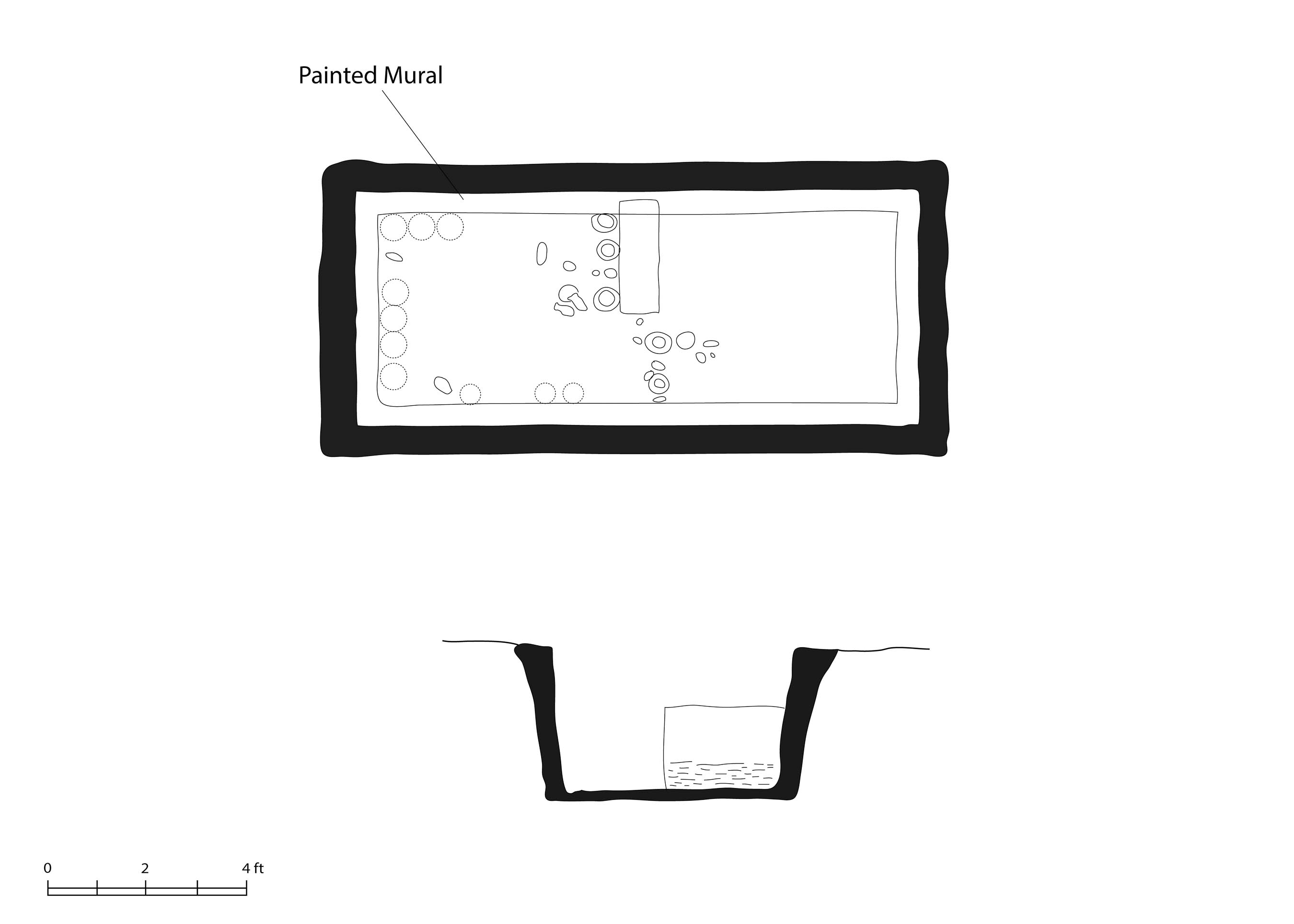
The tomb was robbed, probably several years before Green had a chance to excavate it.
Among the objects recovered from the tomb was black-topped pottery and a fish-tail knife. The latter object sports a uniquely shaped blade whose exact function is unknown. Sir Flinders Petrie thought it was a lance head fitted to a shaft. The broad blade would have acted like a broadhead arrow. However, a stele discovered in Arabia depicting a man carrying a “fishtail knife” suggests that these blades were probably used as knives. The curve of the double blade is not unlike a modern skinning knife.

Three styles of fish-tail knives exhibited at the British Museum. The middle knife is nearly identical to the knife found in Tomb 100.
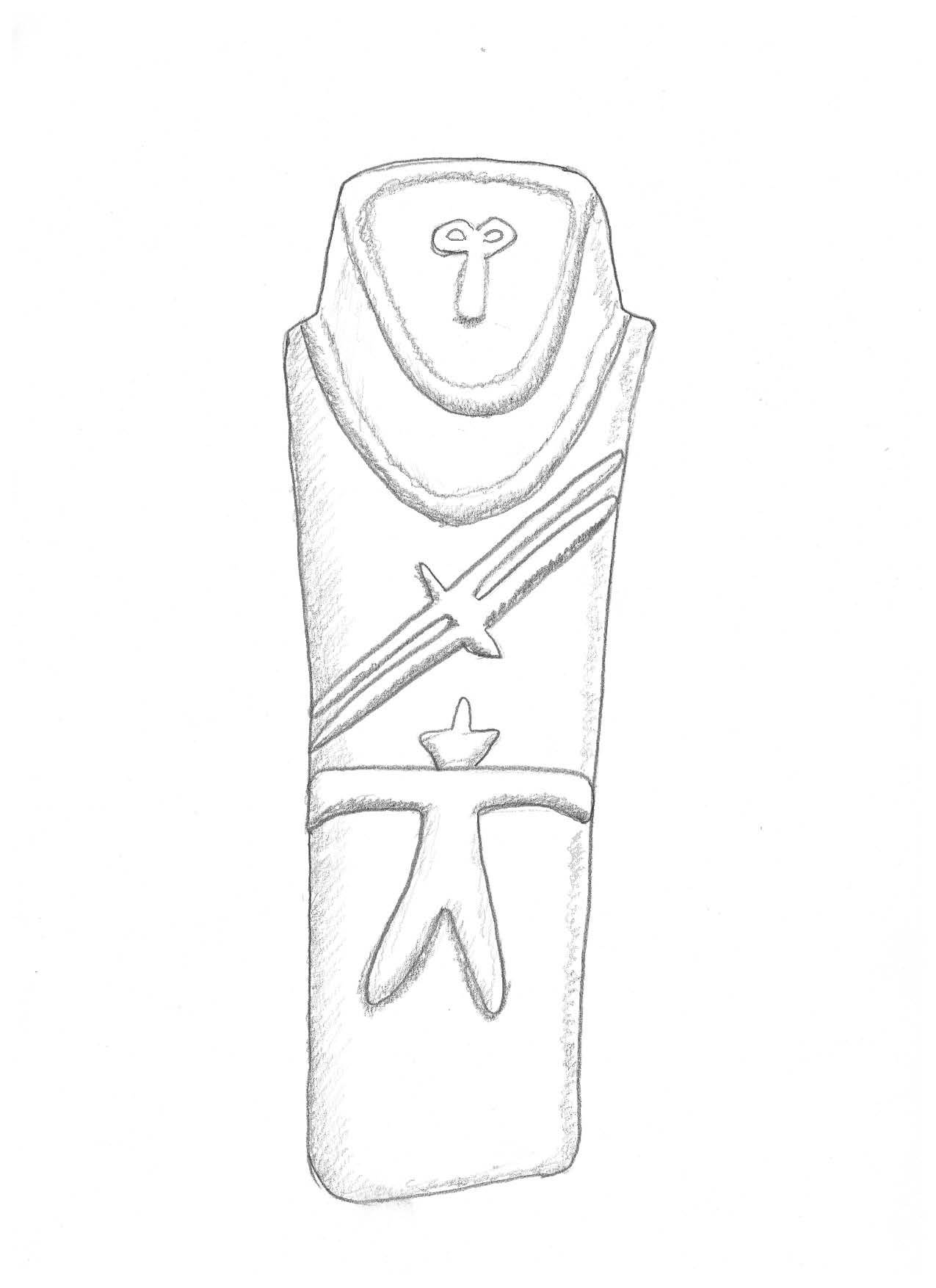
This stone stele from Saudi Arabia shows a man with a fishtail knife attached to his belt.
The tomb presents something of a riddle since the artifacts recovered from it are generally dated to the Naqada II period whereas the motifs depicted on the wall fresco most likely date to the very end of the Naqada III period (also known as the Protodynastic period). This apparent discrepancy is resolved if more overlap is allowed between the various “cultures” of the Predynastic period. What is often regarded as a linear succession of styles that stretches out over many centuries may actually belong to a shorter period of time with a lot of overlap between styles.2Case and Payne write, “…the denial by Kantor that S.D. 60-76 [note: these are Petrie’s sequence numbers which were discussed in our previous entry on Black-topped pottery] existed as a period of time can only mean that the fairly substantial material which is contained within these sequence-dates, and which differs quite markedly from the typical Gerzean, was either contemporary with the Gerzean or with the First Dynasty or overlapped them both.” Case and Payne 1961, 15.

A black-topped vase similar to the one found in Tomb 100.
The Fresco
Undoubtedly the most important feature of the tomb was the fresco preserved on one of its walls. It shows a procession of boats sailing through a strange and bewildering landscape populated with scenes of warfare, hunting, and dancing. The light-colored ships, which assume the form of typical Egyptian river-boats, move through the picture from left to right. They are manned by figures outlined in red. In contrast, the single black ship with high stern is an unusual shape for an Egyptian boat of this period. It is manned by figures outlined with black paint and moves across the mural in the opposite direction, from left to right.3What is often interpreted as a high prow is actually the stern of the boat and therefore also the location of the steering oar. For comparison see also the boats depicted on one of the knives from the Dorak Treasure. (Yadin 1963, 144) Boats with high sterns similar to this one are also depicted on the so-called “Frying Pans” recovered from tombs on the Cyclades (we will come back to these in a future entry).
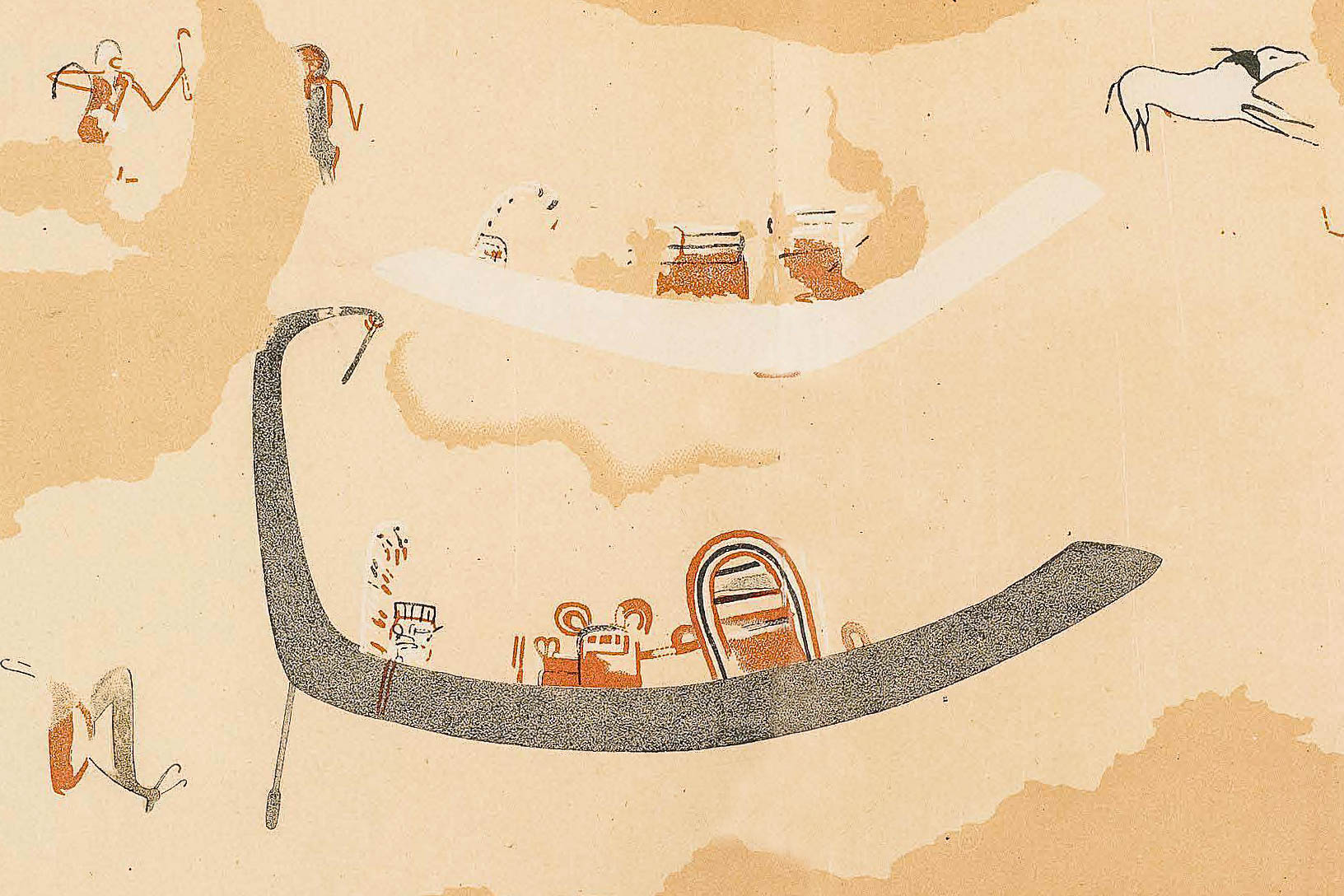
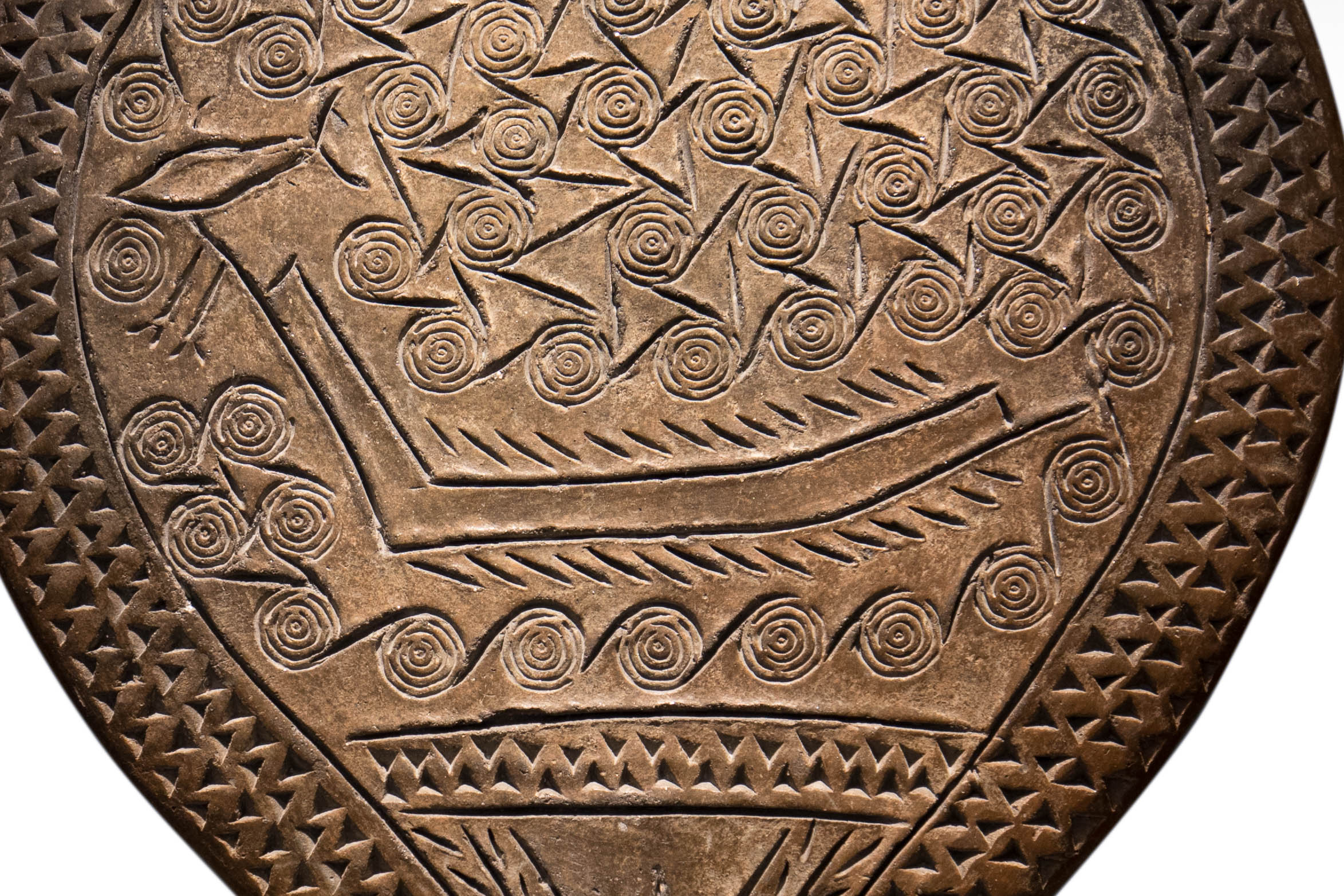
The black craft represents a different style of ship that was foreign to Egypt. Its high stern is similar to representations of boats on “frying pans” from the Cyclades in the Aegean (right).
The fresco is comprised of “episodes” that are not easily strung together. In one episode a “black” figure is about to smite three bound prisoners, painted in red. In another episode, two “red” men, one wearing a leopard skin, appear to tussle over another leopard skin. In the second part of this episode, the man wearing the leopard skin is victorious. Another figure stands alone, clutching a lion in each hand. Known as the “master of the beasts” motif, it is regularly depicted on Mesopotamian artifacts, but is foreign to Egypt. We will encounter it again on the Gebel el-Arak Knife.
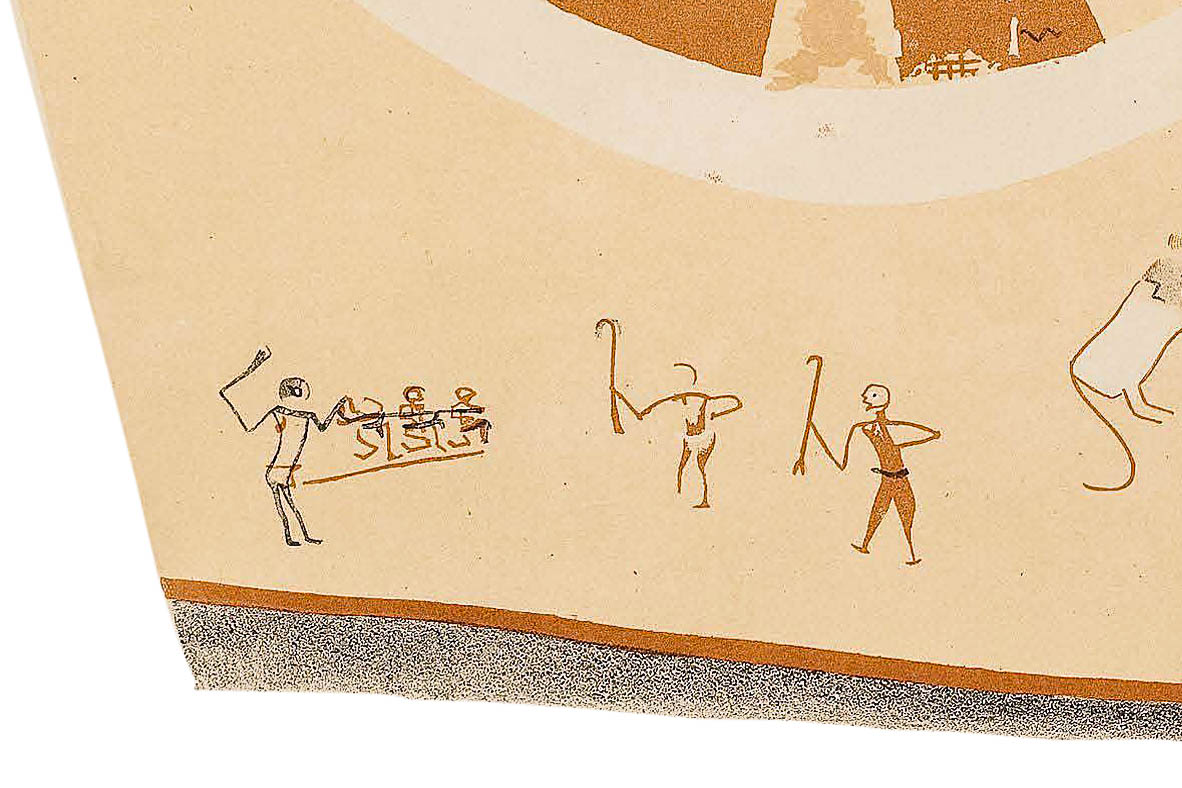
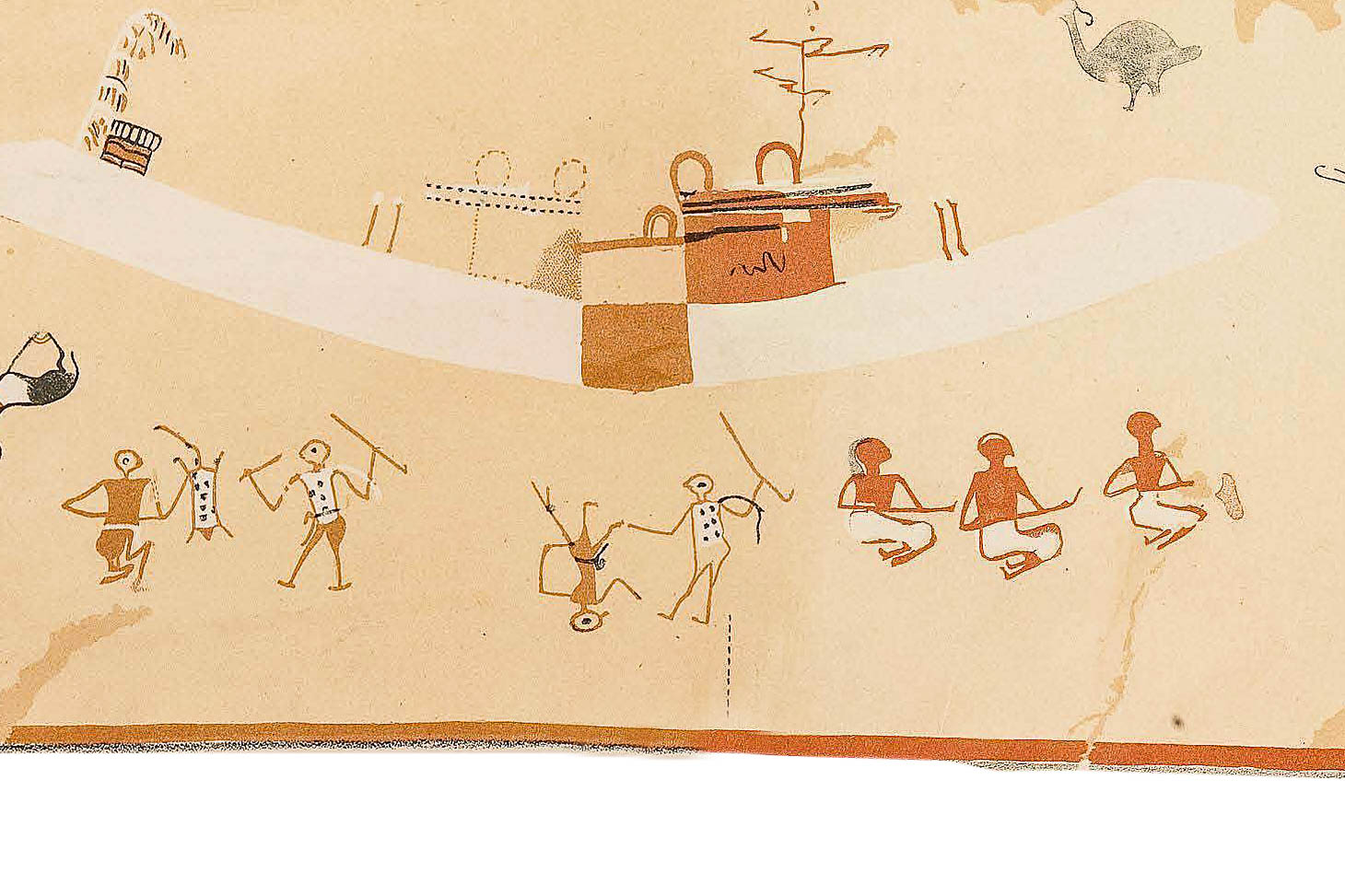
Left: A man raises a mace to strike three bound prisoners. The prisoners are depicted in red paint while the man with the mace is outlined in black. The figures wear nothing more than a sheath attached to a belt for clothing. Right: A man holds up what appears to be a leopard skin.
He is opposed by another man wearing a leopard skin. Part two of the scene shows the the man wearing the leopard skin striking the other man, who is now upside down… apparently having lost his leopard skin!
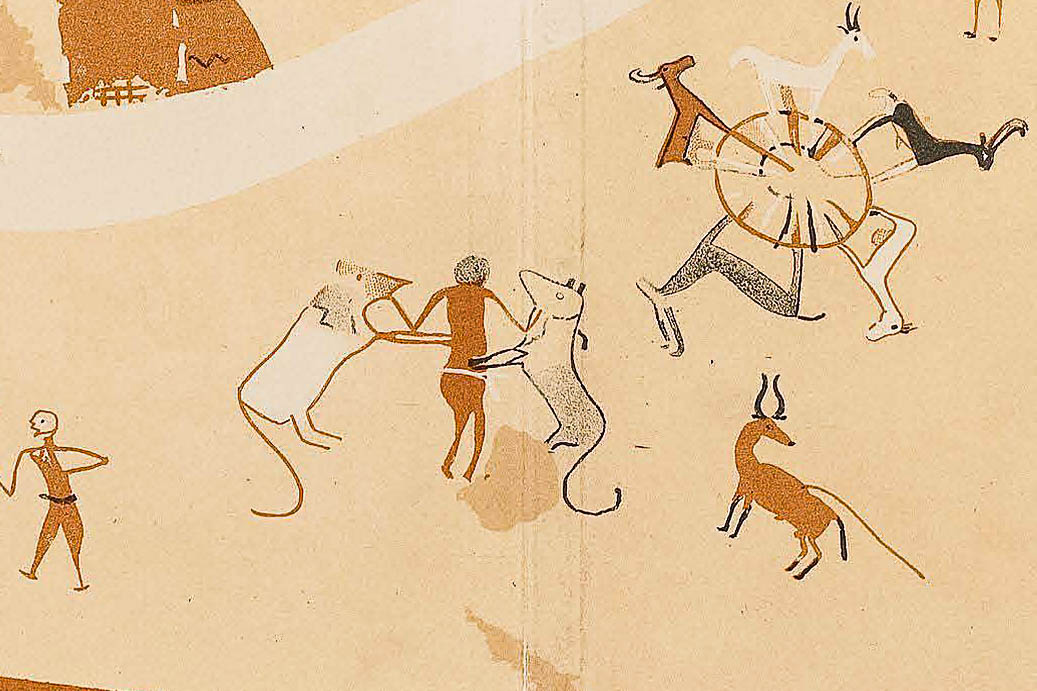
Left: A man grasps a lion in each hand. Right: Women wearing white dresses raise their hands, perhaps in a dance.
It has been suggested that the scenes on this mural represent an attack by invaders from Mesopotamia or Elam since the black ship in the mural is thought to be of an eastern type and the mural displays the “master of the beasts” motif.4Petrie 1939, 65 ff. However, as noted above, the black boat in this mural actually looks more Mediterranean than Mesopotamian. And though the “master of beasts” motif is undoubtedly of Mesopotamian origin, it is not clear how this relates to an invasion. But before making a judgment, let us look at several more items found in Egypt which may have a connection with Mesopotamia.
Humphrey, Case, Joan Crowfoot Payne. “Tomb 100: The Decorated Tomb at Hierakonpolis.” The Journal of Egyptian Archaeology , no. 48 (1962): 5–18. Link
Kemp, Barry. “Photographs of the Decorated Tomb at Hierakonpolis.” The Journal of Egyptian Archaeology 59 (1973): 36–43. Link
Petrie, W. M. Flinders.
The Making of Egypt.
London: The Sheldon Press, 1939.
Quibell, J. E., F. W. Green.
Hierakonpolis. Vol. II vols.
London: Bernard Quaritch, 1902. Link
Yadin, Yigael.
The Art of Warfare in Biblical Lands in the Light of Archaeological Study.
New York: McGraw-Hill, 1963.