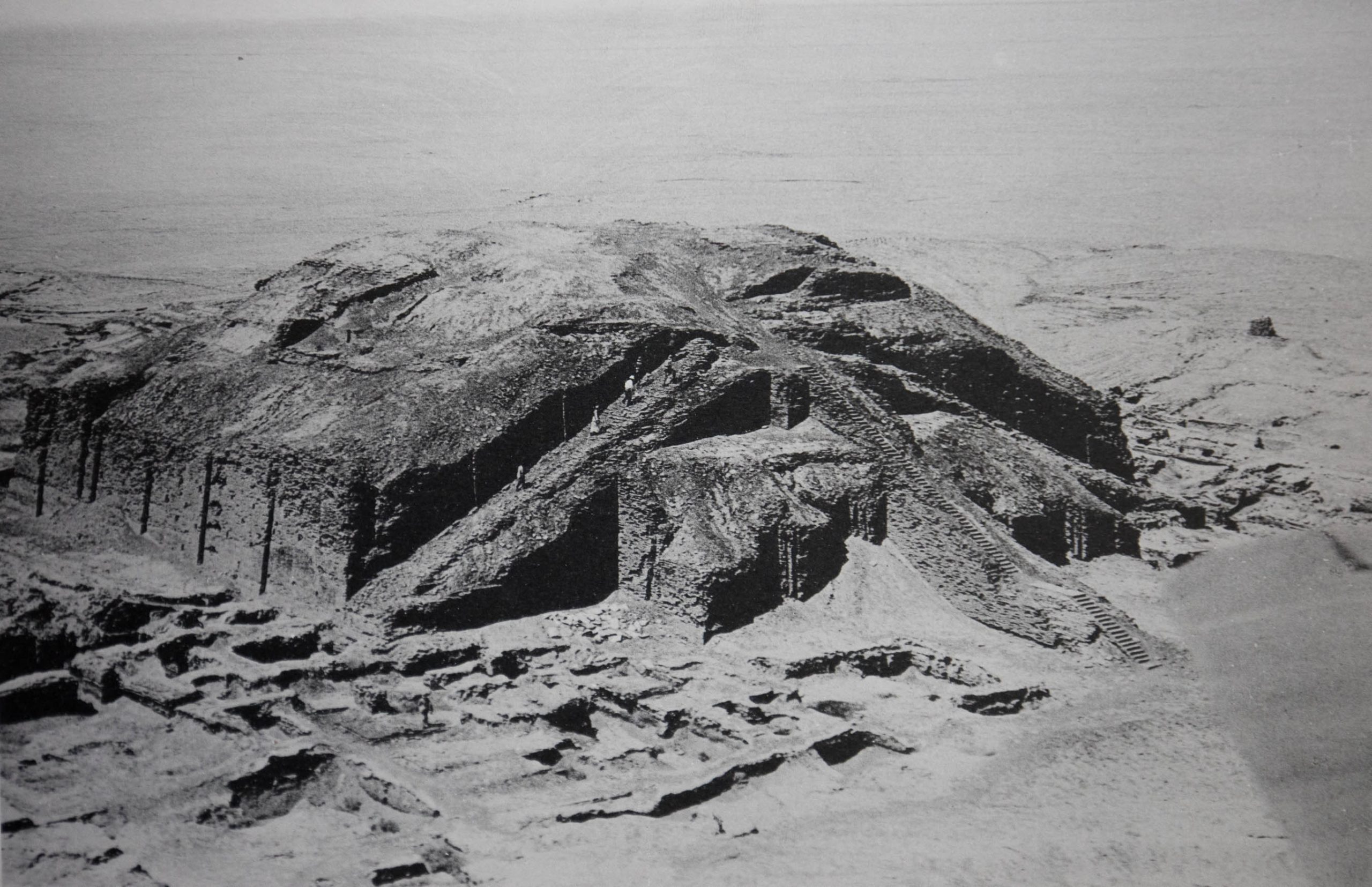
An aerial photo of the ziggurat during excavations.
Aside from his law code, Ur-Nammu is best known for the temple-tower he erected in Ur. Known in Akkadian as a ziqquratu, the name means “to protrude or build high.” The origins of this type of temple may be traced back to older prototypes such as the White Temple of Uruk and the Temple of Enki at Eridu. These were tall buildings constructed on high platforms. The Massif Rouge in Mari and a seven-stage tower constructed by Gudea also stand in the background of Ur-Nammu’s ziggurats although only the lowest stages of the Massif Rouge remain and nothing of Gudea’s tower except for the following literary reference to it:
The temple of E-ghud, his temple in seven stages, he has constructed.1Column II, Inscription on Statue D of the Louvre
No less than six ziggurats were constructed during the Ur III period. Of these, only the ziggurat of Ur remains standing. We have to thank for this the massive renovations undertaken by Nabonidus (556-539 BC), the last king of the Neo-Babylonian Empire. The ziggurat was already 1500 years old by that time. So thorough was the reconstruction effort that no part of the original structure remained visible. The last ruler to add bricks to the ziggurat was the Iraqi president, Saddam Hussein, who restored the facade and stairways of the ziggurat in the 1980’s.
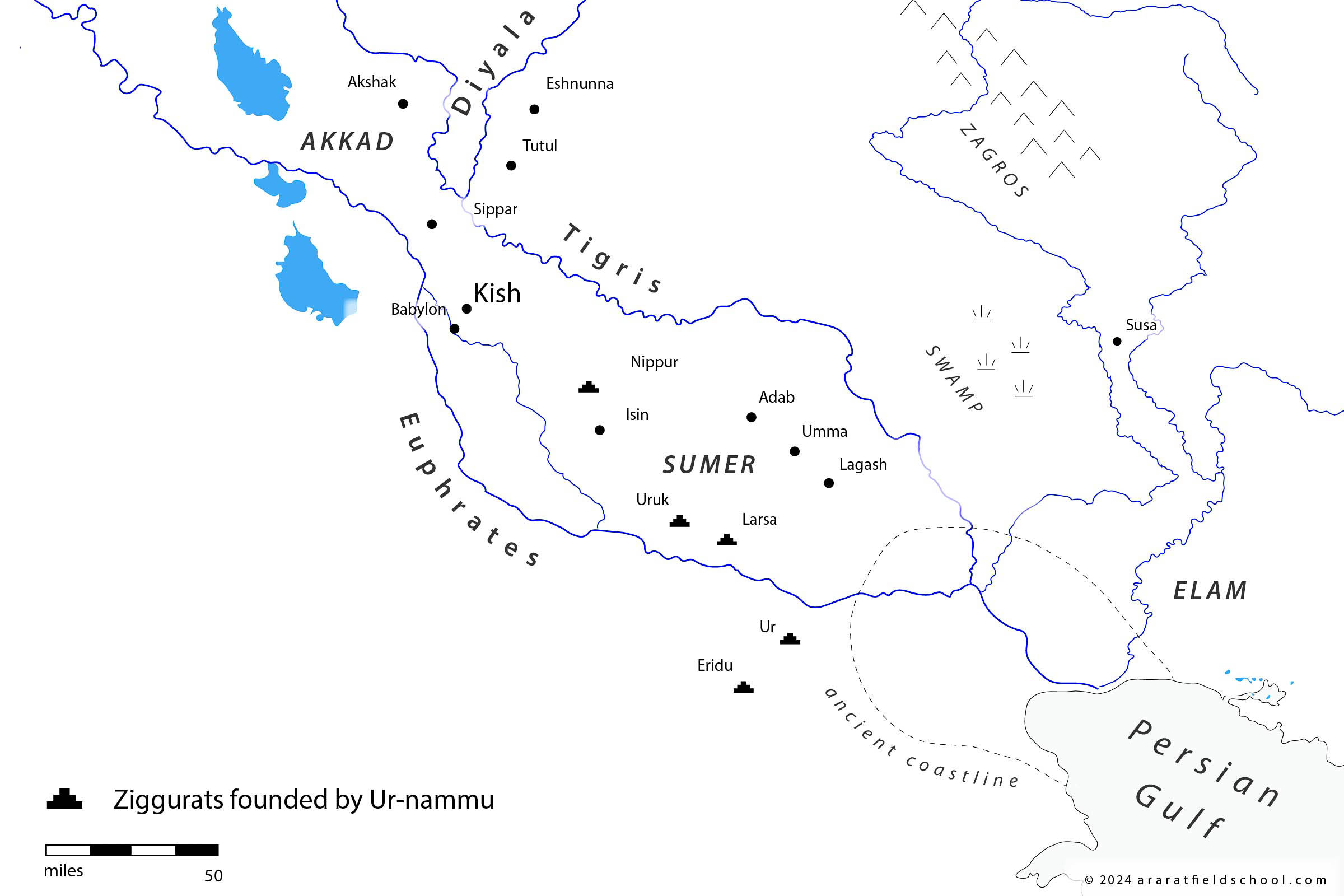
It is possible that the design of these ziggurats are based on Akkadian prototypes although no architecture from this period remains. Nissen notes that the ziggurat of Babylon, the remnants of which date to the 6th century BC, uses the same design as Ur-nammu’s ziggurats.1Nissen 1988, 190
Discovery of the Ziggurat of Ur
British explorer William Loftus was the first to survey the ruins of Ur in 1850. He was followed by John Taylor who attempted a few tentative excavations. Since Taylor did not have the manpower to clear away the huge amounts of rubble around the ziggurat, he focused on the uppermost part. His sketch of the chamber which crowned the ziggurat is all we will ever know of it since it quickly eroded away after it was exposed to the elements. Taylor also discovered the foundation tablets buried by Nabonidus beneath the four corners of the ziggurat.

This line drawing shows how the Ziggurat of Ur looked when William Loftus visited the site in the mid-1800’s.
The most important excavations conducted at Ur were undertaken by the British archaeologist, Sir Leonard Woolley. Before excavating the Royal Cemetery of Ur Woolley spent several years clearing the debris from the ziggurat until its shape began to emerge from the surrounding landscape. He dug several probes into the interior of the structure which revealed its massive core to be made of sun-dried mudbrick while those parts exposed to the elements were made of fired bricks and cemented together with bitumen—a sort of tarry substance dug from oil deposits.
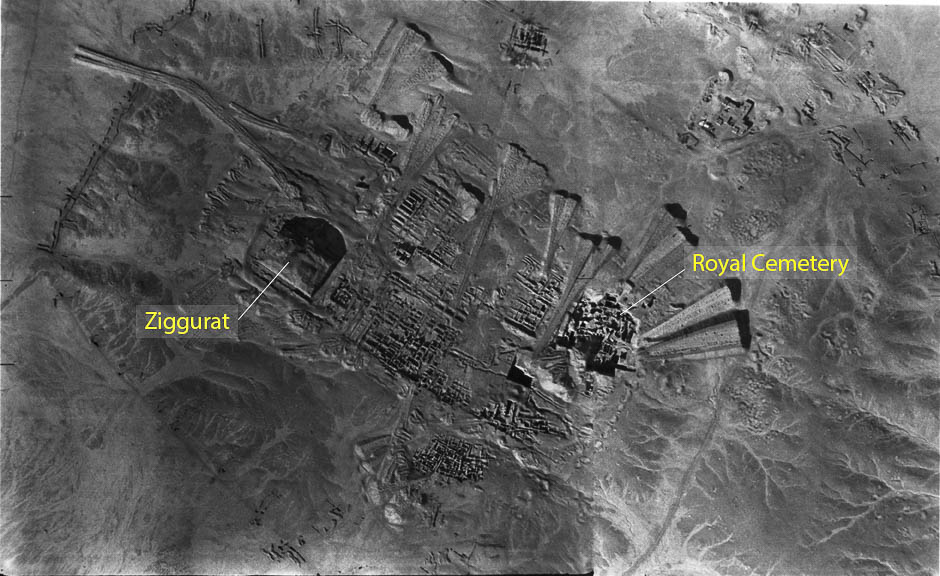
An aerial view of Ur showing the location of the ziggurat in relation to the Royal Cemetery.
The ziggurat was constructed with three stages. Woolley hypothesized that each stage had a different color: the lowest was covered in black bitumen, the middle was constructed from burnt red brick, and the uppermost was constructed from blue glazed brick. According to this schema each stage represented a different aspect of the Babylonian cosmos : underworld, earth, and sky.2Woolley 1939, 143

This section shows the three stages of the ziggurat and the monumental stairway which led to the temple on top of the tower. The ziggurat was completely restored / rebuilt by Nabonidus in the 6th century BC.
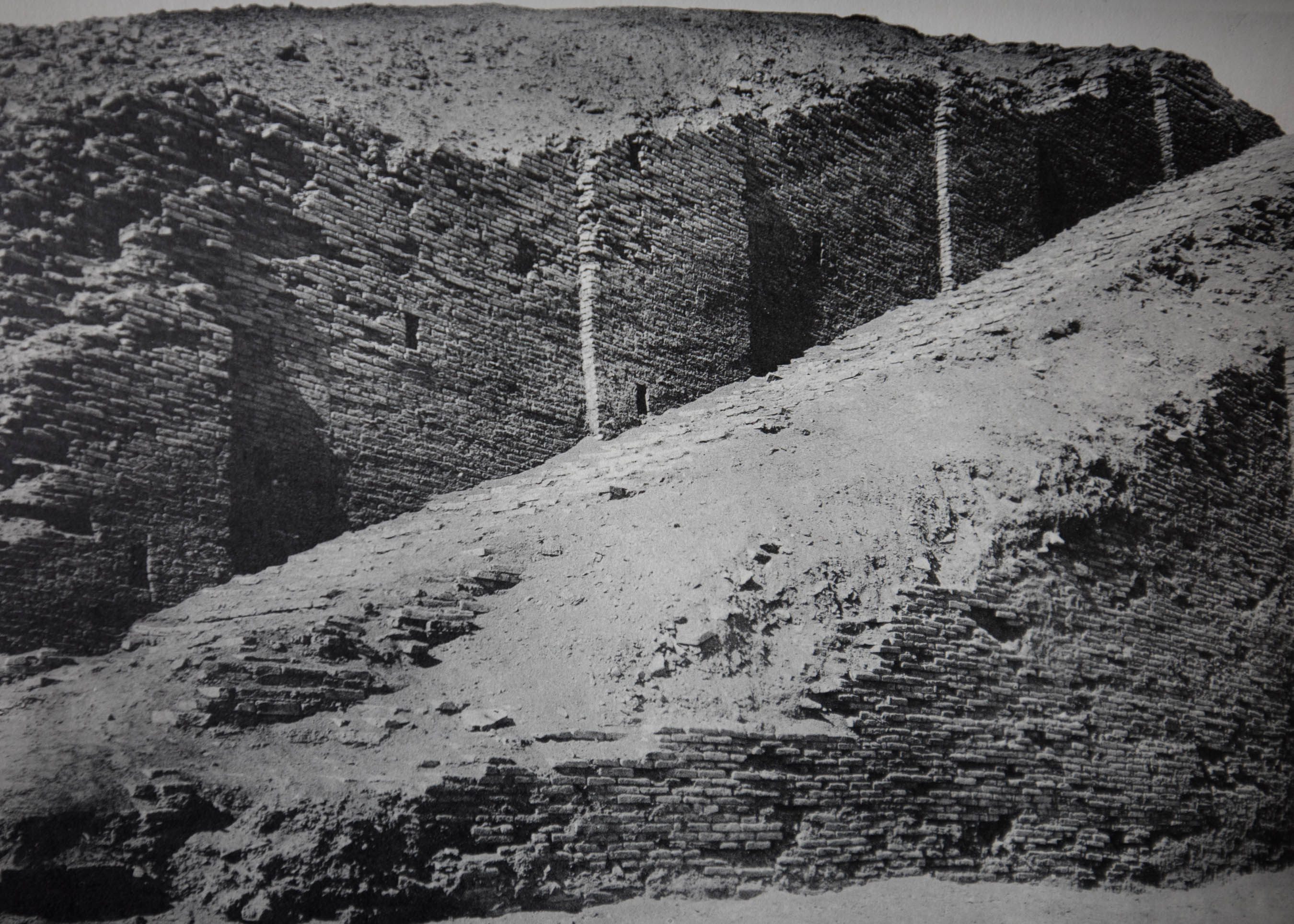

The great mass of the structure was mud brick, while the outer face was made of fired brick cemented together with asphalt. Drainage holes in the brickwork helped wick water out of the inner core.
The ziggurats bear an obvious resemblance to the pyramids of Egypt, especially those constructed by Djoser and Sneferu which also have a stepped design. Although ziggurats were temples and pyramids were tombs, the latter also functioned as temples. Temple towers are just one example of a religious phenomenon which appear to transcend time and space. Goddess figurines, bull worship, sexual rituals, cult statues, serpent symbolism, extispicy and divination, are other examples. Although these religious practices may appear to have fallen away in modern times, it is not difficult to find them lurking under the surface, whether it be the goddess symbolism which permeates popular culture, our towers of finance and alchemical money system, or the promise of technology as a means to salvation.

This temple tower on the Italian island of Sardinia looks like a small version of a Mesopotamian ziggurat.
The Significance of Ziggurats
Leo Oppenheim observed that although we have learned a lot about how ziggurats were constructed we still do not know what they were used for or what rituals were performed on them.3Oppenheim 1977, 172 The little we do know may be gleaned from Babylonian hymns which praise the ziggurats for their loftiness and permanence. The names given to the ziggurats also point to their cosmic significance.
A hymn of praise directed towards the ziggurat of Arbela highlights the place of the ziggurat in the religious topography of Mesopotamia.
The pride of Arbela is [its] lofty place…
Arbela is established like heaven,
Her foundations are firm as the [netherworld].
Arbela’s head is held high, rivalling [heaven].
Her image is Babylon, her double is [ ].
Sublime holy place, daise of destinies, gateway to heaven…
Ishtar dwells within it…4Foster 2005, 840; IV.6
The hymn highlights the ziggurat’s function linking heaven and earth, but what rituals were performed on it? Our only source of information in this regard comes from Herodotus, who is quite late, and whose information about Mesopotamia appears to be second-hand and not very reliable (in contrast to his information about Egypt, which is much better). It is nevertheless worth considering what Herodotus has to say about the ziggurats since he is our only source on the subject.
According to Herodotus, the monumental staircase of the ziggurat led to a special chamber which crowned its summit. There was no statue in the chamber but a richly adorned bed and a golden table. A woman was chosen by the god to stay in the chamber so that he might have a companion whenever he chose to spend the night there.
This looks like the ritual marriage ceremony known from texts of the Ur III and Isin Larsa periods. Iddin-Dagan A provides an explicit description of conjugal relations between a king of Isin and the goddess Inanna. Presumably, the goddess in this instance was a priestess who stood in for the goddess. The ceremony was celebrated during the New Years festival as a means of publishing the favored status of the king and securing the blessings of the goddess on the land. In Enmerkar and the Lord of Aratta the king boasts of the magnificent bed which he shared with Inanna. In light of these references, it is interesting to read Herodotus’s description of the upper chamber of the ziggurat.
On the topmost tower there is a spacious temple and inside the temple stands a couch of unusual size, richly adorned, with a golden table by its side. There is not statue of any kind set up in the place, nor is the chamber occupied of nights by any one but a single native woman, who, as the Chaldaens the priests of this god, affirm, is chosen for himself by the deity out of all the women of the land. They also declare – but I for my part do not credit it – that the god comes down in person into this chamber, and sleeps upon the couch. 5Herodotus 1.181 in Herodotus and G. Rawlinson 1997, 99
Both ancient and modern religions are known to incorporate sexual rituals and even ritual prostitution. Carl Jung, for example, describes the shock he felt upon visiting a Hindu temple in Orissa.
In Konarak (Orissa) I met a pandit (priest) who obligingly offered to come with me on my visit to the great temple.
The pagoda is covered from base to pinnacle with exquisitely obscene sculptures.
We talked for a long time about this extraordinary fact, which he explained to me as a means to achieve spiritualization.
I objected pointing to a group of young peasants who were standing open-mouthed before the monument, admiring these splendors that such young men were scarcely undergoing spiritualization at the moment, but were much more likely having their heads filled with sexual fantasies.6Jung and Jaffé 1989
The pandit (priest) attributed cosmic significance to the sexual symbolism displayed on the walls of his temple, just as a Sumerian might have, for according to Sumerian cosmogonic texts, the cosmos came into existence through the union of the male and female. The fertility of the land likewise depended upon this union, which the king sought to accomplish through ritual enactment. Or it was just obscene (Jer. 2:23-24). The two are not mutually exclusive.

These model beds from the Middle Elamite period (c. 14th century BC) have also been found in Mesopotamia. They probably represent a sacred marriage.
The Tower of Babel
The identification of the tower of Babel described in Genesis 11 with a ziggurat is supported by the fact that it was made from burnt bricks cemented together with tar. Neither of these materials were utilized in the Levant or Egypt, where sun-baked bricks and clay mortar are the norm. Although the earliest known staged towers do not predate the Neo-Sumerian period, the idea of a temple tower is already present in the design of the White Temple, which dates back to the Uruk period.

This clay seal impression from Susa depicts a temple tower as it appeared in the Proto-Elamite period.
The Biblical account of the tower of Babel is set in primordial time (primus is Latin for “first”), immediately after the Flood, when people spoke one language and the earth was empty. In those days a people came “from the east” to the “Plain of Shinar,”—that is ancient Sumer—and built there a city and a tower “whose top shall be in the heavens, in order to make a name for ourselves.” (Gen. 11:4) God judged them for their pride by confusing their tongues and scattering them across the face of the earth. Bab-El—an Akkadian term which means “gate of god,” was renamed Babel—a Hebrew term which means “confusion.” The account doesn’t say where the tower were constructed although one is naturally inclined to identify it with the city of Babylon. However, bab-el is a generic term that could have applied to any of the temple towers constructed in Mesopotamia since all of them were perceived to be “gateways to god.”
Legacy
The temple tower described in the book of Genesis was a favorite theme of Renaissance era artists. Relying upon Herodotus’ description of the Babylonian ziggurat as a round tower with a spiral staircase, this is how it appears in the artwork of the period. Thus Bruegel the Elder painted a remarkably detailed depiction of a spiral tower which incorporated arches and vaults such as were employed by the Romans. Nimrud can be seen standing on a hill across from the tower, overseeing its construction. Although the Bible never actually makes a connection between the tower and Nimrod, the association has a long tradition.


These Rennaissance depictions of the tower of Babel rely on Herodotus’s account (mid 5th century BC). He mistakenly describes it as a round tower with a spiral staircase.
The history of architecture took a curious turn when Brueghel’s depiction of the Tower of Babel inspired the design of the European parliament building in Strasbourg, named the Louise Weiss building after a famous women’s rights activist. Bruegel would undoubtedly be surprised to discover that his painting had been used for this purpose since the Biblical tower stands as a symbol for unconstrained human ambition and “the accumulated wickedness and impiety of mankind.”7Word Biblical Commentary, Vol.1, Genesis 1-11,, pg. 292 Then again, the tradition of tower building has a long and varied history.
Hall, H. R.
Ur Excavations.
London: Oxford University Press, 1927. Link
Herodotus, G. Rawlinson.
The Histories.
New York: Everyman/Alfred A. Knopf, 1997.
Jung, , C. G, A. Jaffé.
Memories, Dreams, Reflections.
New York: Vintage Books., 1989.
Loftus, W. K.
Travels and Researches in Chaldæa and Susiana; with an Account of Excavations at Warka, the “Erech” of Nimrod, and Shu´sh, “Shushan the Palace” of Esther, in 1849-52.
London: J. Nisbet and Co., 1857. Link
Nissen, H. J. R.
The Early History of the Ancient Near East, 9000-2000 B.C..
Chicago: University of Chicago Press, 1988. Link
Woolley, Leonard.
Ur Excavations : The Ziggurat and Its Surroundings. Vol. V vols.
United Kingdom, Oxford: The University Press, 1939. Link
Woolley, L.
Ur of the Chaldees; A Record of Seven Years of Excavation.
London: Benn, 1950.
Woolley, Leonard.
Ur Excavations: The Royal Cemetery (Plates).
Oxford: The University Press, 1934. Link