After five years of digging in the cemetery at Umm el-Qa’ab (1894-1898), the French archaeologists, Emile Amelineau, would report, Tous les fellahs savent qu’elle est epuisee (“all the workmen know she is exhausted”). For Sir Flinders Petrie, who had been forced to sit on the sidelines and watch, Amelineau’s excavations were nothing short of vandalism.1Petrie 1900, 2 Petrie would spend the next several years clearing the tombs and sifting Amelineau’s spoil heaps. His numerous findings and detailed plans, published in several volumes immediately afterwards, show Petrie to have been justified in his criticism.
The work of Amelineau and Petrie was primarily focused on Cemetery B, where the rich tombs of the first two dynasties were located. It wasn’t until 1988 that Tomb U-j was discovered in Cemetery U by Werner Kaiser and Gunter Dreyer of the German Archaeological Institute. The tomb may already have been hastily dug by Amelineau. If so, there was plenty left to discover.
Tomb U-j is thought to have belonged to a ruler named Scorpion (Scorpion I) whose reign fell towards the end of the Predynastic period— a period known alternatively as “Naqada III,” “Dynasty 0,” or the “Protodynastic.” The method of its construction does not differ greatly from the tombs excavated at Hierakonpolis (i.e. Tomb 100 and Tomb 16). However, rather than a single brick-lined pit, Tomb U-j was divided into twelve chambers, each richly furnished with precious objects, food, and drink. This tomb may, therefore, be said to mark the beginning of royal Egyptian tomb architecture which sought to imitate the palace of the king below ground.2Wilkinson 1999, 221 As you may recall, the tombs in cemetery HK6 at Hierakonpolis appear to have had wooden structures erected above them which may also have represented the “palace” of the ruler, but the below ground portion of the tomb was just a single chamber.

The burial area known as Umm el Qa’ab was located in the desert near Abydos. The oldest tombs were in Cemetery U.


Left: Cemetery U was located in the northern part of the cemetery at Umm el-Qaab.
Right: Tomb U-J was the largest tomb excavated in Cemetery U.
Canaanite Wine Jars
Approximately seven hundred Canaanite wine jars were found tightly stacked in three of chambers of Tomb U-j. The combined capacity of these jars has been estimated at around one thousand gallons, which is a lot of wine for any period! The jars were sealed with mud caps impressed with a cylinder seal to prevent tampering. The presence of so many Canaanite wine jars in Tomb U-j suggests that trade with Canaan was already well established by the end of the Predynastic period.3The identification of these wine jars as Canaanite is not universally acknowledged. Braun writes “However it is certain that at least a modicum of those vessels was imported, probably via the Way of Horus, as an array of broken pots strewn over campsites in northern Sinai indicates.” (See Braun 2011, 112)

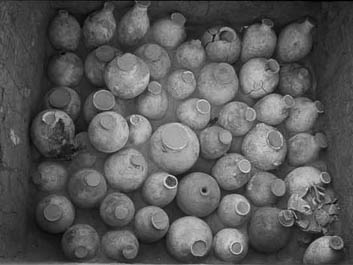
Approximately 700 wine jars, many of them probably originating from Canaan, were found in Tomb U-j.
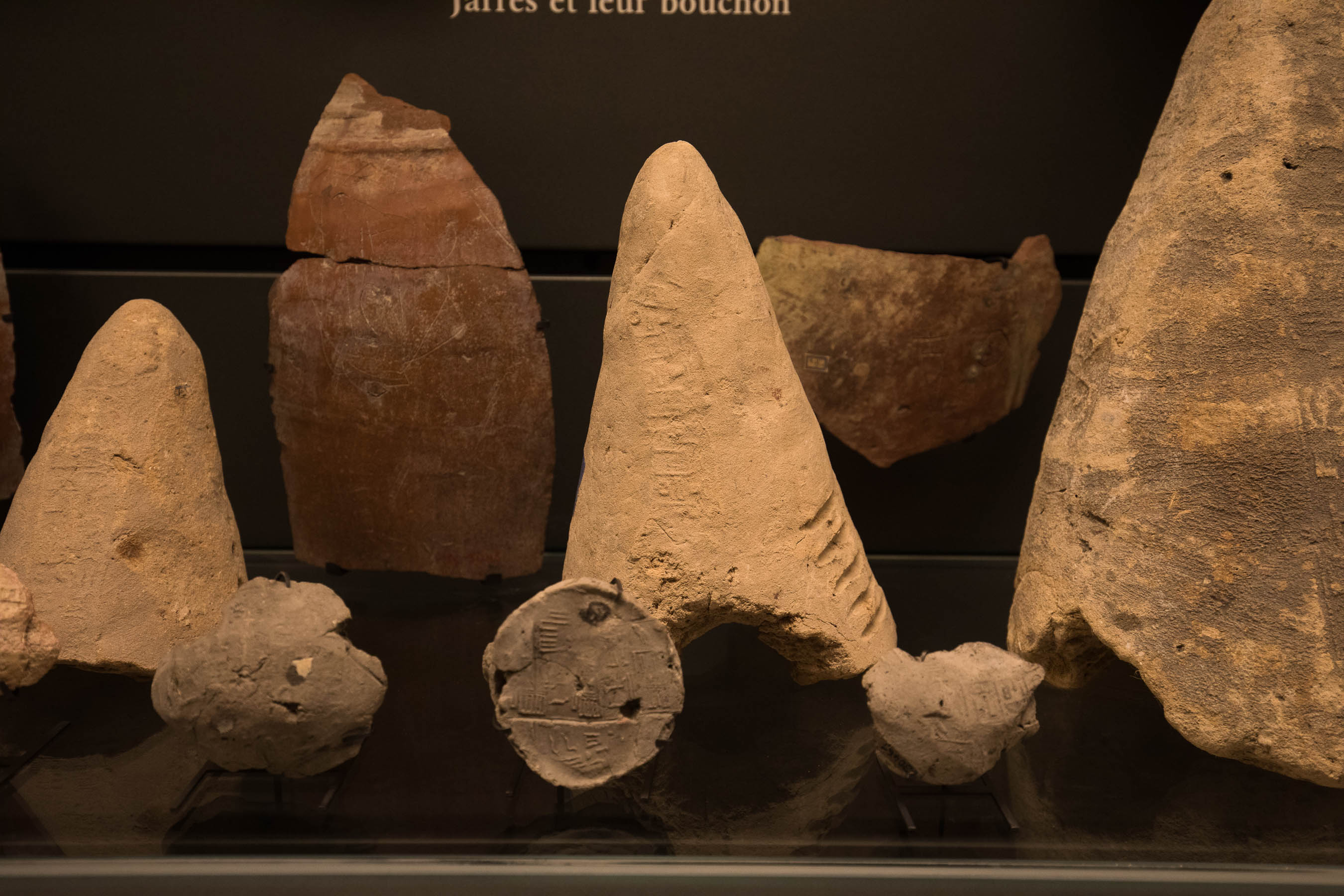
The Egyptians used pointed mud caps bearing the impression of a cylinder seal. The seal impression served to prevent anyone from tampering with the jars. Although the sealings pictured above do not come from Tomb U-j, they illustrate the method of sealing involved.

This seal impression from tomb U-j illustrates the principle of horror vacui, (Latin. “fear of empty space”). As you may recall, seals of the Jemdet Nasr period likewise feature rows of animals, geometric patterns, and horror vacui.
Obsidian Bowl
One of the unique finds from Tomb U-j was an obsidian bowl fashioned in the shape of two cupped hands. This bowl could not have been carved in the traditional manner since obsidian is a glassy rock with a crystalline structure that shatters upon impact. The rough shape was probably achieved through flaking but the final form could only have been achieved through grinding and polishing, a laborious process indeed! The obsidian is thought to have been imported from Ethiopia.

The obsidian bowl measures approximately 9 inches long. Vessels such as this one had to be ground and polished into shape.
Scepter
Shaped like a shepherd’s crook, the heqa scepter is the oldest symbol of kingship in Egypt. Remarkably, an ivory heqa scepter was found in Tomb U-j. The presence of this scepter, together with other prestigious objects in the tomb, suggests that Tomb U-j belonged to an individual whose status was approaching that of a king.


Left: An ivory Heqa scepter measuring approx. 14 inches long (c. 2750 BC in the AL Chronology). Right: The crook and flail grasped by Tutankhamen’s mummy (c. 1325 BC).
Bestock, L.
“The First Kings of Egypt: The Abydos Evidence,” in Before the pyramids : the origins of Egyptian civilization, edited by E. Teeter.
Chicago, Ill.: Oriental Institute of the University of Chicago, 2011. Link
Brandl, B.
“The Sealing and the pr-wr Labels from Tomb U-J at Umm el-Qa’ab, Abydos Reconsidered,” in Egypt at its origins 4 : proceedings of the fourth International conference “Origin of the State: predynastic and early dynastic Egypt”, edited by M. D. Adams.
Leuven – Paris – Bristol, CT: Peeters, 2016. Link
Braun, Eliot.
“Early Interaction Between Peoples of the Nile Valley and the Southern Levant ,” in Before the pyramids : the origins of Egyptian civilization, edited by E. Teeter.
Chicago, Ill.: Oriental Institute of the University of Chicago, 2011. Link
Dreyer, Gunter, E.-M. Engel, Ulrich Hartung, Thomas Hikade. “Nachuntersuchungen im fruhzeitlichen Konigsfriedhof.” Mitteilungen des Deutschen Archaeologischen Instituts, Abteilung Kairo 52 (1996): 11-81.
Dreyer, G.
“Tomb U-j: A Royal Burial of Dynasty 0 at Abydos,” in Before the pyramids : the origins of Egyptian civilization, edited by E. Teeter.
Chicago, Ill.: Oriental Institute of the University of Chicago, 2011. Link
O’Connor, David.
Abydos: Egypt’s First Kings and the Cult of Osiris.
London: Thames & Hudson, 2009.
Petrie, Flinders.
The Royal Tombs of the Earliest Dynasties: Part One.
London: The Egyptian Exploration Fund, 1900. Link
Petrie, Flinders.
The Royal Tombs of the Earliest Dynasties: Part Two.
London: The Egyptian Exploration Fund, 1901. Link
Wilkinson, Toby.
Early Dynastic Egypt.
London and New York: Routledge, 1999.