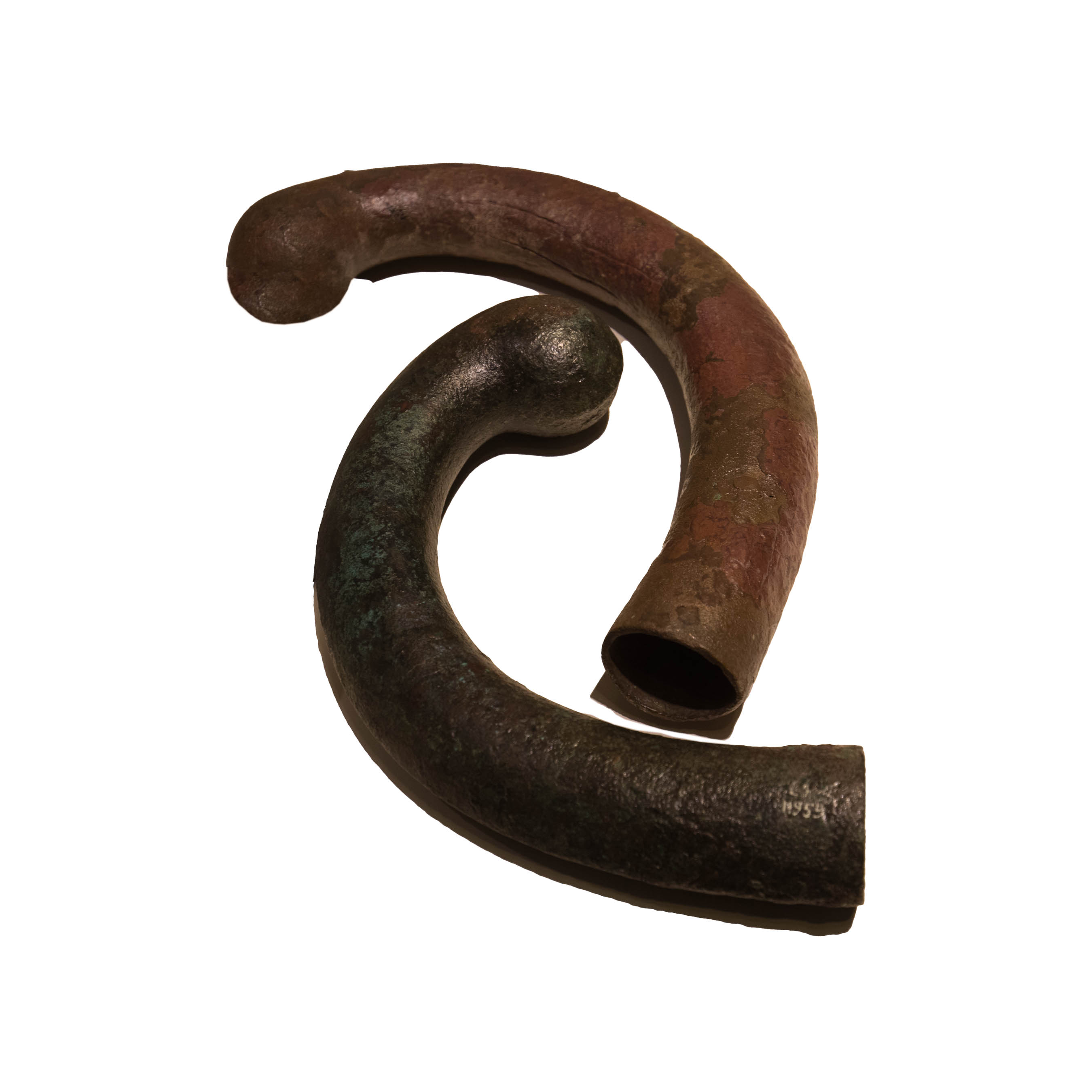
These tubes probably capped the end of a curved staff known as a lituus. They were found in Tomb K at Alacahoyuk.
Among the curious objects discovered in the tombs at Alacahoyuk were a pair of curved bronze tubes which appear to have been made to fit the end of a staff. It has been suggested that these were a precursor to the Hittite ceremonial staff known as the kalmush. Hittite seals and wall reliefs often show the king or deity carrying one of these staffs. The discovery of several curved copper tubes in Grave K at Alacahoyuk points to an early possible origin for this tradition.
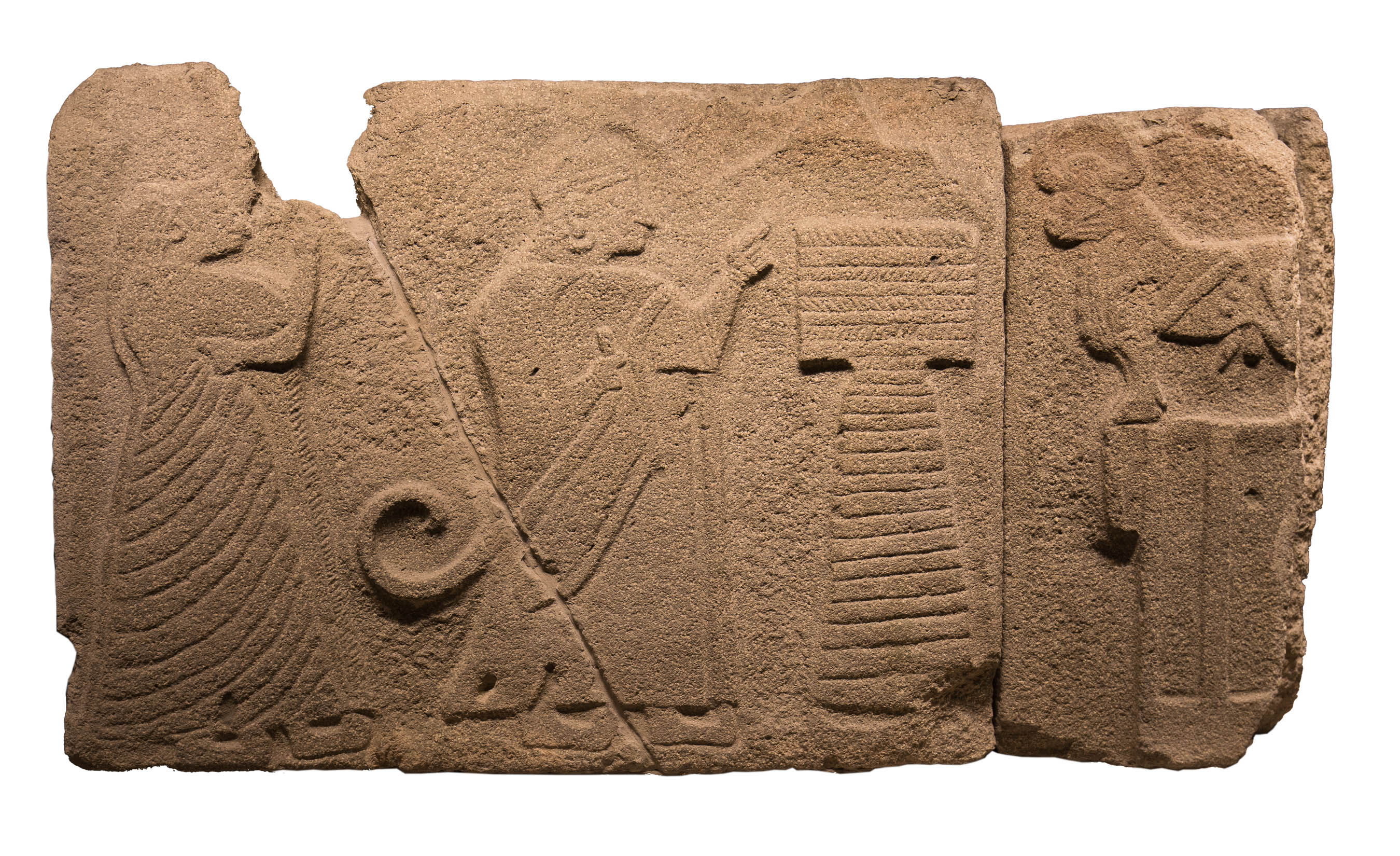
This limestone block was found next to the main gate of Alacahoyuk. It shows a Hittite king and queen sacrificing to a statue of a bull, the Hittite storm god (Late Bronze, 14th century BC). The king is carrying a curved scepter (Hittite kalmush).
There are several reasons why the copper tubes from Alacahoyuk should be interpreted as precursors to the Hittite kalmush.
- The kalmush is a thick rod; the copper tubes from Alacahoyuk are made to fit a heavy round shaft of approximately the same size.
- Although the copper tubes from Alacahoyuk do not curve as much as the kalmush held by kings of the Hittite Imperial period, a study of the iconography of these staffs suggests that the amount of curve increased over time.1See especially Fig. 24 in Ambos and Krauskopf 2010, 137
- The copper tubes from Alacahoyuk terminate with a round knob concordant with their original function as a shepherds crook.
- The kalmush was carried by Hittite kings; the tombs at Alacahoyuk were royal burials. It would make sense to find these ceremonial staffs in the tombs, especially if they do represent early Hittite burials.
Ambos and Krauskopf (2010) trace the origins of the Roman and Etruscan lituus back to the Hittite kalmush, noting also that this staff seems to have originated as a shepherd’s crook and thus seems to have functioned like the Egyptian heqa (see for example Tomb U-j). The lituus would continue to be used as a symbol of imperial authority until the Roman period.
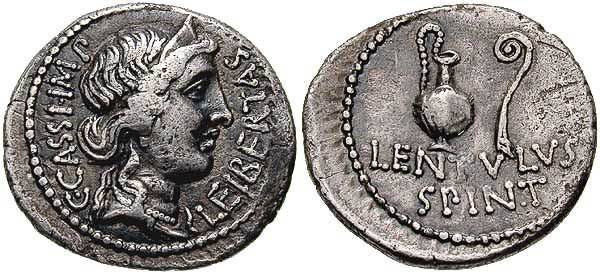

A Roman denarius dated to 42 BC displaying a lituus and a jug.
Ambos, Claus, Ingrid Krauskopf.
“The Curved Staff in the Ancient Near East as a Predecessor of the Etruscan lituus,” in Material Aspects of Etruscan Religion. Proceedings of the International Colloquium Leiden, May 29 and 30, 2008, edited by L. Bouke van der Meer. Babesch Supplement 16 vols.
Leiden: Leiden University, 2010.