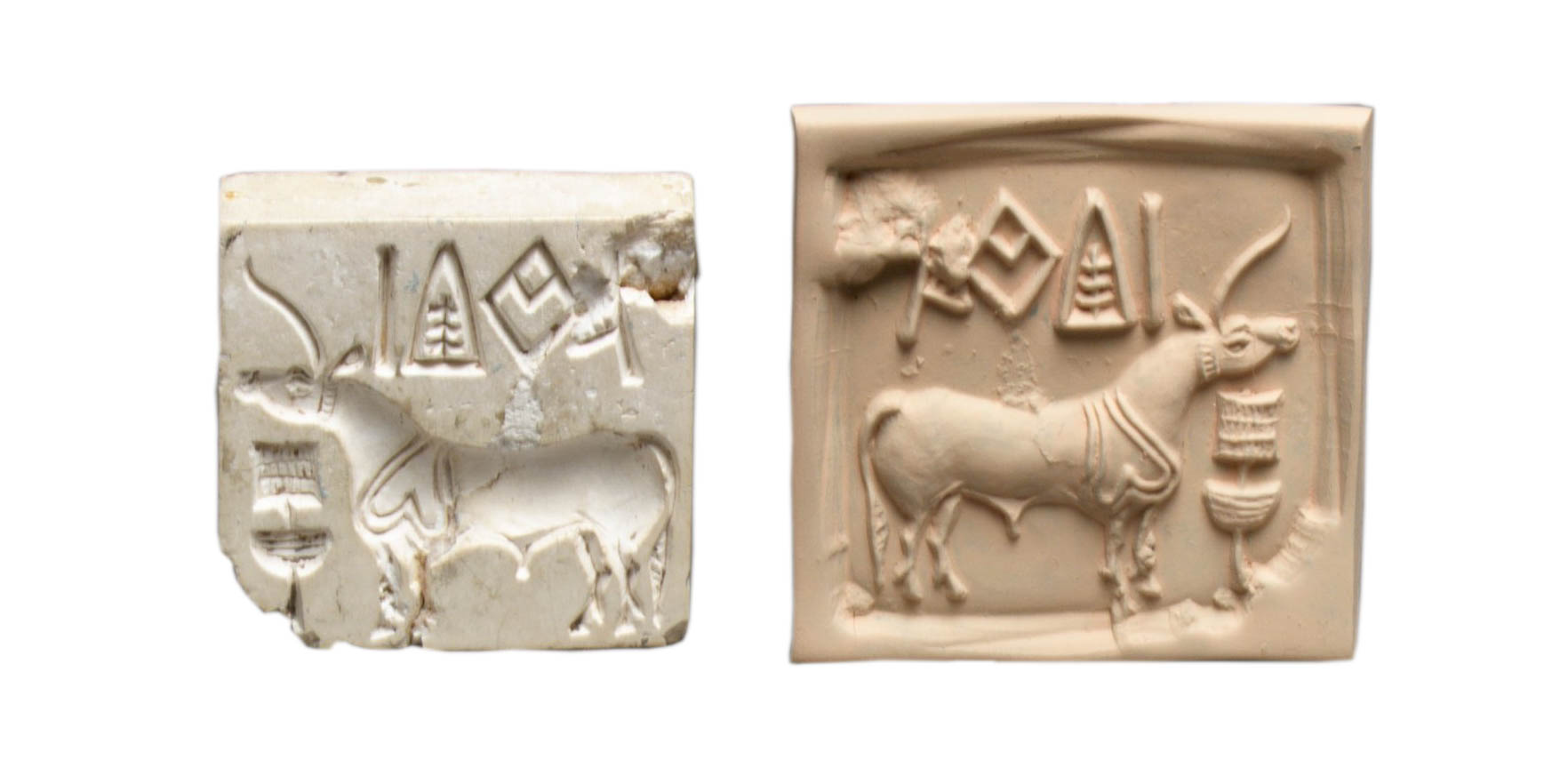
Of all the animals depicted on Harrapan stamp seals, the collared “unicorn” is most frequently depicted. The animal is usually shown standing before a manger. The script remains undeciphered.
The Indus Valley Civilization never adopted the cylinder seal. They used a square stamp seal made from steatite akin to the round, Dilmun-type stamp seals found on Bahrain and Failaka. After the seal was carved, it was coated with an alkali substance and fired, producing a white, glossy finish. Alkali is a basic substance (the opposite of acidic) produced in ancient times from wood ash. It is the primary ingredient in soap and is also used to make faience and glass. The use of alkali with steatite represents an early experiment with these substances which would eventually lead to glass production.
The seal designs are generally comprised of an animal and a short inscription. As noted previously, the animals depicted on the seals are of a type typically found in jungles, such as the elephant, tiger, and rhinoceros. None of these are found in the Indus Valley today. Conversely, the Asiatic lion, which prefers dry open country, does not appear on the seals at all. Of course, we’ve met with a similar phenomenon in Egypt where animals of the African savannah were often depicted on artifacts of the Predynastic and Early Dynastic periods.


Animals displayed on the Indus seals include the rhino and the elephant.
The Unicorn
But of all the animals depicted on Indus Valley seals, the unicorn is the most popular, outnumbering the other animals by a factor of one hundred. Today the range of this animal is confined to My Little Pony kits and 1960’s era songs written on LSD. These fantastical inventions were anticipated by Ctesisias the Cnidian, a Greek physician serving in the Persian court (c. 415-398 BC), who offers the following description of a one horned horse which inhabited the Indian subcontinent:
Among the Indians… there are wild asses as large as a horses, some being even larger. Their head is of a dark red color, their eyes are blue, and the rest of their body white. They have a horn on their forehead, a cubit in length (approx 18 inches) (the filings of this horn, if given as a potion, are an antidote to poisonous drugs). This horn for about two palm-breaths upward from the base is of the purest white, where it tapers to a a sharp point of a flaming crimson,and, in the middle is black.
Unfortunately, Ctesisias is not know for his reliability—his account is full of wild and fanciful stories—and his description of a unicorn seems rather absurd: a giant ass with a red head, blue eyes, and a white horn that terminates in a sharp, flaming-crimson point. It is curious, therefore, that the animal most often depicted on seals from the Indus Valley appears to be precisely this one-horned animal, having the body of a sleek bull, the neck and head of a horse, and the horns of some kind of African antelope. The horn does indeed “taper to a sharp point,” as Ctesisias describes.

These seals show the unicorn with a unique curved horn and the body of a sleek bull.
The “unicorn” appears 1159 times on Indus Valley seals. The next most common animal, the short-horned bull, appears just 95 times.1Possehl 1996, 22 It is true that the so-called “unicorn” might just be a western “humpless” bull shown in profile with just one of its horns showing, but the features of the animal do not match the profile of a bull. And none of the other other horned animals are shown in profile in this manner (see the zebu below, for instance, which is depicted with two horns). A clay figurine of an animal with a single horn lends support to the hypothesis that a unicorn is actually depicted on these seals.
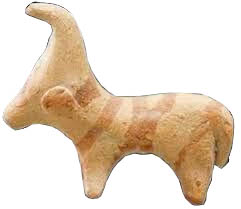
This figurine of a unicorn suggests that the animal really did have one horn.
The unicorn appears to be a captive animal since it is shown wearing some kind of halter and is standing before an object which has variously been interpreted as a brazier, standard, or even a press for making soma. It is almost certainly a manger. A remarkably similar scene from an offering stand found at Susa proves the point. Now on display in the Louvre, it displays two two captive bovines standing before what appears to be a manger.


Left: An offering stand discovered at Susa with two bovines standing before what appears to be a manger. It dates to the Early Dynastic III period (Susa IVA). Right: A “unicorn” standing before what may be interpreted as a manger.
The Zebu
Another animal depicted on Indus Valley seals is the Indian bull known as the zebu (bos indus), identifiable by its humped back. The Indian zebu also begins to appear on Mesopotamian seals during the Akkadian period, probably as a result of flourishing maritime trade between the two regions.


Left: The zebu depicted on an Indus Valley seal. Right: A pair of zebus on an Akkadian cylinder seal.
Contest Scenes
The Harrapan contest scene is clearly borrowed from Mesopotamia, except the hero is shown grasping tigers instead of lions.
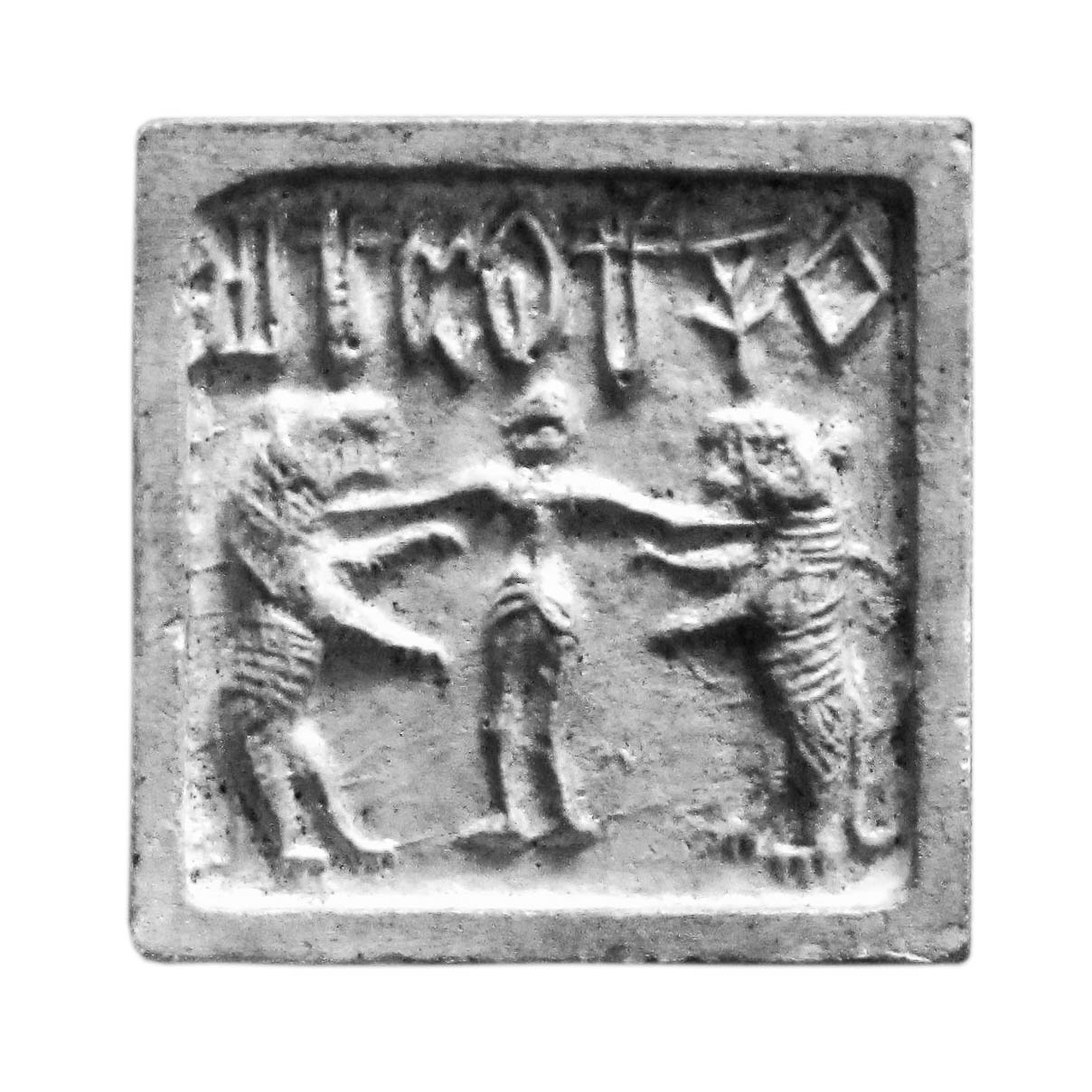
This Indus seal shows a heroic figure holding up two tigers.
Script
The Indus script is comprised of several hundred characters. The symbols are thought to represent a mix of sounds and objects (logo-syllabic) like the Egyptian and Sumerian scripts. Some researchers have noted the close resemblance between the Indus script and Linear Elamite, another undeciphered script discovered in Iran.

The top line is Linear Elamite and the bottom is the Indus script. As you may recall, the earliest examples of Linear Elamite do not predate the Akkadian period. It is unclear if Linear Elamite developed out of the much older Proto-Elamite script which dates to the Jemdet Nasr period since there is nothing between the two that might serve as a bridge between them. The similarities between Linear Elamite and the Indus Valley script are striking.
The Indus script was not used to record transactions; nor were the seals themselves used to seal documents. The Indus script seems rather to have been limited to recording names and titles. The longest inscription discovered so far is only 26 characters long. The Indus script might be compared to the Egyptian script utilized during the First Dynasty. It too was limited to short inscriptions and the recording of names and places. However, advancements in grammar and longer inscriptions began to appear in the Second Dynasty. By the end of the Old Kingdom period one may properly speak of Egyptian literature. No such development can be detected in the Indus script. The script essentially appears from nowhere and dies unchanged.
The Pashupati Seal
Undoubtedly the most intriguing and informative seal discovered at Mohenjo-daro displays a deity crowned with the horns of an ox. The deity appears to have three or perhaps four faces, and is seated in the traditional attitude of a yogi—a practitioner of yoga (the term is derived from the same Indo-European root that gave us the English word “yoke”). The goal of yoga, according to an early Hindu text, was to join or “yoke” oneself to the “Universe in all of its manifold forms.”
Because in this manner he joins the Prana (breath), the Om, and this Universe in its manifold forms, or because they join themselves (to him), therefore this (process of meditation) is called Yoga (joining). The oneness of breath, mind, and senses, and then the surrendering of all conceptions, that is called Yoga (Maitri Upanishad).2Muller 2001

Pashupati is one of the titles for the Hindu god Shiva. It means “lord of the animals.”
The deity seems to be ithyphallic (the sexual virility of the man is emphasized) although some researchers see tassels hanging from a belt instead. If so then seal carver must be accused of gross incompetence, an unlikely interpretation in my opinion. Sir John Marshall, the director of excavations at Harappa and Mohenjo-daro in the 1920’s, argued that the figure on seal was an early representation of the Hindu deity, Shiva, known also as Pashupati—”lord of the animals.” His reasons may be summarized as follows:
- The figure has multiple faces, like Shiva, who in later periods is portrayed with three or four faces.
- The head is crowned with the horns of an ox. The headdress and horns are shaped like a trisula, the traditional emblem of Shiva.
- The figure has assumed the posture of a yogi, like Shiva, who is regarded as the mahayogi—the prince of Yogis.
- The image is surrounded by animals just as one of the primary titles of Shiva is “Lord of Animals” (Pasupati). Most notably, Shiva is lord of wild animals such as those depicted on the seal.
- The sexual nature of the seated figure accords with the veneration paid to the phallic lingam stones discovered at Harrapans site and found also in Hindu temples, where they represent the generative power of Shiva.3Marshall 1973, 52-56
Marshall argues that artifacts such as the Pashupati Seal belong to an early strata of Hinduism already present among the Harappans of the Indus Valley. Their beliefs would later find expression in the vedas and upanishads—the foundational texts of Hinduism.4Parpola 2015, 306


Shiva is associated with the male generative power, which is represented by a phallic stone or linga. The linga pictured above dates to approximately the 1st century BC. Shiva is shown holding an antelope in one hand, a late example of the “master of beasts” motif. He is standing on the shoulders of a dwarf demon. The lingam comes from the Andhra Pradesh province of India (from Wikimedia).
Parpola agrees with Marshall that the roots of Hinduism may be traced back to the Harappans. Parpola also notes a possible connection between the seated figure on the Pashupati seal and the bull-man commonly displayed on Proto-Elamite seals.5Parpola 2015, 211 The Elamite connection is further strengthened by the possible connection between Linear Elamite and Indus Valley scripts which we noted previously.
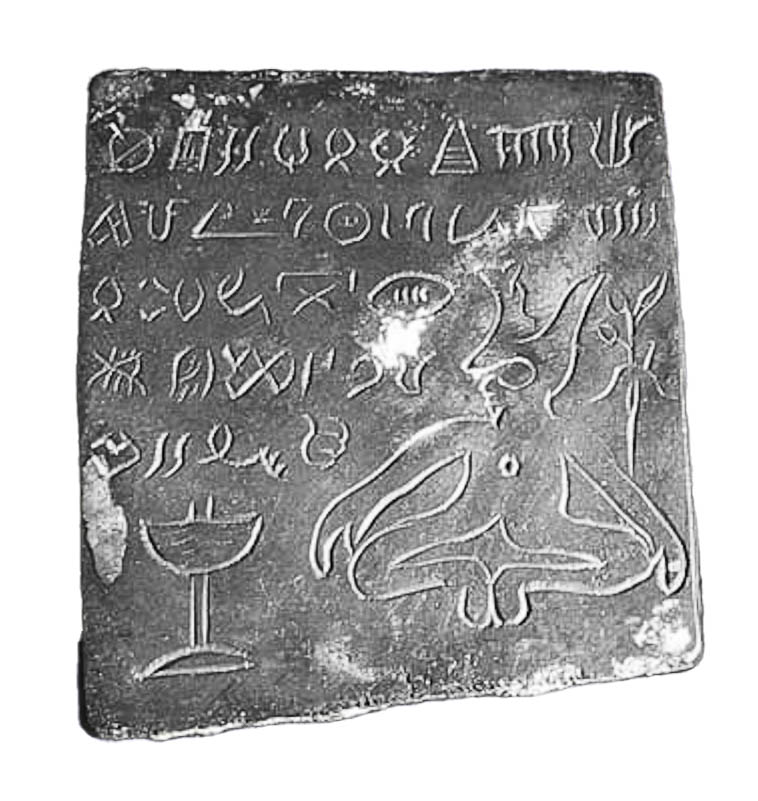
.jpg)

Left: The longest known Indus Valley Inscription shows a naked man with bull horns seated with heels together, like the figure on the Pashupati Seal. Right: Seated bull-figures from Proto-Elamite seals. As you may recall, the bull-man is a common motif in Proto-Elamite art.
Amiet, Pierre.
Art of the Ancient Near East.
New York: Harry N. Abrams Publishers, 1980.
Marshall, John.
Mohenjo-daro and the Indus Civilization; being an official account of archaeological excavations at Mohenjo-daro carried out by the Government of India between the years 1922 and 1927. Vol. I: Text vols.
New Delhi: Indological Book House, 1973.
Parpola, Asko.
The Roots of Hinduism: The Early Aryans and the Indus Civilization .
Oxford: Oxford University Press, 2015.
Possehl, Gregory.
Indus Age: The Writing System.
Philadelphia: University of Pennsylvania Press, 1996.
Possehl, Gregory.
The Indus Civilization : A Contemporary Perspective.
Walnut Creek, California: AltaMira Press, 2002.
Scholars have looked for descendants of the Indus Valley script in later Brahmi and Tamil scripts, or even in the Syro-Phoenician alphabetic scripts. Most curiously, it has been argued that the Indus script is related to Rapanui (or Rongorongo), the mysterious script of the Easter Islands, despite being separated by thousands of miles apart and nearly four millennia. The Hungarian scholar, Guillaume de Hevesy, was the first to publish an article showing the similarities between them, which are admittedly quite striking.

Adapted from Possehl, Indus Age: The Writing System, Fig. 59.
His hypothesis gained the support of several notable scholars, including Professor Stephen Langdon of Oxford University, who offered the following assessment of de Hevesey’s hypothesis,
There can be no doubt concerning the identity of the Indus and Easter island script. Whether we are thus confronted by an astonishing historical accident or whether this ancient Indian script has mysteriously travelled to the remote islands of the Pacific none can say. The age of the Easter Island tablets made of wood is totally unknown, and all knowledge of their writing has been lost. 1Possehl 1996, 96
It does not seem at all possible for the Indus Valley script to have been carried to the furthest reaches of Polynesia, well and truly in the middle of the South Pacific, 1000’s of miles away from anywhere, not to mention the Indus Valley. It is even more difficult to conceive of how the script could have been retained across so many millennia since the Indus script did not flourish for very long and the handful of Rongorongo tablets which have survived are wooden and probably do not date much before the 17th century AD. Furthermore, Easter Island is not thought to have been inhabited until 1200 AD. De Hevesey’s theory is therefore generally dismissed by researchers today. Several of his depictions of Rongorongo signs have been declared spurious, and whatever resemblances do occur between the two scripts are considered superficial. If you have time and inclination, you can make your own assessment. A catalogue of Rongorongo glyphs may be found here, and a list of Harappan signs may be accessed here.