There is something which drives men and women to don clothing, even in places where it might readily be dispensed with. In some regions of the world, the clothing might only be a grass skirt for the women and a sheath attached to a string for the men (predynastic Egypt and the southern Levant). In other places, the clothing might consist of animal skins (ie. the Lullubi on the Naram-Sin Victory Stele) or tufts of wool stitched together (the Sumerian kaunakes). But from an early period, one of the primary means of acquiring clothing was by spinning and weaving cloth. The origins of this skill cannot really be discerned in the archaeological record. The first actual fragments of cloth date to the Neolithic period but these display advanced techniques which prove that weaving was already well developed.1Barber 1991
Fibers
Sheep wool and flax plants are the two most important sources of fiber in ancient times. As you may recall, both are depicted on the Warka Vase. However, of the two, it seems that flax was probably the first to be woven into fabric.2Barber 1991, 20 ff.
Flax
The flax plant produces long, silvery fibers. The cloth produced from these fibers, known as linen, is absorbent and cool, making it the preferred choice in hot climates. Thus it was the preferred fabric in ancient Egypt. In order to obtain the long, flaxen fibers, the plant was soaked in water until the woody core of its stem began to disintegrate, a process known as “retting.” The stem was then dried, passed through rollers, and beaten until the woody sheath surrounding the fiber was completely removed, a process known as “scutching.” The end product was a long, smooth, straight fiber that could be spun and woven into cloth. The very best linen fibers are as fine as wool (less than 30 microns which is .0012 of an inch). The remaining course thick fibers, known as “tow” or “oakum,” could be soaked in tar and used for caulking, or woven into rough cloth.
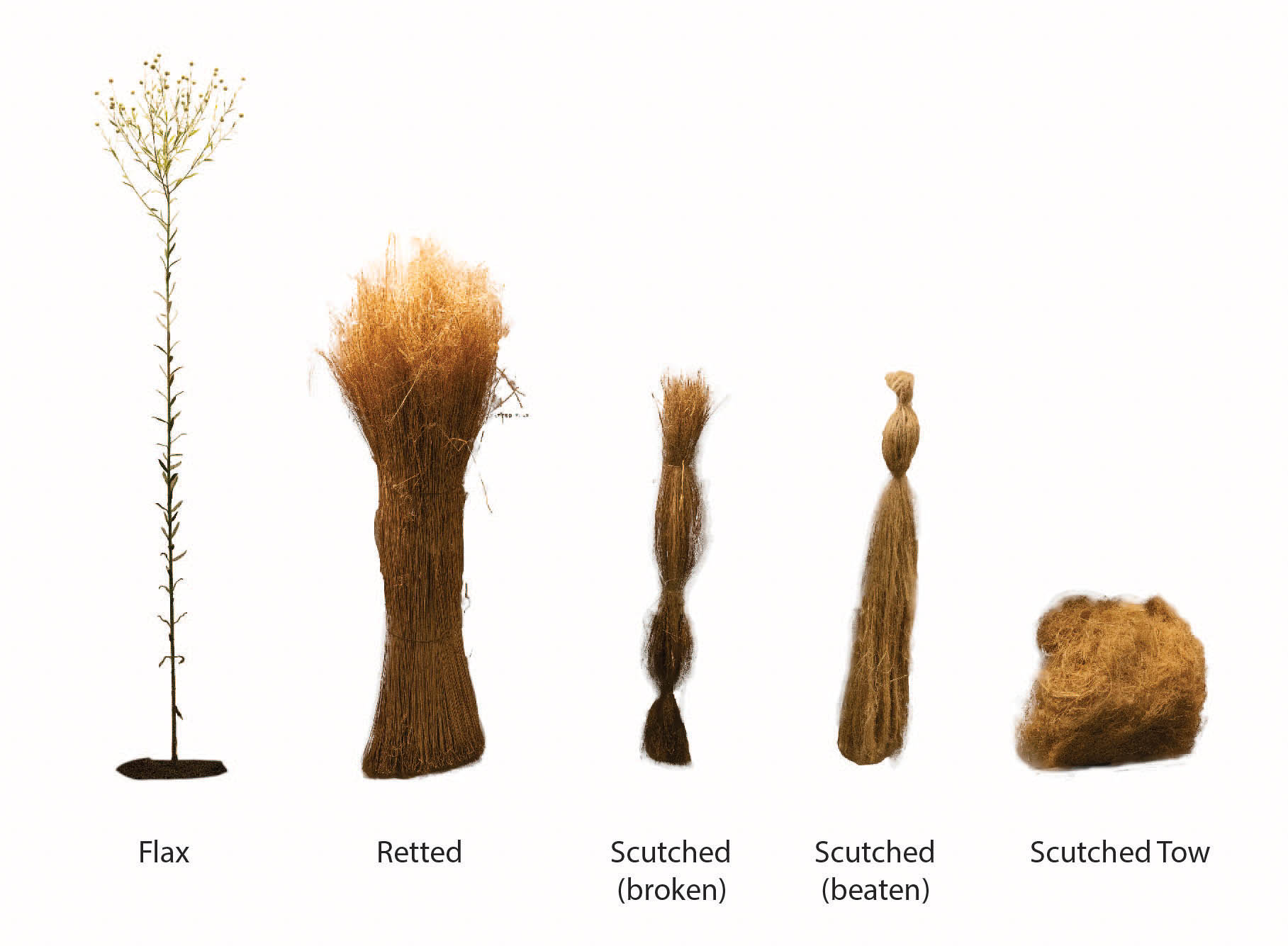
Flax, jute, hemp, and cotton are the most important plant-based fibers used to make cloth.
Wool
In contrast to flax, the hair shorn or plucked from sheep and goats is scaly, kinky and very fine. It is also stretchy. Wool stretches 1/4th of its length before breaking where flax fibers can only stretch 1/25th of their length. The scaly surface of wool fibers interlocks with other fibers to form tiny insulative air-pockets. Thus when it comes to fibers, there is nothing better than wool for staying warm.
Different types of flocks were kept for different purposes. Castrated male sheep produce the best wool, but are not good for eating and, of course, produce no milk. Archaic texts of the Uruk and Jemdet Nasr periods refer to six different types of “wool sheep” (“udu-sig“) of which the highland fat-tail sheep (“udu-gukkal-igi-nim-ma“) produced the finest wool.3Barber 1991, 24-25 The wool could either plucked or sheared before washing. The fibers were then combed strait (“worsted”) for spinning into fine fabric, or made into a fluffy ball (“carded”) for producing yarn or felt.


Nabataean woman at Khirbet Quazone was buried with a linen shroud and wool tunic.
Spinning
Both wool and flax had to be spun into yarn or thread before they could be woven into cloth. The process began with collecting the fiber into a ball that was either placed in a bowl next to the spinner or hung from a long pole known as a “distaff.” A clump of fiber was pulled from the distaff, without detaching, and tied to the end of a spindle. The spindle was whirled with one hand, while more fiber was pulled from the distaff with other. A round weight (“spindle whorl”) made of wood or stone was attached to the spindle in order to keep it spinning, like a top. The speed of rotation was a function of its diameter and weight. The smaller the diameter, the faster it spun (like a figure skater draws her hands in to spin faster), while the weight of the spindle whorl controlled the rate at which the fiber was pulled from the distaff. Thus different spindle weights and diameters were used depending on the type of fiber being spun and the fineness of the desired thread. Super fine cotton thread, for example, does not require a spindle whorl at all. Once a length of thread was spun, it was wound onto the spindle, and the process was repeated. Thus short fibers could be spun into long threads ready for weaving.
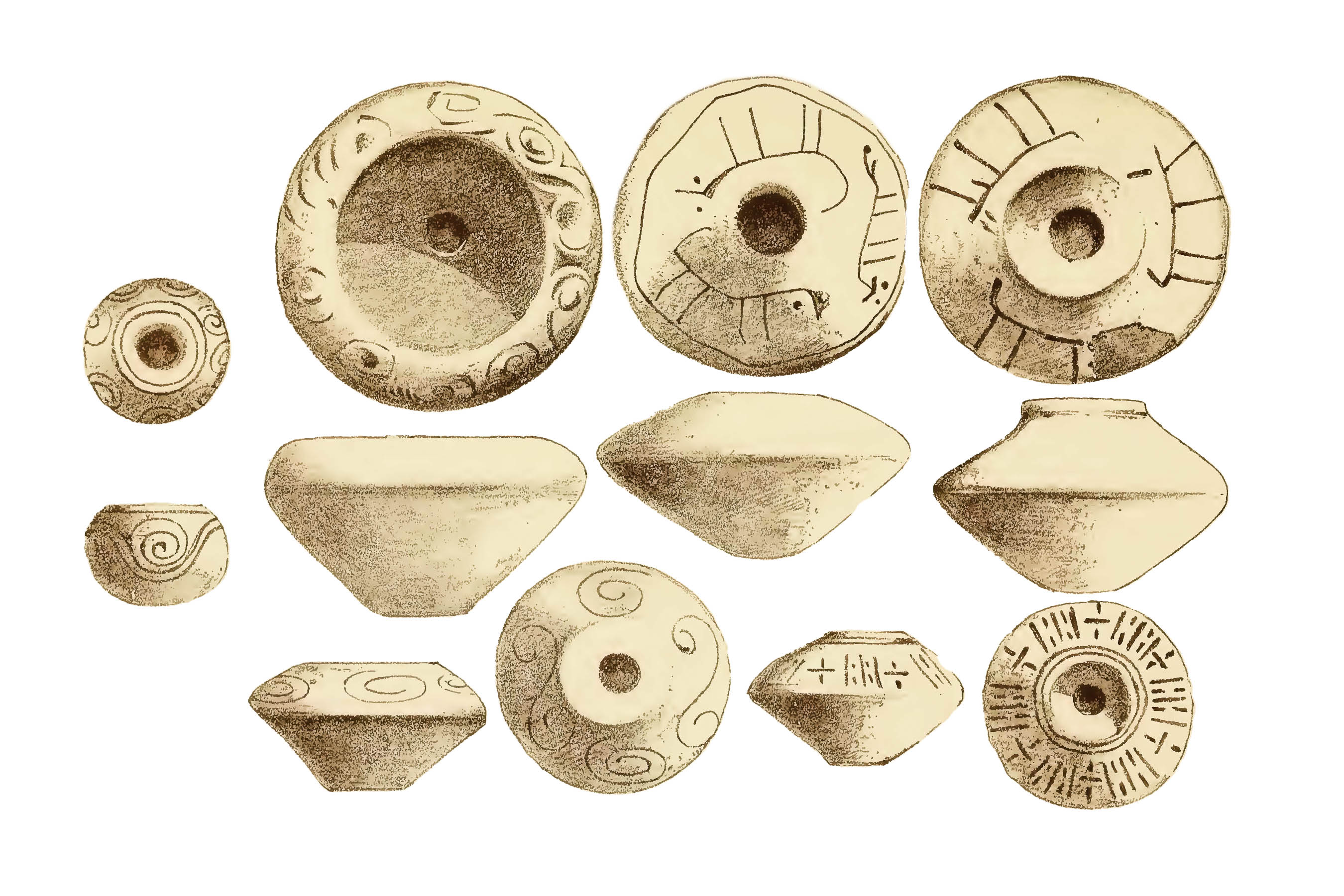
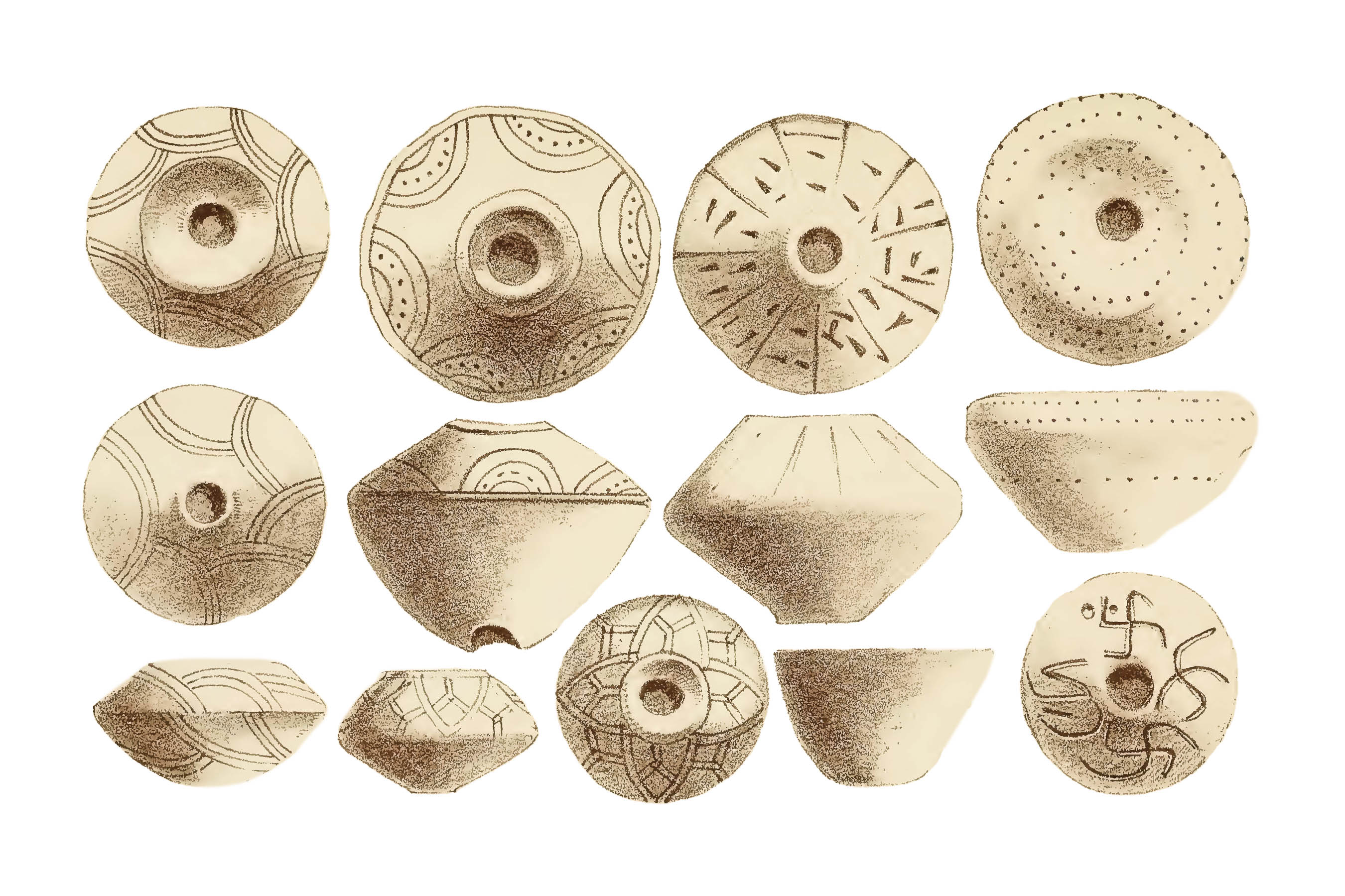
Several plates of spindle whorls from Schliemann’s excavation report. An estimated 8,000 to 10,000 whorls were found in Troy II.1Barber 1991, 54

This painting by Raphaello Sorbi shows a woman pulling the fiber from the distaff with one hand and whirling the spindle in the other.

Wall mural from the Theban necropolis (“Sheikh Abd el-Qurna”) which shows men spinning yarn. The fiber was placed in a bowl at the foot of the spinner.
Weaving
The two types of looms were used in the ancient world: the horizontal “ground loom” and the vertical “warp-weighted loom.” Generally speaking, horizontal looms were used in the Near East (Iran, Mesopotamia, Egypt, Eastern Anatolia and the Levant) while the vertical loom was used in Europe and Western Anatolia. Both types function essentially as frames upon which to stretch the long “warp” thread. The weft (or “woof”) thread was wound around a shuttle and passed through the warp, over one thread and under the next, so on and so forth. Of course, it would be tedious in the extreme to run the shuttle over and under hundreds of warp threads. To solve this problem, every loom has two bars, known as the “heddle” and the “shed,” which separate the over and under warp threads. Fabric was woven by alternatively lifting and lowering the heddle bar for every pass of the weft (horizontal thread) through the warp (vertical threads). A flat stick was used to beat the weft into place.

.jpg)
A reconstruction of a vertical loom from Hungary. It uses loom weights attached to the ends of the warp threads to apply tension.
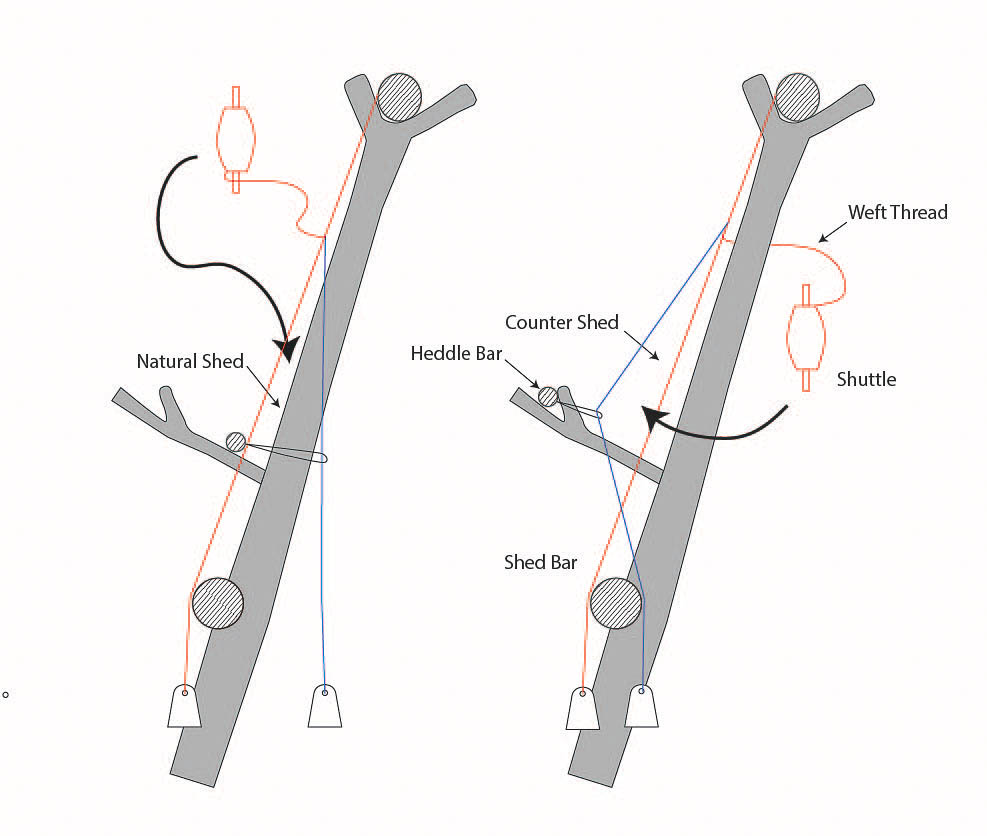

The shuttle is passed alternatively through the “natural shed” and the “counter shed.”
Vertical and horizontal looms operate in essentially the same manner except the warp threads on a vertical loom are attached to loom weights in order to maintain tension on the thread. The vertical loom allowed a lone weaver to pace back and forth across the face of the cloth without having to reach over it. In contrast, horizontal looms generally require two people to operate efficiently. Looms grow more complicated with different types of weaves. There are a great variety of tricks for twisting the warp threads together to form patterns, or twining the weft to create an open weave. Beads and different colors of threads could be embroidered into the cloth, transforming a technical skill into a real artform.
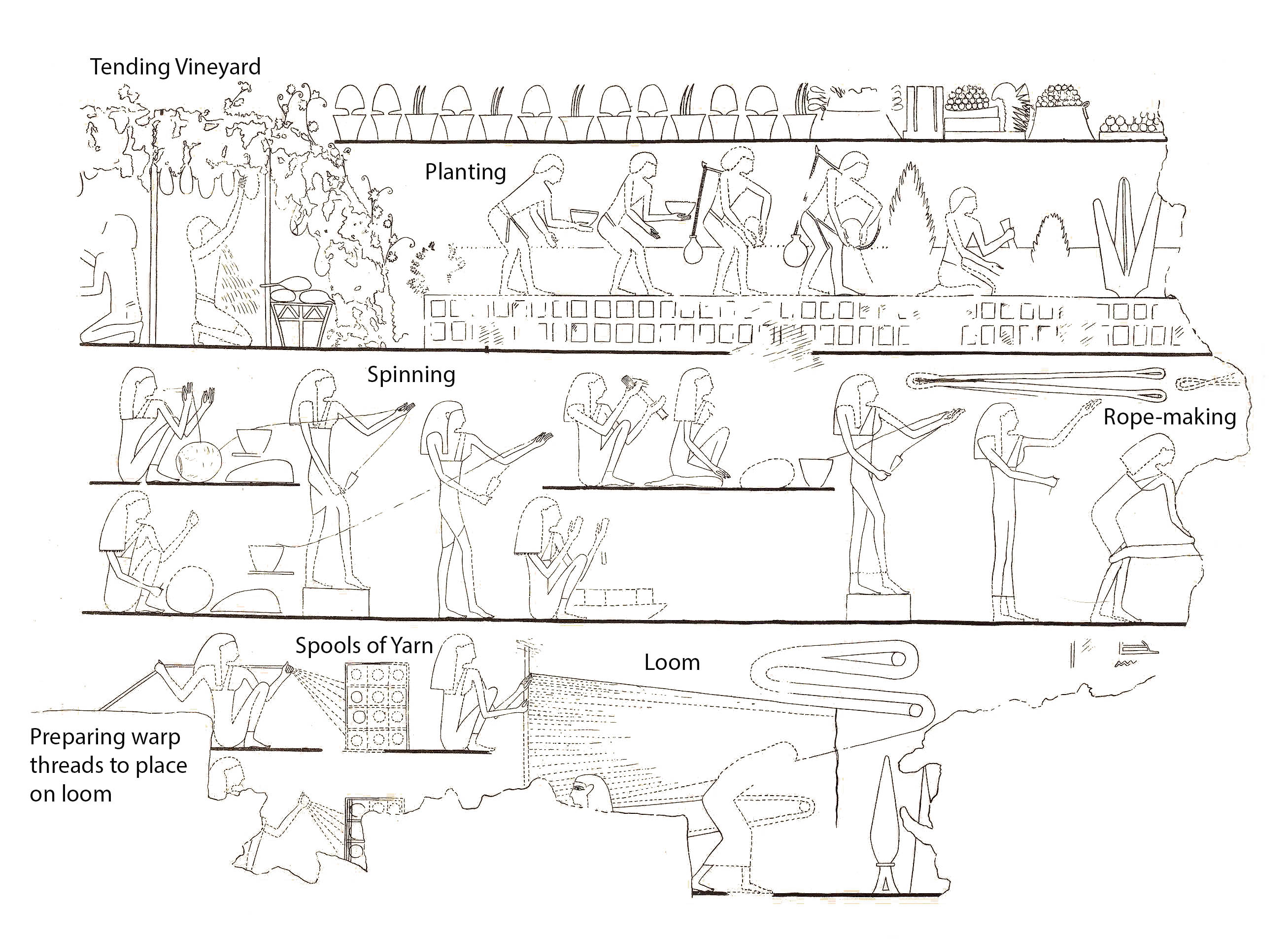
Scenes from daily life in Egypt depict spinners and weavers making cloth and twisting rope. A large horizontal loom is visible at bottom.
Oftentimes, the presence of loom weights and spindle whorls are the only evidence that weaving ever took place at a site. When found individually, it is often difficult to know for sure if they were used for weaving, or served some other purpose, as net sinkers, for instance. However, when loom weights are found lined up in a row, then we can be sure they dropped from a loom. Some of the best evidence for the use of warp-weighted looms comes from Switzerland where, as a result of a severe drought in the 1850’s and 60’s, the remnants of villages were exposed at the bottom of dried up lake beds. Dating to the Neolithic period, these villages were comprised of clusters of pile-dwellings (houses constructed on stilts) constructed along the shorelines of lake. Loom weights and even the remnants of linen fabric were preserved in the anaerobic sediment of the lake bottom.4Barber 1991, 95 ff.
However, of all the ancient looms discovered to date, the most remarkable was found in what must have been a room of the palace in Troy II. Designated Room 206 by Karl Blegen, excavators found a row of loom weights next to two holes left behind by the vertical legs of the loom. They also found 200 gold beads scattered around the loom amid thick layers of charcoal. Evidently whatever was being spun on that loom was fit for royalty.5Barber 1991, 93
The record for most looms found in one place goes to the Iron Age city of Gordion, approximately 300 miles east of Troy, where over 2300 loom weights were found in buildings associated with the palace. Barber notes that if each loom had 21 loom weights on average then over 100 weavers were in the employ of the palace.6Barber 1991, 102 Gordion was the capital of King Midas “of the golden touch” so perhaps there is something to the stories which tell of his great wealth!
Fulling
One final step was required to transform woven fabric into cloth. The fabric had to be “fulled” by washing and conditioning it by beating and twisting. The end result was a fabric whose fibers interlocked to form what may now properly be described as “cloth.”
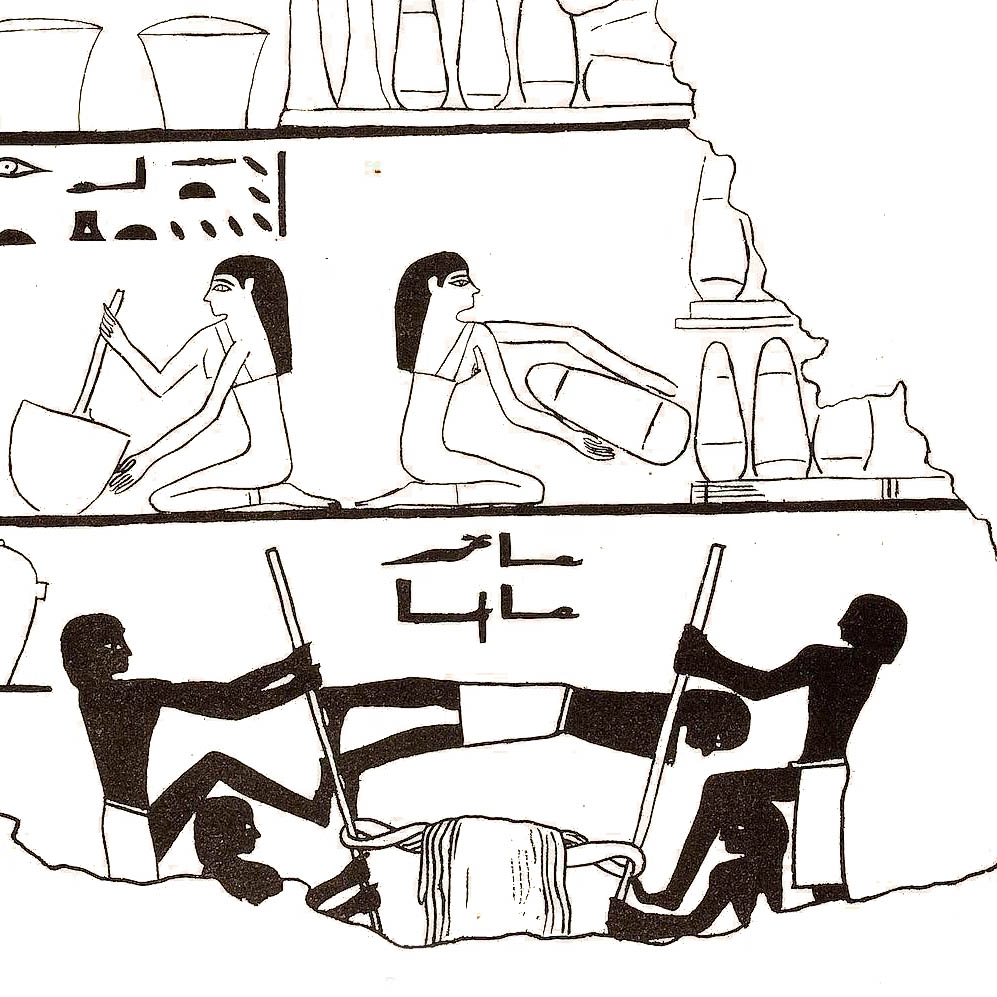
Men stretching and twisting fabric. Fulling is the final step of making cloth.
Barber, E. J. W.
Prehistoric Textiles : The Development of Cloth in the Neolithic and Bronze Ages with Special Reference to the Aegean.
Princeton, N.J.: Princeton University Press, 1991.
Newberry, Percy E.
El Bersheh (Part I) The Tomb of Tehuti-Hetep, edited by G. Willoughby Fraser.
London: Egypt Exploration Fund, 1895. Link