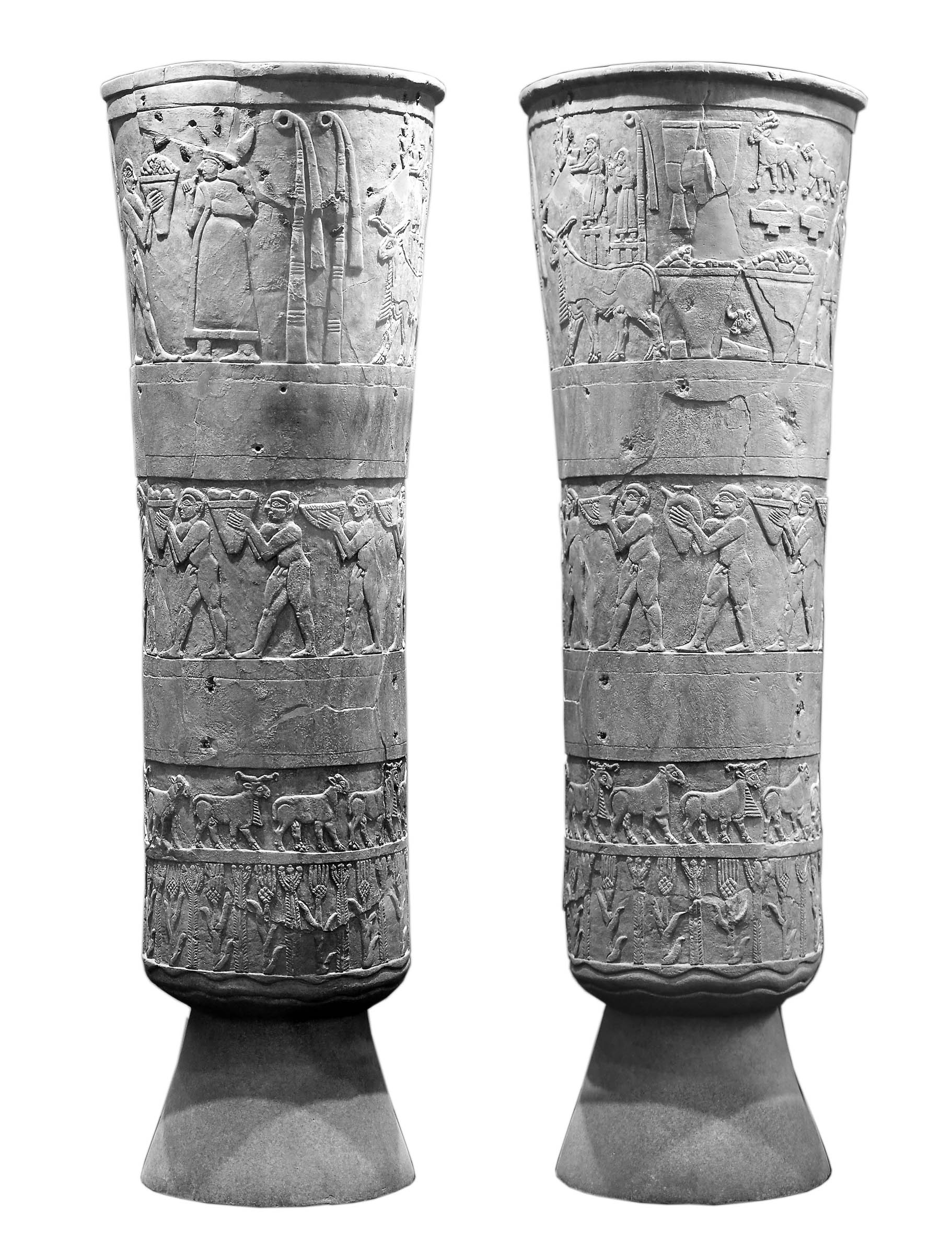
The vase was discovered in the the Eanna district of Uruk. Made from alabaster, the vase stands approximately 36″ tall and weighs around 600 pounds.
In the opening scene of the Babylonian text known as the Atrahasis Epic, the gods of the Babylonian pantheon, the Annunaki, wished to live an easy life and have abundant food provided for them. So they created a lower tier of gods, the Igigi, who were assigned the hard task of digging irrigation canals. After 3600 years, the Igigi gods finally rebelled; burning their tools and laid siege to the palace of Enlil, the king of the Annunaki. Enlil’s attendant, Nusku, carried word of the rebellion to the king,
My lord, [your] house is surrounded, Battle has run right up [to your gate]. Enlil, your house is surrounded, Battle has [ru]n right up to your gate!1Berman 2008, 22
Enlil took counsel with Anu (An) and Ea (Enki) and together they decided to create mankind to do the work which they had formerly assigned to the Igigi.
Ea made ready to speak,
And said to the gods [his brethren],
What calumny do we lay to their charge?
Their forced labour was heavy, [their misery too much]!
Every day []
The outcry [was loud, we could hear the clamor].
[Belet-ili, the midwife], is present.
Let her then create a hum[an, a man]
Let him bear the yoke []!
Let him bear the yoke []!
[Let man assume the drudg]ery of god.2Berman 2008, 22
The message of the Atrahasis Epic is that man exists on this earth to toil for the gods. The Warka Vase is the physical embodiment of this idea. Each register of the vase represents a link in the “chain of being,” beginning with the subterranean waters and ascending to plants, animals, humans, and finally to the king and the goddess, who are depicted on vase larger than life and clothed with rich garments. The plants need the water like the animals need the plants and the gods need men like men need animals.
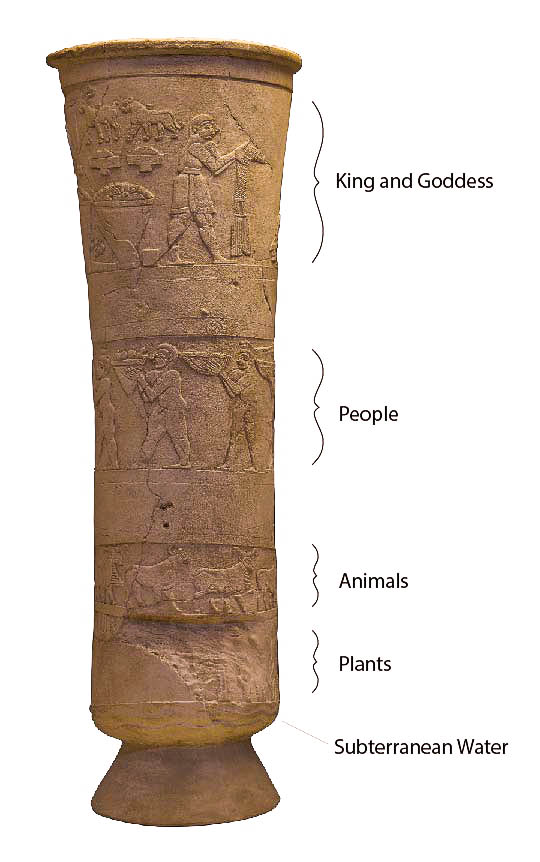
This limestone vase is divided into registers that represent what may be considered the Sumerian version of a “chain of being.”
The Lower Registers
The lowest register of the vase displays stalks of flax and barley. The plants are watered by a stream represented on the vase by a wavy line at the very bottom. The enormous quantities of barley listed in the accounting tablets from Uruk point to the tremendous fertility of the soil in Mesopotamia. According to the Greek historian, Herodotus (c. 484-425 BC), this remained the most salient feature of the region.
Of all the countries that we know there is none which is so fruitful in grain. It makes no pretension indeed of growing the fig, the olive, the vine, or any other tree of the kind; but in grain it is so fruitful as to yield commonly two-hundredfold, and when the production is the greatest, even three-hundred-fold. The blade of the wheat-plant and barley-plant is often four fingers in breadth. As for millet and the sesame, I shall not say to what height they grow, though within my own knowledge; for I am not ignorant that what I have already written concerning the fruitfulness of Babylonia must seem incredible to those who have never visited the country.3Herodotus 1.193
Flax was another important crop grown by Sumerian farmers. Its long silvery fibers were woven into a soft, cool fabric known as linen. Flax seeds could also be pressed for linseed oil.

The lowest register shows two types of plants: barley and flax. The flax is shown with three prongs.
The Upper Registers
Proceeding upwards, the next register shows a procession of rams and ewes. These were kept primarily for their wool which was woven into garments and exported abroad in exchange for vital resources such as gold, silver, copper, and wood.
The next two registers depict a train of bald and naked men carrying vessels filled with grain, dates, and fruit. They are moving towards Inanna’s temple (top register). The doorposts of her temple are represented by two reed poles. Unfortunately, the vase is broken at this point but enough is preserved to reconstruct the scene. The king stands before the Inanna’s temple while an attendant walks behind him, carrying the train of his garment. A woman wearing a tall headdress stands to greet the king. Perhaps she is Inanna, or more likely, a priestess of the goddess (see below).

The upper register of the Warka Vase flattened to show the whole frieze. Inanna or a priestess is shown standing before a richly provisioned temple.
Two small people are visible in the upper register, each standing on a pedestal attached to the back of a ram—a uniquely Sumerian design for a table. As we will see, actual tables of this type were found in the Royal Cemetery of Ur. The small people standing on their “ram pedestals” may represent statuettes of worshipers that were placed inside the temple of Inanna. One of the statuettes bears offerings, including stacks of what appear to be bevelled-rim bowls. The other is presumably bearing an offering also. These peculiar pedestals are, therefore, best understood as offering tables on the analogy of similar pedestals displayed on Early Dynastic cylinder seals.


These unique stands were used as offering tables in Sumerian temples. Left: From an Early Dynastic cylinder seal discovered at Ur. Right: From the Warka Vase.
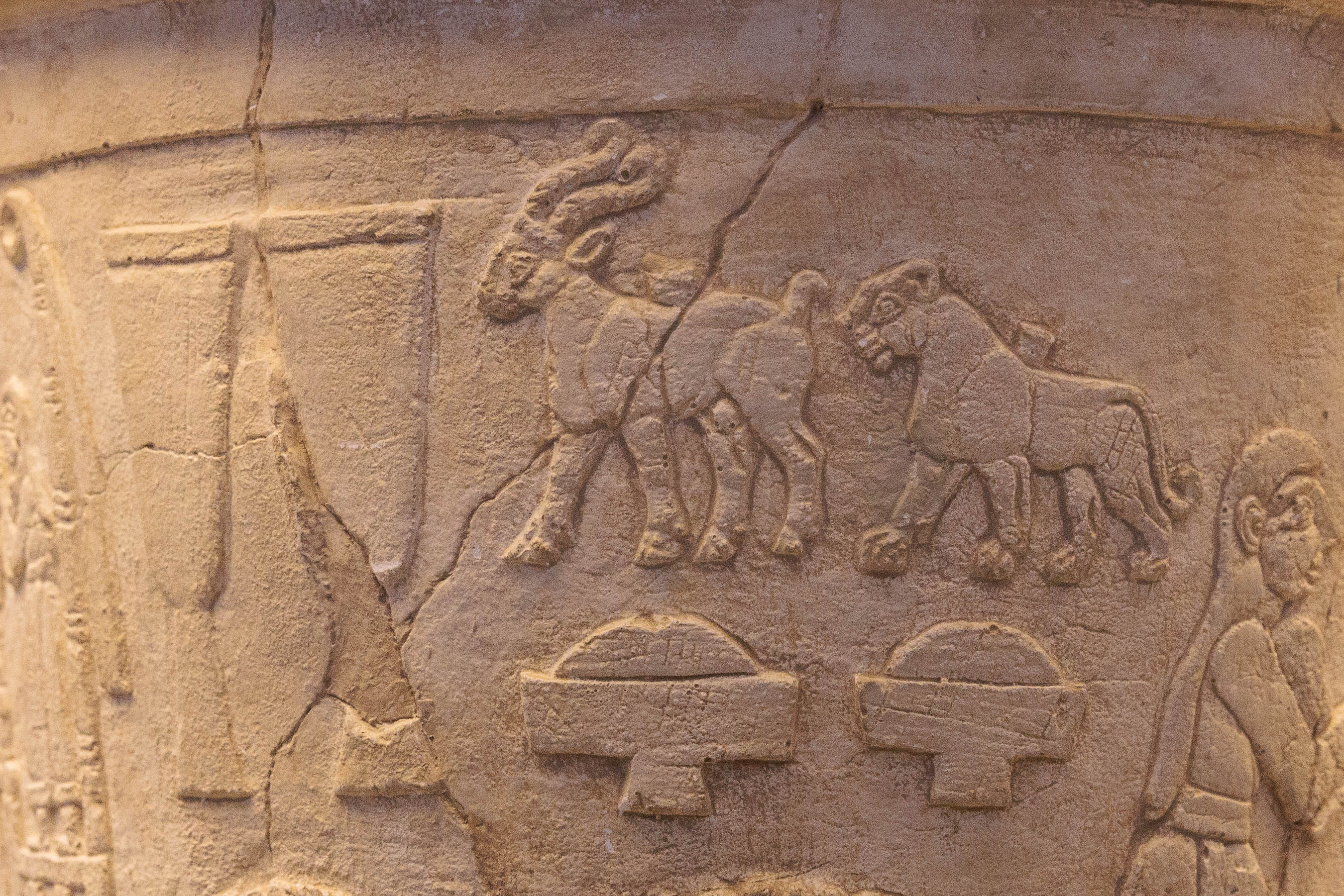
Situated behind the “ram pedestals” are various types of vases and vessels, two of which are very similar in form to the Warka Vase itself. They must have stood in the temple or in one of its storerooms.4Nissen 1988, 103-105 Two other vessels are shaped like a ram and a lion. We probably wouldn’t guess that they are vessels except for the socket on their back which was used to fill them. The spout of the vessel was in the mouth of the animal. As we will see, animal-shaped (“therimorphic”) vessels are typical for this period.
.jpg)
Although the ram and the lion appear to be animal figurines, they are, in fact, vessels with a socket in their back for filling with liquid.
Inanna
Inanna’s name probably comes from Sumerian “Nin-anna” which means “Queen of Heaven,” a title shared by many goddesses of the ancient world, including: Ishtar (Akkadian), Astarte (Western Semitic), and Ashtoreth (Western Semitic).5Black 1992, 108 Sumerian scribes wrote hymns to the goddess, comparing her beauty to the brilliance of the morning star (the planet Venus) and the silvery moon. These two astral bodies in particular have a long association with the goddess.
Other texts depict her as a violent goddess, lustful for power, and temperamental. In the Gilgamesh Epic, she is a femme fatale whose charms the wise man does well to resist. When Inanna propositions Gilgamesh, he deflects her advances by listing her many former lovers who met with an unfortunate end.
We know next to nothing about the cult of Inanna during the Uruk period. Jacobsen argues that the main feature of her cult centered on a sacred marriage with Dumuzi—the two being the female and male aspects of fertility. In support of this theory, Jacobsen cites texts from the Ur III and Isin Larsa period which revolve around the courtship and marriage of Dumuzi and Inanna. These same texts describe a New Years festival during which the king re-enacts the sacred marriage, probably with one of a “caste of priestesses, who, by sacral necessity, will not be allowed to be impregnated except by the king.”6Jacobsen 1976, 120 This may be what is represented on the Warka Vase.
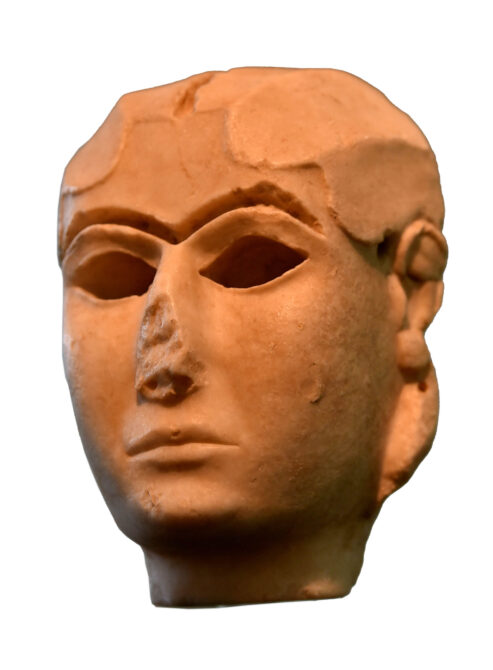
This finely carved alabaster head is thought to have belonged to a cult image of the goddess (however, see below). The sculptor has achieved a remarkably life-like portrait of a woman.
In the world of Sumerian mythology, the marriage of Dumuzi and Inanna was thought to have brought a rich harvest of dates, bountiful fields of grain, and the increase of flocks and herds. The story ended tragically, however, with the murder of Dumuzi, either at the hands of attackers, by drowning, or by the decree of Inanna herself when she returns from the underworld and finds him happily getting along without her! The death of Dumuzi marked the onset of the summer months when every green plant withers and turns to dust. Dumuzi’s mother, who is a cedar tree, laments her son’s death and prays for the return of “him who sails the high waters, the flood… laden with life (-giving) food… laden with life (-giving) water”7Jacobsen 1976, 72 The Bible also describes rituals of “mourning for Tammuz,” this being the Babylonian equivalent of Dumuzi (Ezek 8:14).
City of Harlots
Texts from later periods make reference to male, female, and transvestite temple personnel who seem to have functioned as prostitutes in the temple. Thus in the 10th century BC Babylonian epic, Erra and Ishum (or The Erra Epic), the city of Uruk is described as a city of “courtesans, harlots, and prostitutes.”
As for Uruk, the dwelling of Anu and Ishtar,
the city of courtesans, harlots, and prostitutes (for the cult),
Whom Ishtar deprived of husbands
and reckoned as her own (?),
There Sutean nomads, men and women,
bandy war whoops!
They turned out the actors and singers (of) Eanna,
Whose manhood Ishtar changed to womanhood
to strike awe into the people,
The wielders of daggers and razors,
vintner’s shears and flint knives,
Who take part in abominable acts
for the entertainment of Ishtar…8Erra and Ishum, Tablet IV (54-58) in B. Foster
The transvestites who participated in “abominable acts for the entertainment of Ishtar,” wielded “daggers and razors” with which to lacerate their bodies. Descriptions of this ritual are found elsewhere, most notably in the Latin satirical novel, The Golden Ass, written by the Syrian author, Apuleius, who recounts in graphic detail how Syrian transvestite priests would consecrate themselves to the Anatolian mother goddess, Cybele, by cutting themselves until blood ran in the streets. (We will come back to this topic when we look at the Inandik Vase.)
Whether such rituals were practiced during the Uruk period is unknown, as is all other aspects of religious life in the city during that period. What may be interpreted as religious symbolism on Uruk period artifacts is really guesswork, and since the texts of this period deal mostly with commercial transactions, they are of no aid in this regard. It is interesting to note, however, that representations of the gods and goddesses are curiously absent from the glyptic (“engraved’) or plastic (“molded”) arts. Even the ubiquitous fertility figurines are absent. There is no way of knowing if the alabaster “head of Inanna” (pictured above) actually belongs to the goddess since there is no religious symbolism associated with it, nor was it found in the confines of a temple on the Eanna. The same may be said of the figure usually identified as Inanna on the Warka Vase since she is not shown with the horns of divinity or any other symbol that would indicate her divine status. It seems that in Sumer during the Uruk period the gods were primarily depicted with reference to their temple or a symbol used to represent them, such as the “reed pole” for Inanna.
Berman, J.
Created Equal : How the Bible Broke with Ancient Political Thought.
Oxford ; New York, N.Y: Oxford University Press, 2008.
Black, J. A.
Gods, demons, and symbols of ancient Mesopotamia : an illustrated dictionary.
Austin, Tx: University of Texas Press, 1992.
Foster, B. R.
Before the muses : an anthology of Akkadian literature.
Bethesda, Md.: CDL Press, 2005.
Frankfort, H.
The Art and Architecture of the Ancient Orient.
Harmondsworth, Middlesex : Penguin Books, 1954.
Herodotus, G. Rawlinson.
The Histories.
New York: Everyman/Alfred A. Knopf, 1997.
Jacobsen, T.
The Treasures of Darkness : a History of Mesopotamian Religion.
New Haven: Yale University Press, 1976.
Nissen, H. J. R.
The Early History of the Ancient Near East, 9000-2000 B.C..
Chicago: University of Chicago Press, 1988. Link