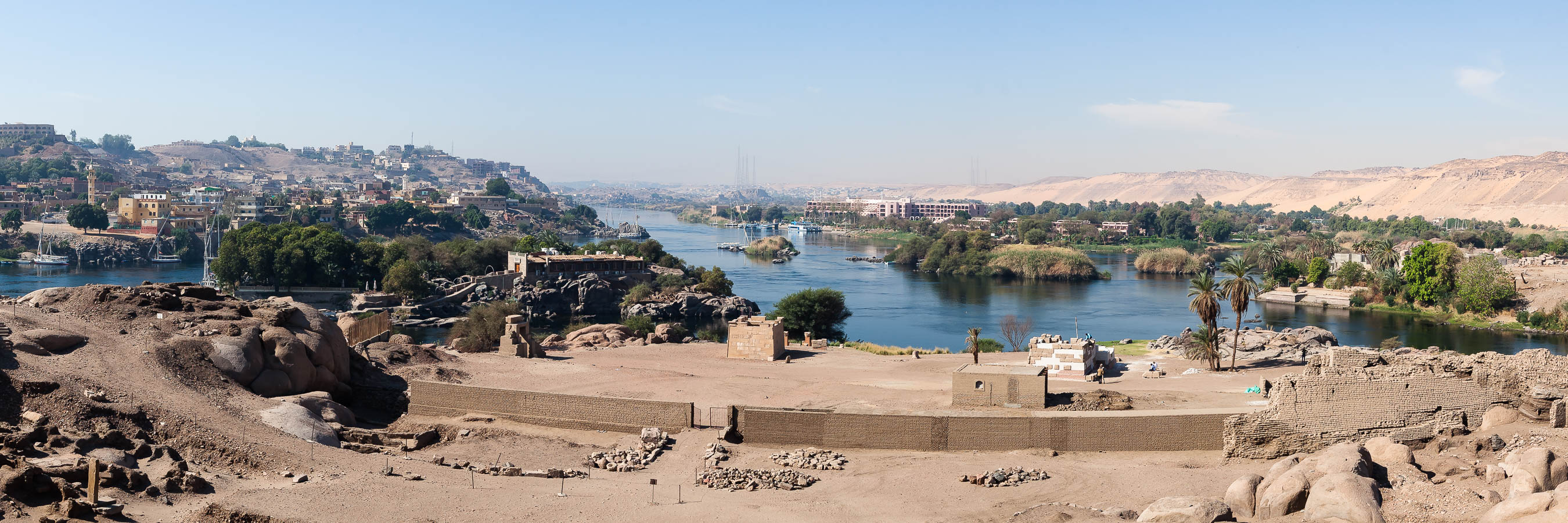
This picture was taken from the island of Elephantine looking south towards Nubia. The heavily fortified city was situated on the southern frontier of Egypt next to the modern day city of Aswan. A section of Elephantine’s ancient wall is visible in the foreground to the right.
Pepi I succeeded Teti to the throne of Egypt. An expansionist king, his name has been found inscribed on objects as far distant as Kerma, in the Sudan, and Ebla in Syria. As you may recall, an alabaster vase with Pepi’s name on it was found in Palace G at Ebla. This important chronological marker suggests that Pepi I ascended the throne sometime prior to the destruction of Ebla (Mardikh IIB1). If Sargon is responsible for destroying Palace G, then Pepi I and Sargon of Akkad were probably contemporaries.
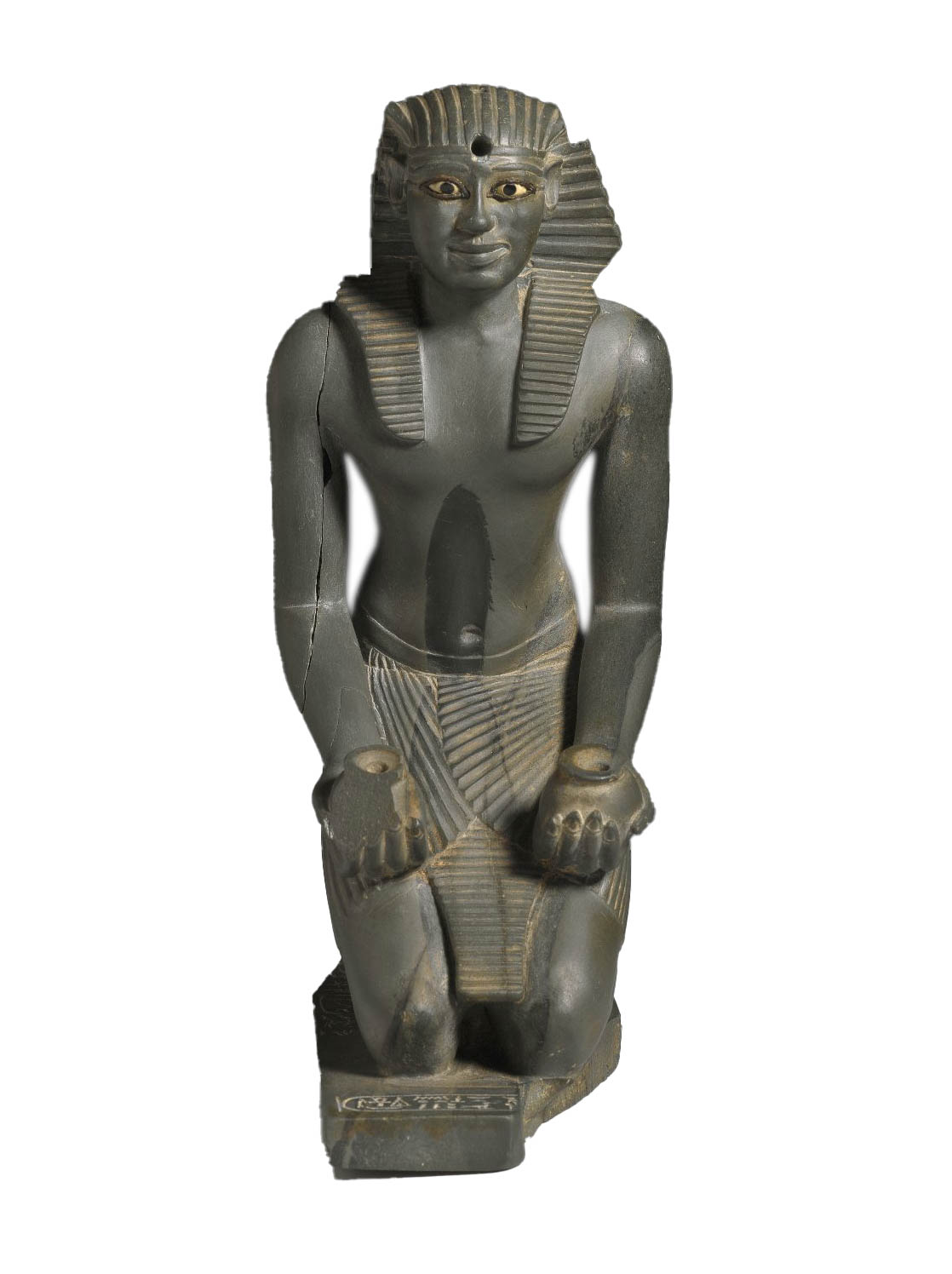
The king is shown making an offering of two vessels of ointment.
Manetho gives Pepi I an unusually long reign length of 50 years during which many temples and shrines were constructed throughout Egypt, perhaps with the goal of regaining some control over the provinces. Provincial governors nevertheless took charge of all the important military campaigns conducted during this period.
The Autobiography of Weni
The official Weni is the first Egyptian to produce a literary account of his military conquests. These are inscribed on the walls of his tomb at Abydos. Weni claimed to lead five or six military expeditions against the “sand-dwellers”—a derogatory title used by the Egyptians to refer to anyone living in the Sinai and Canaan. The term cannot be taken literally, however, since Weni also boasted of destroying their cities and uprooting their orchards and vineyards.
When his majesty took action against the Asiatic Sand-dwellers, his majesty made an army of many tens of thousands from all of Upper Egypt…
This army returned in safety,
It had ravaged the Sand-dwellers’ land.
This army returned in safety,
It had flattened the sand-dwellers’ land.
This army returned in safety,
It had sacked its strongholds.
This army returned in safety,
It had cut down its figs, its vines.
This army returned in safety,
It had thrown fire in all its [mansions].
This army returned in safety,
It had slain its troops by many ten-thousands.
This army returned in safety,
[It had carried] off many [troops] as captives.1Lichtheim 2019, 52-53
Nor were the campaigns of Weni limited to the Sinai and southern Canaan since Weni claimed to use ships to land a contingent of soldiers on the coast of Canaan behind the “nose of Gazelle’s Head”—what is almost certainly a reference to Mount Carmel, the only prominent landmark on the Levantine coast. This sea maneuver allowed Weni’s marines to launch a surprise attack from the north while his main body of troops attacked from the south, thus enveloping the enemy in a pincer movement. This is the earliest written account of naval warfare and the earliest known instance of the use of marines in battle—Manishtushu’s campaign against Arabia probably dates a little later.
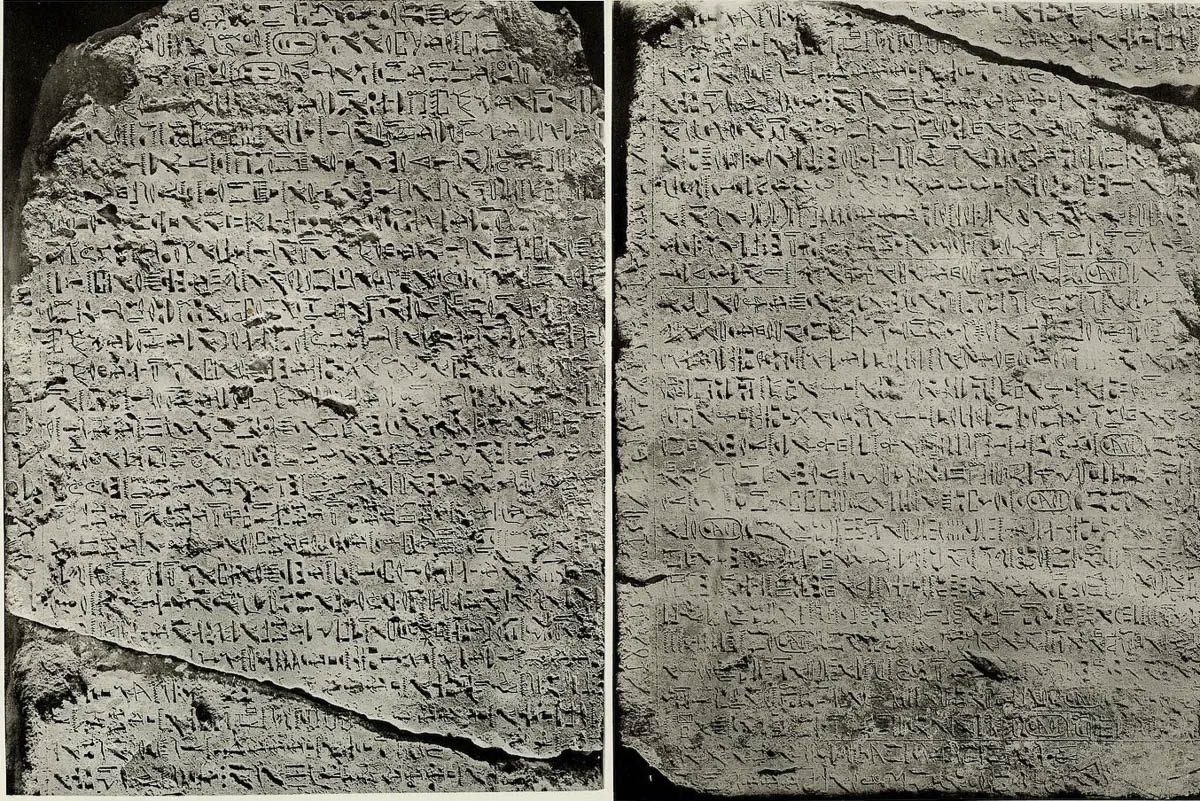
The inscription was found next to the entrance to his tomb at Abydos.
Weni claimed to have had under his command an army of “many tens of thousands,” including numerous groups of Nubian mercenaries from regions south of Egypt. Their names are listed as “Irtjet-Nubians, Medga-Nubians, Yam-Nubians, Wawat-Nubians, Kaau-Nubians; and Tjemeh.2Hamblin 2006, 337 The appearance of Nubian mercenaries in the ranks of the Egyptian army illustrates the importance of Nubia to Egypt, both militarily and economically, during this period.
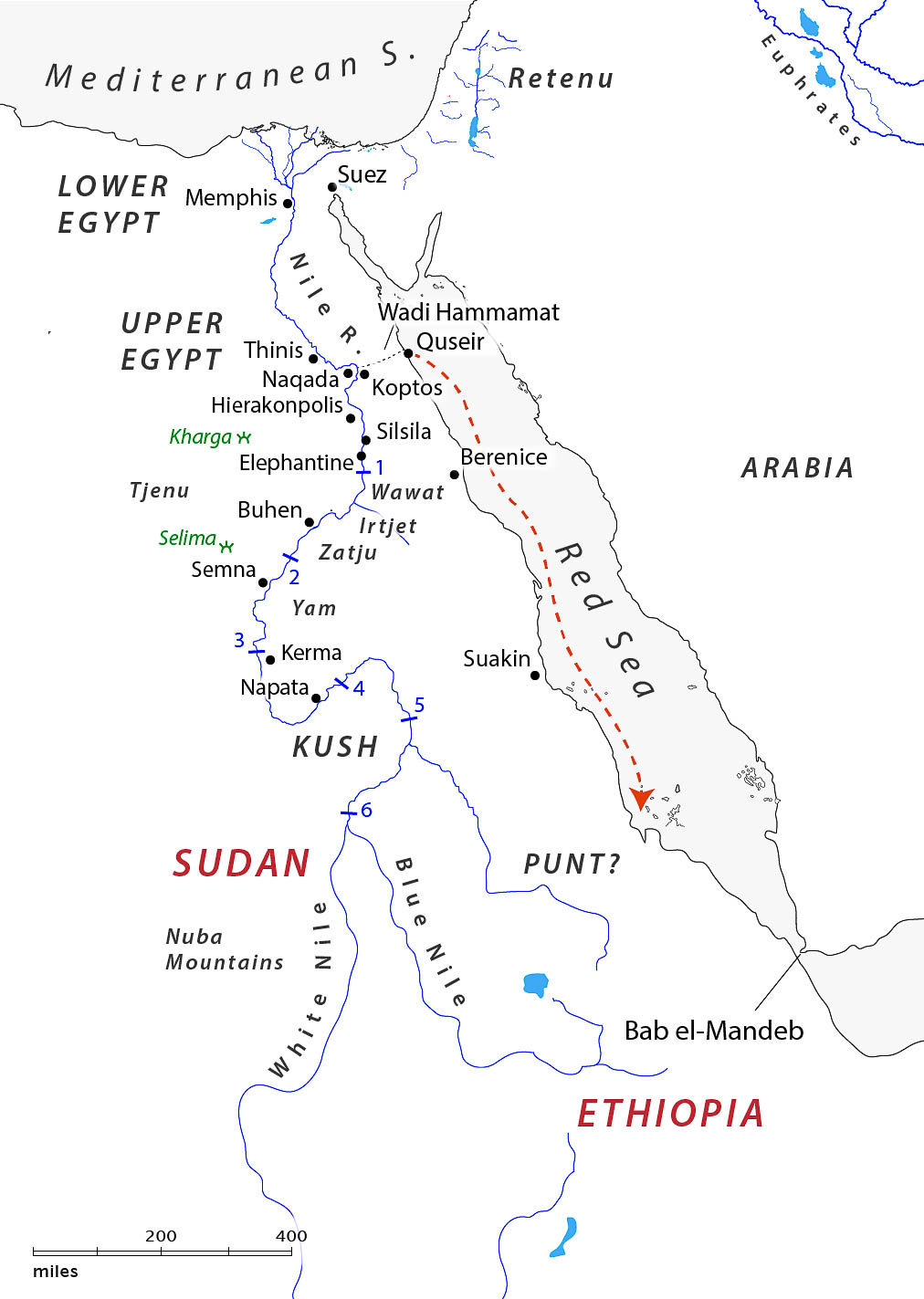
Map showing the location of Elephantine and the First Cataract.
Although Nubia and Egypt are linked by the Nile, they are separated by a series of cataracts—six in total—which make river travel difficult if not impossible. The first and northernmost of the cataracts was located immediately above Elephantine (modern day Aswan) whereas the sixth and southernmost is located a little south of modern day Khartoum in Sudan. Weni’s final and most important task was to construct a canal that circumvented the First Cataract, thereby opening the way for quarrying operations in Nubia.


The First Cataract lay just below Elephantine, near the modern Egyptian city of Aswan. The Third Cataract, in modern day Sudan, is located in the heart of ancient Nubia.
The Autobiography of Harkuf
Although Weni’s canal opened the way for river travel down the Nile, expeditions into Nubia were still primarily conducted via donkey caravan. An account of three such expeditions comes from another tomb inscription, this one belonging to an important official named Harkuf, the apparent successor of Weni. Harkuf came from Elephantine, a city known as the “Gate of the South,” which was located on an island in the Nile immediately below the First Cataract. Harkuf’s tomb is located at Qubbet al-Halwa, on the west bank of the Nile, across from Elephantine.
The purpose for Harkuf’s expeditions into Nubia was to find good stone, minerals, panther skins, and “all kinds of beautiful and rare gifts.”3Hamblin 2006, 342. Although these expeditions were not necessarily military in nature they were always accompanied by a large contingent of troops. As Hamblin notes, it is often difficult to tell “whether the major purpose of these expeditions was trade or tribute—the two are barely distinguishable in the Old Kingdom.”4Hamblin 2006, 341


Harkuf’s autobiography was inscribed on the entrance to his tomb, located on the island of Elephantine.
Harkuf’s autobiography preserves a letter sent to him by Pepi II, the last pharaoh of the Sixth Dynasty, congratulating him on his successful expedition and urging him to hurry and bring “the pygmy of the god’s dances from the land of the horizon-dwellers [at the end of the earth].” Pepi II, who must have still been quite young at the time, further expresses his desire “to see the dwarf even more than to receive the precious gifts from Punt.” The Egyptians, like the Greeks and Romans after them, associated the interior of Africa with a people of unusually short stature. A story related by Herodotus tells of five Libyan youth (Nasamonians) who were selected by lot to make a journey across the great desert (the Sahara) separating Libya from central Africa. Having crossed the desert, the youths encountered a tribe of “dwarfish men.”
After journeying for many days over a wide extent of sand, they came at last to a plain where they observed trees growing; approaching them, and seeing fruit on them, they proceeded to gather it. While they were thus engaged, there came upon them some dwarfish men, under the middle height, who seized them and carried them off.5Herodotus II:32
These men of short stature led the Libyans across extensive marshes until they were brought to a town where, “all the men were of the height of their conductors, and black complexioned. A great river flowed by the town, running from west to east, and containing crocodiles.”6Herodotus II:32 This town was probably situated in the same general area as the famous city of Timbuktu in Mali, which would become famous in the Islamic period as a center of learning and great wealth. In this case the river would have to be the Niger. For Pepi II, no less than for the Libyans, this was the “land of the horizon dwellers.”
Fragmentation
Neither Pepi I nor Pepi II directly participated in any military campaigns that we know of. Indeed, there is no record of any king of Egypt during the Old Kingdom period taking part in a military campaign. In contrast, the kings of Sumer and Akkad often boasted of leading their troops into battle. Pepi II came to the throne when he was only six years old. Thus Queen Ankhesenpepi II served as coregent during the early years of her son’s reign. One of the iconic images from this period is an alabaster sculpture of the young pharaoh, dressed in royal regalia, seated on his mothers lap! Manetho gives Pepi II an incredibly long reign of 90 years, which would make him the longest reigning king of all time, if Manetho can be trusted. Despite the apparent stability of the throne, Egypt was actively disintegrating during Pepi II’s reign. By its end officials were placing their own names inside the royal cartouche, something unthinkable before then. After Pepi II’s death, Egypt fractured into numerous fiefdoms, thus bringing not only the Sixth Dynasty but also the Old Kingdom to an end.

One of only three statues from the reign of Pepi II.
Breasted, James Henry.
Ancient Records of Egypt: Historical Documents: The First to the Seventeenth Dynasties. Vol. I vols.
Chicago, Ill: The University of Chicago, 1906.
Hamblin, W. J.
Warfare in the Ancient Near East to 1600 BC: Holy Warriors at the Dawn of History.
London ; New York: Routledge, 2006. Link
Herodotus, G. Rawlinson.
The Histories.
New York: Everyman/Alfred A. Knopf, 1997.
Lichtheim, Miriam.
Ancient Egyptian Literature. Vol. 1 vols.
Oakland, California: University of California Press, 2019. Link