Excavations commenced at Tel el-Muqayyar—ancient Ur—in 1922 as a joint venture between the British Museum and the University of Pennsylvania and directed by the British archaeologist, Sir Leonard Woolley. Within the first week of excavations, the expedition stumbled upon an ancient cemetery. Woolley knew the area held great promise since tombs tended to produce the greatest number of artifacts, but he decided not to excavate the cemetery immediately. There were several factors that went into his decision. Firstly, tombs are notoriously difficult to date, even when the stratigraphy of the site is well understood—and Ur’s was completely unknown. Secondly, Woolley and his staff were new to the region and their workforce was untested.1Woolley 1934, 5-6 Thus Woolley chose to focus his efforts on clearing the debris from around the famous ziggurat of Ur and excavating the courtyards and temples next to it.
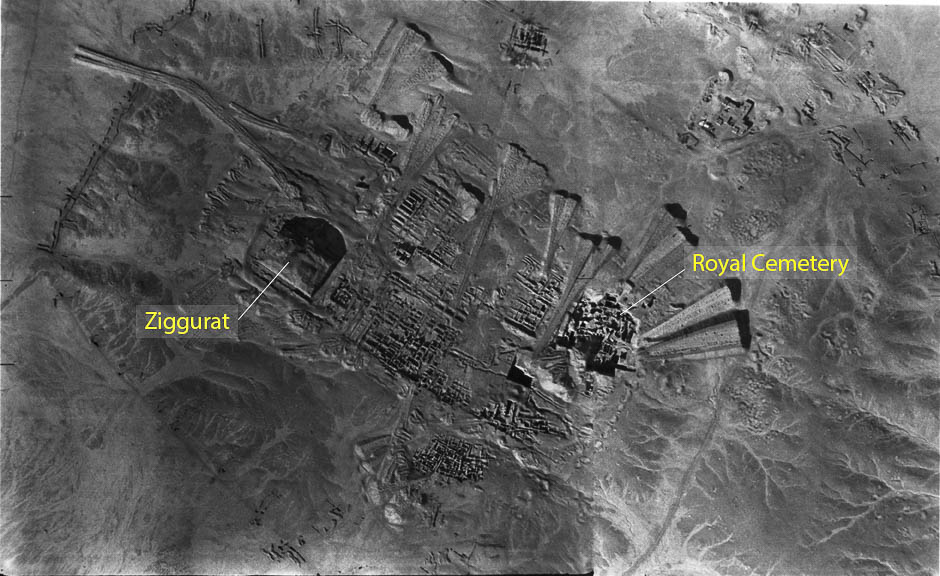
An aerial view of Ur taken during the excavation of the Royal Cemetery. The long cone-shaped objects are heaps of soil from the excavation.
It wasn’t until five years later that Woolley and his team finally returned to the cemetery area. They began the dig season with great expectations but these steadily diminished as one week rolled into another and almost nothing of real importance was found. It wasn’t until the very end of the season that they finally found a significant tomb (PG 580) and next to it, a cache of objects that included two beautiful gold daggers of outstanding craftsmanship.

This ceremonial gold knife has a lapis lazuli hilt studded with gold. Its scabbard is decorated with very fine filagree work. The image shown here is an exact replica on display at the British Museum. The original is displayed at the National Museum in Baghdad.
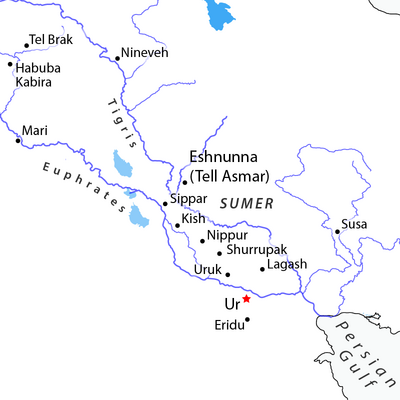
The city of Ur was originally located on the shore of the Persian Gulf.
The knives generated a great deal of excitement but they also presented Woolley with a dilemma. That he had discovered a large and richly furnished tomb, none could deny. Woolley noted in his diary that “the earth face had only to be scratched for more gold objects to appear.” But Woolley did not have time to excavate the tomb. He decided, therefore, to ask Sheikh Munshid, the head of the Ghazzi tribe, who controlled the land around Tell el-Muqayyar, if he would secure the site until the next season. The old sheikh agreed and made good on his promise. Woolley would later recall how, “the site was religiously respected through the six summer months.”

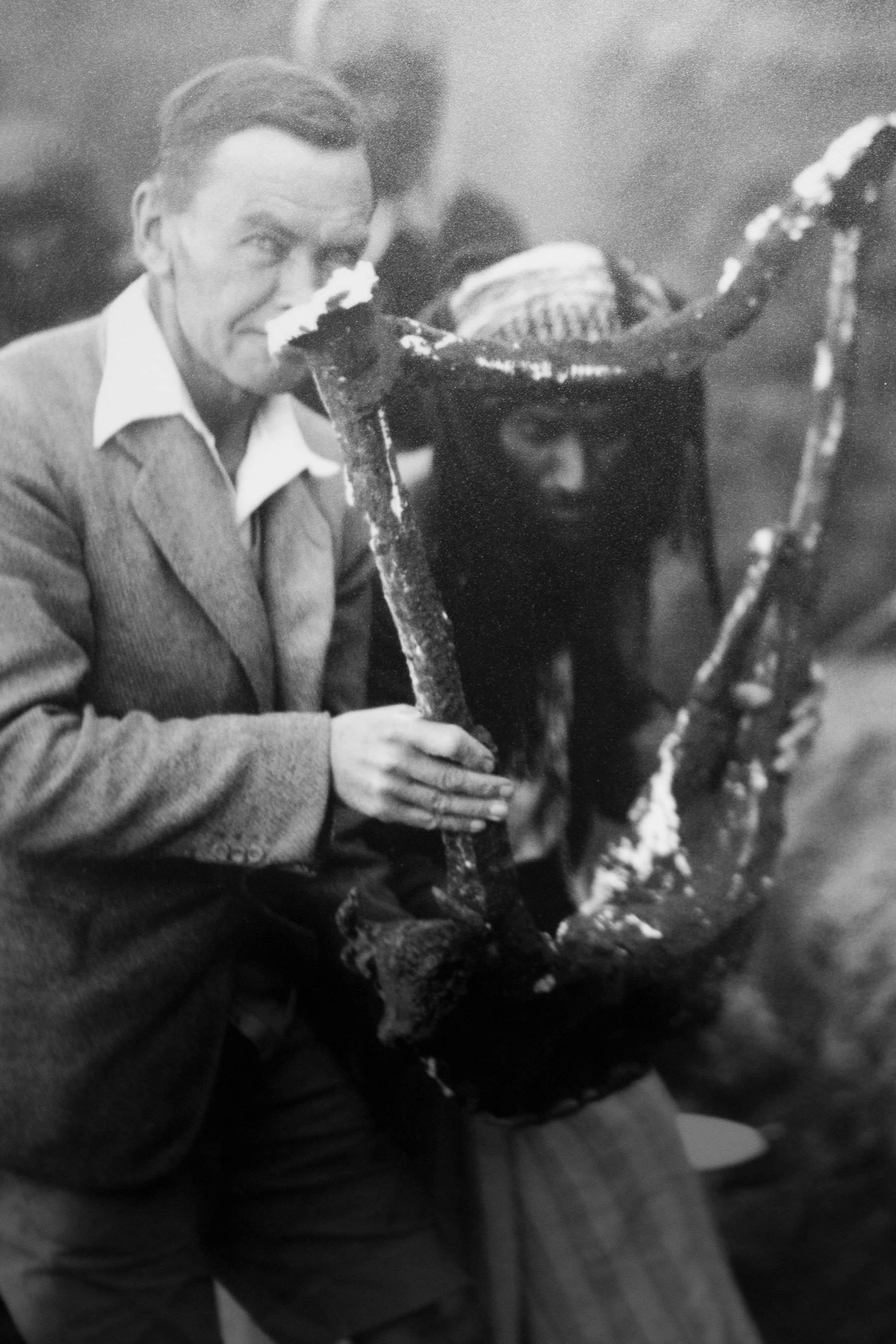
Excavations were conducted through a joint excavation by the Penn Museum of Philadelphia and the British Museum. Oversight was given to Sir Leonard Woolley, whose work at Ur has earned him a reputation as one of the greatest field archaeologists of all time. Left: Wooley and his wife in the field. Right:
Woolley and his foreman, Sheikh Hamoudi Ibn Ibrahim, carrying a harp recovered from one of the tombs.
Woolley and his foreman, Sheikh Hamoudi Ibn Ibrahim, would excavate 1,850 tombs over the next three seasons. Of these, only sixteen could be classified as royal. They were larger than the others in the cemetery and deeper, approximately 20 to 36 feet down. They were also exceptionally rich in grave goods. Indeed, the treasure recovered from the royal tombs of Ur would surpass anything found in the ancient world, before or since, with the exception of Tutankhamen’s tomb in Egypt. Among the objects recovered from the tombs was jewelry fashioned from carnelian, agate, mother of pearl, and lapis lazuli; giant harps covered in silver and gold; boxes inlaid with precious stones; weapons made of copper and bronze; vessels of alabaster, chlorite, obsidian, silver, electrum, and gold; and several ornately decorated ostrich eggs.


A small sampling of the rich grave goods found in the tombs: Left: Gold vessels and a bead made with twisted gold wire soldered into place. Right: Necklaces made from carnelian and lapis lazuli.
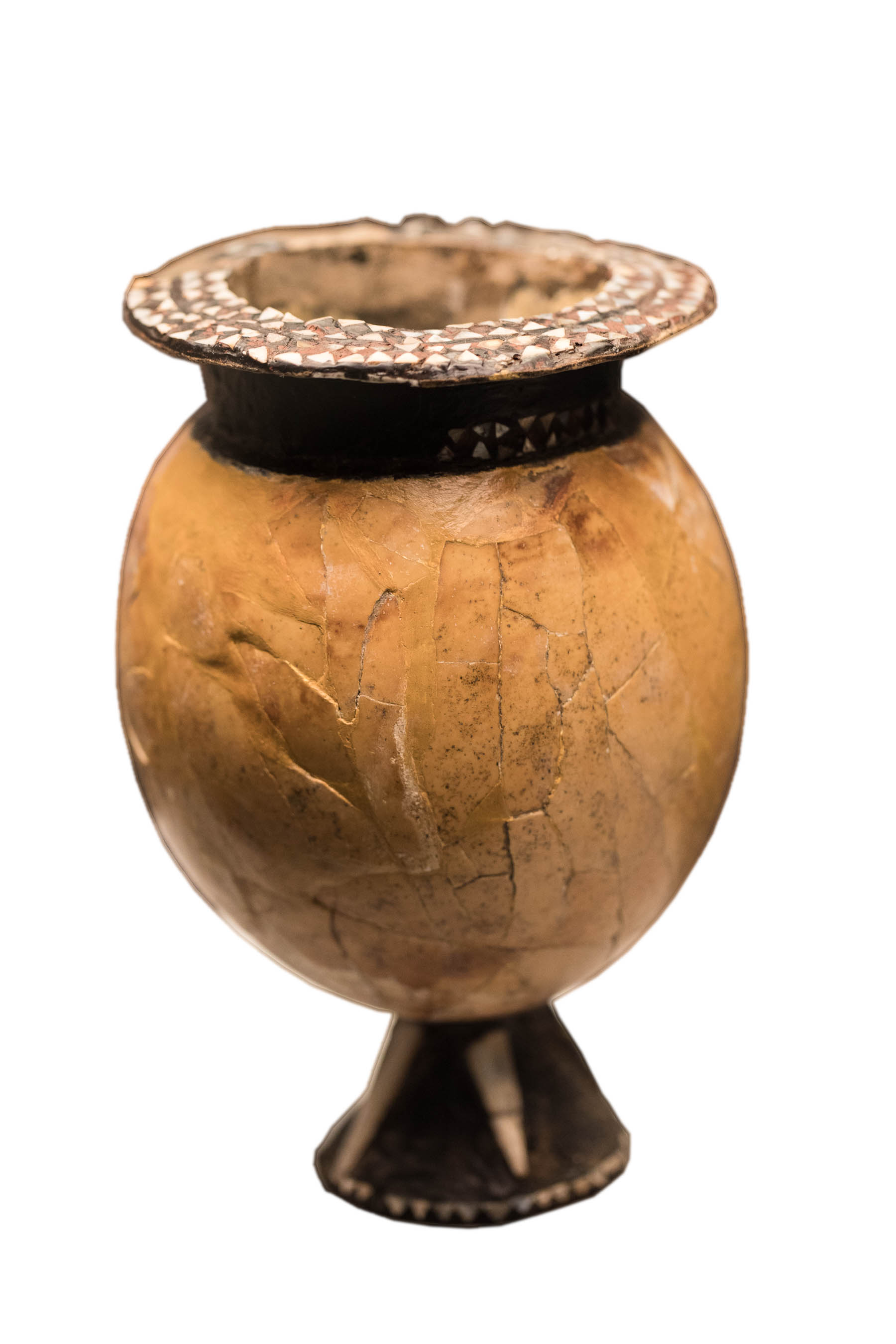

Ostrich egg shells are decorated with bands of shell and lapis lazuli.
To the Bottom of Mesopotamia
As noted previously, the royal tombs were found in the lowest levels of the cemetery. But nowhere did Woolley and his team hit virgin soil. Wishing to discover just how deep the layers of occupation at Ur went, Woolley decided to dig a probe (Trial Pit B) at the bottom of the deepest tomb in the cemetery (PG 1054). Almost immediately Woolley struck a level of pure sand completely devoid of pottery. It would have been easy at this point to declare victory and call it a day, but Woolley thought that he was still too high above the level of the ancient marsh to have reached the lowest levels of occupation. So they continued digging. They would dig through eight feet of pure sandy clay before they struck levels containing pottery again. The pottery in these lower levels was of a type known as Ubaid Ware. As you may recall from our discussion of a similar probe dug on the Eanna of Uruk, Ubaid pottery is typically found beneath the Uruk period levels at sites in Mesopotamia. It is named after the place where it was first discovered—Tell al-Ubaid, only a mile distant from Ur. Ubaid ware was found above and below the 8 foot thick layer of sterile clay. The presence of so much clay interposed between layers bearing the same type of pottery raises some interesting questions to which we will return in a moment.
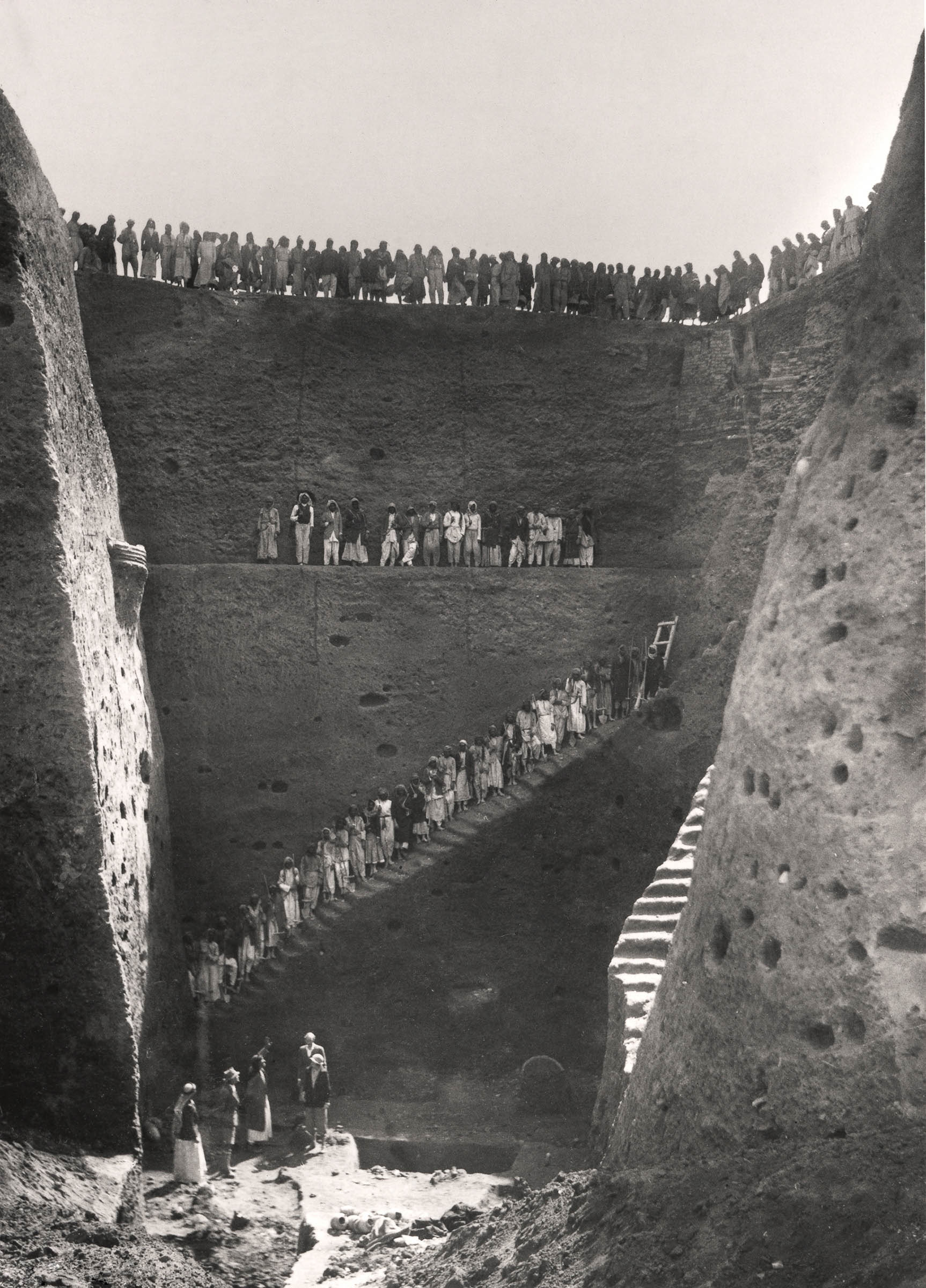
In this sounding trench, Woolley sought to reach virgin soil in order to attain a complete account of the material culture of the city. He would dig a number of other trial probes in the ensuing years.
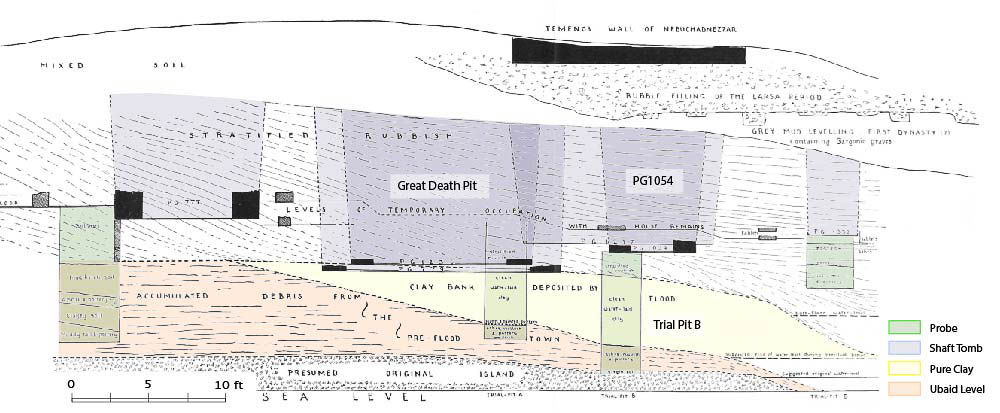
The tombs were found at the bottom of the shafts (purple). Below these was found the Ubaid levels of the city and a thick layer of clay. Trial Pit B was located beneath PG 1054.
‘Trial Pit B’ was not the only probe Woolley dug at Ur. As you may recall from our discussion of Solid-footed Goblets, Woolley dug another probe nearer to the sacred precinct of the city, which he designated ‘Trial Pit F’. This probe was more informative since it penetrated through the heart of the city rather than through the layers of debris which accumulated on the outskirts of the city. Woolley used the information he gathered from ‘Pit F’ to create the following succession of cultures at Ur (from latest to earliest).
- Akkadian
- Early Dynastic
- Jemdet Nasr
- Uruk
- Ubaid
Woolley found a considerable amount of overlap between the Ubaid, Uruk, and Jemdet Nasr cultures. The Ubaid, he thought, belonged to the earliest inhabitants of southern Mesopotamia, followed by the Uruk and Jemdet Nasr cultures. But Woolley admitted that he had a difficult time distinguishing the Uruk period from the Jemdet Nasr based on pottery alone since the two pottery styles were intermixed.


Like Petrie in Egypt, Woolley used distinctive styles of pottery to define different cultural periods at Ur.
Woolley considered Jemdet Nasr Ware to be a foreign import and that its appearance at Ur belonged to a period when “foreign influence was paramount.” Woolley also noted that the “red and black wares” which began to appear in the Uruk period (see Four-Lugged Pot), and thus predates the Jemdet Nasr, continued in use well into the Early Dynastic period.2Woolley writes, “We are justified in speaking of a Jamdat Nasr Period, the well-defined phase during which this foreign influence was paramount; similarly we may call the preceding period when the red and black wares stood alone Uruk Period, but we must remember that the Uruk pottery continues in use long after the “Uruk Period” has come to an end.” (Woolley 1955, 27-28)

Note that beneath the Early Dynastic levels, Woolley found several building strata that utilized flat bricks. These same levels also produced Solid-Footed Goblets and the first sherds of Jemdet Nasr Ware.
Woolley recorded his observations with reference to “meters above sea level.” In Pit F, for example, Woolley noted that he began to find sherds of Jemdet Nasr pottery at the 11 meter mark. (Keep in mind that Woolley is measuring from sea level, so the deeper her digs, the lower the number. See image above for reference.) Between 10 and 9 meters Jemdet Nasr Ware was common; between 9 and 8.5 meters it was less so; and below 8.5 meters it disappeared altogether. Through all these levels Woolley found the wheel-made undecorated red and black pottery typical of the Uruk period. At 8.5 meters he began to encounter handmade and painted Ubaid Ware mixed with the Uruk period pottery. It wasn’t until the 6 meter mark that Uruk period pottery began to disappear. Below 5.5 meters the pottery is exclusively Ubaid.3Woolley 1955, 4
The primary takeaway from this survey of the pottery sequence at Ur is that what often appears to be definite chronological breaks, such as between the Uruk and Jemdet Nasr, or between the Uruk and Ubaid, is not so clearly defined in the ground. This does not render periodization invalid, but some allowance must be made for overlap, otherwise there will be a tendency to allot more time too them than is necessary.
The Flood Deposit
You will notice in the cross section of Pit F, displayed above, an 8 foot thick sterile layer of clay marked “Flood Stratum” just as there was in Pit B, in the Ubaid layers of the city. Woolley theorized that the clay was deposited by a catastrophic flood, and that it was perhaps this event which gave rise to the Sumerian flood myth and eventually the Biblical story of the flood also. Woolley thought that these stories were but a dim memory of a catastrophic flood which caused widespread devastation in Sumer, and was responsible for depositing the eight foot thick layer of sandy clay in his probes. However, as Woolley himself would later acknowledge, the deposit of clay in several of his other probes was not nearly so deep, or was absent altogether. Furthermore, thick deposits of clay have been found at other sites in Mesopotamia, such as at Shurupak (Fara) and Kish, although these date to different time periods. The discovery of thick deposits of sediment at various sites in Sumer suggests that flooding was not a rare occurrence on an alluvial floodplain, and though it may have been catastrophic, it is unlikely to have been a singular event like “the Flood.” Indeed, as Woolley notes in his report, the city above the clay deposit seems to have been a continuation of the one below it, without any significant break in occupation.
The Kings and Queens of Ur
The tombs discovered by Woolley at Ur must have belonged to its earliest kings and queens. Several of their names have been found inscribed on objects recovered from the tombs. A cylinder seal recovered from PG 1054 was inscribed with the name Meskalamdug, while seal impressions with the name, Mesannepadda, have been found scattered across the cemetery area. The relationship between the two may be inferred from a third discovery, an inscribed bead found at Mari, in northern Mesopotamia, which reads:
“…Mesannepadda, king of Ur, the son of Meskalamdug, king of Kish, has inscribed this bead.”
A king by this name is also known from the Sumerian King List where he is credited with founding the First Dynasty of Ur. The SKL further records a victory won by Mesannapeda over the king Uruk, thus bringing all of Sumer under his control. Chronologically, the reigns of Mesannapeda and Gilgamesh cannot be separated by too much time, that is if the testimony of the Tummal Inscription may be trusted. This text, which was written early in the 2nd millennium BC, lists a series of repairs made to the temple of Nintu in the Tummal district of the sacred city of Nippur. The relevant portion reads:
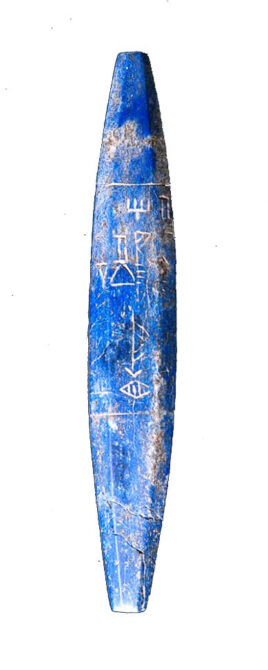

This bead, inscribed with the name of Mesannepadda, was found at Mari.
Enmebaragessi, the king
In this very city (that is, Nippur) built the
House of Enlil.
Agga, the son of Enmebarragesi,
Made the Tummal pre-eminent,
Brought Ninlil to the Tummal.
For the first time, the Tummal fell into ruin,
Mesannepadda built the Burshushua of the House of Enlil
Meskiagnunna, the son of Mesannepadda,
Made the Tummal pre-eminent,
Brought Ninlil to the Tummal.
For the second time, the Tummal fell into ruin,
Gilgamesh built the Numunburra of the House of Enlil.
Ur-lugal, the son of Gilgamesh,
Made the Tummal pre-eminent,
Brought Ninlil to the Tummal…4Kramer 1963, 47-48
According to the Tummal Inscription, Mesannepada reigned after Agga and before Gilgamesh. This presents some difficulties since, according to other Sumerian texts, Agga and Gilgamesh were contemporaries. Kramer thought the texts might be reconciled if Gilgamesh outlived the other two kings, and did not capture Nippur until he was an old man. In any case, despite the difficulties involved, the Tummal Inscription represents the only literary tradition independent of the Sumerian King List which places Agga, Mesannepada, and Gilgamesh in relation to each other.

An impression from a seal discovered in the cemetery of Ur. It carries the following inscription: “Mesannepada, king of Kish…” Although Mesannepada resided in Ur, he claimed kingship over Kish, the traditional capital of Sumer.
Woolley was convinced that the most important tombs actually predated the First Dynasty of Ur since he found a stratum of debris covering the cemetery which contained seal impressions bearing the name “Mesannepada.” If the reign of Mesannepada is tentatively dated to the first half of the Early Dynastic III period, then this provides a terminus ante quem (“no later than”) for dating the cemetery. (The cemetery cannot be later than the stratum which covers it.)
The royal tombs cut through distinctive layers of debris which contained archaic seals of the Jemdet Nasr period. Woolley designated these layers S.I.S. IV and V (Seal Impression Stratum). These levels also contained archaic cuneiform texts which have since been dated orthographically (“style of writing”) to the Early Dynastic I period.5Lecompte and Benati 2017 This makes them roughly contemporary with the Ushumgal Stele which we looked at in a previous entry. S.I.S. IV and V therefore provide us with a terminus ante quem (“no earlier than”). (The tombs cannot predate a stratum they cut through.)
It seems, therefore, that the royal tombs in the cemetery at Ur belong to the Early Dynastic II and the beginning of the Early Dynastic III (ED IIIa).6Hamblin 2006, 48 That is c. 2500 – 2400 BC in the short chronology.
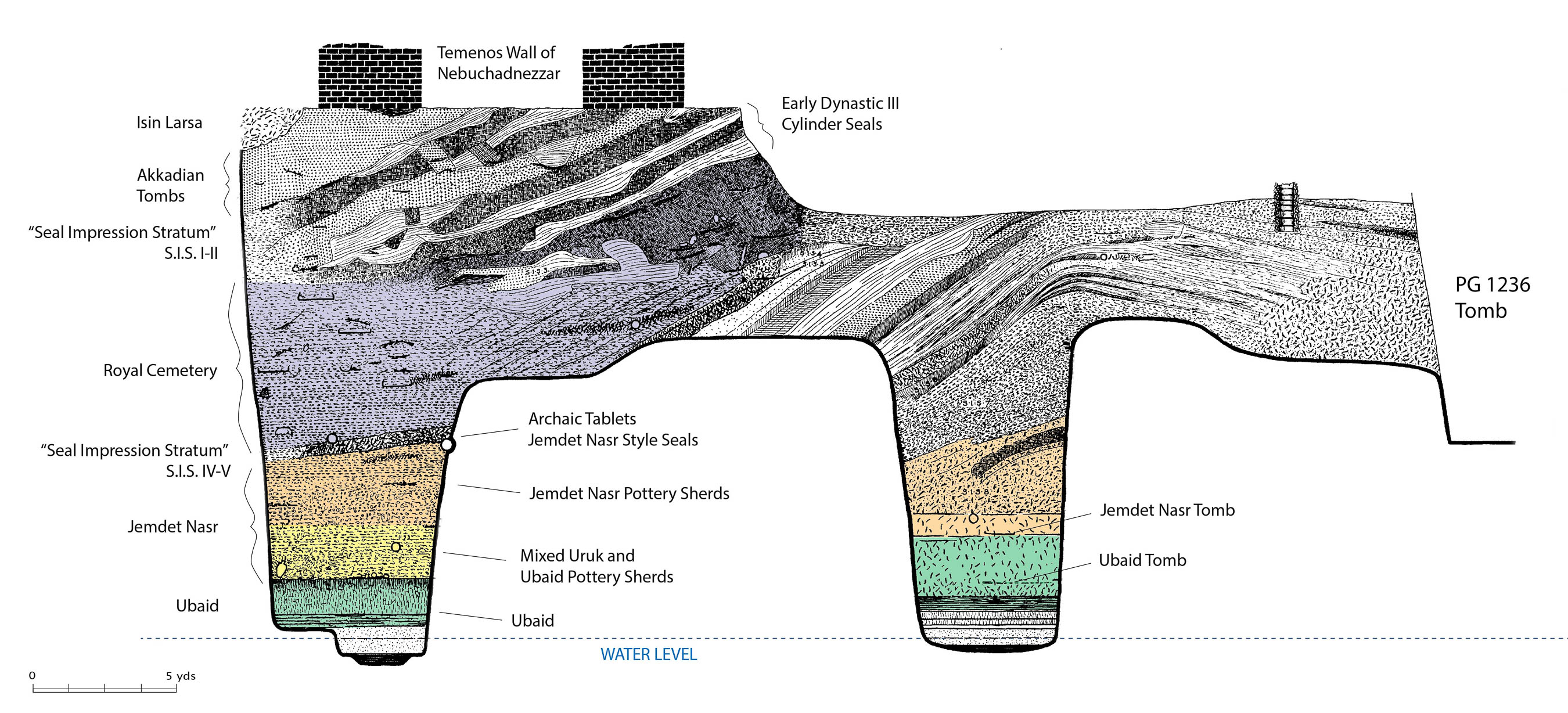
Note S.I.S. IV & V situated below the level of purple fill that contained the tombs of the Royal Cemetery. Also note the absence of a “flood deposit” in these probes (Pit Y & Z).
The Royal Cemetery of Ur reveals the great wealth enjoyed by the city and the high level of skill attained by its craftsmen. The wealth of Ur may be attributed, in part, to its strategic position near the mouth of the Euphrates which gave it control over maritime trade that passed from the Persian Gulf up the Euphrates. Standing atop the mound today, it is hard to believe that the city could have functioned as a port city, since the coastline has shifted more than 20 miles south of the city, and the river, which once flowed nearby, is now a distant band of green on the eastern horizon.
Frankfort, Henri.
“Archaeology and the Sumerian Problem,” in Studies in Ancient Oriental Civilization, edited by James Henry Breasted, Thomas George Allen. No. 4 vols.
Chicago, Illinois: The University of Chicago Press, 1932.
Hamblin, W. J.
Warfare in the Ancient Near East to 1600 BC: Holy Warriors at the Dawn of History.
London ; New York: Routledge, 2006. Link
Kramer, S. N.
The Sumerians: Their History, Culture, and Character.
Chicago: University of Chicago Press, 1963. Link
Lecompte, Camille, Giacomo Benati. “Nonadministrative Documents from Archaic Ur and from Early Dynastic I-II Mesopotamia: A New Textual and Archaeological Analysis.” Journal of Cuneiform Studies 69 (2017): 3-31. Link
Woolley, L.
Ur of the Chaldees; A Record of Seven Years of Excavation.
London: Benn, 1950.
Woolley, Leonard.
Ur Excavations: The Early Periods. Vol. IV vols.
Philadelphia: Allen, Lane & Scott, 1955. Link
Woolley, Leonard.
Ur Excavations: The Royal Cemetery (Plates).
Oxford: The University Press, 1934. Link
Woolley, Leonard.
Ur Excavations: The Royal Cemetery (Text).
Oxford: The University Press, 1934. Link