
These alabaster figurines were found in the early bronze levels of Beyecsultan, in western Anatolia.
As noted previously, the violin-shaped marble figurines found in tombs on the Cyclades are closely related to the highly abstracted, Cycladic marble figurines discovered on the same islands and which date to the same period. Violin figurines have also been found widely distributed on the Greek mainland and Anatolia. Their peculiar shape is clearly derived from the supposedly much older neolithic “mother goddess” figurines which have been found broadly distributed across Europe, Anatolia, and the Near East.
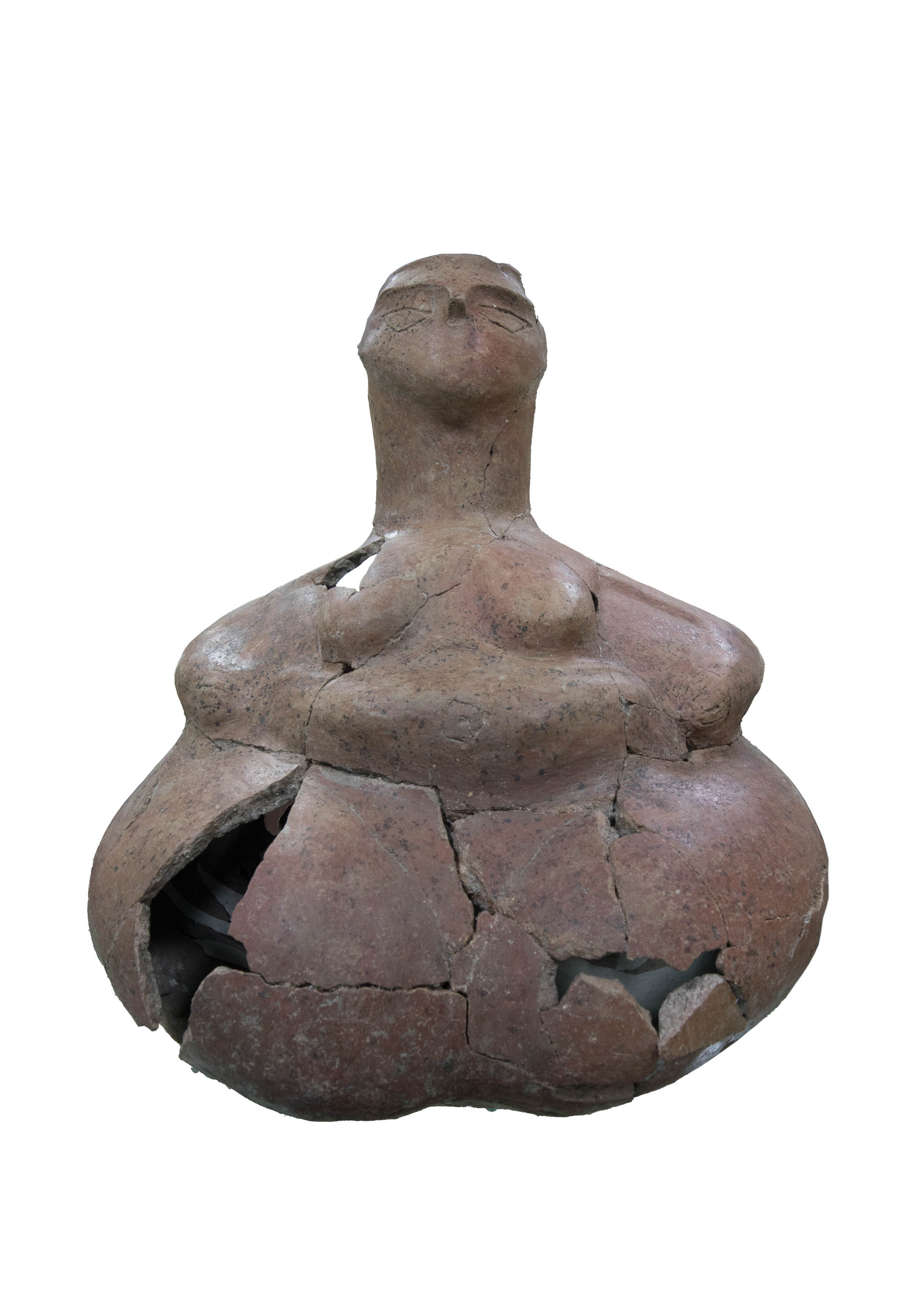


Although these figurines are supposedly separated by several millennia, they are clearly related objects, associated with the mother goddess, and probably not separated by more than half a millennium.

This map shows the location of key sites in Anatolia from the Neolithic and Early Bronze periods.
Violin Figurines in the South
Seventy-six violin figurines were found at the Ghassulian site of Gilat in the Beersheva Valley. Since these Ghassulian villages are generally thought to have thrived during the 5th and early 4th millennia BC, the violin figurines discovered at Gilat have also been dated to this time period. Thus they predate the Aegean and Anatolian violin figurines by a millennium or more. Curiously, violin figurines disappear from the southern Levant after the Ghassulians, only to reappear in Anatolia and the Aegean towards the latter half of the 4th millennium BC.
This unlikely progression is probably not correct. It is a product of C14 dating, which has artificially inserted several millennia into the chronologies of these regions. On the face of it, slashing several millennia from the chronology of Anatolia, and a millennium from the standard chronology of the Southern Levant, appears to be a radical revision that is unlikely to be correct. But there is, in fact, very little in the way of monuments or tombs from Anatolia to fill the span of time between 6000-3000 BC.1Atakuman 2017, 89; Ç. Atakuman writes, “However, it remains difficult to draw a comprehensible pattern of chronology, interaction and continuity for the processes that led to centralization in the Anatolian context; Anatolia still lacks substantial domestic and funerary data from between 6000 and 3000 BC (Düring 2011; Schoop 2011b; Steadman 2011a), possibly due to the proliferation of a weaker pattern of architecture and short-term occupation during this time period (Tuncel 2011).” As noted previously, a similar lacuna may be observed for the Ghassulian culture of the southern Levant.
As an aside, the existence of violin figurines in the southern Levant during the Chalcolithic period lends credibility to the thesis proposed by Paul Lapp and Kathleen Kenyon that the Ghassulian culture likely originated in the north where violin figurines are commonly found. In contrast, violin figurines disappear from the southern Levant with the Ghassulians.

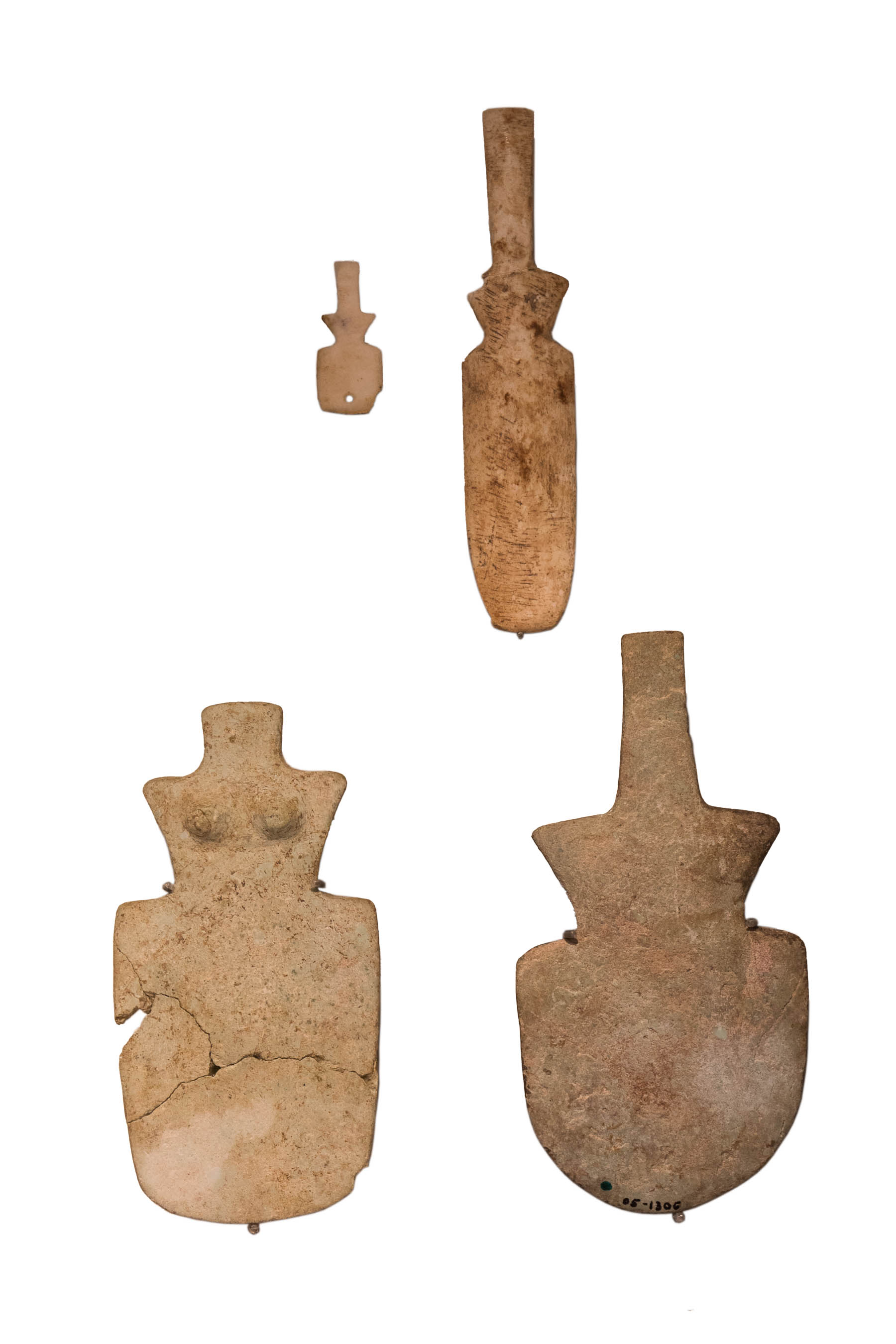
Left: A Ghassulian violin figurine from Gilat, a settlement located in the south of Israel. Right: Ghassulian violin figurines from a cave at Pek’in in the north of Israel.
Violin Figurines and the Kurgan Hypothesis
Goddess figurines are ubiquitous in the ancient world. They seem to have been especially important for the cultures of Anatolia and Europe during the Neolithic period. Thus Marija Gimbutas, an influential scholar from the UCLA, argued that “Old European” neolithic farming societies were organized into egalitarian communities who worshiped the “mother goddess.”2Gimbutas 2007 Gimbutas goes on to argue that the neolithic farmers were destroyed by warlike, patriarchal tribes of Indo-Europeans from the northern steppes who worshiped violent male deities.
Marija Gimbutas coined the term “Kurgan culture” to refer to these groups of nomadic, Indo-European speaking peoples who are known for their large burial mounds (Turkic. “kurgan”), which has become one of the primary means of tracing their migration from the steppes, north of the Black and Caspian seas, into the Caucasus, Anatolia, and Europe. According to Gimbutas, this migration marks the beginning of the Early Bronze Age in these regions.
Putting historical considerations to one side for a moment, Gimbutas’ theory will naturally be attractive to feminists and historians who look upon indigenous cultures as models for how societies may live together peacefully, a view popularized by the French enlightenment figure, Jean-Jacques Rousseau. This romantic view of “uncomplex” societies is a fiction, but Rousseau continues to attract many disciples. That being said, philosophical commitments such as these do not validate or invalidate a historical theory.
If invading groups of Indo-European warriors conquered vast swaths of Anatolia and Europe during the 4th millennium BC, which is by no means a given, there is no evidence to suggest that the people they attacked, displaced, or assimilated were non Indo-European. Colin Renfrew, for example, argues that the Neolithic farming culture of Europe represented an early wave of Indo-European migration.3Renfrew 1988
The history of Anatolia and Europe during the Early Bronze period is by necessity speculative since we do not have any texts to enlighten us and the linguistic evidence is not decisive. It is worth bearing in mind that the elite tombs discovered at Alacahoyuk, which clearly belong to a highly stratified society of warriors, nevertheless preserves idols of a type which may be traced back to the neolithic “mother goddess.” If these tombs belong to “invading” groups of aristocratic warriors, it seems that they were no less devotees of the “mother goddess” than the neolithic farmers they are supposed to have displaced.


Gold ring idols such as the one depicted on the right are found in early bronze contexts in Anatolia. They are clearly related to the stone violin figurines which, in turn, can be traced back to pottery figurines of the mother goddess produced during the Neolithic period.
The Singularity
The objects commonly referred to as “mother goddesses” may not have been exactly that. Some clearly incorporate both male and female sexual symbolism and are, therefore, better described as “fertility figurines.” Although belonging to a much later period, a Phoenician tablet from Madrid offers some insight into how these fertility figurines were understood.

This Phoenician tablet from Madrid (4th century BC) depicts the mysterious processes of life. The warmth of the earth and the heat of the sun combine with the seed of the man and the milk of the woman to create embryonic life. Creation occurs in the presence of male and female winged serpents and male and female date palms. This is the ancient version of the Singularity.
Many ancient cultures perceived the earth as female and sky as male.4Egypt is an exception, but the exception proves the rule, since the Egyptians did not rely on rain from the sky to fertilize the earth but on the Nile River. Therefore they conceived of the subterranean regions from which the Nile emerged as the male god Osiris. The rain was likened to the seed of man and the earth to the womb of the woman. The mystery of the tiny seed planted in the ground which produced a bountiful harvest was not understood in terms of the supernatural (a creation of God) but as the product of mysterious powers inherent in nature, to which both divinity and sexuality were ascribed. The purpose of the violin figurines may, therefore, have been to harness these mysterious powers in order to secure protection, fertility, and even regeneration for those who possessed them. The latter function may explain why violin figurines were so often placed in tombs.
Atakuman, Çiğdem. “Figurines of the Anatolian Early Bronze Age: The Assemblage from Koçumbeli-Ankara.” Anatolian Studies 67 (2017): 85–108. Link
Frothingham, A. L. “Babylonian Origin of Hermes the Snake-God, and of the Caduceus.” American Journal of Archaeology 20, (1916): 175–211. Link
Gimbutas, Marija.
The Goddesses and Gods of Old Europe.
Berkley, Los Angeles: University of California Press, 2007.
Levy, T. E.
Archaeology, Anthropology and Cult: the Sanctuary at Gilat, Israel.
London ; Oakville, CT: Equinox, 2006.
Renfrew, Colin.
Archaeology and Language : the Puzzle of Indo-European Origins.
New York: Cambridge University Press, 1988.
Yalçın, U, G. Yalçın. “Reassessing the Anthropomorphic Metal Figurines of Alacahoyuk, Anatolia.” Near Eastern Archaeology 76 (2013): 38–49.