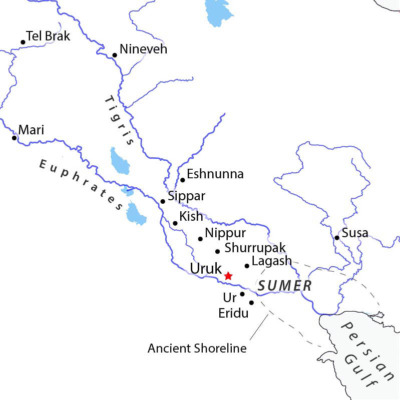
The Sumerians were the first to put language into writing, to make cylinder seals for sealing documents, and to turn pots on a fast wheel. They built their cities on the broad alluvial plain between the Tigris and Euphrates where these rivers empty into the Persian Gulf. Formed by the deposition of river sediment, the plain was known to the Greeks as Mesopotamia (meso “between”, potamoi “rivers”). Hans Nissen theorized that the land must have been too waterlogged at first to farm effectively due to the high volumes of water carried by the Tigris and Euphrates rivers. However, as water levels began to drop, new land was exposed that was well suited for growing cereal crops.1Nissen argues that farmers began cultivating crops in the smaller river valleys of Iran before they migrated to the the broad flood plain of Sumer since the flood plain was initially too marshy for cultivation. See Nissen 1988, 55
In a 1932 monograph, Frankfort would coin the phrase “the Sumerian problem” to refer to the mysterious appearance of the Sumerians in Mesopotamia, seemingly from nowhere.2Frankfort 1932 Scholars continue to debate whether the Sumerians were the first to settle Mesopotamia or whether they came later. Unfortunately, the archaeological evidence does not supply a definite answers to the question.
Ubaid Ware
The earliest pottery discovered so far in Mesopotamia is a peculiar type of fine, light colored pottery, painted with brown and black geometric patterns. It belongs to a people known as the Ubaidians, so-named after the small settlement of Tel el-Ubaid in southern Mesopotamia where this particular type of pottery was first discovered. Since then Ubaid Ware has been found widely distributed across a broad swath of the Ancient Near East, from Arabia to Syria.


Ubaid pottery is characterized by its thin, hand-shaped walls. It was covered with a white paint or “slip”, painted with geometric or floral designs, and fired at very high temperatures.
The Ubaidians were undoubtedly the earliest settlers in southern Mesopotamia, but it is an open question as to whether they were the ancestors of the Sumerians. It is impossible to say for sure since the Ubaidians did not produce any written texts. The continuity between Ubaidian and Sumerian culture suggested to Frankfort that they were the same people.3Frankfort 1932, 20 ff. The Sumerian levels lie directly above the Ubaidian without any interruption. But other scholars have emphasized the differences between the material culture of the two groups. Sir Leonard Woolley observed a mixture of Ubaid and Sumerian (Uruk period) pottery while excavating Ur which suggested to him that the people producing these different pottery types were at least partially contemporary. He thought the Sumerian pottery was foreign to southern Mesopotamia and that its appearance there represented an influx of new peoples to the region who would eventually supplant the Ubaidians.4Woolley 1955, 22 This view obviously contradicts Frankfort’s thesis.
Eridu
The most important Ubaid city was constructed at Abu Shahrein—ancient Eridu. Here archaeologists excavated a series of temples which stretched all the way back to the early Ubaid period. The temple began as a small building with a single chamber and a niche along the back wall. However, by the end of the Ubaid period, the temple had grown into an impressive complex. We know from later Sumerian texts that it was dedicated to Enki, god of the vast underground sea known as the abzu. The discovery of fish bones in the Ubaid levels of the temple suggests that the temple was dedicated to this deity already in the Ubaid period.
According to a later Babylonian creation myth, the world began at Eridu when Marduk, the chief god of the Babylonian pantheon, created a floating reed mat and heaped dirt on it, thus forming dry land. The myth points to an early method of construction used by the marsh dwellers of southern Iraq until recent times. Ubaidian architecture was once thought to have consisted exclusively of reed huts but the early Ubaid shrine excavated at Eridu proves that they also built with mud brick.
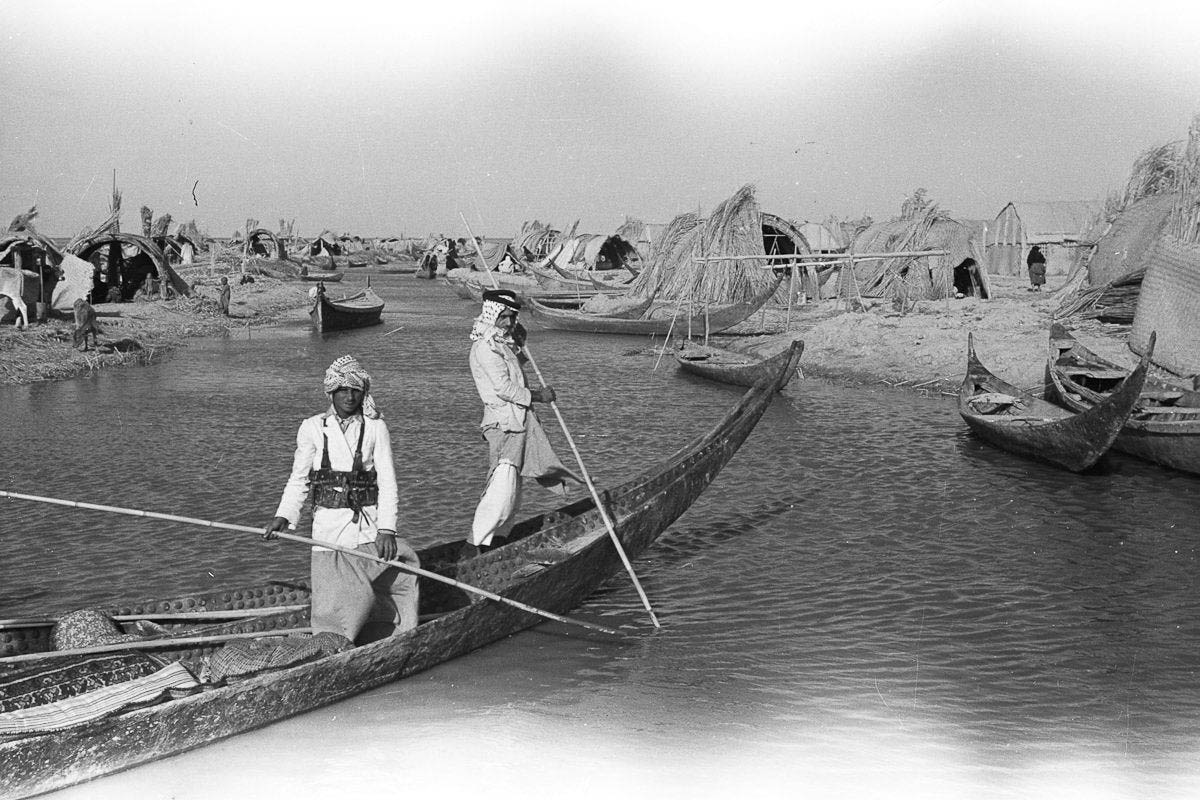
The southernmost region of Iraq is a vast marsh encompassing 3,700 square miles. This region was inhabited until recently by a people, known as the Marsh Arabs, whose method of constructing houses from reeds does not vary greatly from that employed by the Sumerians.


A relief carved on the side of a feed trough found at Uruk which shows the type of reed architecture employed in Sumer at that time. The tassled ring poles above an “animal byre” (barn) indicates that the building was dedicated to Inanna. The “animal byre” is a common motif in Uruk period iconography.
Sumer
If Eridu was the the most important Mesopotamian settlement during the Ubaid period, it was superseded by Uruk in the period which followed, which was named after this city. Located just 60 miles north of Eridu, the city also appears in the Bible, where it is named Erech, one of the cities controlled by Nimrud in the “land of Shinar” (Gen. 10:10). Shinar was the ancient Hebrew name for the southern plain of Mesopotamia, known also to the Egyptians as Shngr, to the Hittites as Sanhara, and to the Akkadians as Sumeru.5Hallo 1971 The Sumerians, however, referred to themselves simply as the “black headed people” and to their land as Kengir (“the land of the Noble Lord”).
As noted previously, the average annual rainfall in Sumer was insufficient to support agriculture without irrigation (< 8″ per year). Although the region likely received more rainfall during the Uruk period, it was nevertheless advantageous for farmers to dig irrigation canals in order to secure a reliable supply of water for their crops. Farming on the alluvial plain was complicated by the fact that the spring floods did not occur until April, after the harvest!6Lloyd 1985, 17 Thus the Sumerians also had to dig reservoirs and sluice gates with which to store water and regulate its distribution.
Irrigation enabled Sumerian farmers to grow large surpluses of food, especially grain, which could be stored for long periods of time without spoiling. Now a certain percentage of the population was free to work in other types of industries, such as metalworking, weaving, and pottery production. At the heart of this reorganization of labor and capital was the palace and the temple, which not only fulfilled legal and religious functions, but also maintained granaries and canals, kept records, and provisioned storehouses. What we have, in essence, is a city. Over the course of the next several centuries approximately thirty cities would rise from the southern plain of Mesopotamia. But of all these, none could compare with Uruk in terms of size or reach. Indeed, the city does not shrink from comparison with some of the other great capitols of the ancient world.


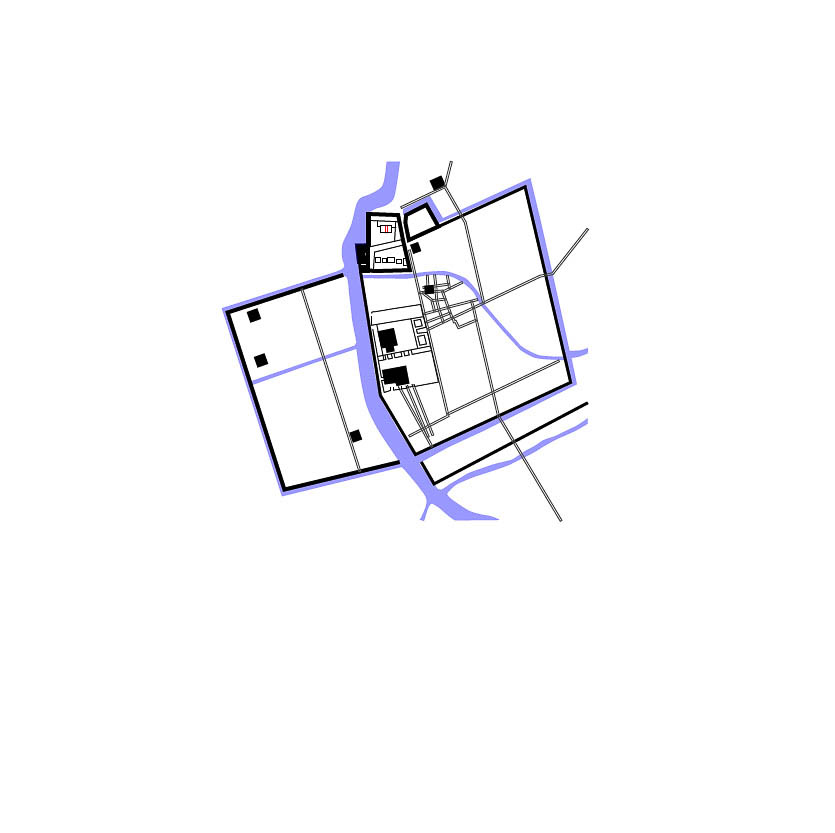
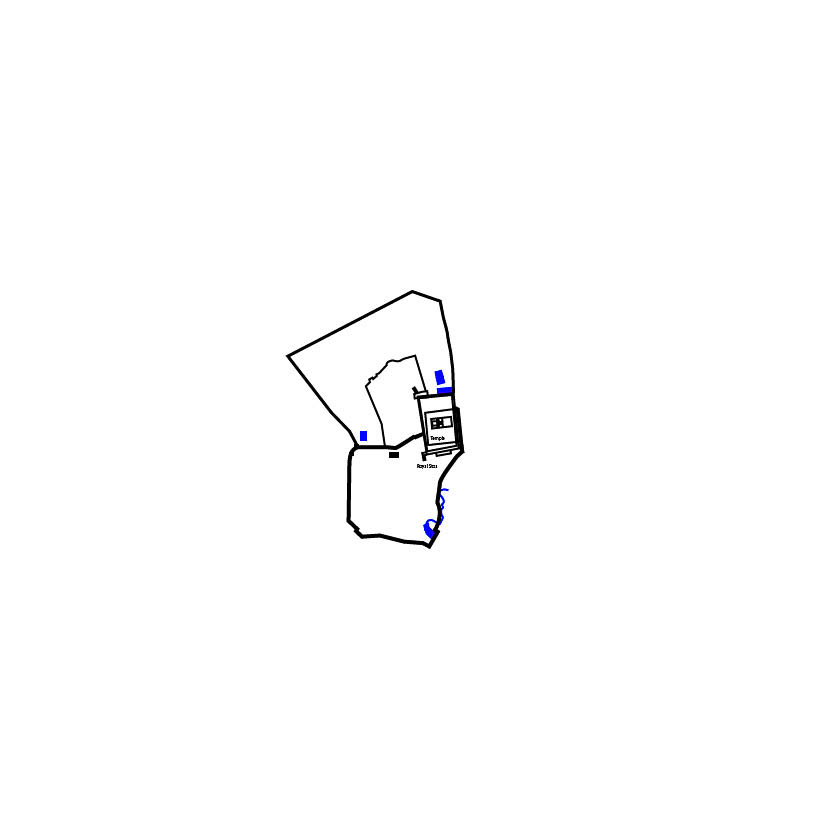

The walls of Uruk encompassed an area nearly equal to Nineveh or Babylon at their peak.
The Age of Uruk
Archaeologists have identified as many as eighteen levels of occupation at Uruk. The earliest levels date to the Ubaid period and are, therefore, generally assigned to the 6th and 5th millennia BC (c. 6000-4000 BC). Directly above the Ubaid are the levels associated with Uruk period, which are usually assigned to the 4th millennium BC (c. 4000-3100 BC). These absolute dates are primarily based on C14 dating, which returns dates which are too high in my opinion, but we will save a fuller discussion of Mesopotamian chronology for our study of the succession of temples discovered at Khafajah.
Frankfort, Henri.
“Archaeology and the Sumerian Problem,” in Studies in Ancient Oriental Civilization, edited by James Henry Breasted, Thomas George Allen. No. 4 vols.
Chicago, Illinois: The University of Chicago Press, 1932.
Kramer, S. N.
The Sumerians: Their History, Culture, and Character.
Chicago: University of Chicago Press, 1963. Link
Nissen, H. J. R.
The Early History of the Ancient Near East, 9000-2000 B.C..
Chicago: University of Chicago Press, 1988. Link
Pritchard, J.B.
The Ancient Near East; An Anthology of Texts and Pictures.
Princeton: Princeton University Press, 1958. Link
Woolley, Leonard.
Ur Excavations: The Early Periods. Vol. IV vols.
Philadelphia: Allen, Lane & Scott, 1955. Link