
The jewelry Puabi wore to her grave are now on display at the Penn Museum. It is made form carnelian (red), lapis-lazuli (blue), shell (white), and gold.
Of the sixteen royal tombs discovered at Ur, the tomb designated PG 800 is the only one that wasn’t robbed in antiquity. The primary occupant of the tomb was a woman, obviously royal. She was found lying on a bier in a corner of the tomb, smothered in beads made from precious stones and gold. Three pins were found lying near her shoulder, each with a lapis lazuli cylinder seal attached. One of the seals was inscribed with the name “Pu-abi, queen.” Another seal found in the adjacent tomb (PG 789) identifies its occupant as “A-kalam-dug, king of Ur.” Woolley inferred from this that Pu-abi was the wife of Akalamdug, and that the two ruled as king and queen of Ur. We will look at these seals in more detail in the next entry.
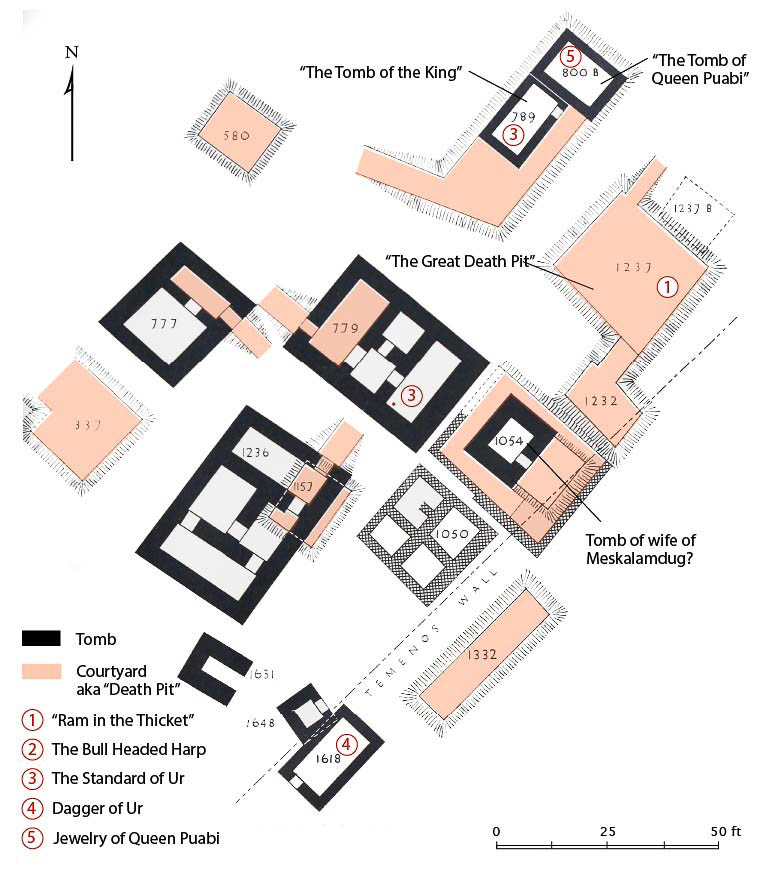
This plan shows the location of the tomb of Queen Puabi (PG 800), and the one next to hers (PG 789) which likely belonged to her husband, Meskalamdug.
The Tomb
The entrance to the tomb was “guarded” by five male attendants, each wearing a copper dagger on their waist. Ten women were discovered further down the shaft, and two more inside the burial chamber, next to Puabi. The tomb and connecting courtyard were filled with incredibly rich grave goods, made from copper, silver, gold, and different types of costly stone.
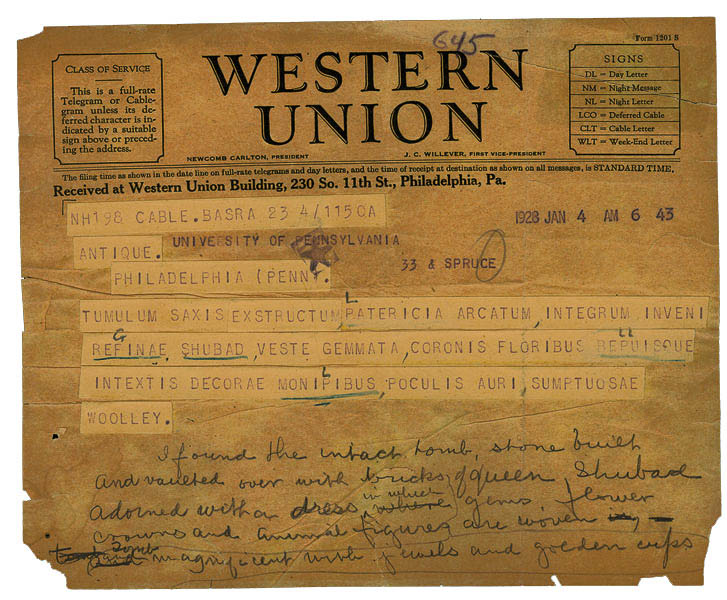
Upon discovery of the tomb, Woolley wired home news of the discovery in Latin, wishing thereby to evade undue attention to the tomb while it was being excavated. Woolley read the name of the woman occupying the tomb as “Shubad” instead of “Puabi.”
I found the intact tomb, stone built and vaulted over with bricks of Queen Shubad adorned with a dress in which gems, flowered crowns, and animal figurines are entwined with decorative cords of sumptuous gold. Woolley
It is difficult to comprehend just how much wealth is represented by the objects found in these tombs. As Woolley would later note in his report, gold was very rarely found in tombs of later periods, even in ones belonging to important personages. When gold was found, it took the form of beads made of cheaper material and plated with the “thinnest of gold leaf.”1Woolley 1934, 39 Only in the earliest tombs of Ur’s first dynasty does one find beads, vessels, spearheads, knives, etc. made of solid gold!


Gold vessels and cosmetic boxes shaped like seashells were found in Puabi’s tomb.


A silver spouted jar and paten, and a collection of silver goblets shaped like solid-footed goblets, but in silver instead of clay.

Six game boards were found in the Royal Tombs at Ur, one of them in Puabi’s tomb.
Onagers
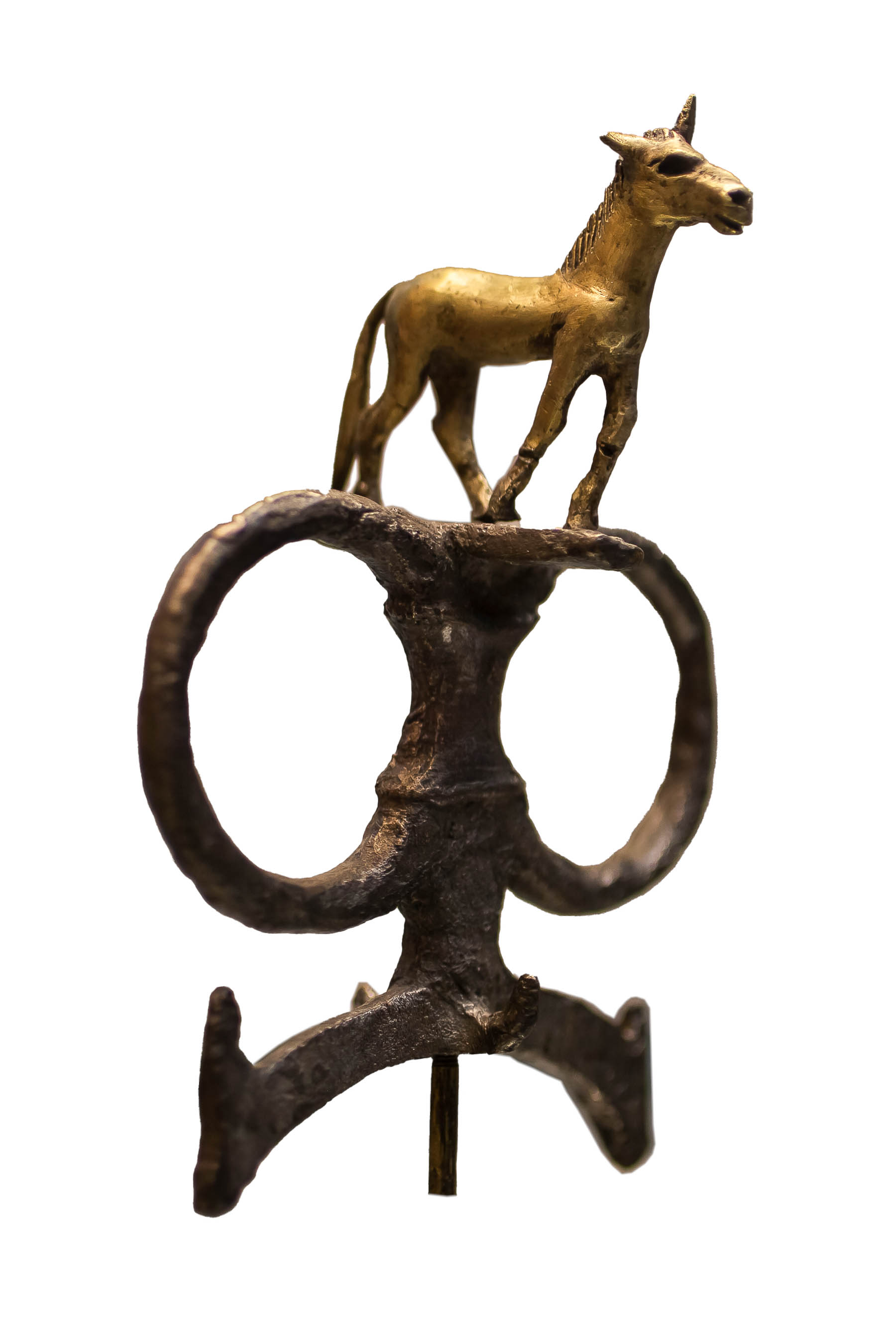
The skeletons of two onagers were found next to the tomb together with a yoke, harness, and five groomsmen. Almost nothing could be salvaged from the chariot except a silver reign retainer ring surmounted by a very fine model of an onager cast in electrum using the cire perdue method of casting metal. Woolley called it “astonishingly accurate” and “one of the most charming objects that the cemetery has produced.”2Woolley 1934, 78

The reign ring can be seen at center between two onagers while the skull of one of the groomsmen is visible bottom right (marked with the letter ‘b’ in the image).
Jewelry
In his description of the queen’s burial, Woolley noted that the queen was buried without a casket but laid out on a bier instead. “The whole of the upper part of the queen’s body was covered with beads of gold, silver, lapis-lazuli, carnelian, and agate…” They were “astonishingly numerous and of exceptionally fine quality.”3Woolley 1934, 87 The most remarkable part of the queens attire was a diadem made of many thousands of tiny lapis lazuli beads strung together with very detailed, miniature, solid gold figurines fashioned in the form of “stags, bearded bulls, gazelles and rams, small eight-petalled rosettes, ears of wheat, clusters of three pomegranates with their leaves, plants with stems of gold leaf over silver, and with gold, lapis, or carnelian pods, palmettes of twisted gold wire…”4Woolley 1934, 89


Left: Necklace made of lapis lazuli and solid gold. Right: Carnelian and gold beaded necklace.
Lapis Lazuli
The bright blue semi-precious stone known as lapis lazuli is rarely found in Mesopotamia before the Early Dynastic period and becomes increasingly rare afterward. By the Ur III period, several hundred years later, it is once again, very rare. The only known source for this stone is in the northeastern mountains of Afghanistan. Its appearance in Mesopotamia is proof of long distance trade between the two regions. Its been suggested that the stone may perhaps have been brought to Sumer via a maritime route through the Indus Valley. However, the rarity of lapis lazuli in the Indus Valley suggests an overland route instead.5Sheila Weiner, Hypotheses regarding the Development and Chronology of the Art of the Indus Civilization, in Lal and Gupta 1984, 409 Probably the Indus Valley Civilization, of which we will have more to say shortly, was yet in its infancy.